
This treadmill mat guide starts with a small confession: a mat is the cheapest part of a treadmill setup, and it’s the part people think about last. They carry the machine up the stairs, level it, plug it in. Then somebody notices a dent in the hardwood, a pale rubber ring on the vinyl, or a hum in the kitchen below. A mat can help with all three, as long as you know what it’s for.
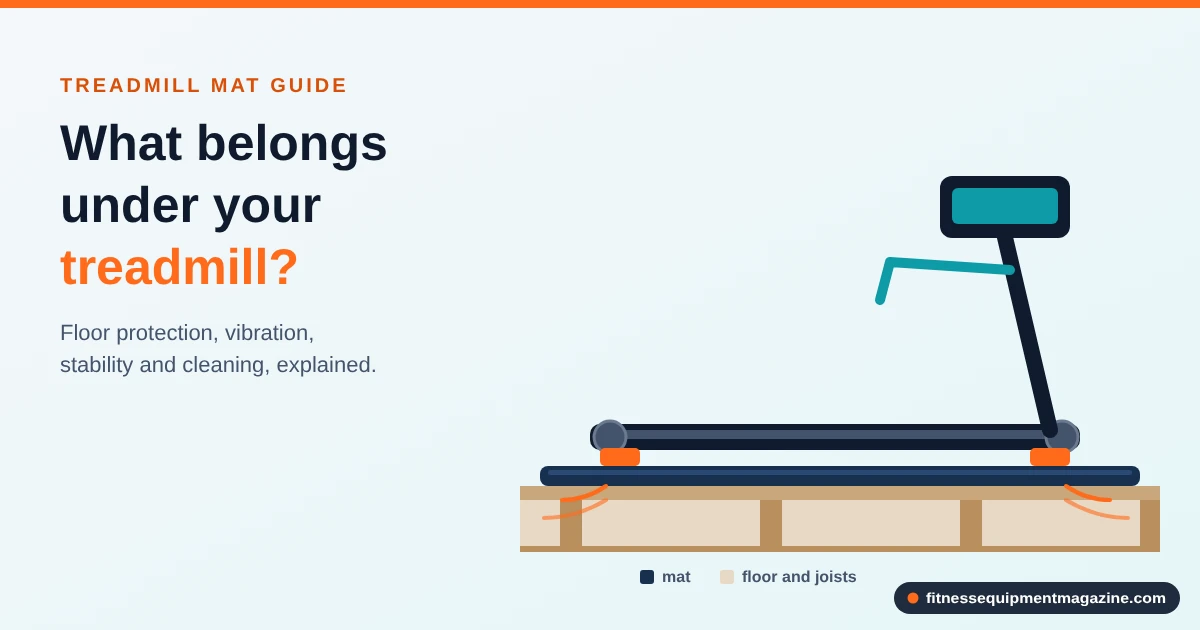
Here’s the scene we keep picturing. A treadmill arrives in a spare room. The feet are hard plastic or rubber, the frame weighs well over a hundred pounds, and every footstrike pushes that weight into two or three small patches of floor. Over months, those patches leave their mark. The belt also throws off a fine dust of lubricant and fibers that settles under the machine, where nobody sweeps.
So the question isn’t really “should I buy a mat?” It’s “what do I want this mat to do, and which kind does it?” That’s the thread running through this treadmill mat guide. We’ll sort the jobs a mat can handle from the ones it can’t, then walk through materials, size, thickness, setup, cleaning and troubleshooting.
A good treadmill mat protects the floor, grips the feet, spreads the machine’s weight and catches dust. It does not make a treadmill silent, and a mat that’s too thick or too squishy can make the machine feel less stable. For most homes, a dense, firm mat that extends a few inches past the frame on the sides and further behind it is the sensible choice.
- Who it fits: anyone with hardwood, laminate, vinyl, tile or low-pile carpet under a treadmill. It also suits renters who want their deposit back, and households with a bedroom or living room below.
- The biggest tradeoff: softness. A plush mat feels comfortable to stand on but can let the frame rock or sink. Firm and dense usually beats soft and bouncy.
- The common trap: buying by thickness alone, then finding the mat too short, too slick under the feet, or too smelly to keep indoors.
If noise is your main worry, finish this treadmill mat guide first, then read our deeper guide on treadmill noise in an apartment.
How we researched this. This is research-based guidance built from manufacturer specification patterns, federal safety information and ownership problems that buyers commonly report. We haven’t hands-tested the mats or machines described here, so this treadmill mat guide has no decibel readings, lab numbers or “our testers” claims. We name no brands and quote no prices for specific products. Every size and thickness in this treadmill mat guide is a typical range, so check them against your own manual and the mat’s spec sheet. Last reviewed: October 2026.
Specs, warranties, materials and recalls change every few months. Treat the numbers here as typical patterns, not quotes. Before you buy a machine or a mat, read the current manual and warranty page. Then check the CPSC exercise equipment recall list for the treadmill you own or plan to buy.
What a Treadmill Mat Guide Should Cover First: What Mats Do and Don’t Do
Mats get oversold. Some listings promise a quiet apartment, a happier belt, and joints that float on a cloud. Real mats do a smaller set of jobs, and they do them well when you pick the right one. Any treadmill mat guide that skips this part sends you shopping for the wrong thing.
Treadmill mat guide basics: four jobs a mat can really do
Think of a mat as a layer between a heavy machine and a floor you care about. That layer has four realistic jobs.
Protect the surface
It keeps feet, rollers and wheels off bare wood, vinyl and tile. It also catches belt dust, lubricant drips and the odd spilled drink.
Spread the load
Instead of three or four small contact patches, the weight sits on one wide sheet. That lowers the pressure on any single spot of floor.
Add grip
Rubber against rubber resists creep. A treadmill that walks a quarter inch across the room over a month is a machine that’s fighting your floor.
Take the edge off noise
It softens the hard knock of footstrike through the frame. The effect is real but modest, and it varies with the floor underneath.
Notice the order in this treadmill mat guide. Protection and grip come first. Noise comes last, because it’s the job mats do least reliably. We’ll spend a whole section on that later.
Treadmill mat guide limits: three things a mat will not do
First, a mat won’t fix a machine that’s out of level or a belt that’s misaligned. Those problems live in the frame and the rollers, and our treadmill maintenance guide covers them. Second, a mat won’t make an upstairs treadmill inaudible below. Low-frequency thump travels through joists no matter what sits on top.
Third, a mat won’t add cushioning to your run in any meaningful way. The deck and its shock-absorbing system sit between you and the mat. A thin sheet of rubber under the frame has almost nothing to say about how your knees feel. If cushioning is what you want, that’s a deck question, and we cover it in our piece on treadmill cushioning.
Before you shop, finish this sentence: “I want a mat so that ____.” If the blank says “my floor doesn’t get dented” or “my machine stops sliding,” you’re shopping for a sensible reason. If it says “my neighbor never hears me,” keep reading, because a mat is only one part of that answer.
Do you actually need one?
Not always. A treadmill on a bare concrete garage slab may not need much more than a level spot and a way to keep dust down. A machine on a thick, dense low-pile carpet over a solid subfloor is sometimes fine without one, although the carpet itself may mat down or hold dust.
The cases where a mat earns its keep are the common ones, and they’re the ones this treadmill mat guide is built around. Hardwood, laminate, luxury vinyl and tile all scuff, dent or crack under concentrated weight. Floors above living space amplify sound. Rentals come with a deposit and a walkthrough. In those homes, we’d treat a mat as part of the purchase, the way you’d treat a surge protector for a TV.
Floor Protection: Matching the Treadmill Mat Guide to Your Floor
The right mat depends first on what’s underneath it. A rubber sheet that’s perfect on concrete can stain vinyl. A foam mat that’s fine on tile can crush on carpet. So start with the floor, not the product page. That’s the first rule of any treadmill mat guide.
Treadmill mat guide for hardwood, laminate and luxury vinyl
These are the floors that show everything. Concentrated weight dents softer woods, and a rolling or sliding foot leaves scratches. Laminate can chip at the edge of a plank. Luxury vinyl plank looks tough, yet it can be pressed permanently by a small hard foot.
A mat large enough to carry all the feet and the rear roller area solves most of this. Look for a dense, non-porous surface and a smooth underside. A rough or heavily textured underside can trap grit, and grit is what scratches. Check the flooring maker’s care guide as well, because some warn against rubber backings on certain finishes.
Some rubber products can leave a yellow or tan stain on vinyl over time, a reaction people often call plasticizer migration. It isn’t guaranteed, and it’s more of a risk with cheap, strongly scented rubber. If you have vinyl or LVP, ask the mat seller directly whether the product is safe for it, and consider a small test patch under a corner for a few weeks.
Tile and concrete
Tile is hard and unforgiving, but it’s not indestructible. A treadmill foot that sits on a grout line can concentrate force on the weak spot. A mat spreads that out. On concrete, the floor itself is rarely the worry. Condensation and dust are. A garage slab can sweat in humid months, and a mat laid flat can trap that moisture against rubber feet.
In a garage, choose a mat with a smooth top that wipes clean, and lift one corner now and then to check for dampness. Our home gym flooring guide goes deeper on slabs, rolls and tiles if you’re planning a whole room.
Carpet
Carpet seems forgiving, and it’s tricky. A treadmill on thick or plush carpet can sink unevenly, tilt a degree or two, and put strain on the frame. Fibers also pull into the motor area and rollers. Many manuals say the machine should sit on a hard, level surface. If your only option is carpet, a firm, flat mat over low-pile carpet is usually better than the bare machine.
Avoid a thick foam mat on top of carpet. Two soft layers stack into a wobbly platform. We’ll come back to this in the stability section.
Upper floors and rentals
If anyone lives below you, the floor protection question becomes a two-sided one. Your mat protects your surface, and it may also lighten the knock that reaches the room beneath. Pair it with sensible habits: use the treadmill at reasonable hours, keep the belt lubricated, and keep the frame level. For floors that sag, creak or feel springy, the load itself matters, and our home gym floor load basics explain what to check.
Renters have one extra rule. Photograph the floor before the mat goes down, then again when it comes up. Rubber that sat for two years in the same spot can leave a faint outline. If your lease says anything about flooring, read it before you commit to heavy rubber.
Vibration and Noise: What This Treadmill Mat Guide Can Honestly Promise
This is the section where listings get loud, and where a treadmill mat guide has to stay calm. “Absorbs vibration.” “Cuts noise by half.” We can’t verify numbers like that, and neither can you from a product page. What we can do is explain how the sound gets out of a treadmill, so you know where a mat can plausibly help.
Three ways a treadmill makes noise
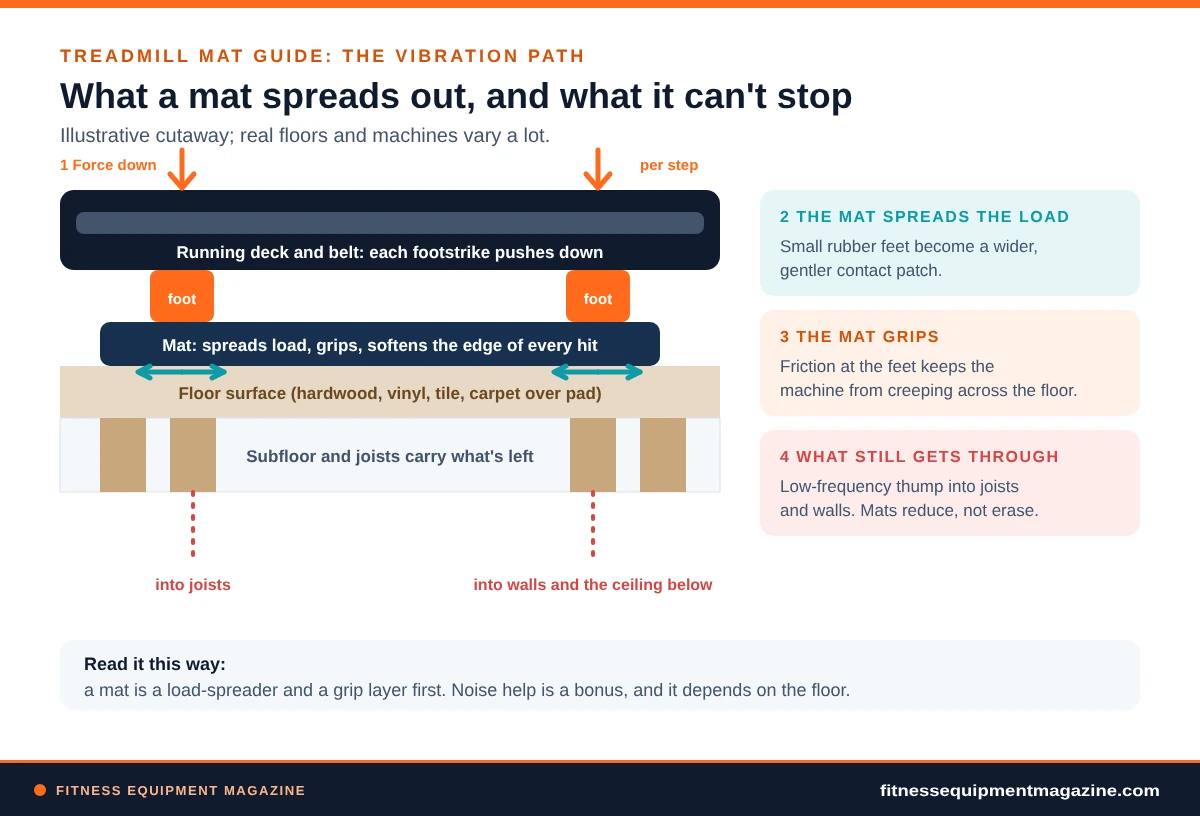
A treadmill creates sound in three overlapping ways. There’s the motor and drive: a hum or whir that travels through the air. There’s the belt and deck: a slap, squeak or scuff from your stride. And there’s the footstrike: a dull thump that leaves the frame and enters the floor.
A mat is best at the third path. It can’t touch the motor’s whir in the air, and it does little for a belt that needs lubricant. Footstrike thump is the part that moves through floors and walls, and it’s also the part that the people below you notice most. That’s why a mat is helpful in an apartment, even though this treadmill mat guide can’t call it a cure.
What actually helps a mat do its quiet work
Mass and density matter more than thickness. A thin but heavy, dense rubber sheet tends to damp vibration better than a thick but light foam one. Foam compresses easily, and compressing is the opposite of damping a hard knock. Dense rubber spreads and absorbs. That’s why many buyers end up with something in the range of a quarter to three-quarters of an inch, in heavy rubber, rather than a puffy inch of foam.
Coverage helps too. A mat that reaches every foot of the machine, plus the rear roller zone, gives the whole frame a damped base. A small mat under only half the machine leaves the other half knocking on bare floor.
- Dense rubber or rubber-like composite usually damps better than light foam.
- Full coverage under every foot and roller area beats a small patch.
- A level, rattle-free machine sends less energy into the floor to begin with.
- A well-lubricated belt cuts the squeak and slap that no mat can touch.
When one layer isn’t enough
In stubborn cases, people stack solutions. A dense mat goes on a thicker underlayment, or a platform adds mass beneath the machine. Those setups can reduce the thump further, but they raise the deck height and can soften the base. Treat them as advanced and slow. Add one change at a time, then listen from the room below.
Our broader pieces on how loud a treadmill gets and home gym noise reduction cover the rest of the toolbox: timing, lubrication, wall placement and floor decoupling. A mat is one tool in that box, and as this treadmill mat guide shows, a good one to start with.
If a mat takes the sharp edge off the knock and the neighbor says “I barely notice it now,” that’s a win. If your goal is zero audible sound upstairs, no mat in any listing can promise that, and you’d be better served by timing, a lighter walking pace or a quieter category of equipment.
Stability: When a Mat Helps and When It Wobbles
Here’s the part most listings leave out. A mat sits between the machine and the floor, so it changes how the machine stands. Done well, it adds grip and locks the feet in place. Done badly, it turns a rigid frame into something that rocks. A serious treadmill mat guide has to cover both outcomes.
Firm versus soft under a moving load
A treadmill isn’t a static object. Every stride pushes down, and on the next beat the force shifts. If the mat compresses a lot under the feet, the frame tilts slightly with each step. You might notice a faint sway in the console, a rattle in a fastener, or a belt that tracks a bit differently at speed. Runners feel it most, because their forces are larger and quicker.
Rules of thumb for a steady base
You don’t need an engineering degree to pick a stable mat. A handful of habits cover almost every case in this treadmill mat guide.
- Prefer dense over squishy.Press a thumb into a sample or a corner. If it dents deeply and springs back slowly, it’s too soft for a heavy machine.
- Keep it flat and single-layer.Stacking mats, or putting one on thick carpet, multiplies the give.
- Check level after the mat goes down.Place a small level across the frame, front to back and side to side. Adjust the leveling feet if the manual allows it.
- Recheck after a few days.New rubber settles. A machine that was level on day one can lean a little by day ten.
- Listen for new rattles.Loose bolts and shifting parts show up first as sound. Tighten what the manual says you may tighten.
Grip and the sliding machine
The other half of stability is staying put. Treadmills drift. A runner’s push-off loads the belt backward, and over weeks the whole frame can creep. A mat with a grippy top that meets the feet and a non-slip underside holds the machine where you placed it. Without grip, you’ll find the treadmill slowly angling away from the wall, with a bare strip of floor at one end.
The same grip works on your feet when you step on from behind. Wet shoes, sweat drips and a smooth vinyl mat make a slick landing. A lightly textured top is a safety feature, not a luxury. For anything involving a person in motion, rely on the manual’s guidance and a clear walkway, and see the CPSC exercise equipment page for known hazards.
Mat Materials and Construction: A Practical Treadmill Mat Guide
Mat listings use a dozen names, but most products fall into a handful of families, and this treadmill mat guide sorts them for you. Knowing the family tells you the weight, the smell, the cleaning behavior and the likely failure. The real-world differences live in the drawing below, not in a spec grid.
Solid rubber: the default for heavy machines
Rolled or sheet rubber is the workhorse. It’s dense, grippy and tough, and it handles a heavy machine without much give. The downsides are weight and smell. A large rubber mat can be a two-person lift, and fresh rubber often gives off a strong odor for days or weeks. Let it air in a garage or on a balcony before it goes into a bedroom.
Foam sheets and tiles
Foam is lighter, cheaper and easier to cut. It’s fine for a walking pad or a light machine on a hard floor, and it works as a quick dust catcher. For a heavier treadmill, the stability problem from the last section shows up. Foam can also tear at the edges, and a heel scrape can leave a permanent gouge. Tile versions give you modular coverage, but seams can lift or shift if the room sees traffic.
Composite and textured designs
Some mats pair a dense top with a ribbed or textured underside. The grooves help the mat grip a smooth floor and let dust and moisture escape. They can also hold grit, so wipe the underside whenever you lift the mat. Whichever family you pick, ask about thickness, weight per square foot and whether the surface is closed or porous. Closed surfaces wipe clean. Porous ones hold sweat.
Size and Thickness: Measuring for a Treadmill Mat Guide That Fits
Size is where good intentions go wrong. Mats are often sold in generic sizes, and treadmills are not generic. A mat that’s too short leaves the rear roller on bare floor. One that’s too narrow misses the feet on one side. Take thirty minutes with a tape measure and this treadmill mat guide, and save yourself a return.
How to measure your machine and room
Start with the machine’s own footprint, which you’ll find in the manual or on the spec sheet. Use the in-use dimensions, not the folded ones. Then add margins for the side, the front and, above all, the back. That rear margin is the place you step on and off, and it’s where drips and dust land.
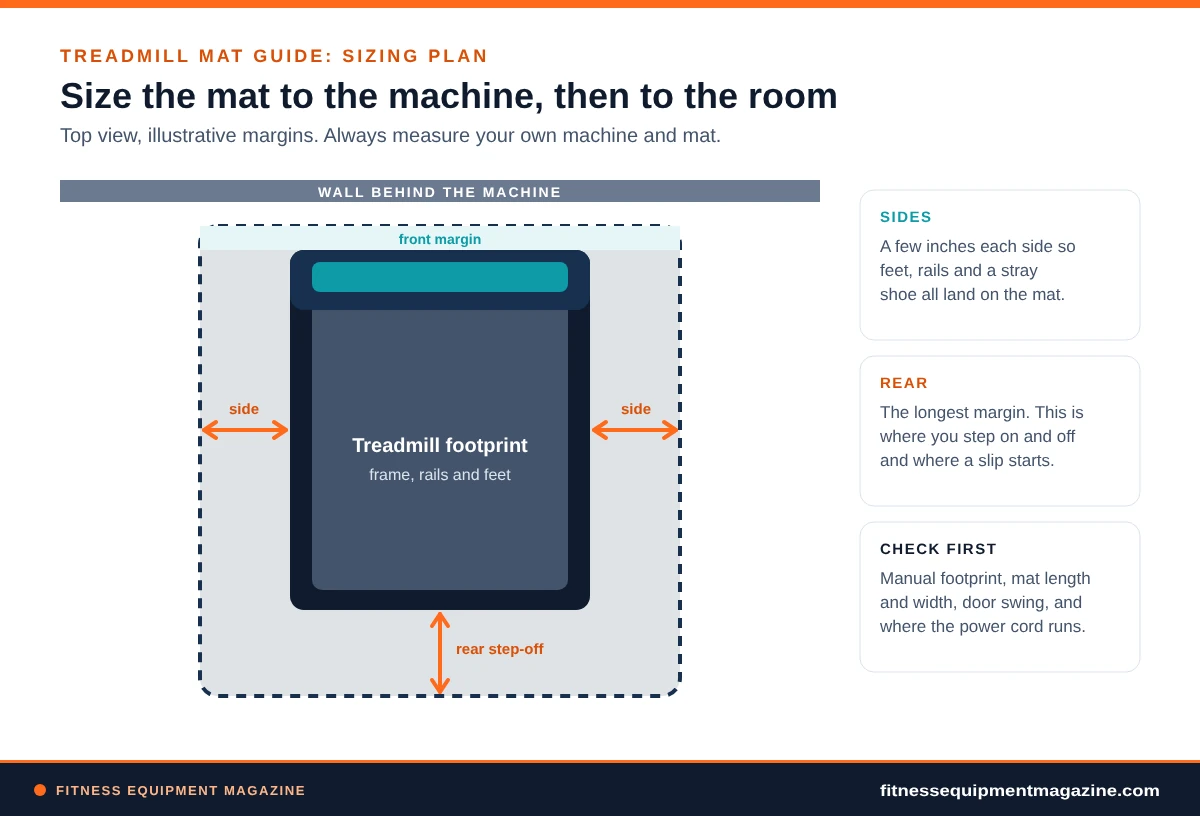
- Sides: commonly a few inches past each side of the frame, so feet, rails and a stray shoe all land on the mat.
- Front: a modest margin under the motor housing, because that’s where the heat and dust collect.
- Rear: the longest margin, often a foot or more, because you step on and off there.
- Doorways and furniture: check swing and clearance before you pick a size.
Thickness: why more isn’t automatically better
Thickness is the number shoppers fixate on, and our treadmill mat guide would say it’s the least useful on its own. A thin, dense rubber mat can outperform a thick foam one on every job except comfort when you stand. Typical mats for home treadmills run from roughly one-eighth of an inch to about three-quarters of an inch. Heavier machines and noise-conscious buyers tend toward the thicker, denser end. Lighter machines and tight budgets tend toward the thin end.
A thicker mat also raises the machine. That slightly lifts the deck, the console and your step-up. If the manual includes a maximum under-machine height or says to avoid soft surfaces, follow it. A treadmill that was designed to stand on a floor may not enjoy standing on a thick cushion.
Every mat has an edge, and every edge is a place to catch a toe. Pick a mat with a beveled or low-profile edge, keep the rear margin flat, and never let a corner curl up. A lifted edge behind the machine is the sort of small hazard that gets noticed only after someone trips on it.
Setting the Mat Up, Step by Step
Putting a mat down looks like a two-minute job. It’s closer to twenty, and the order matters. Skip the prep and you’ll be lifting a heavy machine twice. Here’s the treadmill mat guide sequence we’d follow, adapted to whatever your manual says about moving and leveling the treadmill.
- Unroll and air it out.Lay a new rubber mat flat somewhere ventilated for a day or two. Let it relax, because rolled rubber curls at the ends and smells at its strongest in the first week.
- Clean the floor.Sweep and wipe the spot. A single pebble under a mat becomes a permanent bump, and grit scratches finished floors.
- Unplug and clear the machine.Disconnect power, fold or lower the deck as the manual says, and remove anything on the frame. If the treadmill is heavy, get a second person. Don’t drag it across the mat.
- Position the mat.Center it on the space where the machine will stand, with the longer margin at the back. Square the edges to the wall or the door so it doesn’t look crooked.
- Set the treadmill down gently.Lower it rather than sliding it. If the machine has transport wheels, lift or tilt it per the manual so the wheels don’t dig into the mat.
- Level it.Place a small level across the frame, front to back and side to side. Adjust the leveling feet if the manual includes them. Make small changes and recheck.
- Route the power cord.Keep the cord off the walkway and out from under the mat. A cord under rubber can chafe, and a bump in the mat is a trip hazard.
- Test at low speed.Run the belt empty, then at a slow walk. Listen for new rattles and watch for drift. Then recheck the level after a few days.
If you need to trim a mat to fit, measure twice and use a sharp utility knife with a straightedge. Cut on a protected surface, away from the machine, and wear gloves. Check first with the seller, since cutting can void a mat’s own warranty.
Folding treadmills and transport wheels
If your machine folds up and rolls away, think about where the wheels go. Small wheels carry a lot of weight when you tilt the deck, and they can press grooves into soft foam. A firm mat handles this better. Also check that the mat doesn’t snag when the deck folds. Our folding treadmill guide explains the clearances and hinge behavior worth checking before you decide on a spot.
Cleaning and Care Schedule: Keeping a Mat Fresh
A mat is a dust catcher by design, so it’s going to get dirty. The trick is to treat cleaning as a short, regular habit. Five minutes every week keeps grit off the floor, keeps the rubber from smelling, and gives you an early look at the machine’s belt dust and drips, which are clues about its health.
What to use and what to avoid
Mild is the rule. Warm water with a drop of dish soap on a well-wrung cloth cleans most rubber and composite mats. Rinse the cloth and wipe again with clean water so no soap film remains, because soap residue makes a mat slick. Let it dry before the machine goes back on it, or at least before anyone steps on.
Avoid strong solvents, bleach, oily polishes and glossy “restorers.” They can dry out rubber, cloud the surface, or leave a slippery film. Never apply a cleaning product while the treadmill is powered on or while the belt is moving. If a mat’s seller or the machine’s manual names a cleaner or lists one to avoid, trust that over any general rule.
Odor, dust and the stuff under the machine
Fresh rubber smells, and a mat that stays smelly after a few weeks is worth a conversation with the seller. Light airing and a baking-soda sprinkle left overnight on the mat, then vacuumed up, helps with mild odor. Heavy sulfur-like or oily smells deserve a return. Dust under a treadmill is mostly belt fibers and dried lubricant, so a sudden increase can point to an alignment issue or a worn belt. If you see a lot of black dust or sticky drips, check the manual and consider reading our treadmill maintenance guide.
Before you clean around the motor housing or lift the machine off the mat, switch the treadmill off and unplug it. Keep hands, hair and loose clothing away from the belt and rollers. If you’re unsure what the manual allows you to touch, leave it for a service technician.
Troubleshooting Common Mat Problems: A Treadmill Mat Guide
Most mat problems are small and fixable, so this treadmill mat guide keeps the fixes simple. The trick is to match the symptom to a likely cause and try the least invasive fix first. Here’s how we’d work through the usual suspects.
The mat or the machine creeps
If the mat slides across the floor, the underside is probably too smooth for the floor, or the floor is dusty. Clean both, then try a rubber-friendly anti-slip underlay made for the floor type. If the treadmill itself walks across the mat, check that the feet are clean and that the surface has real grip. A glossy top or a dust film defeats traction. A slight level problem can make drifting worse, so recheck that too.
The mat smells
Air it in a ventilated spot, wipe it with mild soap and water, and let it dry fully. If the odor stays strong after two to three weeks, contact the seller. Don’t mask it with sprays, since those can leave residues that attract dust and make a surface slick.
Edges curl or ripple
Curling is common with rolled rubber that spent months coiled in a box. Lay it flat in a warm room for a few days, or place something heavy but safe on the edges while it relaxes. Never leave a curled corner in the walkway. If it keeps lifting, a thin double-sided carpet tape designed for that floor can help, though check that it won’t harm the finish.
Dents and compression marks
Rubber and foam both hold the shape of heavy feet over time. That’s normal. If the dents are deep enough that the frame no longer sits level, rotate or reposition the mat slightly, or move to a firmer product. Hardwood dents underneath are another matter. A mat reduces that risk, but it can’t promise to eliminate it, particularly with soft woods.
The belt slips or the machine acts oddly
Mats rarely cause belt slip, but a soft mat can change tracking by letting the frame flex. If the belt drifts or hesitates after you added a mat, check level, tension and lubrication first. Our guide to treadmill belt slipping lays out the safe steps. If the machine only misbehaves on the mat, try the same run on a firm spot and compare.
Rubber and synthetic belts can build up static, particularly in dry winter air. A small shock is annoying but usually harmless. If you see sparks, smell burning, or notice a hot motor housing, stop using the machine, unplug it and consult the manufacturer.
Manufacturer Caveats, Warranty and Safety in a Treadmill Mat Guide
The treadmill’s own manual outranks any general treadmill mat guide, including this one. Some makers specify a particular type or size of mat. Others warn against thick padding or against anything that blocks airflow near the motor. Reading those pages takes ten minutes and can save a warranty claim.
What to look for in the manual
- Recommended surfaces: some manuals say “hard, level floor only.”
- Clearance and ventilation: the motor housing often needs air space and a clear floor underneath.
- Maximum mat thickness: a rare but real instruction that affects step-up and stability.
- Cleaning instructions: what you may wipe, and which parts you shouldn’t spray.
- Warranty terms: whether a non-approved accessory could affect coverage.
The mat’s own warranty and return terms
Mat warranties are usually short and cover defects like peeling or cracking, not wear or stains. Return terms matter more, because you can’t judge odor, thickness or fit until the mat is in your room. A seller that accepts returns on opened rubber products is worth a little extra. One that doesn’t should make you extra careful with measurements.
Safety with a mat in the room
A mat changes your footing. Wear proper shoes, keep the edges flat and keep the walkway clear. Anyone with balance concerns should add a step-up check and extra supervision, and talk to a healthcare professional about starting a new routine. General activity guidance is in the HHS Physical Activity Guidelines. For machine hazards and known recalls, the CPSC exercise equipment page is the place to look.
Alternatives and Add-Ons Beyond a Basic Treadmill Mat Guide Pick
Not every setup ends with a boxed mat labeled “treadmill.” Plenty of home gyms use something adjacent, and some of those choices are smart. Others are false economy. Here’s how the common alternatives compare with what this treadmill mat guide has covered so far.
Horse-stall and utility rubber mats
Heavy utility rubber, sold in sheets for stalls and gym floors, is the favorite of the budget-minded. It’s dense, thick and often cheaper per square foot than a branded mat. The tradeoffs are weight, a strong smell and a rough, unfinished look. It can also be larger than you need, so you’ll be cutting it down. For a garage or a basement, it’s a sensible choice. For a living room with vinyl, it’s the kind of rubber to test before committing.
Anti-vibration pads and isolation feet
Small pads under each foot, usually rubber or a rubber-and-cork sandwich, target vibration at the contact points. They can work well on a light machine and may reduce rattles. On a heavy treadmill, they carry a lot of load in a small area, and they can compress unevenly. Use them under a mat’s protective sheet rather than instead of it, and check that the manufacturer doesn’t object to feet that change the machine’s height.
Plywood or composite platforms
Some people build a platform: layers of plywood over rubber, sometimes with a felt or foam isolation layer. It adds mass and spreads the load across a larger part of the floor. It also raises the machine, takes up space and can create its own resonance if built poorly. Think of it as a project for a garage, a basement or a dedicated room, not a quick weekend fix in an apartment. If you’re weighing a build, read about floor load first.
Underlayment and thick padding
Carpet pad, acoustic underlay and thick foam sound appealing, and they can reduce noise. They also add the soft layer we warned about earlier. Under a treadmill, that softness invites rocking. If you want to pursue it, keep the machine’s feet on a firm, dense surface on top of the underlayment, and stay within what the manual allows.
A boxed treadmill mat is the simplest path and the easiest to return. Utility rubber is the best value for a garage. Pads and platforms are for tinkerers who can accept some trial and error. Whichever you choose, the treadmill mat guide rules stay the same: dense beats squishy, coverage beats a small patch, and the manual has the last word.
When to replace a mat
A good mat lasts for years, but not forever. Replace it when the surface cracks, when deep dents keep the frame from sitting level, when edges crumble, or when the mat has absorbed an odor that never fades. Also replace it if it starts to feel slick even after cleaning. A mat that has lost grip stops doing its second job.
If you buy a new machine, don’t assume the old mat still fits. A larger footprint, a different foot layout or a heavier frame can change the answer. Re-measure, and run through the shopping routine again. It’s cheaper than a floor repair.
Five Hypothetical Shoppers and the Mats That Suit Them
These are invented households, built to show how the decision changes with the room. They’re not reviews, and no real person is behind them. Use them as a mirror: find the one closest to your own situation, then borrow the reasoning.
The second-floor apartment walker
Lives above a neighbor, walks in the evening, owns a mid-weight folding machine. Priority: take the sharp knock out of each step and keep the machine from creeping. Fits a dense rubber or composite mat with full coverage, a modest thickness and a firm top. Skip plush foam.
The hardwood spare-room runner
A heavier machine on oak flooring, with fast runs three times a week. Priority: spread the load and keep the frame rigid. Fits thick, dense rubber sized generously at the back, with a smooth underside so no grit scratches the finish.
The garage user on a concrete slab
Humid summers and dusty winters. Priority: easy cleaning and moisture awareness. Fits a wipe-clean mat with a smooth top, lifted occasionally to check for dampness. Thickness matters less here.
The renter with a security deposit
Luxury vinyl plank, a landlord who inspects, a plan to move in a year. Priority: avoid staining and marks. Fits a vinyl-safe product, tested under a corner first, with before-and-after photos of the floor.
The family with a curious toddler
A treadmill in a living-room corner. Priority: low-profile edges, no loose corners and a machine stored out of reach. Fits a thin, flat, grippy mat with beveled edges and a clear safety routine. Never rely on a mat to child-proof a machine.
What the five profiles teach this treadmill mat guide
None of them chose by thickness alone. Each started from a floor, a machine weight and a worry, and the mat followed from that. It’s a simple pattern, and it’s the one we’d suggest you use too. For the wider question of which machine belongs in your space, our guide to the best treadmills for home use walks through size, training style and noise before you ever get to the floor.
What to Skip: Common Mistakes a Treadmill Mat Guide Can Help You Avoid
Almost every mat complaint we see traces back to one of a few predictable mistakes. Skim this list before you click “buy.”
- Buying by thickness alone. A thick, soft mat can make the frame less stable and add nothing to quiet.
- Using a “yoga mat” or puzzle foam as a treadmill mat. It’s too soft for the load and tears at the feet.
- Ignoring the rear margin. A short mat leaves you stepping off onto bare floor.
- Skipping the vinyl test. Some rubber stains vinyl, and you’ll only learn that after a year.
- Stacking layers. Two soft layers multiply wobble.
- Believing noise promises. No mat makes an upstairs treadmill silent.
- Never lifting the mat. Moisture, grit and floor marks hide below.
Claims to read with a raised eyebrow
Phrases like “military grade,” “100% noise elimination” or “extends machine life” show up in listings without anything behind them. Treat them as decoration. What matters is a stated material, a stated thickness, a stated size and clear return terms. If a seller can’t say what the mat is made of, that tells you what you need to know.
Likewise, be wary of review sections that say “works great” with no detail. The helpful reviews name the floor, the machine type and the problem solved. Search them for words like “smell,” “slide,” “stain” and “edge.” Patterns in those words beat star averages, and they’re the habit we’d recommend for most home-gym purchases.
A Shopping Routine That Works
You can turn this treadmill mat guide into a ten-minute routine. Do it once, and the product pages start to sort themselves.
- Write down the floor and the worry.One line: “second-floor laminate, neighbors below” or “garage slab, dust.”
- Get the machine’s footprint and weight.Copy them from the manual or spec sheet, using in-use dimensions.
- Choose the material family.Dense rubber or composite for heavier machines, foam only for light ones on hard floors.
- Size it with margins.Sides, front and a generous rear, within what the room allows.
- Read the return terms and the vinyl note.Opened rubber that can’t be returned raises the stakes.
- Check the manual and CPSC.Confirm there’s no warning against thick mats, and glance at the recall page for your machine.
- Set up, level, listen.Follow the setup steps above, then recheck after a week.
Consider the floor at the same time you choose the treadmill. A lighter folding model, a walking pad or a machine with a better-sealed deck can change what the mat has to do. Our walking pad vs treadmill comparison and the treadmill buying guide are good places to start.
Questions People Ask About Treadmill Mats
What does a treadmill mat guide say about whether I really need a mat?
In this treadmill mat guide’s view, most home treadmills benefit from a mat if they stand on hardwood, laminate, vinyl, tile or an upper floor. The mat protects the surface, adds grip and may soften the knock that travels downward. On bare concrete, you might skip it, though a wipe-clean mat still catches dust. Always read your machine’s manual first, because a few makers have specific instructions about surfaces and padding.
How thick should a mat be, according to this treadmill mat guide?
Typical home mats run from roughly one-eighth to three-quarters of an inch. Heavier machines and noise-conscious buyers often lean toward the thicker, denser end, while lighter machines can do fine with thinner mats. Density matters more than raw thickness, since a soft thick mat can let the frame rock. Check your manual for any limit, and verify the real thickness on the spec sheet.
Will the mat in a treadmill mat guide stop the noise downstairs?
No mat can promise that. A good one, as our treadmill mat guide explains, can reduce the sharp footstrike thump that enters the floor, but motor hum, belt squeak and low-frequency vibration through joists often remain. Combine the mat with a level machine, a lubricated belt and sensible workout times. Our guide to treadmill noise in an apartment covers the full list of fixes and what to expect from each.
Is rubber or foam better in a treadmill mat guide for heavy machines?
For heavy machines, dense rubber or a rubber-like composite is usually the safer pick. It resists sinking and keeps the frame steady. Foam is lighter and cheaper, but it compresses and tears more easily, which is why it suits walking pads and lighter treadmills better. If your floor is vinyl, ask the seller whether the rubber is safe for it before you buy.
Can a treadmill mat damage my floor?
It can in a few cases. Some rubber may stain vinyl, a rough underside can trap grit that scratches, and a mat that never moves can hide moisture. Keep the floor and the underside clean, lift the mat a couple of times a year and test a corner on delicate finishes. Check your flooring maker’s care guide, since some discourage rubber backings, and keep this treadmill mat guide handy for the cleaning steps.
How do I clean a mat using a treadmill mat guide routine?
Vacuum or sweep weekly, then wipe with a well-wrung cloth and a little mild dish soap in warm water. Rinse with clean water and let it dry. Avoid bleach, solvents and glossy restorers, which can degrade rubber or leave a slippery film. Unplug the machine before cleaning near the motor housing, and follow any cleaner advice from the mat seller or the treadmill’s manual.
Should I put a treadmill mat on carpet?
Only if the carpet is low-pile and firm, and only with a flat, dense mat. Plush carpet plus a soft mat stacks two layers of give and can tilt the frame. Many manuals recommend a hard, level surface, so check yours. If carpet is your only option, a firm single layer is usually safer than none and better than a thick foam one.
How big should the mat be for my machine in a treadmill mat guide?
The treadmill mat guide method is simple. Start with the machine’s in-use footprint from the manual, then add a few inches at each side, a modest margin at the front and a longer margin at the rear, often a foot or more. The rear margin matters most, since that’s where you step on and off. Confirm doorway clearance and room layout before ordering.
Do treadmill mats help the treadmill last longer?
They can indirectly, by keeping dust away from the motor area and keeping the frame from sliding or rattling. They don’t repair worn belts or poor lubrication, and no listing can honestly promise years of extra life. Think of the mat, as this treadmill mat guide does, as a clean, steady base. The real longevity work is in following the manual’s care steps.
Bottom Line: Use This Treadmill Mat Guide as a Checklist
A good treadmill mat is firm, dense, correctly sized and easy to wipe, which is the whole treadmill mat guide in one line. It protects your floor, grips the feet and takes some of the edge off the knock. It won’t make a treadmill silent or a soft machine solid. If you remember one line from this treadmill mat guide, make it this: choose density over thickness and coverage over bargains.
Here are your next steps with this treadmill mat guide. Measure the machine and the room tonight. Decide whether your floor needs a vinyl-safe product, then read the return terms before you buy. Set the mat up, level the treadmill and recheck in a week. If you’re still deciding on the machine itself, start with our guide to choosing the right home treadmill, and come back to this page when the floor question arises.
Sources and Further Reading
- HHS Physical Activity Guidelines — federal guidance on weekly activity for adults
- CPSC exercise equipment recalls — check model safety history before you buy
Some links on this site may be affiliate links. If you buy through them we may earn a commission at no extra cost to you. Recommendations are based on the criteria in the article, not payout. This article is general information about equipment and isn’t medical advice; talk to a qualified professional about your own health and training. Last reviewed: October 2026.