How we test treadmills is a fair question, and the honest answer is a little different from what most review sites imply. We don’t run machines in a lab, and we don’t publish decibel readings or belt-wear numbers. What we do is a documented, repeatable research process, and we tell you exactly where its limits are. This page explains how we test treadmills, the scorecard, and how you can run a sturdier version of the same checks yourself.
Plenty of readers arrive here suspicious, and they should. Many “we tested” pages are a rewritten spec sheet with a star rating on top. Some are genuinely rigorous. You usually can’t tell which kind you’re reading, because the method is hidden.
So we put how we test treadmills on the table. Below you’ll find what counts as evidence for us, what doesn’t, and how a claim moves from a manufacturer’s page into one of our guides. Then we hand you a store-visit routine and a home-trial log. Those two tools matter more than any rating we could print.
How we test treadmills today is a desk-based, research-led process. We read specification patterns, review federal safety sources, study the ownership problems that buyers report again and again, and run every draft through a fact-review checklist. We have not hands-tested the machines we describe, and we never claim otherwise.
- Who this page helps: anyone deciding how much weight to give our treadmill guides, and anyone who wants a fair way to judge a treadmill in a showroom or during a return window.
- The biggest tradeoff: a research-based method is transparent and consistent, but it cannot feel a belt hesitate or hear a motor whine. Only a person standing on the machine can.
- What you can do with it: use the six-part scorecard below on any treadmill, ours or anyone else’s, and trust your own ten minutes on the deck over any rating.
If you’re ready to shop, our guide to the best treadmills for home use applies this framework to real buying decisions.
How we researched this. This page describes our own editorial process, so the evidence is the process itself. It is research-based guidance built from manufacturer specification patterns, federal guidance and ownership problems commonly reported by buyers. We haven’t hands-tested the machines our guides describe, so you won’t find lab results, measured decibels or “our testers” claims here. We name no brands and quote no prices for specific products. Figures are typical ranges to verify against current spec sheets. Last reviewed: October 2026.
How we test treadmills changes when we find a better way to do something, and treadmill specs, warranties and recalls shift every few months. This page was last reviewed in October 2026. Before you buy any machine, read the current spec sheet and warranty page, then check the CPSC exercise equipment recall list for that model.
What “How We Test Treadmills” Means on This Site
The word “test” carries a lot of baggage. To most readers it means a person, a machine and a notebook. We’d rather define it plainly than let you assume. On this site, how we test treadmills means how we evaluate them: a structured comparison of what makers say, what safety bodies publish and what owners keep running into.
How we test treadmills: a definition you can hold us to
When one of our guides says a feature “matters,” it has passed through a fixed set of questions. Is the claim specific enough to check? Does it match what similar machines commonly list? Do owners report problems with it? Does a federal source say anything about it? A feature that clears those questions earns a place in a buyer’s checklist. One that doesn’t stays out, however loudly it’s advertised.
None of that involves us standing on a belt, and that is the honest core of how we test treadmills. We’d rather say so in the first paragraph than bury it in a footer. Your trust is worth more than the word “tested” in a headline.
Why we publish how we test treadmills
Two reasons. First, a buying guide is only as good as the reasoning behind it, and reasoning you can’t inspect is just opinion. Second, the method is useful on its own. The scorecard behind how we test treadmills is the same one we want you to carry into a showroom.
There’s a third, quieter reason too. Treadmills are big, heavy, expensive to ship back and hard to judge from photos. Anything that helps a buyer decide with fewer surprises is worth writing down. So this page works as both a disclosure of how we test treadmills and a how-to.
Who should read how we test treadmills
If you read one of our shopping guides and wondered how we reached its conclusions, start with how we test treadmills here. The same goes if you’re comparing several review sites and want to know how to weigh them. And if you’ve already narrowed your list, skip ahead to the store-visit routine near the end. It works with any machine on any shortlist.
For the full spec-by-spec explanation of what we’re scoring, the treadmill buying guide is the companion piece. This page explains how we test treadmills. That one explains what we’re judging.
Four Evidence Levels Behind How We Test Treadmills
Not all evidence weighs the same, and pretending otherwise is how rating inflation starts. We sort every claim we make while we test treadmills into one of four levels. The label tells you how much confidence the claim deserves before you act on it.
Level 1: what the maker says
This is the lowest rung. A product page tells you the stated belt size, stated motor rating and stated weight limit. Those numbers are useful, but they’re marketing as much as measurement. Two makers can describe the same motor in very different terms. So a Level 1 fact never drives a recommendation by itself.
Level 2: patterns across many spec sheets
Here we compare. If a feature shows up on nearly every well-built machine in a category, that tells us something. If a number sits far outside the usual range, that tells us something too, whether it’s a bargain or a warning. Patterns are harder to fake than a single listing, and that’s what makes Level 2 more trustworthy.
Level 3: independent sources and owner patterns
The third rung is the one that does the heavy lifting. Federal safety sources are independent of any seller. Ownership problems that appear again and again, in many places, from many people, are signal too. A single angry review proves nothing. Forty similar complaints about belt drift or a flaky safety key prove quite a lot.
We read these patterns carefully and describe them as patterns. We never invent a failure rate. If we can’t say how common a problem is, we say that instead.
Level 4: hands-on measurement, which we do not claim
The top step is measuring the machine itself. That means timing belt wear, logging motor temperature, recording sound levels with a calibrated meter and checking frame flex with proper instruments. It’s real work, and it takes a real facility. We haven’t done it, so none of our guides report such results. When we get there, we’ll say so loudly and publish the protocol first.
When you read any review, ask which rung each claim stands on. “The motor is rated at a certain horsepower” is Level 1. “Most machines in this class list a similar belt size” is Level 2. “Owners keep reporting that the belt drifts” is Level 3. “We measured 62 decibels” is Level 4, and it should come with the method, the room and the meter.
How We Test Treadmills on Paper: The Five-Step Pipeline
How we test treadmills follows the same five steps for every guide, in the same order. The order matters. Doing the safety check last, for example, tempts you to explain away what it finds. Doing it early means a red flag can reshape the whole article.
Step 1: collect and normalize the specifications
We start with the numbers makers publish: running surface, motor rating, speed and incline range, weight limit, deck and frame details, warranty terms. Then we normalize them. A “belt size” that includes the end caps isn’t a running surface. A peak horsepower figure isn’t a continuous one. Putting every claim in the same units is dull work, and it’s where many misleading listings give themselves away.
Step 2: read the safety sources first
Next we check federal sources before any opinion pieces. The Consumer Product Safety Commission publishes recalls and safety information for exercise equipment, and we link it wherever it’s relevant. If a type of failure shows up in recall notices, that shapes what we tell you to look for. For instance, repeated notices about unexpected belt movement is why we keep telling readers to test the safety key.
We don’t summarize individual recalls in our guides, because they change too fast. We point you to the live list and tell you to check it for your exact model.
Step 3: look for ownership patterns
Then we read what buyers describe after months of use. We’re not counting stars. We’re listening for repetition. A complaint that appears across different sellers, different years and different writers is more believable than a pile of vague praise.
Typical patterns include belts that creep to one side, consoles that freeze, noise that grows after the first few months, and folding mechanisms that loosen. We treat each as a question to ask before buying. We never turn a pattern into a percentage, because we don’t have the data to justify one.
Step 4: run the fact-review checklist
Before a draft is cleared, every number and every causal claim goes through a checklist. Is the figure a typical range, and is it labeled as one? Does the sentence promise a result no one can promise? Does it name a brand or quote a price it shouldn’t? Does a health sentence stay general? Anything that fails gets rewritten or deleted.
Step 5: publish with a date and a recheck
Finally, each guide carries a “last reviewed” date, and we schedule it for another look. Treadmill markets move. Warranty terms shift, features migrate between price tiers and old recalls get new companions. A guide with no review date is a guide you shouldn’t trust, including ours.
The Six-Part Scorecard: How We Test Treadmills Across Six Checks
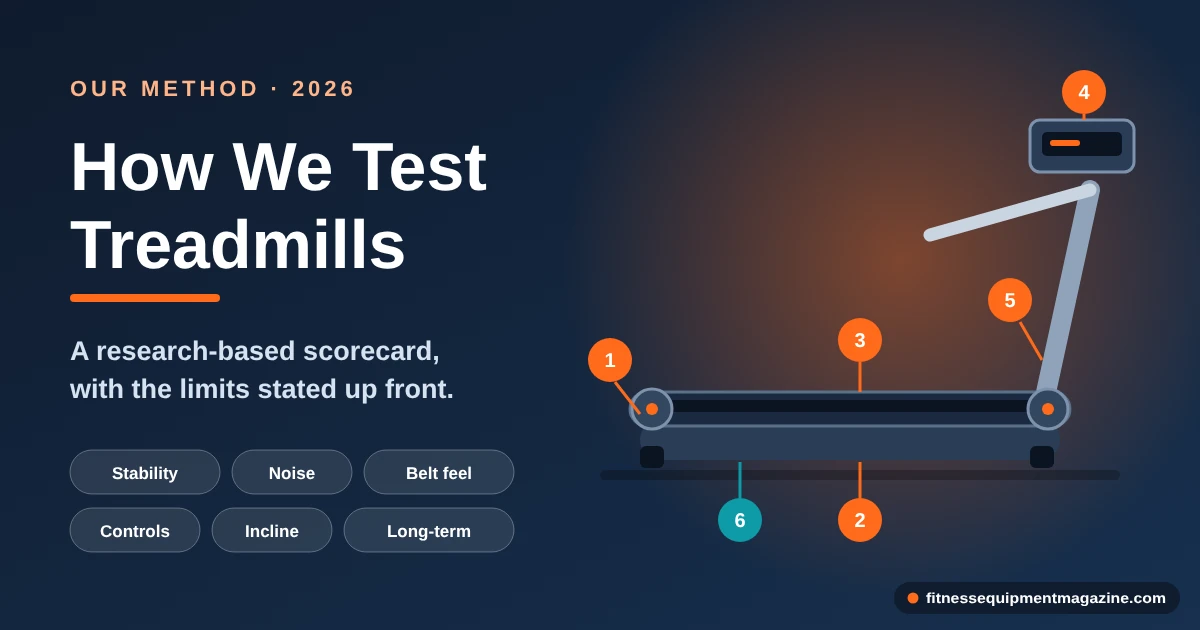
Across the process above, how we test treadmills comes down to six buckets: stability, noise, belt feel, controls, incline and long-term use. Together they cover what a household actually lives with. Everything else on a spec sheet either feeds one of these or is decoration.
Why how we test treadmills uses six checks, not twenty
A long checklist feels thorough, but it hides priorities. When twenty items carry equal weight, a flashy screen can outscore a safe frame. Six forces trade-offs into the open. Each bucket also maps cleanly to something you can check yourself, which is the whole point of sharing the framework.
- Stability: does the frame stay put, and does the deck feel planted under a real stride?
- Noise: how much motor, footstrike and vibration reach the room, and the room below?
- Belt feel: is the surface smooth at low speed, centered and quiet to start?
- Controls: can you adjust, stop and read the machine without thinking?
- Incline: does the grade change smoothly, and does the motor cope with it?
- Long-term use: will it still run, and will the maker still answer, in year three?

How we test treadmills differently for each shopper
The scorecard has no single fixed weighting, because no single shopper exists. An apartment walker cares about noise far more than a garage runner does. A heavy user should push stability and long-term use higher. We show the principle below with two illustrative profiles.
Treat the numbers as a thinking tool. Write your own six weights before you shop, on paper, adding up to 100. The exercise takes two minutes and it exposes what you actually care about. Most people discover they’d been about to pay for something near the bottom of their own list.
Stability and Noise: What We Look For When We Test Treadmills
These two buckets decide whether a treadmill gets used or gets resented. Stability is about safety and confidence. Noise is about the people around you. Both are hard to judge from a photo, so this is where how we test treadmills on paper is most upfront about its limits.
Stability: frame, footprint and rail
On paper, we read stability from a few clues. A wider base and a longer frame generally resist rocking. Heavier machines tend to be steadier, within reason. Stated weight capacity, and how far it exceeds the heaviest user, hints at the margin built into the frame. Rear and front rollers that are larger usually mean a smoother, more stable belt path, though makers describe them inconsistently.
Folding designs add a joint, and every joint is a place for play to develop. That’s not a reason to avoid folders. It is a reason to check how the hinge locks, which our folding treadmill guides covers in more detail.
What stability findings cannot tell you
Here is the honest gap. A spec sheet can’t tell you whether the console wobbles at a 10 percent incline or whether the frame hums at your running cadence. Nor can it show whether the rails flex under a hand. Only a person on the deck can learn these things, which is why we build a shake test into the store routine below.
Any treadmill that rocks, shifts or moves unexpectedly on a flat floor is a hazard. Never rely on a rating to override what you feel. Keep the safety key clipped on whenever the belt is moving, and keep children and pets away from running machines. For recalls, use the CPSC exercise equipment page (linked in the sources below).
Noise: three sources, not one
People say a treadmill is “loud” and mean three different things. The motor hums or whines. The footstrike thuds into the deck and the floor. And the belt and rollers scuff or squeak. Each has different causes and different cures. A quiet motor on a thin deck can still shake a ceiling below.
From a desk, we can compare motor type, deck construction and belt thickness against patterns in owner complaints. We can’t print a decibel number. When a site does, ask who measured it, where the microphone sat, and at what speed. Our dedicated treadmill noise in an apartment guide goes deeper on this one.
The room is half of the noise
The same machine sounds different on concrete, on a wood subfloor and on a second floor above someone’s bedroom. Hard, hollow floors carry vibration well. A mat helps a little with scuffing and a lot with protecting the floor, but it’s not a magic silencer. So when we discuss noise, we always pair the machine with the room. A “quiet” claim without a room is just an adjective.
Belt Feel and Controls: Where We Test Treadmills for Daily Annoyance
You’ll never see these two on a headline spec list, yet they shape every single session. A belt that hesitates at 1.5 mph or a console that buries the stop button turns a good machine into a chore. Both are mostly about feel, so both are mostly out of reach when we test treadmills from a desk. We can still narrow the field.
Belt feel: surface, tracking and start-up
What we can read: stated running-surface length and width, belt layering and thickness, deck material and the roller sizes. The treadmill belt size guide explains how to match the surface to your stride. Deck cushioning is the other half of belt feel.
What we infer from owner patterns: belts that drift, belts that stick when new, and decks that grow louder with use. These are the recurring complaints, so they become checklist items. Does the manual explain tracking adjustment in plain language? Is lubrication a user task or a service task? Those answers predict ownership frustration better than any marketing line.
The low-speed test nobody advertises
Plenty of machines feel fine at 3 mph and rough at 1.5. That matters if you walk, if you warm up slowly, or if an older relative shares the treadmill. It’s also something no spec sheet states. We tell readers to ask for it in a store, and the routine below shows how.
Controls: can you use it without thinking?
Console reviews on paper are limited to what the maker lists. Still, a few signals are readable. Are speed and incline set with dedicated keys or buried in menus? Does the quick-set button jump in big steps? Is there a clear, physical stop? Does the display need an app or subscription to work at a basic level? We favor a plain console that does the basics well, and we say so.
The safety key deserves its own line. It’s a small clip and cord that stops the belt if you pull away. A good control layout makes it obvious and easy to reach. Any report of a key that fails to stop the belt is a hard stop for us.
Large touchscreens can lock core features behind a paid plan. Before you buy, find out what still works if the subscription lapses. A treadmill that can’t start without a login is a rental in disguise.
Incline and Long-Term Use: The Slow Part of How We Test Treadmills
These last two buckets reward patience. Incline problems show up under load. Durability problems show up in year two. How we test treadmills has real trouble with both, and honesty here is worth more than confidence.
Incline: range, smoothness and motor coping
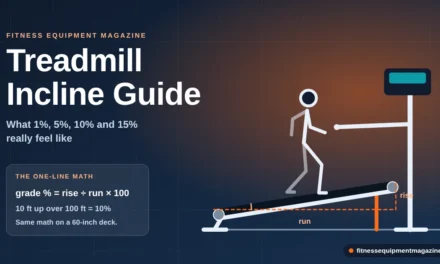
From the spec sheet, we read the stated grade range, the type of adjustment (motorized or manual) and whether the motor and frame are described as handling it. Our treadmill incline guide explains what different grades feel like. One caution applies to all of them: a bigger number isn’t automatically better. A machine that climbs to 15 percent but strains at 8 is worse than one that tops out lower and holds steady.
The patterns we watch for include incline motors that grind or stall, slow changes in grade, and consoles that lose the incline setting. Each becomes a question for the retailer. We never claim to have felt the climb.
Motor and duty cycle in plain terms
Incline and long sessions both push the motor. That’s where the continuous-duty rating matters more than any peak figure. If you want the full story, our treadmill motor guide unpicks the marketing claims. As a rule of thumb, we read a modest, honest continuous rating as better than a big, vague peak number.
Long-term use: what year three looks like
Durability is the hardest bucket to judge, and the one where fake certainty does the most harm. We can’t age a belt in a lab. What we can do is read warranty structure, which tells you how much risk the maker is willing to carry. Compare frame, motor, parts and labor terms. Note who pays shipping on a heavy repair. Check whether the maker has a parts supply and a phone number that rings.
Then we weigh the owner patterns again, this time for time-based complaints: belts that wore early, consoles that died after the warranty, folding hinges that loosened. If those cluster in a design, we flag it as a question to ask. We never turn it into a ranking claim.
Why upkeep belongs in a test conversation
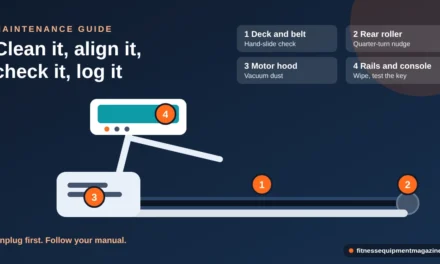
A machine that is easy to maintain scores better over time. Cleaning access, lubrication method and belt adjustment all count. Our treadmill maintenance guide lays out a routine, and the belt slipping troubleshooting guide helps when something goes wrong. Both inform how we judge long-term use, because a design that punishes ordinary upkeep will punish you.
What We Do Not Do Yet When We Test Treadmills
A methodology page that only lists strengths isn’t a methodology page. Here are the gaps, stated plainly, so you can discount our guides accordingly.
What the method does well
- Applies the same questions to every machine type, so guides stay consistent.
- Puts federal safety sources and recall checks ahead of opinion.
- Labels each claim by evidence level instead of hiding the weak ones.
- Stays free of brand ties, because we name no brands and quote no product prices.
What it cannot do
- Feel belt hesitation, frame flex or console lag firsthand.
- Measure sound, vibration, temperature or wear with instruments.
- Prove any failure rate, since we have no manufacturer or service data.
- Replace your own time on the machine before the return window closes.
No lab results in how we test treadmills, and no pretending
We don’t publish dB readings, wear hours or “tested for 500 miles” claims, and you shouldn’t expect them. If one ever appears on this site, it will link to a full protocol. Until then, any such number you find here is an error you should report.
No fake reviews, quotes or surveys
We don’t invent owner quotes, make up survey results or attribute statements to unnamed experts. When we describe what owners report, we describe it as a pattern from public sources, in our own words. If we can’t support a statement, we cut it.
What would change how we test treadmills
Level 4 evidence needs equipment, space and a written protocol that others can repeat. It also needs a way to buy or borrow machines without strings attached. Those are real costs, and we won’t fake the result before the work exists. When the plan is ready, it will appear on this page first, with a changelog.
Affiliate Links, Corrections and Recalls: The Rules Behind How We Test Treadmills
Trust isn’t only about method. It’s also about money and mistakes. So these are the standing rules that sit behind how we test treadmills and everything else we publish.
Money: how links work
Some links on this site may be affiliate links. If you buy through them, we may earn a commission at no extra cost to you. Recommendations are based on the criteria in the article, not payout. Our guides describe machine types and criteria, not paid placements, and no maker can buy a better score on the scorecard.
We also try to keep the incentive from tilting the advice. A guide that says “wait” or “buy the simpler machine” is as welcome here as one that says “buy this type.” If a recommendation would only make sense with a commission attached, we shouldn’t be making it.
Mistakes: how we fix them
We will get things wrong. A spec changes, a reader spots an error, a recall lands the week after publication. Our rule is simple. Fix it, date the change and say what changed when the change matters. We don’t quietly rewrite a claim and pretend it was always that way.
Recalls: why we link instead of list
Recall lists change faster than articles do. A summary we write today could be stale next month. So we send you to the live CPSC exercise equipment recall page and tell you to search by the exact model before you buy. It takes two minutes. It’s also the single most protective habit in this whole article.
How often how we test treadmills gets reviewed
Each guide gets a date and a recheck. High-traffic or fast-moving topics, such as recalls and warranty language, get revisited sooner. If you see a guide here that looks out of date, tell us. A reader pointing at a stale paragraph is worth more than an internal calendar.
The Scoring Scale and Fact-Review Checklist Inside How We Test Treadmills
A scorecard only helps if the numbers mean the same thing every time. So here is the scale we use when we write a buying guide, and the checklist every draft must pass. You can borrow both for your own notes.
A five-point scale that says what it means
Scores in how we test treadmills describe how well a design’s stated features match the need, not how well a machine performed. That distinction matters, because “performed” would imply a trial we haven’t run. The scale below keeps the wording honest.
Strong match
Specs fit the need, no recurring owner complaints and no safety concerns in the sources we read.
Good match
Fits well, with minor questions worth asking a seller, such as a thin warranty term.
Acceptable
Fine for light use. One or two patterns to check in person before you commit.
Weak match
Stated features fall short of the need, or owner patterns point to a recurring annoyance.
Avoid
A safety signal, a failed key or a pattern we would not ask anyone to gamble on.
Notice that a 3 is not an insult. A budget walker doesn’t need a 5 for every bucket. What matters is that the low scores land in the buckets you don’t care about, and the high ones land where you do.
The fact-review checklist, in full
Every guide built on how we test treadmills passes this list before it goes live. We’ve kept the wording blunt on purpose.
- Is every number a typical range? If a figure is stated as exact, we need a source, and we name the type of source.
- Does any sentence imply we used the machine? Phrases like “we found” or “in our experience with this model” get deleted.
- Are brands, models and prices absent? Product types and criteria only.
- Is health content general? No treatment, rehab, pain or weight-loss promises, and a link to federal guidance where activity is discussed.
- Does safety content point to CPSC? We link the live page and avoid summarizing individual recalls.
- Is there a “last reviewed” date and a “how current is this” note?
Independence: what keeps the scores honest
No maker pays for a score, a mention or a placement. We don’t accept free machines in exchange for coverage, and we don’t let a seller see a draft. We describe types of treadmills, so there is no brand to favor in the first place. That’s a deliberate design choice. It limits how specific we can be, but it removes the most common source of bias in how reviews get written.
It also means we can say “this category is a poor fit for you” without worrying about a partner relationship. If you ever spot a page here that reads like a sales pitch, treat it as a bug and let us know.
A Ten-Minute Store Test: How We Test Treadmills, Done by Hand
This is the part we most want you to keep. How we test treadmills on paper gets you to a shortlist. Ten minutes on the deck gets you to a decision. The routine below is a pocket version of how we test treadmills, and it needs no tools beyond a phone, a tape measure and the willingness to look slightly odd in a showroom.
Wear the shoes you’d really exercise in. Ask the salesperson to power the machine on, and say plainly that you plan to try it at several speeds. A good seller expects this. If a seller resists, you’ve learned something about the return policy before you’ve even asked.
Five of those checks need no explanation beyond the figure. Three need a closer look, and the steps below walk you through them in order.
- Measure the running surface yourself.Use a tape measure from the front roller to the rear roller on the visible belt, then the width between the side rails. Compare your numbers with the listing. A gap of an inch or two can be rounding. A gap of several inches is a conversation with the seller.
- Do the shake test.Stand beside the machine with both hands on the rails and push firmly side to side, then front to back. Watch the frame and console, not just the base. A little give in a folding frame is normal. Rocking, clunks or a console that sways at a gentle push is not.
- Step on slowly, belt stopped.Hold the rails and rock your weight from foot to foot. Notice the step-up height, the width of the side platforms and whether you can reach the console without leaning. This is also a good moment to clip on the safety key.
- Start at the lowest speed.Let the belt run at its minimum for a full minute. It should move evenly, without surges or a notchy feel. Then step up in small increments. Walkers should pay extra attention here, because this is where many machines show their worst side.
- Walk, then run if you run.Use your real stride, not a polite shuffle. Look for the deck feeling planted, with room ahead and behind your feet. If you plan to jog, try a pace near your actual speed. A machine can feel perfect at a stroll and flimsy at a jog.
- Test the safety key.With the belt running slowly, pull the key and confirm the belt stops promptly. Ask the seller’s permission first. Then clip it back and restart. If it doesn’t stop, you’ve found a deal-breaker, and you should tell the staff.
- Cycle the incline.Raise the grade through its range and back down. Listen for grinding. Watch the console for hesitations. See whether the belt still feels centered at the top. A slow climb is fine, while a noisy or jerky one deserves a question.
- Listen, then ask about the return.Close your eyes for ten seconds at a steady walk and just listen. Then ask what the return window is, who pays freight if you send it back and whether there’s a restocking fee. Write the answers down.
Many buyers can’t. In that case, treat the first week at home as the test, and read the return terms before you pay. Keep the box, the foam and the hardware until your trial is over. A return you can’t ship is not a return.
What a showroom hides from any way of testing treadmills
Showrooms have their quirks. The floor is often concrete, the room is loud and the machine has been used all day. A treadmill that seems quiet at a busy store may sound very different above your living room. So use the store to judge feel and stability, and judge noise by the room it’s going into.
It helps to measure your space before you go. Our guide to choosing the best treadmills for home use includes the clearances to check, and it’s worth reading alongside this one.
The Home Trial: Week One to Year One
The real test of any treadmill starts after delivery. That’s where a spec sheet’s promises meet your floor, your schedule and your tolerance for odd noises. A simple log makes that trial much more useful than gut feeling, and it costs nothing.
Day one: setup that sets up everything else
Level the machine on a flat, firm floor and let it sit before you judge it. Check every bolt you can see and the safety key. Then run it empty at a low speed for a few minutes and watch the belt. A slight drift at first is common and usually fixable, while a belt that runs into the rail within minutes is a flag. Our belt troubleshooting guide helps with the common fixes.
Week one: the keep-or-return decision
Use the machine the way you meant to. If you bought it for 2.5 mph walks, walk at 2.5 mph. If it’s for runs, run. Each day, jot down anything that bugs you: a hiccup at start, a smell, a creak, a neighbor’s comment. By the end of the week, you’ll have a short list. If the list is long, return it while you still can.
Most buyers skip this log and decide on mood. That’s a pity, because the log is the only way to tell a temporary break-in quirk from a design problem. Noises that fade after a week are usually the former. Noises that grow are usually the latter.
Months one to twelve: the quiet checks
After the first month, the job becomes upkeep. Keep the area under and around the deck clean, since dust reaches the motor and rollers. Check tracking every so often. Follow the lubrication instructions your manual gives, and not a forum’s guess. Our maintenance guide covers a plain schedule.
Around month six, look at the belt edges for fraying and listen for new noise. At the year mark, re-read your warranty and note what’s still covered. Recheck the CPSC page too. Recalls can land long after a purchase, and registering your machine with the maker helps them reach you.
How to Read Other Sites’ Claims About How They Test Treadmills
You’ll meet plenty of “tested” pages while you shop. Some are excellent. Others are thin. You don’t need to be cynical to read them well, only consistent. The questions below work on any review, including ours.
Signs that a description of how they test treadmills deserves trust
- It describes the method: who used the machine, for how long, in what room.
- It gives measured numbers with units and says how they were taken.
- It reports flaws and tradeoffs, including for the winner.
- It discloses affiliate relationships near the recommendations.
- It shows a date and mentions updates or corrections.
Signs a test claim is mostly packaging
- It uses “tested” in the headline and never explains what the test was.
- Every product earns four or five stars, and the cons are trivial.
- It lists specs identical to the maker’s page, in the maker’s phrasing.
- It cites decibels, miles or hours with no method or conditions.
- It has no date, no disclosure and no contact route for corrections.
None of these flags proves anything alone. A site can run a rigorous protocol and still write badly. Still, the more boxes a review misses, the less weight it deserves. We’d rather you trust a modest page that tells you its limits than a confident one that hides them.
Your own bias counts too
One more thing. Readers tend to trust the review that agrees with the machine they already want. Resist that. Read the negative notes first, and look for the ones that describe your actual situation. A complaint about a third-floor apartment matters to a third-floor apartment dweller and not to anyone else. That, in the end, is what scorecard weighting is for.
How We Test Treadmills for Three Different Shoppers
Here’s the framework behind how we test treadmills, applied in practice. These are hypothetical profiles, not real customers, and they exist only to show the weights at work. Your own situation will differ.
The second-floor walker
Walks about forty minutes most mornings above a neighbor’s bedroom. Noise and low-speed belt feel get the heaviest weights, then stability. Incline barely registers. A compact, well-built walking machine with a plain console fits, and a warranty that covers parts for years matters.
The garage runner
Runs four times a week on a concrete slab, nobody to disturb. Stability and long-term use lead, with belt size close behind. Noise is nearly free. This shopper should read warranty structure closely and test the frame at pace in a store.
The shared family machine
Three adults at different heights and speeds, plus curious kids. Controls and the safety key rise to the top, followed by stability and a wide speed range. A clear, physical stop and a console anyone can read beat a clever screen.
Making your own version of how we test treadmills
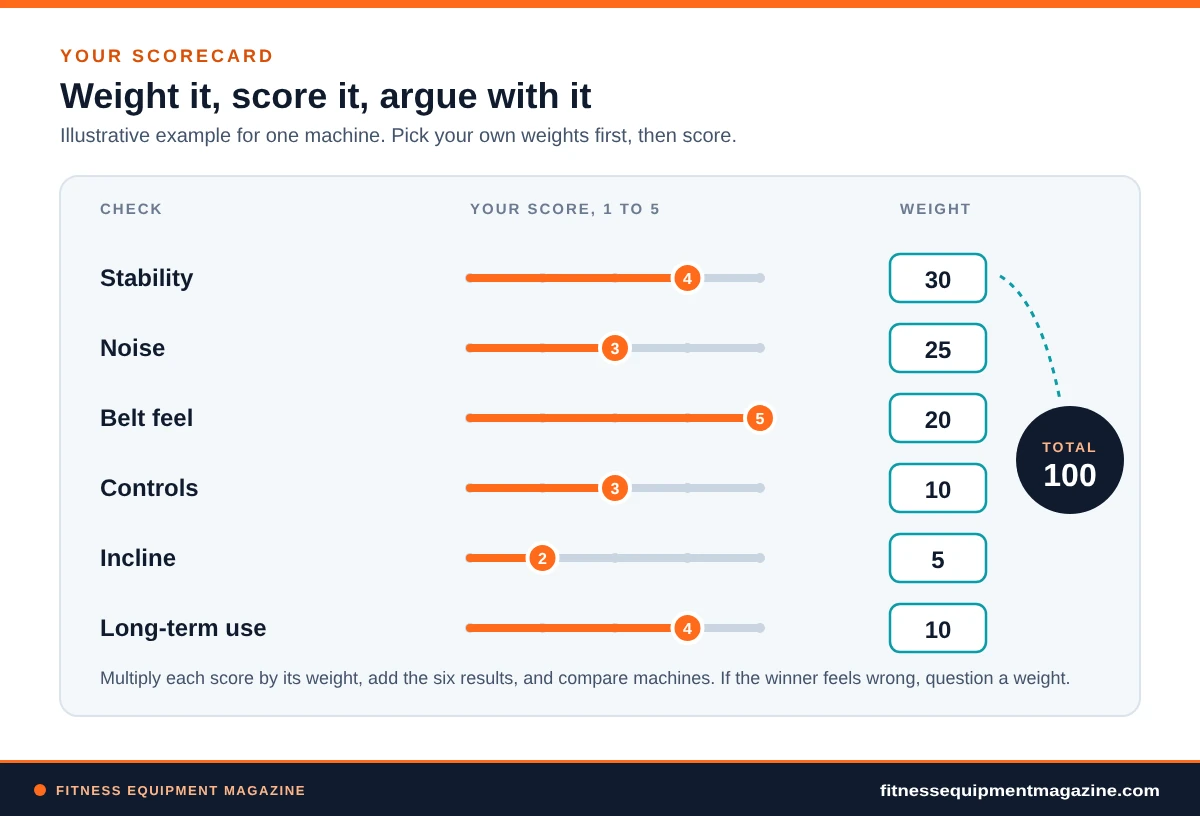
Take a sheet of paper. Write the six buckets down the side. Assign 100 points across them according to your life, not ours. Then, for each machine on your shortlist, mark a score from one to five using what you saw in the store and in the specs. Multiply, add up and compare.
The totals will matter less than the arguments they provoke. If the top scorer feels wrong, ask which bucket is lying. Often it’s a weight that doesn’t reflect what you really care about. That’s useful, and it’s cheaper to learn at the kitchen table than in the garage. If budget is the tight constraint, our budget treadmill features guide shows which buckets to protect first.
Questions About How We Test Treadmills
Does how we test treadmills involve physically using the machines?
No. We haven’t hands-tested the machines our guides describe, and we say that on every page. How we test treadmills is research-based: we analyze manufacturer specification patterns, read federal safety sources, study the ownership problems buyers report repeatedly and run each draft through a fact-review checklist. That approach has real limits, because it can’t feel a belt or measure a sound. It also keeps us from inventing results. If we ever add hands-on measurement, we’ll publish the protocol first.
What does how we test treadmills actually involve?
It involves a five-step pipeline. First we gather and normalize specifications. Next we check CPSC recall and safety information. Then we look for repeating owner complaints, and after that we run a fact-review checklist on every number and claim. Finally, we publish with a “last reviewed” date and schedule a recheck. Each step leaves a written note, and a guide can’t skip one to meet a deadline. The result is a consistent framework, not a lab report.
What six checks sit at the core of how we test treadmills?
We sort what matters into stability, noise, belt feel, controls, incline and long-term use. Together they cover how a machine behaves under you, around you and over the years. The weights shift with the shopper: an apartment walker leans on noise and low-speed belt feel, while a garage runner leans on stability and durability. We encourage you to write your own six weights before shopping, since your priorities will rarely match anyone else’s.
Can I trust a treadmill review that lists decibel readings?
Only if it explains how they were measured. A useful number comes with a method: the meter type, the distance, the speed, the room and whether anyone was walking on the belt. Without those details, a decibel figure is decoration. Noise also depends on your floor, so a reading from a showroom or a basement may not predict what a downstairs neighbor hears. Treat unexplained numbers as marketing and run your own listening check instead.
How do I apply how we test treadmills to stability in a store?
Stand beside it with both hands on the rails and push firmly side to side and front to back. Watch the frame and console, not just the base. Then step on, belt stopped, and shift your weight from foot to foot. Finally, run it at your real pace for a minute. A little give in a folding frame can be normal, but rocking, clunking or a swaying console is a reason to keep looking.
Do affiliate links change what you recommend?
Our standard is that they shouldn’t, and the structure helps. Some links on this site may be affiliate links, so if you buy through them we may earn a commission at no extra cost to you. Our guides describe machine types and criteria rather than paid placements, and we name no brands or product prices. A recommendation to wait, or to buy the simpler option, is as welcome as any other. If you think a page falls short of that, tell us.
What should I do if my treadmill is recalled?
Stop using it and follow the instructions in the official notice. The CPSC exercise equipment page lists current recalls and explains remedies, which commonly include repair kits, refunds or replacements. Because the list changes, search by your exact model name and number. It also helps to register your machine with the maker when you buy it, so notices reach you directly. Recheck the page once a year, even if nothing seems wrong.
How often is how we test treadmills updated?
We review it on a schedule and whenever how we test treadmills changes. The “last reviewed” date near the top tells you when it was last checked, and meaningful changes are noted. The same applies to our treadmill guides, where specifications, warranties and recalls move faster. If something looks stale or wrong, a reader report is the quickest way to get it fixed.
Bottom Line: How We Test Treadmills, and How You Should
The short version of how we test treadmills is that we research, we label our evidence and we hold back where we have no right to claim more. That is a smaller promise than “tested in our lab.” It’s also one we can keep, which is rather the point.
The better test is yours. Measure the running surface, shake the frame, start the belt at its slowest speed, pull the safety key and listen. Write down what you find and read the return terms before you pay. Those ten minutes will tell you more about your future treadmill than any star rating can.
- Write your six weights.Stability, noise, belt feel, controls, incline and long-term use, adding up to 100.
- Shortlist with the guides.Start with best treadmills for home use, then dig into specs with the treadmill buying guide.
- Check CPSC for each finalist.Search the exact model on the recall page, and read the warranty.
- Run the store routine, or the home trial.Keep the log, and decide before the return window closes.
General activity guidance, including what counts as aerobic activity, is in the HHS Physical Activity Guidelines. We leave advice about your own body to you and a qualified professional, and pick machines that make regular movement easier to repeat.
Sources and Further Reading
- U.S. Consumer Product Safety Commission: exercise equipment recalls and safety information — the live list to search by model before and after you buy.
- HHS Physical Activity Guidelines for Americans — general federal activity guidance for adults.
Editorial note: some links on this site may be affiliate links. If you buy through them we may earn a commission at no extra cost to you; recommendations are based on the criteria in the article, not payout. This page describes our research process and does not report hands-on lab testing. Specifications, warranties and recalls change, so verify current details with the manufacturer and the CPSC before buying. General activity information is not medical advice.