Choosing a treadmill for seniors is mostly a question of what happens in the two seconds before and after the walking: stepping on, steadying yourself, reaching for something solid, and stepping off. A machine that is fine for a confident 30-year-old jogger can feel wobbly, tall and twitchy to someone who simply wants a safe, predictable indoor walk. The good news is that the features that make a treadmill for seniors easier to use are concrete, visible on a spec sheet or in a showroom, and rarely the expensive ones.
This guide is about equipment, not medicine. We look at step-up height, handrail length and placement, very low starting speeds, gentle belt starts, safety keys and auto-stop, deck width, console readability, frame stability and the room around the machine. Wherever a health question comes up, the right person to answer it is your own clinician or a physical therapist. We say so often, because it is true. For the wider shopping picture, our guide to the best treadmills for home use covers every machine type.

Quick answer: what to look for in a treadmill for seniors
The short answer
The best treadmill for seniors is usually a stable, full-length-handrail walking machine with a low deck, a starting speed of 0.5 mph or lower, fine speed steps and a magnetic safety key. Stability and something solid to hold beat motors, screens and programs every time. Folding walking pads rarely have handrails, so they suit fewer people in this group.
- Who it fits: older adults and anyone with balance or mobility concerns who want a predictable indoor walking option, ideally after checking with their clinician.
- The big tradeoff: a heavier, handrail-equipped frame takes more floor space and often costs more than a slim pad. In return, you get something to hold on to.
- Do before buying: try the step-up in person if you can, measure the room including rear clearance, and search the CPSC recall list for the model.
How we researched this guide
How we researched this. This guide to the treadmill for seniors is research-based. It draws on manufacturer specification patterns, federal activity guidance and the problems owners commonly report. We have not hands-tested any machine, and we name no brands or models on purpose.
Treat every number as a typical range, then confirm it on the manufacturer’s spec sheet. Some links on this site may be affiliate links. If you buy through them we may earn a commission at no extra cost to you. Recommendations are based on the criteria in the article, not payout.
General information only
Nothing here is medical advice, a diagnosis or a rehabilitation plan. If you have dizziness, heart or lung conditions, joint problems, balance concerns, a history of falls or take medication that affects alertness, talk with your clinician or a physical therapist about exercise and about the equipment itself before you start.
How current is this?
Last reviewed: October 2026. Specs, prices, warranties and recalls change. Before you buy any treadmill for seniors, check the seller’s current terms and search the CPSC exercise equipment recall list for the exact model name.
What is inside this guide
Who this guide is for, and what it cannot do
Older adults are a huge and varied group. A 68-year-old who hikes on weekends and an 84-year-old who uses a cane indoors have almost nothing in common as treadmill shoppers. So we avoid the word “frail” and we avoid assumptions about ability. What we do is describe equipment features and let you match them to your own situation.
The readers we have in mind
Think of three groups. First, people who walk well and want weather-proof, private exercise at home. Second, people who walk steadily but feel less sure on moving surfaces, uneven steps or when turning. Third, family members shopping for a parent or partner, who want to know what a sensible, low-drama machine looks like before they spend money.
Anyone in these groups may be looking for the same list: a treadmill for seniors that holds still, starts gently, offers something to grab and stops quickly when asked. That is the list we build below.
What a buying guide cannot do
We can describe features. We cannot tell you whether a treadmill is appropriate for you, how fast you should walk, how long a session should be or what to do about symptoms. Those are clinical questions. A physical therapist can watch you walk, check your balance and suggest whether a treadmill, a stationary bike or a seated option fits better.
If you see a claim anywhere, including on retailer pages, that a treadmill will prevent falls, fix balance or treat a condition, treat it as marketing. Equipment can be easier or harder to use safely. It cannot promise outcomes.
A useful first conversation
Bring a short list to your appointment: the machine type you are considering, its handrail layout and the room you plan to use. Ask what a safe starting routine looks like for you, and whether anything about your health makes a treadmill a poor fit.
Why choose a treadmill for seniors at home
People reach for a home treadmill for ordinary reasons. Winter sidewalks are icy. The summer afternoon is too hot. The street has no flat stretch, or the walker simply prefers not to be watched while building a routine. A treadmill gives a flat, predictable surface and a bathroom close by.
The activity context
Federal guidance describes how much physical activity adults, including older adults, are generally encouraged to get each week, and it notes that older adults should adjust to their own abilities and conditions. The HHS Physical Activity Guidelines are the right starting reference. They also mention balance-focused activity as part of a varied week, which is a topic for your clinician rather than for an equipment guide.
What matters for shopping is simple. Whatever amount of walking you and your clinician settle on, the machine should make that walking feel steady rather than stressful.
Treadmill versus the street
A treadmill for seniors is not a replacement for fresh air. Walking outside brings sunshine, neighbors and varied terrain. Walking indoors brings control: no curbs, no traffic, no weather, and a handrail you can grab within an arm’s reach. Neither is better in general. Many people use both, depending on the season.
One honest drawback of the indoor version is that a belt moves under you. Your feet must match its pace. That is exactly why speed control, the safety key and the rails get so much space in this guide.
The mindset we recommend
Shop slowly. Rushing a purchase around a holiday sale is how people end up with a tall, fast, handrail-free machine in a spare room. A treadmill for seniors should be chosen the way you would choose a good armchair: sit on it, try it, and walk away from anything that feels precarious.
Step-up height and the first foot on the belt
On any treadmill for seniors, step-up height is the vertical distance from the floor to the surface you stand on at the side of the belt. It is rarely printed on a product page, yet it shapes every single session, because you climb it at the start and descend at the end.
What counts as a low step-up on a treadmill for seniors
Typical home treadmills put the side rails roughly 6 to 10 inches above the floor, and some taller, more heavily built frames sit higher. Slim, low-profile designs can be a few inches lower. Those numbers are commonly seen ranges, not promises, so verify the figure for the exact model, or measure it in a showroom.
Lower is generally easier to step onto. However, lower is not automatically safer. A very low deck with no handrails removes the climb and removes the support at the same time.
How to check step-up height before buying a treadmill for seniors
Ask the seller for the deck height or the side-rail height from the floor. Online listings sometimes bury it under “dimensions”. If it is missing, treat the silence as information. Then compare it with a stair riser in your own home, which is commonly around 7 inches. If the treadmill step is clearly higher than a stair you manage comfortably, think twice.
- Find the floor-to-side-rail height in the manual or the dimension drawing.
- Compare it with a stair step you already use without trouble.
- Check whether the side rails are flat and wide enough to stand on securely.
- Confirm that both rails sit at the same height, with no lip or bump.
The tradeoff most listings skip
Some compact decks achieve their low height by sacrificing cushioning travel, motor size or handrails. A low-profile design can be great for a steady walker with a clear plan. Still, for anyone who wants to hold something while stepping on, a slightly taller, sturdier frame with real rails may be the safer pick. Neither is wrong. The right choice depends on you, which is why a quick trial in a store beats any article.
Handrails: length, height and grip reach
For a treadmill for seniors, handrails are the single most important feature after the frame itself. They give the hands a fixed reference while the feet deal with a moving belt. Yet “has handrails” tells you very little. Length, height, thickness and where they stop all matter.
Long rails beat short stubs on a treadmill for seniors
On a treadmill for seniors, look for side rails that run from the console area back along most of the deck, ideally to around the rear third. Short rails that end near your hips leave you reaching forward and leaning when you want to steady yourself mid-stride. Long rails let you hold on while stepping on at the back of the belt, which is where most people begin.
A front rail across the console is a useful extra. It gives a place to rest both hands, but it should not replace the side rails. Reaching up and forward to a console bar pulls the posture out of line.
Height and grip
The comfortable height is roughly where your hands land with elbows slightly bent and shoulders relaxed, commonly around waist to lower-rib level for many adults. Taller or shorter walkers differ, so test it. Adjustable-height rails are rare on home machines, which makes fit in a showroom worth the trip.
As for the grip itself, a round tube about as thick as a broom handle, with a textured or foam-covered surface, tends to be easier to hold than a thin metal bar. People with arthritis or reduced grip strength may prefer a wider, softer profile. If you have hand or wrist concerns, mention them to your clinician.
Rails are for balance, not for leaning
One habit deserves a clear note. Holding the rails lightly to steady yourself is a normal use. Gripping hard and leaning your weight onto them changes your gait and can be tiring. If you find yourself clinging, the speed is probably too high, or the machine is a poor fit. A physical therapist can help you work out which.
Check the welds and bolts
Before the first walk, push down and sideways on each rail with your full body weight, with the machine off. Nothing should flex, creak or shift. Loose rail bolts are one of the easiest problems to catch early and fix with the correct tool and the manual’s torque notes.
Speed control: low starts and fine steps
Belt speed is where the “ease” of a treadmill for seniors shows up in numbers. Two specs matter: the slowest speed the machine can run, and how big each step is as you adjust.
The minimum speed on a treadmill for seniors
Many full-size treadmills start at 0.5 mph, and some begin at 0.1 to 0.3 mph. Others bottom out at 1.0 mph, which can feel brisk for someone who walks slowly or who wants a gentle warm-up. A very low starting speed gives you time to step on, find your rhythm and decide whether to go faster.
Keep a sense of scale. A relaxed indoor stroll is often described as roughly 2 mph, and a lot of people settle between 1 and 3 mph. Your own comfortable pace is individual, and your clinician can suggest one.
Fine steps versus coarse jumps
Now the detail many listings omit. On some machines each tap of the speed button raises the belt by 0.1 mph. On others a single quick-key jumps the belt by 0.5 mph or a full mile per hour. A coarse jump can be startling when you are mid-stride and holding the rails.
Fine adjustment in 0.1 mph steps is gentler and gives more control. Look for physical buttons you can press confidently, ideally with a slow-then-fast hold behavior. A touchscreen that needs precise taps while the belt moves is a weaker choice for this purpose.
Ramp-up and speed memory
Two smaller details help. First, some treadmills let you set a maximum speed or lock it, which suits a shared household. Second, a machine that remembers the last speed can restart too quickly if that was brisk. Prefer one that always starts from its lowest setting. Check the manual for the start behavior, because it is rarely advertised.
Belt start, safety key and auto-stop
The moments when a belt starts and stops deserve more attention than the walking between them. A good treadmill for seniors starts gently and stops without drama when something goes wrong. Three features work together here.
A gentle belt start
Some consoles begin with a short countdown, then ramp the belt up slowly from a standstill. Others start at the last-used speed, or leap straight to a pre-set pace. You want the first behavior. Manuals sometimes describe the start sequence in a line or two, and a showroom demo will show it in seconds. If the belt starts with a jerk, walk on.
It also helps to start from a standing position on the side rails, with both hands on the rails, and step onto the belt only once it is moving at the lowest speed. We walk through that sequence below.
The safety key or clip
Nearly every treadmill includes a safety key, a small magnetic fob that plugs into the console and attaches to a clip on your clothing by a cord. If you move too far back, the key pulls free and the belt stops. It is simple and it works only if you actually wear it.
For this reason, look at the details. Is the key easy to see and easy to seat? Is the cord long enough to reach your waistband without tugging while you walk, yet short enough that it pulls out if you drift backward? Is the clip strong enough to hold on a loose shirt, and easy for arthritic fingers to fasten? Little things, big difference.
Auto-stop and the big red button
A prominent stop button is the second safeguard. It should be large, red, easy to hit with an open palm and unmistakable. Some machines add an “auto-stop” that halts the belt after a period without detected use, or after the key is removed. Not every model has this, so ask. The manual will say what the belt does after it stops, how quickly and whether it coasts.
Safety habit
Wear the clip every single session, even on slow days and even when someone else is in the room. A safety key you keep in a drawer protects nobody. If you use a cane or walker elsewhere in the house, park it where you can reach it when you step off, but never on the belt side.
Deck width, side rails and belt surface
The walking surface is another place where small differences add up. A treadmill for seniors does not need a marathoner’s long deck, but it does need room for a natural stride and a margin for error.
Belt width and length
A treadmill for seniors benefits from a belt that is not cramped. Belt widths commonly run from about 16 inches on compact machines to 20 inches or more on full-size ones, and lengths from roughly 45 to 60 inches. A wider belt gives you a margin if your path wanders a little to one side. A belt that is too narrow forces your feet near the edges, which is the worst place to be. Our explainer on treadmill belt size and stride length shows how to match the dimensions to your height and walking pace.
For most walkers, a belt around 18 to 20 inches wide and 50 inches long or longer is a comfortable target. Shorter people with a short stride can manage a little less. When in doubt, take the wider option.
Non-slip side rails and stand-on platforms
The platforms beside the belt are where you stand before and after walking. They should be wide enough for your whole foot, textured and level with each other. Smooth plastic that gets slippery with sweat or socks is a quiet hazard. Wear sturdy, closed, flat-soled shoes whatever the platform surface looks like.
Belt surface and cushioning
A belt with a lightly textured top gives consistent grip. Cushioning is a comfort feature, and many people like the softer feel, but a deck that is extremely springy can feel unstable underfoot. Moderate is fine. Ask the seller how the deck feels underfoot, and try it if you can.
Console, frame and incline: the quiet details
Once handrails, speed and stopping are covered, a handful of smaller features decide whether a treadmill for seniors feels calm or fussy day after day.
A readable, forgiving console
Large digits, high contrast and a clean layout matter more than program counts. Look for speed displayed in numbers at least about an inch tall, big buttons with clear labels and a “quick start” that does not require a menu. A console that needs three taps and a swipe to begin walking is a trap for anyone who is already concentrating on balance.
Avoid, if you can, setups where the main controls live on a tablet you mount on the console. Fiddling with a screen while on a moving belt is the opposite of what you want.
Frame stability and quiet running
On a treadmill for seniors, a heavier steel frame with wide feet and levelers resists rocking. Weight capacity matters even if you are well below the number, because a higher rating usually signals a sturdier build. A machine that wobbles when you grip the rails is wrong for this purpose, full stop. Quiet operation matters too, since a clattering belt or a loud motor is distracting and makes it harder to hear a spouse, a phone or a knock at the door. For the wider picture of how machines differ, see our complete treadmill buying guide.
Incline: optional, and restrained
Many treadmills offer incline, and few buyers of a treadmill for seniors need it. If you do want it, choose a machine whose incline changes in small steps, moves smoothly and stays at the chosen angle with a clear display. Always return to flat before stepping off. Ask your clinician before using incline at all.
Showroom test
Stand beside the machine and put your weight on the handrails, then shake them side to side. Next, step on and off a few times with the belt stopped. If the frame moves, or the step feels awkward, you have your answer before you ever read a review.
Setting up the room for a treadmill for seniors
The machine is only half the story. The floor, the light and the space around it decide whether a perfectly good treadmill for seniors stays safe in daily life. Most of this is cheap, and all of it is boring in the best way.
Clearance at the sides and rear
Manufacturers commonly ask for about 2 feet of free space on each side and roughly 6 feet behind the belt, though your manual’s figure rules. That rear zone matters because it is where you would end up if you stepped off the back. It should be empty: no furniture, no boxes, no pets’ beds, no shelves with sharp corners.
The side space lets someone step beside you, and it lets you get on and off the side platforms without squeezing past a wall. If a side clearance is tight, choose the side you step off to and keep that one wide. Headroom matters less for walking than running, but check the ceiling if you use incline.
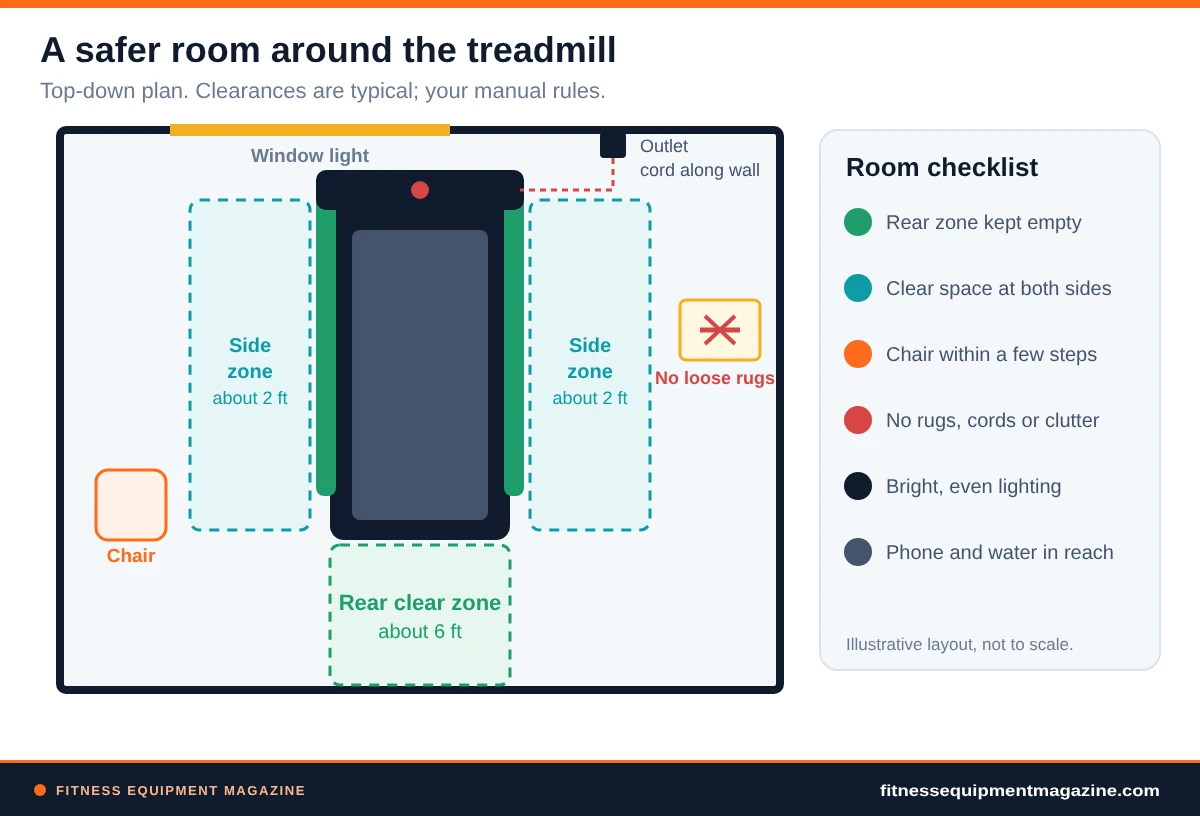
Flooring and no loose rugs around a treadmill for seniors
A level, hard floor, such as sealed hardwood, vinyl or low-pile carpet, usually supports a treadmill best. Put a dense rubber equipment mat under the frame to protect the floor and reduce vibration, and make sure the mat lies completely flat. Remove loose rugs, runners and cords from the area. A curled rug edge near the treadmill is a classic trip hazard.
Plug the machine into a suitable outlet with the cord routed along the wall and out of any foot path. Avoid extension cords unless the manual allows them. If a long cord must cross open floor, tape it down flat or use a cord cover. And never leave a cord where you step off.
Lighting and what is within reach
Good lighting is unglamorous and powerful, and it costs little. Bright, even light from above or in front, with no glare on the console, helps you see the belt edge, your feet and the display. A night-light along the path from the bedroom helps for early sessions. Keep a phone, a water bottle and a small towel on a stable shelf or table within arm’s reach, not on the rails.
- A sturdy chair within a few steps of the side platform, for sitting after the walk.
- A phone or alert device within reach, in case you want to call someone.
- Water nearby, in a spill-resistant bottle that fits a holder.
- A clear floor path from the treadmill to the nearest doorway.
Temperature and clothing
Choose fitted but not tight clothing, and avoid long hems, loose scarves or drawstrings that could catch on the belt or rails. Keep the room comfortably cool. A fan beside the machine, not in the foot path, helps many people feel more comfortable, but check that its cord is out of the way.
Getting on, walking and getting off a treadmill for seniors
The mounting routine is where a good treadmill for seniors earns its keep. Here is a calm, repeatable sequence that many manuals and fitness professionals describe in similar terms. It is general information, so adapt it with your physical therapist.

Starting the session
- Check the belt and the pathWith the machine off and the key out, look at the floor around it, then at the belt for anything on it. Confirm the incline is flat and the console is awake.
- Hold the rails and stand on the side platformsFace forward with a foot on each platform, straddling the belt. Never step onto a belt that is already moving at speed.
- Clip the safety key on and start at the lowest speedSeat the key, attach the clip to your waistband, then press start. Let the belt reach its gentle starting pace.
- Step on, one foot at a timeKeep your hands on the rails, place one foot on the moving belt, then the other, and walk. If the pace feels fast, press stop and begin again.
While you walk
Look ahead, not down. Keep your stride natural, with heels landing first and your torso upright. Hold the rails lightly or swing your arms if your clinician has said that is fine for you. Talk a little as you go. If you cannot say a short sentence, slow down, and if anything feels wrong, stop and sit.
Avoid turning your head to look behind you, reaching for objects or checking your phone mid-stride. Those are the moments when feet drift. If you want to watch television, place the screen straight ahead at eye level.
Ending the session
First, slow the belt gradually to the lowest speed. Next, hold the rails, step with both feet back onto the side platforms and wait for the belt to stop. Remove the key. Then step down, one foot at a time, to the floor. Sit for a moment if you feel at all light-headed.
Many falls around exercise equipment happen at the end, when a person feels finished and hurries. Slow down at the finish line. It costs you ten seconds.
When to stop right away
Stop, hold the rails and sit if you feel dizzy, short of breath in a way that is unusual for you, chest discomfort, sharp pain, or unsteadiness. Seek medical help for anything that worries you. These are not equipment questions, and a buying guide cannot judge them.
Keeping the machine safe over time
A treadmill for seniors that was safe on delivery day can drift out of shape. Belts stretch, bolts loosen and lubricant wears off. A few minutes each month keeps the machine predictable, and predictable is what you want.
A short monthly check
- Wipe the belt, side platforms and handrails, then dry them. Sweat and dust make surfaces slick.
- Shake each handrail and the console mast with the machine off. Report any movement to the seller.
- Look at the belt. It should run centered, without slipping, hesitating or rubbing the sides.
- Inspect the power cord and plug for kinks, heat marks or damage.
- Test the safety key by starting the belt and pulling it free. The belt must stop.
What the manual decides
Belt lubrication, tension and alignment vary by model. Some belts need periodic lubricant and others come sealed. Follow the manual rather than a video about a different machine. If you cannot do something safely, because it needs lifting, bending or tools, ask the manufacturer, a technician or a family member. Do not improvise.
Unplug the treadmill before any cleaning under the hood, and never use a wet cloth on the console. If the belt slips, the motor smells hot or the display flickers, stop using the machine and call for service. A strange noise on an ordinary treadmill is an inconvenience. On a treadmill for seniors that you grip for balance, it is a reason to pause.
Keep a log
Write the model number, serial number, purchase date and warranty terms on a card taped inside a cabinet. Add the date of each monthly check. If a recall appears later, you will know within a minute whether it applies.
Supervision, support and when to pause
Some people want company the first few times they use a treadmill for seniors. Others want to be left alone. Both are reasonable, and neither says anything about ability. What matters is deciding in advance, not in the moment.
Having someone nearby
Having a partner, friend or family member in the next room, or at least aware that you are walking, is a sensible habit. For the first sessions, many people like a helper standing beside the machine, not behind. Agree on a plain signal: “stop” means stop, with no debate. A helper should never grab the person or the belt. Their job is to hit the stop button and hold out a hand.
If you live alone, tell someone your walking times and keep a phone within reach. Some people use a wearable alert or a smart speaker to call for help. These are personal choices, and none replace the safety key.
Working with a professional
A physical therapist or qualified exercise professional can look at your gait, your balance and the machine itself. They may suggest a particular handrail style, a routine or alternatives such as a recumbent bike. Bring the spec sheet and photos. Ask them about pace, duration and what signs mean you should pause. It is common for a single visit to answer questions that cost hours online.
If the treadmill has been bought for someone else, include them in the choice. Surprise machines tend to go unused, and nobody should be talked into equipment that scares them.
Reasons to pause and reassess
Pause the treadmill plan and talk with your clinician if you have a new health issue, a fall, a change in medication, or a stretch of poor sleep that leaves you foggy. Also pause the machine if it develops a new noise, a belt that slips or drifts, a hot smell or a loose rail. Equipment problems are safety problems.
Small wins
The most successful routines are dull. Same time, same shoes, same short warm-up, same careful stop. A calm, repeatable ritual leaves less room for surprises, and it frees attention for the walk itself.
Pads, folders and full-size machines compared
Not every shopper needs a full-size frame. Still, each machine type has strengths and weaknesses for this audience, and the biggest is whether there is something to hold on to.
Walking pads versus a treadmill for seniors with rails
Slim walking pads are popular for apartments and desks. Most have no handrails at all, and many start at 0.5 mph or faster and are controlled by a remote or a phone app. That can be fine for a steady walker with excellent balance and a clear floor. For anyone who wants a rail to grab, it is a poor match. If you are curious, our guide to the best walking pads for home and office explains the category, and the comparison of a walking pad versus a treadmill shows where each one fits.
Why a pad can be less suitable
No handrails means nothing to steady you when you step on, off or if you stumble. Remote controls can be misplaced, and apps add taps. Some pads also use a lower, lighter frame that can slide on slick floors. If you like a pad, a physical therapist can tell you whether it works for you.
Folding treadmills
A folding treadmill for seniors saves space, and some include real handrails. The catch is that folding hinges add moving parts, and lighter folders may feel less planted. Check whether the fold mechanism has a latch you can operate without bending or lifting a heavy deck. Our folding treadmill guide goes through lift assists, latch types and storage footprint. For this audience, a fixed frame is often a calmer choice if space allows.
Full-size, fixed-frame walkers
This is the type most people mean when they picture a treadmill for seniors: heavier, with long rails, a wide deck, a bigger motor than you strictly need and steadier behavior. It takes more room and costs more. In return, it feels planted, which is the whole point. Our guide to the best treadmill for walking compares this kind of machine against runners’ decks and compact options.
Other choices worth mentioning
A treadmill is not the only indoor option. Stationary bikes, recumbent steppers and seated machines remove the balance demand completely. They are worth raising with your clinician. Honest advice sometimes means saying that a treadmill is not the best fit.
The feature priority ladder
With so many features, it helps to rank them. When budget or space forces trade-offs on a treadmill for seniors, protect the top rungs first and give up the lower ones without guilt.
Why this order
A frame that moves under your hands defeats everything else. Rails come next because they give you a place to hold. After that, the safety key and stop button make errors survivable, and the speed controls make small adjustments easy. Step-up and deck width are comfort and margin. A readable console reduces fumbling. Apps and programs come last, because a treadmill for seniors is a tool for calm walking, not a gadget showcase.
Shopping checklist and questions to ask
Evidence note. The checklist below is built from specification patterns and commonly reported ownership issues. We have not tested machines. Verify every item with the seller and the manual.
Print this section or screenshot it. Whether you shop in a store or online, the same questions apply to any treadmill for seniors. Retail staff are used to detailed questions, and a good seller will answer without fuss.
Ten questions for the seller
- What is the step-up height?Ask for the floor-to-side-rail measurement in inches.
- How long are the side handrails?Look for rails that run most of the deck.
- What is the lowest speed, and the speed step?Seek 0.5 mph or lower, with 0.1 mph increments.
- How does the belt start?Ask for a slow ramp, not a jump to the last speed.
- Where is the safety key, and how does it attach?It should seat easily and stop the belt when removed.
- What does the stop button do?A large, red, easy-to-hit button is the standard.
- How wide and long is the belt?Look for 18 inches or more across, if space allows.
- How heavy is the frame, and what is the weight capacity?More mass and a higher rating signal stability.
- What are the return, delivery and assembly terms?Ask whether the seller will place it in your room and take away the box.
- What does the warranty cover?Frame, motor, parts and labor are often covered for different periods.
Delivery, assembly and service
Heavy machines arrive in heavy boxes. If lifting is a concern, ask about white-glove delivery that includes carrying it to the room, assembling it and checking it over. Assembly errors, such as loose handrail bolts, are a safety matter on this type of machine. The best treadmills for home use guide covers delivery and warranty in more depth.
Look up the recall history too. The CPSC exercise equipment recall list is searchable and free. Do it before you buy new, and certainly before you buy used.
A word about budget
Spend on frame, rails and controls, not on a screen. A moderately priced machine with heavy steel and long rails is usually a better buy for this purpose than a flashier one with thin tubing. If money is tight, protect the safety features here first and trim everything else.
Three hypothetical shoppers
These are invented profiles, not real people or case studies. They show how the ladder can play out.
Profile A
The steady walker
A retired teacher, confident on her feet, wants a winter walking option. Her priorities: a quiet motor, a readable console and a clear floor. A mid-size fixed frame with long rails and a low start speed fits. She still checks the recall list and asks her doctor about a starting routine.
Profile B
The cautious returner
A man in his seventies, back from a long break, feels unsure on moving surfaces. He tries machines in a showroom and picks the one with the lowest step-up and the longest rails. A physical therapist helps him design a short, gentle first routine.
Profile C
The adult child
A daughter is shopping for her father, who dislikes gadgets. She values a console with three big buttons, a magnetic key and delivery with assembly. She includes her father in the showroom visit so the final pick is his.
Mistakes and myths to skip
Many mistakes come from assumptions. Here are the ones we see most in discussions of any treadmill for seniors.
Common mistakes
- Buying a handrail-free walking pad because it is cheap and small.
- Ignoring step-up height until the box is in the hallway.
- Choosing a console with only a touchscreen.
- Leaving the safety clip off because “I’m only going slowly”.
- Putting the machine in a room with a loose rug, a low table or a tight rear space.
- Skipping the doctor or physical therapist conversation.
Myths worth retiring
“A slower belt is always safer.” Not necessarily. Very slow speeds can feel awkward for some walkers, and a comfortable pace is individual. “A bigger motor makes it safer.” Motor size has little to do with fall risk; frame stability and rails matter more. “Older adults need a special machine.” Not exactly. They need a well-chosen standard machine, with specific features, in a well-prepared room.
And one more: “If I hold the rails firmly, I can’t fall.” Holding on helps, but hard gripping changes gait and is no substitute for a sensible speed and clear floor.
Treadmill for seniors: frequently asked questions
Choosing a treadmill for seniors
What is the best treadmill for seniors?
There is no single best model, but a good treadmill for seniors has a stable frame, long sturdy handrails, a low minimum speed, fine speed steps, a magnetic safety key and a big stop button. Choose the one that feels most planted in a showroom, and confirm every spec with the seller. Ask your clinician or a physical therapist whether a treadmill suits you at all.
Are walking pads safe for older adults?
Some older adults use walking pads happily, but most pads have no handrails, which removes the main source of support. That makes them a weaker fit when balance or mobility is a concern. A physical therapist can advise. If you do choose a pad, keep it on a flat, non-slip floor with plenty of clearance and wear the safety key if one is supplied.
Speed and step-up on a treadmill for seniors
What speed should an older adult start at?
That is a question for your clinician, not for us. In equipment terms, a treadmill for seniors that begins at 0.5 mph or lower, with 0.1 mph steps, gives you room to find a comfortable pace. Many people walk between 1 and 3 mph, but individual comfort and health vary widely, so let a professional set the plan.
How low should the step-up height be?
There is no official number, but lower is generally easier. Many home treadmills sit roughly 6 to 10 inches above the floor. Compare the figure with a stair you already use comfortably, such as the 7-inch riser many homes have. Also check that the side rails are wide, level and textured so you can stand securely before you step onto the belt.
Handrails and safety features
Do I need a treadmill with handrails on both sides?
For most people looking for a treadmill for seniors, yes. Two long side rails let you steady yourself with either hand and step on from either side. A machine with only a front console bar is less supportive. If you need a rail on one side only, say because of a wall or a hand injury, talk with a physical therapist about positioning.
What safety features matter most on a treadmill for seniors?
The magnetic safety key, a large stop button, a gentle belt start and a stable frame matter most. Add long handrails, a readable console and non-slip side platforms. Then look at the room: a clear floor, good light and no loose rugs. Equipment features reduce risk but cannot remove it, so supervision and a sensible routine still count.
Folding, health and your doctor
Is a folding treadmill a good idea for older adults?
It can be, if the fold mechanism is easy to operate and the unfolded machine feels solid. Check the latch, the lift assist and the rail design. Avoid any folder that requires lifting a heavy deck. If you have the room, a fixed frame is often calmer. The folding treadmill guide on this site compares the options in detail.
Should I talk to a doctor before using a treadmill?
Yes, especially if you have a health condition, take medication, have had a fall or have not exercised for a while. A clinician or physical therapist can advise on how much and how fast to walk, what warning signs to watch for and whether another type of equipment would suit you better. We provide general information only.
Conclusion: choosing a treadmill for seniors with confidence
The right treadmill for seniors is not the fastest, flashiest or cheapest. It is the one that stays put under your hands, starts gently, stops reliably and sits in a room you have prepared on purpose. Rank the features, protect the top rungs and be honest about what you need.
Your next steps are straightforward. Talk to a clinician or physical therapist, then visit a showroom with the checklist above. Measure your room, search the CPSC list, and choose the machine that feels most planted. For federal context on weekly activity, revisit the national guidance for older adults mentioned earlier. Then take that first careful step, with the clip on.
Sources and further reading
- HHS Physical Activity Guidelines — general federal activity context for adults and older adults.
- U.S. Consumer Product Safety Commission: exercise equipment recalls — search recalls by brand and model before buying new or used.
- ACSM top fitness trends for 2026 — background on why home cardio equipment stays popular.
- Manufacturer spec sheets, owner’s manuals and warranty documents — the final authority on step-up height, speed steps and safety-key behavior for any specific machine.
Some links on this site may be affiliate links. If you buy through them we may earn a commission at no extra cost to you; recommendations are based on the criteria in the article, not payout. This guide to the treadmill for seniors offers general information, not medical or electrical advice. Specs, prices, warranties and recalls change, so verify before you buy. Last reviewed: October 2026.