The best budget treadmills aren’t the cheapest machines with the longest feature list. They’re the ones that spend a limited amount of money on the parts you’ll feel every single workout, then refuse to pay for the rest. That sounds obvious, yet most budget listings are built to make you do the opposite.
Picture the shopping tab you probably have open right now. One machine boasts a huge touchscreen, a “peak” horsepower figure that sounds like a pickup truck, and fifteen preset programs. The next one looks plain and costs a bit more. Which one will still feel solid in eight months? That one question sorts the best budget treadmills from the merely cheap. Usually the plain one, and this guide explains why, with enough detail that you can check the claim yourself.
The short answer
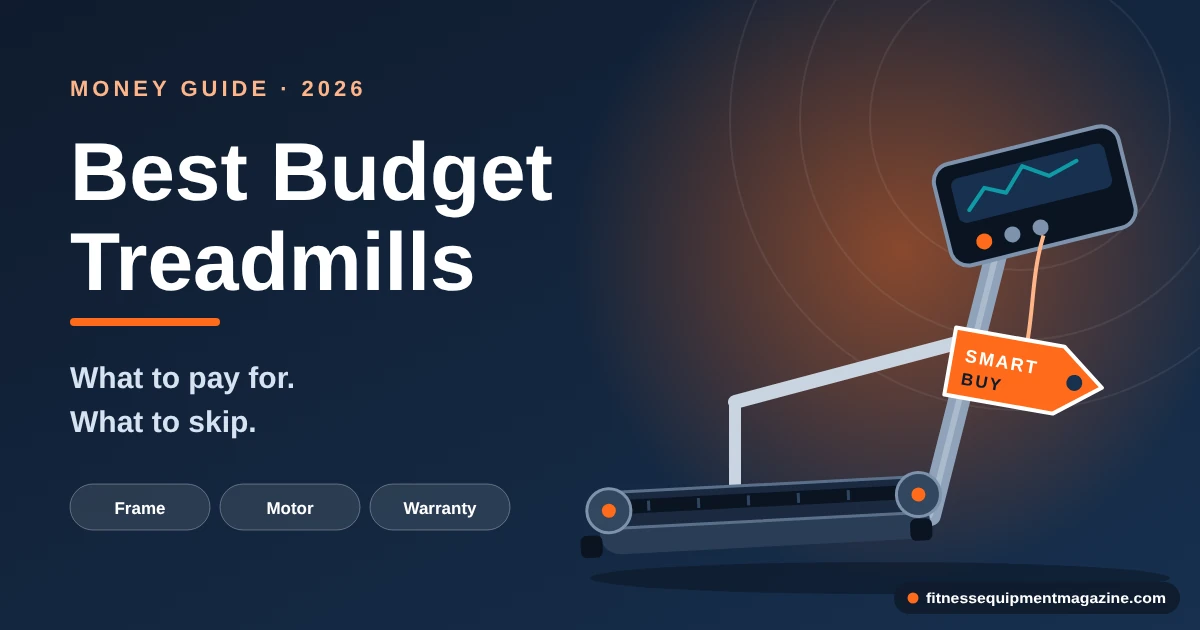
To land on the best budget treadmills, put your money into frame stability, a continuous-duty motor that suits your actual speed, a deck that fits your stride, a warranty you can read in under two minutes, and working safety features. Save on touchscreens, subscriptions, extreme incline and bundled extras.
- Who it fits: first-time buyers, walkers, light joggers, apartment dwellers and anyone who wants a machine they’ll still use in a year.
- The biggest tradeoff: every dollar you leave in the frame and motor is a dollar you don’t spend on screens. Most people feel the frame; very few miss the screen.
- The common trap: trusting peak horsepower, “max user weight” and “cushioning” claims at face value.
If you only run on a treadmill once in a while, or your space is tiny, a walking pad may be the smarter buy than a stretched-budget treadmill. We cover that decision near the end.
How we researched this. This is research-based guidance. We built it from manufacturer specification patterns, federal guidance and ownership problems that buyers commonly report. We haven’t hands-tested the machines described here, so you won’t find lab numbers, decibel readings or “our testers” claims. We name no brands and give no prices for specific products. Tier ranges below are rough and change often, so verify everything against the current spec sheet and the retailer’s return policy. Last reviewed: October 2026.
How current is this?
Specs, prices, warranties and recalls shift every few months. Treat the numbers here as typical patterns, not quotes. Before you buy anything, read the manufacturer’s current spec sheet and warranty page, then check the CPSC exercise equipment recall list for the model you’re considering.
What the Best Budget Treadmills Buy You in Late 2026
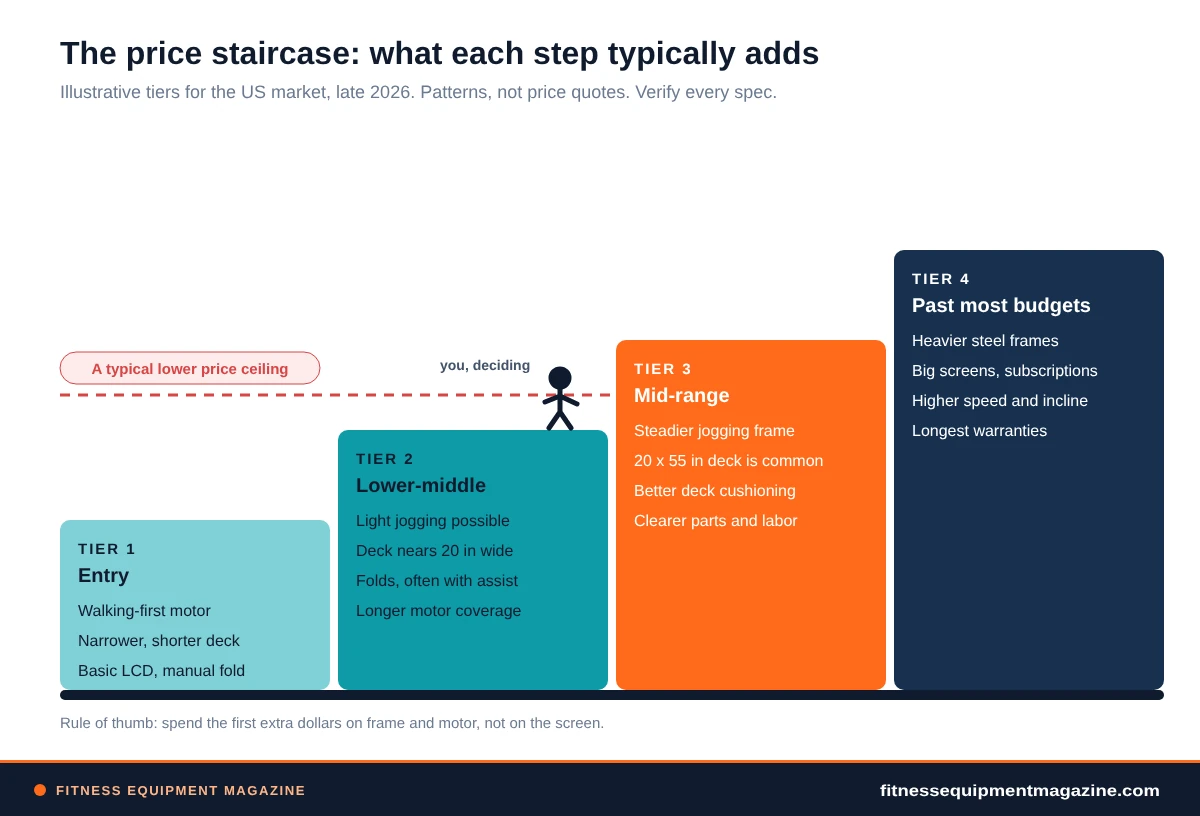
Let’s start with an honest premise: “budget” isn’t a single price. It’s a ceiling you set, and what it buys changes sharply as that ceiling moves. In the US market in late 2026, treadmills tend to fall into four loose tiers. The dollar ranges below are rough and hedged on purpose, because sales, tariffs and shipping costs keep moving them around.
Four tiers, roughly
Tier 1 · entry
Roughly the lowest few hundred dollars
Mostly walking-first machines. Expect a narrower, shorter deck, a modest motor, a basic LCD and a short warranty. Fine for steady walking, rarely happy with real running.
Tier 2 · lower-middle
Roughly the mid hundreds to low thousand
This is where most searches for the best budget treadmills end up. Light jogging becomes plausible, decks get closer to 20 inches wide, and warranties start to look more serious.
Tier 3 · mid-range
Roughly the upper end of most budgets
Sturdier frames, better deck cushioning, more incline and clearer parts-and-labor coverage. Many shoppers hunting for the best budget treadmills end up happiest here.
Tier 4 · beyond budget
Where big screens and subscriptions live
Heavier steel, higher speeds, longer coverage, and also a lot of money going into displays and software. Useful as a reference point, not a target.
The graphic below shows the same ladder with the features that typically show up at each step. Notice the dashed line. Your ceiling probably sits somewhere between tier 2 and tier 3, and the single most useful question you can ask is whether the next step up buys frame and motor, or only buys glass.
Why the tiers blur
Real listings don’t respect these boundaries. A tier 2 machine can have a surprisingly good motor and a mediocre deck. A tier 3 machine can arrive with a slick screen and a thin warranty. So treat the staircase as a map of tendencies. It tells you where to look harder, not what to believe.
Two forces explain most of the mess. First, feature creep is cheap. Adding a bigger display, a speaker or a handful of programs costs far less than adding steel to the frame, so brands compete on the cheap stuff. Second, spec sheets are marketing documents. A number that looks like a motor rating may describe a short burst that the motor can’t hold. We pick that apart in the section on spec inflation.
What a lower ceiling forces you to decide
A lower ceiling removes the option of buying everything at a “good enough” level. You have to pick what the machine is for. If it’s for walking, you can lean into a smaller deck and a gentler motor, and you’ll probably be happier than someone who bought a stretched jogger.
If it’s for running, you’ll have to accept fewer frills and probably a plainer console. Trying to buy “a little of everything” at a low price is how people end up with a machine that does nothing well. It’s also why the best budget treadmills tend to be focused machines rather than all-rounders.
If you haven’t yet worked out whether your space and training even suit a full-size machine, our guide to choosing the right treadmill for your space and training covers the bigger picture. The pages that follow, which are built to help you pick the best budget treadmills for your situation, assume you’ve decided a treadmill is the right tool and the question is how to spend a smaller budget wisely.
A quick sanity test
Write down, in one sentence, what you’ll do on the machine in your first three months. “Walk 30 minutes while watching shows” and “run three mornings a week before work” lead to completely different shopping lists. If you can’t write the sentence yet, jump to the beginner archetype in the shortlist section.
A note on how much use you’re buying for
Federal guidance gives a useful sense of scale. The HHS Physical Activity Guidelines describe weekly activity targets for adults, and a treadmill is simply one convenient way to meet general activity goals indoors. We aren’t making health promises here. The practical point is about volume: a machine that gets used several times a week for years deserves a stronger frame and motor than one that gets used a few times a month.
That distinction drives almost every recommendation in this guide. The best budget treadmills for a heavy user aren’t the same as the best budget treadmills for a light one, even at an identical price.
Where to Spend: Five Things Worth Paying For Among the Best Budget Treadmills
When you shop for the best budget treadmills, think of your budget as a fixed pile of coins. The goal is to put coins where wear and discomfort actually show up, which is the frame, the motor, the deck, the paperwork and the stop mechanism. Everything else can ride along if it’s free and be ignored if it isn’t.
1. Frame stability
A treadmill is a vibrating machine that you stand on, and the frame is what keeps that vibration from turning into noise, wobble and loose fasteners. At lower prices, frames get lighter, uprights get thinner and the folding hinge becomes the weak joint. You feel that weakness as shake at the console, a creak at heel strike or a rattle when you step on and off.
You can’t test a frame through a screen, but you can read for clues. Look for the machine’s own weight on the spec sheet. Within a given size class, a heavier treadmill is often (not always) built from more material. Read owner reviews for the words “wobble,” “shake,” “loose” and “creak,” and notice whether complaints cluster around a particular speed or after a few months. A handful of complaints is normal. A pattern is not. Frame quality is where the best budget treadmills most often pull ahead of cheaper lookalikes.
Folding designs deserve extra scrutiny. A hinge that lets the deck swing up for storage is also a hinge that can loosen. If you plan to run, a non-folding frame at the same price is usually the sturdier choice.
2. A continuous-duty motor that suits your speed
Motors are rated in horsepower, but the number printed biggest on the box is often “peak” horsepower, which describes the most the motor can produce for a short moment. What you want is continuous-duty horsepower (CHP), the output it can sustain through a workout. We explain the gap in detail in the spec inflation section, so for now just remember the habit: look for “CHP” or “continuous.” The best budget treadmills state that figure plainly.
How much do you need? Commonly cited rules of thumb in treadmill buying advice run something like this, and you should treat them as starting points rather than law:
- Walking only: a modest continuous rating is usually enough, particularly for lighter users.
- Light jogging: look for a clearly higher continuous rating than a walking machine offers, often in the mid-2 CHP range or above.
- Regular running: many buyers aim for a continuous rating around 3 CHP or higher, because a motor that is loafing runs cooler and lasts longer.
Heavier users and multiple users push these needs up. A motor working near its limit gets hot, and heat is what shortens motor life. If you want the full explanation of motor ratings, our treadmill buying guide to motors, belts, incline and warranty goes line by line.
3. A deck that fits your stride
Deck size is one of the few specs that you can verify with a tape measure, and it matters more than most feature lists admit. A short deck makes you shorten your stride. A narrow deck makes you watch your feet. Neither is dangerous when you’re walking slowly, but both get uncomfortable as speed rises. The best budget treadmills publish the running surface, not just the overall length.
Taller people and anyone with a long stride should add length first, then width. As a rough check, mark out a long, easy stride on the floor and measure it. If your running stride is longer than the deck minus a safety margin at each end, the machine is too short for running at your height, regardless of what the box says.
4. A warranty you can read in two minutes
At this price the warranty is often the clearest signal of how a maker expects the machine to hold up. Look for separate lengths for the frame, the motor, the parts and the labor, and for who pays for shipping a defective part. We dig into the layers in a dedicated section below. For now, treat a vague “limited warranty” with no breakdown as a weak signal rather than a deal-breaker. Among the best budget treadmills, the clearest warranties usually come from makers who expect the machine to last.
5. Safety features that actually work
A magnetic safety key, clear emergency stop behavior, sturdy handrails and a belt that starts at a low, predictable speed aren’t luxuries.
Treadmill injuries tend to involve falls and belt contact, so a clip-on key that kills power when you step away is not an optional extra, and every one of the best budget treadmills should include it. Check that the key is included, that the belt edge has guarding and that the instructions mention a minimum clearance behind the machine. The CPSC recall page linked above is the place to see whether a given product type has had safety problems.
Safety first
If a household includes small children or pets, a safety key you actually clip on matters more than any other feature here. Keep the key out of reach when the machine isn’t in use, and keep the area behind the belt clear.
Where to Save: Features That Cost More Than They Deliver
The flip side of spending on the frame is declining the shiny extras. Skipping them is how the best budget treadmills stay affordable without feeling cheap. None of these are bad in themselves. The problem is that they absorb a large share of a small budget while contributing very little to the thing you bought the machine for.
Big touchscreens
A large display looks expensive in a photo, and it is expensive to build. It also adds software that can lag, stop updating or lock features behind an account. For a budget buyer, a plain, readable console showing time, speed, distance and incline does the job. Your phone or tablet on a shelf handles the entertainment better than a built-in screen ever will. The best budget treadmills put their money elsewhere.
Subscriptions and connected programs
Some treadmills lean on a monthly plan for classes or advanced features. That’s a legitimate business model, but it’s also a recurring cost that never shows up in the purchase price. Ask what still works if you never subscribe. If the honest answer is “very little,” you’re buying a gateway to a service rather than a machine.
Extreme incline
Incline is useful, and modest incline gives walkers a way to vary effort without going faster. Very steep incline is a different story at a budget price, since it needs a stronger lifting mechanism and a motor that can handle the extra load. Most people use a small share of the available range. Unless hill work is central to your plan, a moderate incline range is a perfectly sensible place to save.
Bundled gimmicks
Massage attachments, tiny dumbbells, tablet holders that block your view, “free” mats that are barely thicker than a placemat. Bundles make a listing look generous. Count only the items you would have bought anyway, and judge the rest as packaging.
What a good trade looks like
On the road to the best budget treadmills, giving up a bigger screen for a longer warranty, or giving up steep incline for a heavier frame, is almost always a good trade. Giving up a longer deck for a faster top speed almost never is, because most people never use the top speed.
Preset programs and tracking
Preset workouts feel motivating on day one and invisible by month two. If you like structure, a phone app or a simple written plan works just as well. The best budget treadmills keep the console simple. The one feature worth a second look is a clear, quick speed control, since you’ll press those buttons thousands of times.
Spec Inflation: Four Numbers Budget Listings Stretch
Nobody has to lie on a spec sheet to mislead you. They only have to choose the most flattering true number and put it in the biggest font. Once you know the four usual suspects, you’ll start seeing them everywhere, and comparing the best budget treadmills gets much easier.
Peak horsepower versus continuous duty
Peak horsepower measures what a motor can produce in a short burst, such as the instant of starting up. Continuous-duty horsepower measures what it can deliver for the length of a workout without overheating. The two figures can differ a lot, and an honest listing shows both. A listing that shows only a large peak number and no continuous figure is hiding the one you need.
When both numbers aren’t listed, look at where the motor is described elsewhere. A product page that talks about “continuous duty” in the text but not in the spec table is better than one that never mentions it. If you can’t find it at all, treat the machine as walking-grade until the maker says otherwise.
“Max user weight”
This figure is a design limit, and manufacturers set it in different ways. Some choose a generous number because it sells. Others test conservatively. Either way it describes the maximum, not a comfortable working load. A common-sense practice is to leave a healthy margin: if you or another user will be near the stated limit, move up a size class instead of assuming the number is a promise.
Include everyone who will use the machine. In a two-person household, the heavier user sets the minimum motor and frame requirement. Also remember that running loads the frame much harder than walking does, so a machine rated for a given weight is usually more comfortable for walking at that weight than for running at it.
“Cushioning”
Deck cushioning is a real feature, and it can make a machine kinder to joints and quieter on the floor. But the word has no standard unit. One brand’s “multi-zone cushioning” may be a thin rubber pad and another’s may be properly tuned elastomers. At a low price, assume cushioning is modest and judge it by owner comments about feel rather than by the marketing name. If you’re very sensitive to impact, that is a good reason to look higher in the price range, or to consider a different type of machine altogether.
“Foldable”
Folding is a storage feature, and it carries real tradeoffs. It adds a hinge, which is a possible loose point. It may require lifting a heavy deck. And a folded machine still has a footprint, often deeper than people expect. Look for the folded dimensions, not just “foldable,” and think about whether you have somewhere to put it. A treadmill that folds but can’t be moved is simply a treadmill with a taller silhouette.
One more thing to check
“Space-saving” is a marketing claim, not a measurement. Ask for three numbers: the footprint while in use, the footprint folded, and the clearance you need behind the belt. If any of the three is missing from the listing, that’s worth a message to the seller before you pay.
Hidden Costs That Change the Math on Budget Treadmills
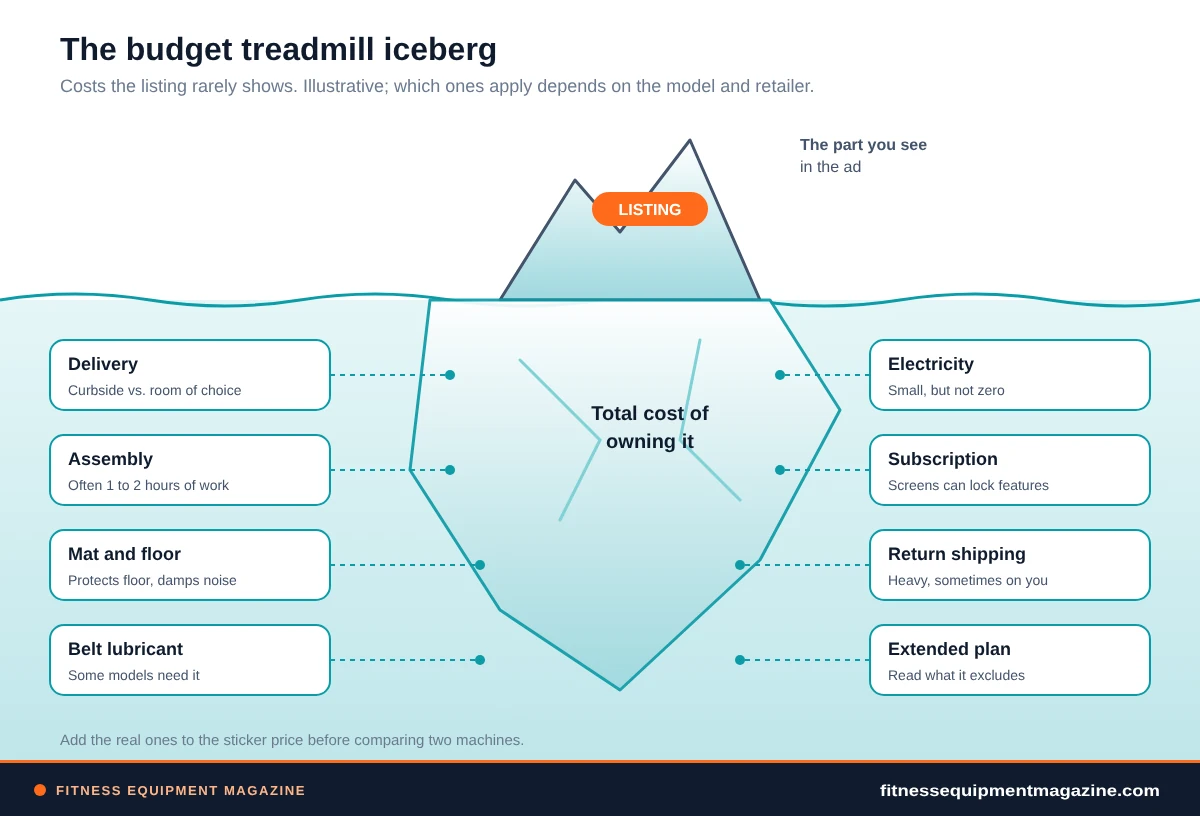
The sticker price is the part everyone compares. It is also the part that tells you the least about the total cost of owning the machine. Two treadmills with identical prices can differ by a surprising amount once delivery, setup and upkeep arrive. That matters most when your ceiling is tight, because a few extra charges can push the real price past the next tier up. The best budget treadmills still look good after you add these up, while the merely cheap ones often don’t.
Delivery, assembly and your own time
Treadmills are heavy and awkward, and shipping reflects that. Some retailers include delivery to the curb, others to a room of your choice, and others charge extra for anything beyond the driveway. If you live up a flight of stairs, ask exactly where the carrier stops. Assembly often takes an hour or two and is easier with a second person. Some sellers offer paid assembly, which is a sensible expense if you’re unsure about heavy lifting.
A mat, lubricant and the floor
A mat protects the floor and damps vibration, and it is worth buying for almost any treadmill on a hard surface. Some machines also need periodic belt lubrication, usually done with a silicone product the manual specifies. Others come pre-lubricated and ask only for inspection. Read the maintenance chapter of the manual before you buy, which most listings let you download. If upkeep sounds like a chore you’ll skip, pick a model that asks for less of it.
Electricity and the outlet
Running costs are usually modest for a home treadmill, and the machine draws only as much as the motor needs. Still, check the power requirement. Most budget treadmills plug into a standard household outlet, but the manual may recommend a dedicated circuit. Avoid thin extension cords and check the plug rating. If the manual says what it expects, follow that, because motor controllers don’t enjoy a weak supply.
Subscriptions, accounts and add-ons
If a machine’s best features sit behind a monthly plan, count at least a year of fees in your total. Ask what happens when you stop paying and whether the console still works with the basic controls. Also check whether the account depends on a server that might disappear someday, which would leave a screen that cannot do much.
Return shipping and restocking
Returns on a treadmill can be costly. The machine is large, and a retailer may deduct return freight or a restocking fee from your refund. Before ordering, read the return policy and look for these details: the return window, who pays freight, whether the packaging must be kept and whether assembled machines are accepted. Return terms help separate the best budget treadmills from risky ones, and a generous policy has real value, because it lets you test whether you’ll actually use the thing.
Extended warranties
Retailers often offer an extended plan at checkout. Sometimes it’s a good idea, particularly when the base warranty on parts and labor is short. Read what it excludes before you pay. Plans that overlap the manufacturer’s coverage, require a mail-in process or exclude the most common failures can be poor value. A simple test is to compare the plan’s price to the likely cost of one service visit.
Reading a Budget Treadmill Warranty Like a Contract
A warranty isn’t a single number. It’s a stack of separate promises with separate lengths, and the way they stack tells you more about a machine than the headline “years of coverage.” Budget makers frequently advertise the longest layer and say little about the shortest, so the useful skill is to find all four layers. Reading them closely is one of the quickest ways to rank the best budget treadmills on your shortlist.
Questions to answer before you buy
- How long does each layer last: frame, motor, parts and labor?
- Does the warranty apply to home use only, and is that stated clearly?
- Who covers shipping on a replacement part, and who covers it on a return for repair?
- Is there a way to reach support that you can test now, such as a phone number or a chat?
- Does the coverage transfer if you resell, or is it for the original purchaser only?
Support matters as much as the paper. A decent warranty with a company that never answers is worth less than a shorter one with a responsive team. Searching owner comments for the words “support,” “replacement” and “part” gives you a feel for how claims go. You’re looking for patterns, not a single angry story, and certainly not a single glowing one.
Finally, keep your records. Save the order confirmation, the model and serial number, and a photo of the assembled machine in your space. If you ever need a claim, those three items solve most of the paperwork before it starts.
Refurbished, Open-Box and Used Commercial: Bargains With Fine Print
When the new price won’t stretch, the secondhand market starts to look attractive. Sometimes it is. A good used machine can sometimes match one of the best budget treadmills for build quality, and it can certainly beat a weak new one. But treadmills hide their wear well, and the three kinds of “not new” carry very different risks, so it helps to separate them.
Refurbished
Fixed, tested, resold
Quality depends entirely on who did the work. A maker-certified refurbishment with a fresh warranty is a different animal from a reseller’s “tested” listing with no paperwork.
Open-box
Returned or display units
Often nearly new, sometimes used for a week and sent back. Check the belt, missing hardware and, above all, whether the warranty still applies to you.
Used commercial
Built tough, bought tired
Gym-grade frames can outlast several home machines, but they may be heavy, power-hungry and worn from many hours of use.
The warranty question comes first
Ask whether any warranty survives the sale. Many manufacturer warranties are for the original purchaser only, which means a used machine is effectively on its own the day you bring it home. With a refurbished unit sold by the maker or an authorized seller, you may get a new, shorter warranty. That is a point in its favor. A private seller can offer only their word.
A hands-on inspection routine
If you can see the machine in person, do it properly. Don’t be shy about this. A seller with nothing to hide won’t mind.
- Check the safety key and stopPull the key mid-run at a slow speed. The belt should stop promptly and not restart on its own.
- Run it for ten minutesStart slow, then step through the speed range. Listen for grinding, squealing or a rhythmic thump, and note any hot smell near the motor.
- Watch the beltLook for fraying edges, a belt drifting to one side, or shiny worn patches on the deck underneath.
- Test the inclineRaise it and lower it fully. A hesitant or noisy lift motor is an early repair bill.
- Shake the frameGrip the handrails and push gently. Loose uprights or a clunking hinge tell you what the reviews can’t.
- Look up the serial numberThen search the CPSC exercise equipment recalls for that model before money changes hands.
Used commercial machines need extra homework
Commercial treadmills are tempting because the build quality can be excellent. They’re also far heavier, they often need a dedicated circuit, and parts or service for older models can be hard to find. Moving one is a two-or-three-person job, and getting it up stairs may mean hiring professionals. A used commercial unit can be a superb value for a runner with a garage and a dedicated outlet. For an apartment on the third floor, it’s rarely a bargain.
Be skeptical of
“Like new” with no photos of the deck, belt or serial plate. A price far below every comparable listing. A seller who can’t or won’t let you run the machine. Any of these should send you back to shopping for new.
Best Budget Treadmills by Buyer Type: Five Shortlist Archetypes
We don’t name brands or models here. The site hasn’t hands-tested individual machines, and a list of brand names would imply a certainty we don’t have. What we can offer is a shortlist of archetypes: the kinds of machines that tend to suit five common buyers, each with a minimum acceptable spec. Use these lists to screen candidates, then verify every figure against the current manufacturer’s page. Think of it as a way to find the best budget treadmills for you, not a ranking of products.
Evidence level for this section. The archetypes and minimum specs below come from manufacturer specification patterns and commonly reported ownership problems. They’re a screening tool, not test results, and the shoppers described are hypothetical profiles written to illustrate the logic.
1. The walker
Hypothetical profile: Dana walks 30 to 45 minutes most evenings, mostly to keep a routine through winter and bad weather. She’ll never run on it, and she doesn’t want to pay for speed she won’t use.
The walker is the buyer for whom the best budget treadmills work best. Walking speeds are gentle on a motor, so a modest machine can last a long time. The risk is overbuying speed and underbuying comfort. Spend on a stable frame, a sturdy set of handrails and a deck that doesn’t feel cramped. Skip the high-speed ratings entirely.
- A continuous motor rating that the maker states clearly, sized for walking speeds
- A deck wide enough that your feet never feel near the edges, commonly 18 inches or more
- Sturdy handrails you can lean on without any flex
- A low, predictable starting speed and a magnetic safety key
- Quiet operation per owner comments, since walking often happens during TV time
2. The casual jogger
Hypothetical profile: Marcus jogs two or three mornings a week, 20 to 30 minutes at an easy pace. He wants something he can do before work without driving anywhere.
Here the middle tiers earn their place. A jogger’s feet land harder than a walker’s, so the deck, the frame and the motor all work harder. This is the archetype where a small stretch in budget often pays back the most, because the difference between a walking-grade machine and a jogging-grade one shows up in noise, wobble and belt wear. For joggers, the best budget treadmills sit near the top of the budget range, not the bottom. If you’re torn between two models, choose the one with the clearer continuous-duty motor rating and the heavier frame.
- A continuous-duty rating above walking-grade levels, commonly mid-2 CHP or higher
- A deck near 20 by 55 inches or larger, matched to your stride
- A non-folding or very sturdy folding frame, with stated user weight comfortably above yours
- Separate, readable warranty periods for frame, motor, parts and labor
- Deck cushioning described in specifics, not just a marketing label
3. The apartment dweller
Hypothetical profile: Priya lives on the second floor of a building with thin floors and a neighbor who works nights. She has a corner of the living room and a ceiling that’s about eight feet high.
Apartment buyers fight three constraints at once: space, noise and ceiling height. Space is the one that surprises people. A treadmill needs clearance behind the belt, a little on each side and room above your head, especially when the incline is raised. The floor plan below shows a typical pattern, though your manual’s numbers rule.
For noise, the best insurance is a thick mat, placement away from shared walls and a machine with a smoother, steadier belt. Exact decibel figures on listings are hard to compare, so lean on owner comments about downstairs neighbors instead. In tight spaces, the best budget treadmills are the ones that fit without a fight. And if the space is truly tight, take a serious look at a walking pad. Our guide to the best walking pads for home and office shows what they do and don’t replace.
- Published folded and in-use dimensions, plus the stated clearance behind the belt
- Transport wheels and a folding mechanism that you can operate alone
- A weight you can realistically move, or a plan for leaving it in place
- A mat or isolation plan for the floor
- A deck and motor honest about being walking- or light-jogging grade
4. The beginner who isn’t sure they’ll use it
Hypothetical profile: Sam has bought equipment before that turned into a clothes rack. This time Sam wants to try a routine without committing a big chunk of money.
The honest advice for this buyer is to limit the downside. That could mean a sensible entry-tier walking treadmill with a generous return policy, or an open-box purchase from a seller that accepts returns. It might also mean starting with a walking pad. Our comparison of a walking pad versus a treadmill for your space, goals and budget is the right next read for this decision. For this buyer, the best budget treadmills are the ones you can send back.
A good trick is to set a trial condition. Decide in advance that if you’ve used the machine a certain number of times in the first month, you’ll keep it, and otherwise you’ll return it within the window. This only works if the return policy is real, so read it first and note the deadline in your calendar.
- A return window and freight policy you’ve read and understood
- Walking-grade motor and deck are fine, as long as they’re described honestly
- A low starting speed and obvious safety stop, since this buyer may be new to treadmills
- No subscription needed for the basic controls to work
5. The household with two users
Hypothetical profile: Two adults of different sizes share a machine. One walks, one jogs, and they’re sure their teenager will borrow it.
Shared machines break the usual rule that budget buyers should spec for the lightest likely use. Here, the heaviest and fastest user sets the requirement. A walking-grade motor that’s fine for one person will be pushed hard by the other, and the frame sees the combined hours. Expect to spend more of your budget on frame and motor than a solo walker would, and accept that this buyer often belongs in the upper part of the lower-middle tier. For two users, the best budget treadmills usually cost more than the solo-walker versions.
- A continuous motor rating sized for the heavier or faster user, not the average
- A deck that suits the taller user’s stride
- A user weight limit with a comfortable margin over the heaviest user
- Warranty language that covers normal home use by a household, not a single person
- Handrails and a console height that work for different heights
Red Flags in a Budget Treadmill Listing
You’ll never get perfect information, but certain patterns show up again and again in listings that go badly. Collect two or three and you’ve found a reason to walk away. Collect one and you’ve found a question to ask the seller. Spotting these early keeps the best budget treadmills on your shortlist and the risky ones off.
- A warranty described only as “limited,” with no lengths for frame, motor, parts and labor
- No mention of a safety key, emergency stop or belt guarding anywhere on the page
- Only a “peak” horsepower figure, with no continuous rating at all
- Missing dimensions: no running surface, no folded size, no weight
- Owner reviews that keep mentioning wobble, belt slipping or a console that dies after a few months
- Photos that appear to show a different machine from the one in the title
- No way to contact the seller or the maker before purchase
- A user weight limit that seems high compared with the machine’s own weight and size
A two-minute review trick
Sort reviews by lowest rating and read the three-star ones first. Five-star reviews tell you the box arrived, and one-star reviews are often about shipping. The three-star reviews usually describe how the machine actually behaves after a month of use.
A Smart Shopping Timeline for the Best Budget Treadmills
Timing won’t rescue a bad machine, but it can move a good one into your price range. Retail patterns shift year to year, so treat the calendar below as a typical rhythm, not a promise. Also remember that a discount on a poor machine is still a poor machine, and a modest one on the best budget treadmills is a bonus, not the point.
The yearly rhythm
- Early January: demand spikes with New Year resolutions, and prices on popular models often hold firm or even rise. Don’t assume January is the cheap month.
- Late winter and spring: promotions around presidents’ holidays and spring sales sometimes appear as stock turns over.
- Late spring through summer: demand tends to soften as people move outdoors, which can bring quieter deals. Memorial Day and early July events are common.
- Late fall: Black Friday and Cyber Monday are the best-known windows for big-ticket fitness gear. Since it’s late October as we write, that window is close for many readers.
One caution about holiday pricing. Some “was” prices on listings are inflated or rarely used, so a bright discount badge isn’t evidence of a real deal. Compare the final price against a few retailers, against the warranty and against total cost, rather than against the crossed-out number.
A six-week plan
- Weeks 1 and 2: define the jobWrite your one-sentence use case. Measure the room, the doorway, the stairs and the ceiling. Decide your hard price ceiling, and include delivery and a mat in it.
- Week 3: build a shortlist of threeScreen candidates using the minimum spec for your archetype. Throw out anything with a red flag you can’t resolve.
- Week 4: read the paperworkDownload the manual and the warranty. Check the return policy and the CPSC recall list for each finalist.
- Week 5: ask questionsMessage the seller about anything missing, such as the running surface, clearance or who pays for return freight. How they respond is information too.
- Week 6: buy, or wait for the saleIf a sale window is near, you can afford to wait. If not, buy the one that passed every check.
- Day of delivery: inspect before you signLook for shipping damage and note it. Then assemble, level the machine and run it empty before you step on.
After it arrives
Keep the box and packing for the length of the return window. Run the machine every day for the first week, even briefly, so any problem shows up while returning it is still easy.
Set it up well and it’ll last longer
The best budget treadmills get less forgiveness than expensive ones, so setup counts. Put it on a flat, hard surface with a mat. Tighten every fastener at assembly and again after the first couple of weeks, since vibration loosens bolts. Center the belt if the manual describes how. Wipe the deck and rails regularly, keep the area behind and below the belt free of dust and pet hair, and follow the lubrication schedule if the manual specifies one. None of this is glamorous. It is, however, the cheapest way to add years to a machine.
When to Pay More, or Buy Something Else Entirely
Honest advice about the best budget treadmills sometimes ends with “spend more” or “don’t buy this at all.” Here’s how to tell.
Signs you should raise the ceiling
- You plan to run three or more days a week, year after year.
- Two or more people with different sizes will use the machine.
- You’re tall, and a long stride needs a long deck.
- You are sensitive to impact and want better cushioning.
- Your best-value shortlist keeps landing at the very bottom of each tier, with thin warranties.
In these cases a mid-range machine usually costs less per year of use than a budget machine you replace. If this sounds like you, raising the ceiling is a smarter move than hunting for the best budget treadmills at the very bottom of the range.
Signs a walking pad is the smarter buy
A walking pad is a compact, low-speed belt, and for the right person it’s a better answer than a stretched-budget treadmill. Treat it as an alternative to the best budget treadmills, not a lesser version of them.
It suits you when you mostly want to walk, your space is small, you want to store it under a bed or sofa, or you’ll use it at a desk. It doesn’t suit you if you plan to run, need handrails for balance or want a big, stable deck. Many buyers sit between the two, and the best budget treadmills for them are often the ones that fold small.
When something else beats both
If your real goal is general activity and you don’t love walking indoors, a bike, a rower or simple outdoor walking might fit better. A treadmill is a good tool for people who like walking or running and need weather-proof access to it. For anyone else, it can become the largest piece of furniture in the house that nobody uses. Be honest about which one you are.
A fair rule of thumb
If you can’t point to a specific time in your week when you’d use the treadmill, don’t spend more on it. If you can, and that time recurs, then a modestly higher budget on frame and motor is usually the better use of money than any extra feature.
Questions Buyers Ask About the Best Budget Treadmills
What should I prioritize when shopping for the best budget treadmills?
Start with frame stability, a continuous-duty motor suited to your speed, and a deck that fits your stride. Then check the warranty layers and the safety features. Those five things shape how the machine feels and lasts. Screens, subscriptions and steep incline can wait, since they cost a lot and add little for most people.
How much horsepower do the best budget treadmills need?
It depends on your speed and weight. Walkers can usually do well with a modest continuous rating, while joggers often look for something noticeably higher, and regular runners commonly aim around 3 CHP or more. Always look for the continuous-duty figure, not peak horsepower, and size up if more than one person will use the machine.
Can the best budget treadmills handle running?
Some can, within limits. Light jogging is realistic on the upper part of the budget range if the motor, frame and deck are suited to it. Regular running at a faster pace is harder, because impact and speed stress every part of a lightweight machine. If you plan to run often, consider raising your ceiling rather than stretching a walking-grade model.
Are refurbished or open-box treadmills worth it?
They can be, with care. Refurbished units from the maker or an authorized seller, with a fresh warranty, are lower risk than a private sale. Open-box units are often nearly new but may lose warranty coverage. Inspect the belt, test the safety key, check the serial number against recalls and read the return policy before you commit.
What hidden costs come with the best budget treadmills?
Plan for delivery, assembly, a mat, lubricant if the manual calls for it, some electricity, any subscription you’d want and the possibility of paying return freight. An extended plan may be worth it when the base warranty is short, but read its exclusions. Adding these to the sticker price often changes which model offers the best value.
Is a walking pad better than the best budget treadmills?
For walking in small spaces, often yes. A walking pad stores easily and costs less than a decent treadmill, but it generally lacks handrails and the speed or stability for running. If you plan to run or you need something sturdy, a treadmill is the better tool. Our comparison guide helps you choose between them.
When should I buy the best budget treadmills?
There’s no guaranteed month, but late-fall sales such as Black Friday and Cyber Monday, plus some spring and summer holiday events, are common times for deals. January often brings high demand. Compare real prices across retailers and judge the warranty and return terms, not just the discount badge.
How do I know a “max user weight” claim is realistic?
Treat it as an upper limit, not a comfortable working load. Compare it with the machine’s own weight and size, read reviews for wobble complaints and leave a margin if you’ll be near the limit. Heavier users and runners should move up a size class for the motor and frame.
Bottom Line: Choosing the Best Budget Treadmills Without Regret
The best budget treadmills are less about a clever find and more about discipline. You decide what the machine is for, put money into the frame, the motor, the deck, the warranty and the safety features, and decline the glossy extras that eat up a small budget. Then you add up the real cost, read the paperwork and give yourself a way out if it doesn’t work.
If you take only three actions from this guide, make them these. First, write a one-sentence use case before you open a single listing. Second, screen every candidate against the minimum spec for your buyer type and the red-flag list. Third, check the total cost and the return policy before you pay. Then compare your finalists with the broader home treadmill selection guide if you’re still torn, and check the CPSC list one last time. These habits matter more than any single model, because the best budget treadmills change every season.
Sources and Further Reading
- HHS Physical Activity Guidelines — federal guidance on weekly activity for adults
- CPSC exercise equipment recalls — check model safety history before you buy
- ACSM top fitness trends for 2026 — context on home exercise equipment interest
Some links on this site may be affiliate links. If you buy through them we may earn a commission at no extra cost to you. Recommendations are based on the criteria in the article, not payout. This article is general information about equipment and isn’t medical advice; talk to a qualified professional about your own health and training. Last reviewed: October 2026.