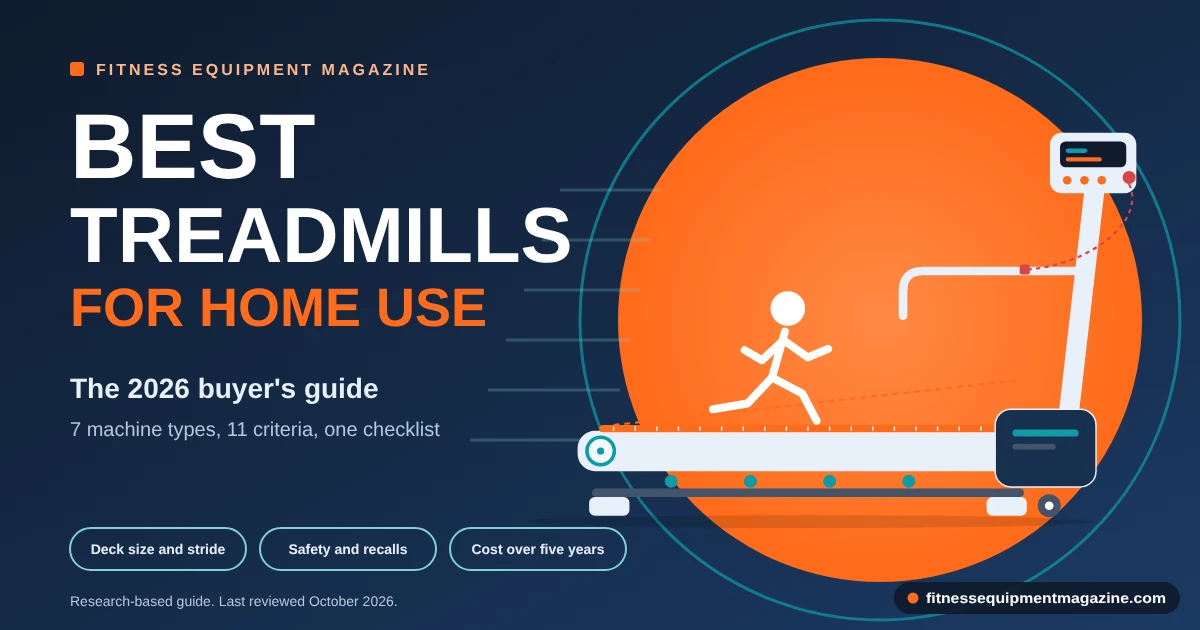
Picking the best treadmills for home use is less about finding one magic model and more about matching a machine to two things the spec sheet can’t see: how you’ll really use it, and the room it has to live in. A treadmill that suits a daily 4 mph walker in a tight apartment is a poor buy for a 6-foot-2 runner with a garage. Same product category, completely different shopping lists, which is why the best treadmills for home use differ from one household to the next.
This guide is the hub for our whole treadmill series. We start with your week and your floor plan, then walk through seven types of the best treadmills for home use, the criteria that separate a good one from a regret, and the safety, setup and upkeep details most listings skip. If you’d rather meet every spec in depth first, our treadmill buying guide on motors, belts, incline and warranties goes much further on each number.
Quick answer: the best treadmills for home use at a glance
The short answer
For most households, the best treadmills for home use are mid-size all-rounders: a belt around 20 inches wide and 55 to 60 inches long, a sturdy frame, a quiet continuous-duty motor and a warranty you’ve actually read. Walkers in small spaces can step down to a compact folder or a walking pad. Taller or faster runners should step up to a 60-inch deck and a heavier frame.
- Who it fits: mixed walking and jogging, one to three users, a room with about 7 feet of length to spare.
- The big tradeoff: every extra inch of belt, pound of frame and year of coverage costs money and floor space. Spend on stability and deck size first, screens last.
- Do before buying: measure the room, check the manufacturer’s clearance rules, and search the CPSC recall list.
Read this first: how we researched this guide
How we researched this. This guide to the best treadmills for home use is research-based. It is built from manufacturer specification patterns, federal guidance and the ownership problems that buyers commonly report. We have not hands-tested the machine types described here, and we name no brands or models on purpose.
Treat every number as a typical range and confirm it on the spec sheet of the exact machine you’re considering. Some links on this site may be affiliate links. If you buy through them we may earn a commission at no extra cost to you. Recommendations are based on the criteria in the article, not payout.
How current is this?
Last reviewed: October 2026. Specs, prices, warranty terms, app subscription fees and recalls change often. Before you commit to any of the best treadmills for home use, check the seller’s current terms and search the CPSC exercise equipment recall list for the model name.
What is inside this guide
Start with how you’ll actually use it
Ask ten people why they want a treadmill and nine will say “to run.” Ask the same people what they did on their last three workouts and a good half will describe walking while watching something. Neither answer is wrong. It just matters, because walking at 3 mph and running at 7 mph put very different demands on a machine.
So before you open a single page of best treadmills for home use listings, write down your honest week. How many days, how many minutes, how fast, and who else will step on the belt. That short note will do more for your list of best treadmills for home use than any rating badge.
Walking and jogging: what each asks of a machine
Walking. Most home treadmill hours are walking hours. At 2 to 4 mph the impact is gentle, the motor barely strains and a compact belt works for most people. What matters is quiet operation, a low starting speed and a console you can read at a glance. If this is you, you have the widest choice, including a walking pad. Our guide to what to look for in a walking pad covers that end of the market.
Jogging. Easy jogging, roughly 4.5 to 6.5 mph, is where cheap machines start to show their limits. The belt needs to be long enough for a bouncier stride, and the frame must stay still when your foot lands. A mid-size deck and a solid base usually settle it.
Running, intervals and sharing
Running. Regular running at 6 mph and up asks for a longer, wider belt, a stronger drive system and a frame that doesn’t flex. Taller runners need the extra belt length for their stride. We cover that in the deck section below.
Intervals. Intervals mean repeated jumps in speed and incline. The machine has to respond quickly without lurching, and the motor works harder through every change. A buyer who plans hard intervals should shop closer to the runner’s tier than the walking tier, even if the average pace sounds modest.
A shared household. Two or three users with different heights, weights and habits complicate things. The deck has to suit the tallest stride, the capacity has to suit the heaviest user with margin, and the console should be simple enough that a teenager and a grandparent can both start it without a manual. Shared machines also rack up hours faster, so the duty rating and warranty deserve more weight.
A word on how much activity people aim for
Federal guidance gives a general yardstick. The HHS Physical Activity Guidelines for Americans describe weekly amounts of moderate and vigorous activity for adults, and a brisk treadmill walk can count toward them. We mention it for planning only. It helps you picture whether you’re buying for 90 minutes a week or 400, and the second number should push you toward a sturdier machine.
Nothing here is medical advice. If you have a health condition, a recent injury or a long gap since you last exercised, ask your clinician before choosing a program and a machine.
Four hypothetical shoppers
These people are invented, but the situations are common. Notice how different the right answers are.
Hypothetical
Dana, one-bedroom apartment
She walks 45 minutes most evenings, mostly while on calls. Her priorities are low noise, storage behind a door and a belt that doesn’t make the downstairs neighbor flinch. A compact folder or a walking pad fits her life better than a full-size machine.
Hypothetical
Marcus, garage runner
He’s 6-foot-3 and runs four mornings a week, with one interval session. He needs a 60-inch belt, a stable frame and a motor that won’t labor. Space isn’t his issue. Weight and stride are.
Hypothetical
The Okafor household
Two adults, a teenager and a dog that loves the garage. Heights vary and so do speeds. They want a mid-size all-rounder with a high weight rating, a clear safety key habit and a spot the dog can’t reach.
Hypothetical
Priya, hybrid worker
She wants to walk through meetings and jog twice a week. Her spare room doubles as an office. A compact folder with a decent deck, or a mid-size machine she can slide behind a door, is the realistic range.
A five-minute usage audit
- Count your weekly minutesBe conservative. Use what you did last month, not what you plan for January.
- Name your top speedNot your best day, your regular day. This sets motor and deck needs.
- List every userHeights, rough weights and who might jump on without warning.
- Decide on inclineDo you want hill walks, or will you leave it flat? Steeper ranges cost more and add moving parts.
- Note what you’ll watch or hearA built-in screen only helps if you’d use it. A tablet shelf might be enough.
Measure the room before you shop for the best treadmills for home use
Here’s a pattern we see described over and over in owner complaints: the machine arrives, it’s the right machine, and it doesn’t fit. Not the box, the treadmill. The belt is fine. The ceiling isn’t. Or the clearance behind it is two feet short, or the door hits the console.
Measure first. It takes ten minutes and a tape. Every search for the best treadmills for home use starts with your own tape measure, and everything else gets easier once you know your real envelope.
Footprint, clearance and the fall zone
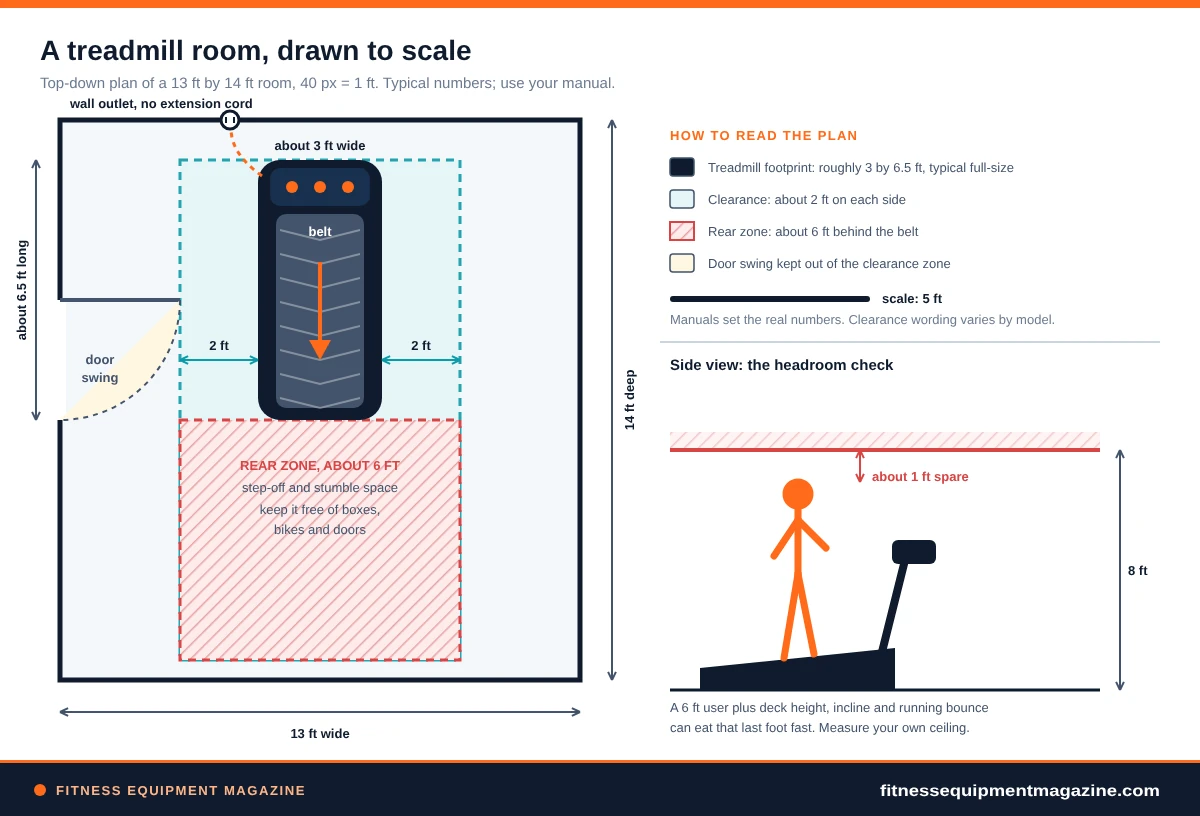
A full-size treadmill commonly measures roughly 70 to 84 inches long and 33 to 40 inches wide, though compact folders can be shorter and narrower. The footprint is only part of the story. Manuals typically ask for open floor behind the belt and along the sides. A common wording is about six feet at the back and around two feet at each side, but manufacturers differ, so read the one for your machine.
Why so much? The back zone is where you step off, and where you land if you stumble. Treat it as part of the machine. Boxes, a bike and a door that opens into it all belong somewhere else.
Ceiling height and the incline lift
Your head, the deck and the incline all stack up. Add the height of the deck off the floor, the extra lift when the front rises and a few inches for the bounce in your stride. For a 6-foot adult on an 8-foot ceiling, the spare room can shrink to around a foot, and that is before you jump on at 10% incline. Taller users who want the best treadmills for home use often need a basement or garage.
Check the ceiling fan, the sprinkler head and the low beam too. They’re the usual culprits.
The path in, and the floor under it
Even the best treadmills for home use arrive in boxes that can weigh well over 150 pounds, and many full-size ones run heavier. Measure the doorways, the stair turns and the hallway. Then measure the room’s own door, because that is the one you’ll walk through every day.
Floors matter as well. A treadmill on thick carpet can feel unsteady and can overheat its motor with lint. A rubber mat helps on hard floors and protects the finish, but check that the mat’s thickness doesn’t throw off the front-to-rear level. Upstairs rooms add one more question: how much vibration will reach the ceiling below? We return to this in the noise section.
Outlets and cords
Most home treadmills plug into a standard 120-volt household outlet, and many manuals want that outlet on its own circuit. Extension cords and cheap power strips are widely discouraged because the motor draws a lot when it starts. Look at where the outlet sits relative to where the console will stand. If the cord has to stretch across a walkway, rethink the layout.
Quick measuring list
Write down five numbers: room length, room width, ceiling height at the planned spot, narrowest doorway on the delivery path, and the distance from the outlet to the front of the machine. Keep the list in your phone. It will save you at checkout.
7 machine types: matching the best treadmills for home use to real shoppers
We don’t name brands here, and that’s a choice. The market churns every year, models get renamed and prices drift. Machine types last longer. Each of the seven below is a profile with a set of criteria that earn it a place on your shortlist. Find your type first, then compare actual best treadmills for home use against its criteria on the seller’s spec sheet.
Evidence level. The shortlist of best treadmills for home use below is research-based: it draws on typical manufacturer specification ranges and on ownership problems that buyers commonly describe. It is not a tested ranking, and the deck sizes are typical ranges, not promises. Verify every figure for the exact model.
1. The compact folding walker
This is the machine for people who walk, sometimes jog lightly, and live where square footage is precious. A belt of roughly 16 to 20 inches by 48 to 55 inches is typical. The deck folds up, and many models roll on built-in wheels so you can park it behind a door or in a closet.
The criteria that earn it a spot are modest but firm. Look for a folding latch you can operate with one hand, a hydraulic or gas-assisted lowering system so the deck doesn’t slam down, and a frame that doesn’t shake at your walking speed. A low minimum speed matters too, since some folders start faster than a gentle stroll.
Strengths
- Stores upright in a small footprint
- Usually the lightest full treadmill to move
- Fine for walking and easy jogging
Tradeoffs
- Shorter belt cramps longer strides
- Folding joints are extra parts to wear
- Lighter frames can shake at running speed
2. The mid-size all-rounder
If one type of the best treadmills for home use deserves the label of default, it’s this one. A belt around 20 by 55 to 60 inches gives most adults room to walk, jog and sometimes run. The frame is heavier than a compact folder’s, the motor is rated for sustained use and the console offers a decent range of speed and incline.
What earns it a place? A belt at least 55 inches long, a continuous-duty motor and a base that feels planted. Some of these fold and some don’t. A non-folding deck tends to be sturdier, while a folding one wins on space. Your room settles that argument, not a brochure.
Most households who read this guide and keep a machine for years will end up here. Among the best treadmills for home use, it’s the least dramatic answer, and often the right one.
3. The serious runner’s machine
Regular runners, tall people and anyone doing hard intervals belong in this tier. A belt of about 20 to 22 inches by 60 inches is the common standard. The motor is larger and the frame is more rigid. Cushioning is usually more refined, and the console responds quickly to speed and incline changes.
The criteria for the best treadmills for home use in this tier are strict. Look for a 60-inch belt, a high top speed with headroom above your normal pace, strong stability at speed and a warranty with real length on the frame and motor. You’ll also want a fast incline motor if you do hill intervals.
You’ll pay in weight, too. These machines are often too heavy to move alone, so plan the final location before delivery. A runner’s machine is a decision about a spot in your home, not just a purchase.
4. The heavy-duty, high-capacity machine
Some buyers need more capacity than a typical machine offers, and others simply put in a lot of hours. A heavy-duty machine commonly lists a higher user weight rating, often 350 pounds or more, a thicker frame and a larger motor. Households with several runners and small studios sharing equipment fit here as well.
Watch the wording. A listed capacity is the maximum the manufacturer states, and reasonable shoppers leave a margin beneath it. Check the rating for the whole machine, as some list a lower number for running than for walking. Also check the warranty terms for commercial or shared-use exclusions.
Plan for the delivery, since the best treadmills for home use in this tier are also the heaviest. These machines can top 300 pounds, which means two or three people for the stairs and a wide path to the room.
5. The incline-focused trainer
Some treadmills lean into steep climbs, with incline ranges far beyond the usual 10 to 15 percent. They suit people who like hill workouts and walking at gradients that feel closer to a trail. The belts are often shorter and slower at the top end, since the design aims at climbing rather than sprinting.
What earns it a place is a smooth, quiet incline motor, a stable frame at steep angles and clear controls. The extra moving parts also mean more to maintain and more to cover under the warranty, so read the incline motor’s coverage line closely. Check ceiling height with care too, because a tall incline lifts you toward the light fixture.
6. The under-desk walking pad
A walking pad is a flat, low belt designed for slow, steady walking, often under a desk. A typical belt is about 16 to 17 inches wide and 40 to 45 inches long, with no handrails and a top speed that suits walking rather than running. It slides under a sofa or leans on a wall.
If your goal is steady steps through the workday, it’s an honest and affordable choice. If you ever picture yourself jogging, though, it’s the wrong tool. We compare the two directly in our walking pad versus treadmill comparison, which is worth reading before you commit.
7. The budget-first pick
This isn’t a separate machine so much as a mindset: you have a price ceiling and you won’t go past it. The honest approach to finding the best treadmills for home use on a budget is to pick your type from the six above, then find the cheapest version that still clears the non-negotiables. Those are belt size, frame stability and a warranty you understand.
Features you can drop without much pain include a large touchscreen, dozens of preset programs and fancy audio. What you can’t drop is the physical stuff. We go deeper in our guide to which features matter most on a budget treadmill.
A common trap
Budget shoppers often chase the longest feature list at the lowest price. That usually means a thin frame carrying a large screen. If you have to give up something, give up the screen.
Choose it if, skip it if: a quick match
A shortlist of best treadmills for home use stays useful only if each type has an honest “not for you” line. Here are both, side by side.
Type 1
Compact folding walker
Choose it for daily walking and light jogging in a small home. Skip it if you’re tall or you run most days.
Type 2
Mid-size all-rounder
Choose it for mixed use and one to three users. Skip it if you need a rock-solid sprint platform or a tiny footprint.
Type 3
Runner’s machine
Choose it for regular running and long strides. Skip it if you only walk, since you’d pay for strength you won’t use.
Type 4
Heavy-duty
Choose it for high capacity or heavy shared use. Skip it if your path in is narrow or your floor is weak.
Type 5
Incline trainer
Choose it for steep climbs and hill walking. Skip it if you want to sprint, or your ceiling is low.
Type 6
Walking pad
Choose it for slow steps under a desk. Skip it if you may ever jog, or you want handrails.
Type 7
Budget-first
Choose it when price is the firm limit. Skip it if it forces you below a safe belt size or a clear warranty.
Find your type with a quick route map
If the seven profiles still feel like a blur, follow the route below to the best treadmills for home use for your situation. It doesn’t replace thinking about your room, but it gets you to the right neighborhood fast. Notice that the heavy and runner branches appear only after you answer a question about running frequency and weight. That order is deliberate.
Anatomy of a home treadmill: what each part does
Spec sheets throw around words like “deck,” “roller” and “duty rating” as if everyone grew up in a gym. It helps to know the parts once, because every criterion used to judge the best treadmills for home use points back to one of them.
From the belt down
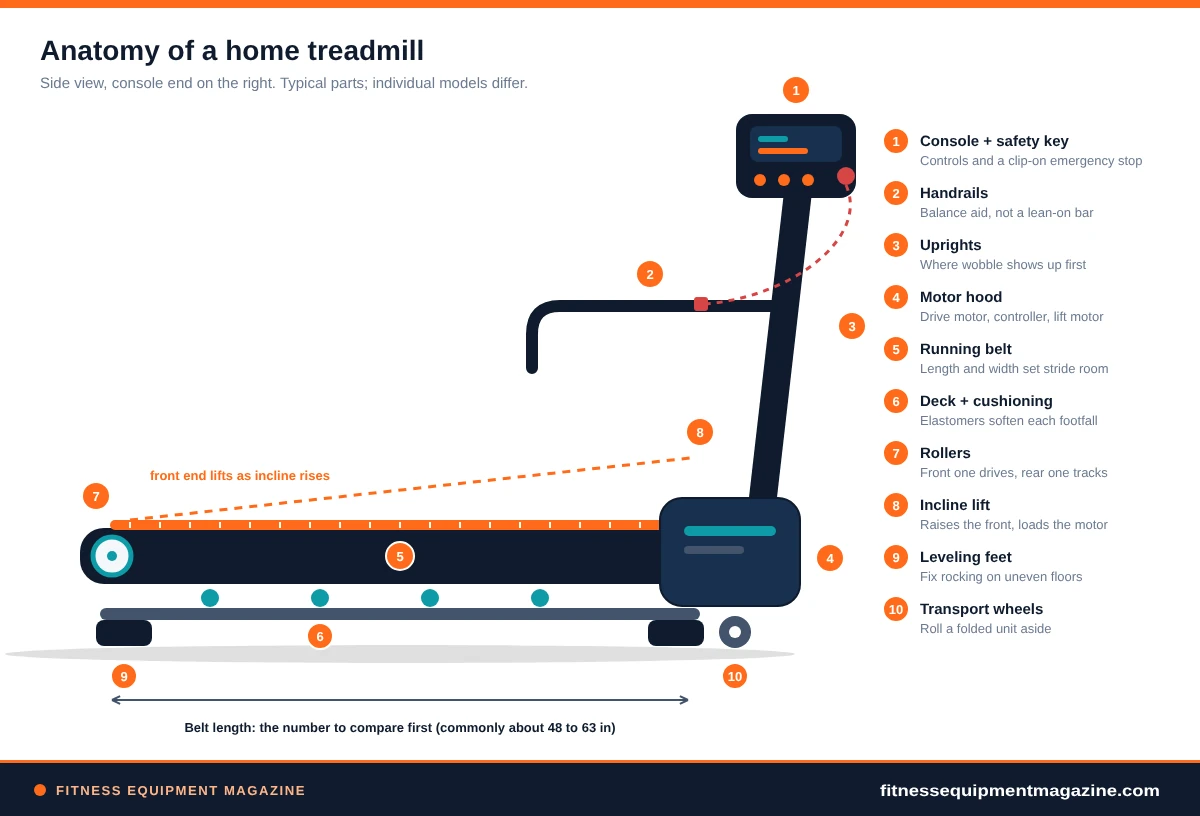
The running belt is the moving surface under your feet. It loops around two rollers, one at each end. The front roller is driven by the motor, and the rear roller follows along. Under the belt sits the deck, a flat board that supports your weight and slides the belt over a low-friction surface.
Between the deck and the frame, most machines place a cushioning system. It might be rubber elastomers, springs or a flexing deck design. Its job is to soften impact and, on a good design, keep the feel consistent from the front of the belt to the rear. Beneath everything is the base frame with its leveling feet and, on many models, small transport wheels.
From the motor up
At the front, a motor hood covers the drive motor, the controller board and, on machines with incline, a second lift motor. A heavy hood is not always a good sign or a bad one. But a hood that gets warm to the touch and smells of hot plastic after a normal session is worth reporting to the seller.
Two uprights carry the console and the handrails. The uprights are where wobble shows. If you shake the console gently and it sways, you’ll feel the same sway at 7 mph. The safety key, a tether clipped to your clothing, plugs into the console and cuts power if it pulls free. We’ll return to it in the safety section.
Deck size and stride: the spec that decides comfort
If we could make you check only one number on the best treadmills for home use, it would be the belt size. Everything else can be adjusted around it. A belt that’s too short makes you shorten your stride, tense up and hover near the front of the machine.
Belt length
Commonly, walking pads run about 40 to 45 inches. Compact folders usually land between 48 and 55. Mid-size machines often list 55 to 60 inches, and runner-grade machines start at 60 and may go to 63 or more. A longer belt gives you room for your stride and a little drift without stepping on the plastic shrouds.
Taller people need more belt, and faster running needs more still. Many runners over about 6 feet look for 60 inches. Even so, there’s no standard test everyone agrees on. Treat 60 inches as a common rule of thumb, not a law.
Belt width
Width is more forgiving. Many walkers are comfortable on 16 to 18 inches, and 20 inches is a common size for jogging and running. Wider belts, near 22 inches, give a feeling of space, but they also make the whole machine bigger and heavier. If you tend to veer left or right when you tire, choose width over fancy features.
A simple stride test you can do at home
- Mark a floor linePut tape on a hallway floor and walk past it at your normal pace.
- Measure heel to heelHave someone mark where one heel lands and then where the next lands. That gap is your step.
- Repeat at a jogYour running stride is longer, so measure it too if you run.
- Add bufferCompare the longer number to the belt length and leave a good margin for drift. If the margin looks thin, go up a size.
It’s rough and unscientific, but it will tell you more about your needs than most lists of the best treadmills for home use. For the underlying reasoning on every belt dimension, our in-depth guide to treadmill belt size, motor and cushioning goes through the geometry in detail.
Folding versus fixed deck
A folding deck costs you a little rigidity, since there’s a hinge in the middle of the structure. Most buyers who fold their machine daily accept that. If you rarely fold, a fixed deck is the more solid choice.
Motor, duty rating and weight capacity
Motor numbers cause more confusion than any other spec on the best treadmills for home use. Listings quote “peak horsepower,” “continuous duty horsepower” or just “HP,” and there’s no single standard that makes these comparable across makers. A higher number usually signals a bigger motor. It doesn’t guarantee a better treadmill.
What the numbers usually mean
Continuous-duty horsepower (CHP) describes what a motor is said to deliver for long stretches. As a rough guide, many walking-and-jogging machines list around 2.0 to 3.0 CHP, while runner-grade machines often list 3.0 or more. Buyers with heavier loads, several users or hard intervals benefit from headroom above the minimum.
The motor is only one link. A strong motor hooked to a weak controller or a loose drive belt will still disappoint. Pay attention to how the machine behaves when speed changes. A smooth ramp is a better sign than a number on a box.
User weight capacity
Every machine lists a maximum user weight. Common ratings run from about 250 to 300 pounds for mainstream machines and 350 or more for heavy-duty ones. Many shoppers choose a rating comfortably above their body weight, often by a margin of fifty pounds or more, because running multiplies the forces on the frame. That margin is a rule of thumb, not a standard.
Check how the manufacturer words the limit. Some list a lower capacity for running than for walking. For anyone near the upper end, the right answer is the next tier up, not a “close enough” model.
Duty is about hours, too
A machine used for 30 minutes a few times a week lives a gentle life. One that runs for an hour or more most days, or is shared by a family, uses up its parts faster. If that’s your plan, move up a tier.
Speed and incline ranges: match them to your week
Top speed headlines on the best treadmills for home use often reach 10 or 12 mph. That’s more than most home users ever need, so don’t pay extra for a number you won’t touch. What’s more useful is the low end and the middle. A machine that starts at 0.5 mph and climbs smoothly in small steps feels better to a walker than one that jumps from 1 to 2.
Incline: how much is enough
Typical incline ranges run from 0 to 10 or 15 percent on mainstream machines. A few reach much higher. A modest incline is a simple way to change the effort of a walk without speeding up. Regular runners often keep it low, around 1 percent, to approximate outdoor running. These are common habits, not rules.
The more important question is how fast the incline changes. In interval workouts, a slow lift makes your pace feel awkward. On many machines the incline motor is a separate part with its own warranty line, and it’s a common repair item. Read the coverage language before you pay extra for a steeper range.
What about decline?
A few higher-end machines offer a negative gradient. If you’re thinking of it for downhill training, remember that it means extra mechanics and more space for the rear to drop. For most home users, it’s a nice-to-have at best.
Rule of thumb
Choose a top speed 2 to 3 mph above your regular running pace, and choose the incline range based on whether you’ll really climb. Everything beyond that is a bonus you may never use.
Cushioning, frame and stability
Stability is the quiet quality nobody advertises well. It’s the difference between a machine that feels like part of the floor and one that hums, wobbles and walks a few inches across the room. Most long-term complaints that owners describe trace back to this, not to the console. That’s why stability sits near the top of any list of the best treadmills for home use.
Cushioning: soft is not the goal
Marketing loves the word “cushioned.” In practice, buyers react to cushioning very differently. Some like a springy deck, and others find a soft belt tiring. The sturdier test is consistency. Does the belt feel the same at the front and the back? Does it bounce you back awkwardly at running speed? These are things a showroom visit or a generous return window can answer. A spec sheet can’t.
If you’ve had foot, knee or back concerns in the past, ask a clinician what surface and impact level suit you. We don’t make claims about what any deck feels like for a given body.
Frame, rollers and the shake test
Heavier is not always better, but a very light frame is often a warning. Look at the roller diameter. Commonly, larger rollers, around 2.5 inches or more on stronger machines, are gentler on belts and bearings. Look at the thickness of the uprights, and at how many bolts hold the console to them.
When you can test a machine in person, try this. Stand on the deck, hold the rails, and rock your weight from side to side. Then walk at a medium pace and glance at the console. If it vibrates enough to blur the numbers, imagine it at a jog. If a store can’t let you try, ask the seller about the return policy and who pays for pickup, because shipping a treadmill back is often expensive.
- The console stays steady when you hold the rails and walk briskly.
- The belt stays centered without constant tracking adjustments.
- The machine doesn’t creep across the floor under load.
- The leveling feet are adjustable and the frame sits flat on them.
Consoles, connected features and subscriptions
A treadmill console is a control panel, and in recent years it has also become a storefront. The screen on a machine can run workouts, stream classes and push you toward a monthly plan. That’s fine if you want it. It becomes a problem when you pay for hardware you’ll never use or discover that half the console is locked.
What you really need on the console
Large, readable numbers for speed, time, distance and incline. Quick-select buttons for speed and incline, so you aren’t tapping a dozen times to move up one mile an hour. A prominent stop button and a good key slot. A device holder if you’d rather stream your own show. For many people that’s the full list.
Connected features and the subscription question
Connected consoles frequently depend on an account and a paid plan. Plan prices vary by service and change over time, and in the US market they have often landed somewhere around $10 to $45 a month. Verify the current price. Then ask three questions before you buy:
- Does the machine still work without the plan, including speed and incline control?
- Is the trial a free month or a free year, and what’s the price after?
- If the service closes or changes, what happens to the console you already paid for?
These questions matter because some consoles lose guided features, or even basic functions, when a subscription lapses. Others work perfectly well in manual mode. Seller listings don’t always make that clear, so read the fine print and the owner’s manual if it’s posted online.
Watch the lock-in
A big touchscreen is a repair risk, an update risk and a subscription hook. If you mostly want to watch something while you walk, a simple console with a tablet shelf can be the longer-lived choice.
Noise, neighbors and power needs
Noise is a real feature of the best treadmills for home use, and it has two sources that people mix up. The first is the machine itself: motor hum, belt friction and rattling parts. The second is the impact of your feet, which travels through the floor. A quiet motor won’t help the neighbor downstairs if your jog thumps through the joists.
Machine noise
We can’t give you decibel figures, because we haven’t measured any machine, and we’d distrust anyone who quotes them without a test setup. What you can do is read owner feedback for patterns. Common complaints include a high-pitched belt squeal, a loud incline motor and a rattle from loose bolts. Many of those get better with lubrication where the manual calls for it, tightening and proper leveling.
Floor noise and vibration
On upper floors, a thick rubber mat under the treadmill can help absorb some impact and reduce what travels downward. So can placing the machine along a load-bearing wall rather than mid-span. Treat these as general tips and expect mixed results. If you live above someone, a walking-only machine is far kinder than a runner.
Power
A standard 120-volt outlet is the norm for home machines. Most manuals call for a dedicated circuit and advise against extension cords and standard power strips. A few high-demand machines use a larger circuit. Always confirm in the spec sheet. If the room’s circuit is already shared with a space heater or window air conditioner, the breaker may trip at the worst possible moment.
Delivery, assembly and moving day
This is the section nobody reads until the truck is in the driveway. Treadmills are heavy, awkward and often arrive on a pallet. Plan before you order the best treadmills for home use, not after.
Curbside, room-of-choice and white-glove
Delivery options usually come in three flavors. Curbside means the driver leaves the box at the street or the door. Room of choice means the crew brings it indoors. White-glove adds unboxing, assembly and removal of the packaging. Prices and availability vary by retailer. If stairs are involved, ask whether the crew carries up flights and whether that fee is extra.
Assembly reality
Many treadmills arrive mostly assembled, with the uprights and console to attach. That’s commonly a one-to-three-hour job for two people. Some come with professional assembly as an add-on. The most common mistakes are rushing the cable connections and not tightening the bolts in the stated order.
- Clear a large spaceYou need room to open the box and lay out the parts, plus a path to carry the finished machine.
- Get a second personLifting uprights and aligning bolt holes is a two-person task. Don’t improvise.
- Follow the orderTighten hardware in the sequence the manual lists, then do a final check of every bolt.
- Level before the first runUse a small level on the deck and adjust the feet until the machine doesn’t rock.
If you ever have to move it
A treadmill you can’t move is a treadmill you’ll hate on moving day. Note the weight and whether the deck folds and locks. Foldable machines with wheels can usually be tilted and rolled a short way. Fixed decks need a dolly and help.
Warranty and service: reading the fine print
A warranty is a promise about what a manufacturer will fix, for how long. For the best treadmills for home use, it’s also the clearest signal of how confident the maker is in the machine. The problem is that most listings reduce it to one phrase like “lifetime frame,” which says almost nothing.
The typical structure
Coverage usually splits into four lines: the frame, the motor, parts and labor. It’s common to see long coverage on the frame and motor, often 10 years or longer, and much shorter periods for parts and labor, sometimes a year or two at most. Wear items like the belt and deck may be excluded or covered for a shorter time. These are patterns, not promises. The paperwork for the exact model is the only authority.
Questions to ask before you pay
- Who does the repair: the manufacturer, the retailer or a third-party technician?
- Does an in-home visit come with the labor coverage, or do you ship parts yourself?
- Is home use the only covered use? Shared or commercial use is often excluded.
- Does the warranty need registration, and by what deadline?
- Is an extended plan worth it, and what does it exclude?
Ask for the warranty text in writing, and save it with your receipt. A great warranty with nobody to call is worth far less than a decent one with a local service network.
The real cost over five years
Sticker price is just the first line of the bill. Delivery, a mat, electricity, small repairs and optional app plans all add up. When you compare two of the best treadmills for home use, compare what each costs to own, not what it costs to put in the cart.
The picture shows something worth remembering. The sticker price tends to be roughly two-thirds to four-fifths of the five-year total. The rest comes from the extras, and an optional app plan can become the second-biggest slice if you let it.
The line items people forget
- Mat: protects flooring and can calm noise. A basic one is a modest cost.
- Delivery and assembly: sometimes free, sometimes a real fee, especially with stairs.
- Electricity: small per session, a little bigger over years of daily use.
- Upkeep: lubricant if your manual calls for it, belts and the occasional part.
- Plans and accessories: chest straps, tablet holders, subscriptions.
- Return or removal: if it doesn’t work out, what does pickup cost?
Decoding listings: what the spec sheets for the best treadmills for home use really say
Product pages are written to sell, so the same fact can be dressed up three different ways. A little translation goes a long way. Here’s how to read the phrases you’ll meet while comparing the best treadmills for home use, and what to check behind each one.
Phrases about power and speed
“Peak horsepower.” This is the most a motor can produce for a moment, not what it sustains. It’s useful for nothing except making a number look big. Look for the continuous figure, and then watch how the machine behaves in a video or review rather than trusting either.
“Up to 12 mph.” The “up to” is doing real work. It tells you the ceiling, not whether the machine feels stable there. If you run at 7 mph, a stable 10 mph machine beats a shaky 12.
“Max user weight.” Read it as the limit, not the target. As we covered earlier, leave margin, and check whether running and walking carry different limits.
Phrases about build and comfort
“Commercial grade” or “pro level.” No official standard sits behind these words on a home machine. They hint at ambition, nothing more. The real clues are frame weight, roller size and warranty length.
“Shock absorption” or “cushioned deck.” Fine, but vague. Ask what the system is made of and whether the feel changes from front to back. Take claims about joint comfort with a pinch of salt, and talk to a clinician if you have specific concerns.
“Lifetime frame warranty.” Good to see. Then read what “lifetime” means (often the original owner, for home use) and what’s excluded. A frame can be covered while the motor and labor lines are brief.
Phrases about the experience
“Smart” or “interactive.” Usually means a screen plus an account. Find out whether the manual controls still work without the account.
“Easy assembly.” A treadmill is rarely an easy assembly. Expect a second person, a couple of hours and a few awkward moments with a cable.
Star ratings. Look at the shape of the complaints, not the average. Ten reviews describing the same squeak at the same mileage tell you more than a 4.5 average. Also be wary of reviews from the first week, which can’t speak about durability.
Seller questions that cut through the gloss
Ask a retailer for the belt size in inches, the weight of the machine, the weight limit and the warranty document as a file. A seller who answers quickly and plainly is a good sign. If they can’t, treat that as information too.
Safety: kids, pets, the key and recalls
A treadmill is a moving machine in your living space, and it doesn’t turn off when you walk away. The risks are ordinary and well understood. Most of them are solved by habits and placement rather than by buying something fancier, so safety belongs in any honest list of the best treadmills for home use.
Safety first
Keep children and pets away from a running or recently used treadmill, and never leave one running unattended. Read your owner’s manual for the manufacturer’s own safety rules, which override anything general here.
Children and pets
Small hands and paws find the gap between the belt and the front shroud, and the rollers can pinch. Toddlers climb on anything. A treadmill that’s off but still plugged in can be started by a curious child, and the belt may begin to move faster than they can handle.
The simplest rules are the best ones. Take the safety key out and keep it somewhere high when you finish. Unplug the machine if kids are around often. Put the treadmill in a room with a door that closes, or fold it and lock the deck when it’s not in use. If you own a dog that likes to follow you, give it a different job during your session.
The safety key habit
The safety key is a clip tethered to a magnet or plug on the console. If you stumble and move away from the console, the key pulls free and the belt stops. It only works if you clip it to your waistband or shirt every time. People skip it because it feels fussy. It takes two seconds.
- Clip the key to your clothing before the belt starts, every time.
- Stand on the side rails while you start the belt, then step on from the side.
- Begin at the lowest speed, then adjust.
- Hold the rails to step off, and wait for the belt to stop completely.
- Remove the key when you’re done and store it out of reach.
Check the CPSC recall list
The U.S. Consumer Product Safety Commission maintains a public list of exercise equipment recalls, including treadmills. Before you buy any of the best treadmills for home use, search it for the brand and the model name. Do it again for a used machine, and again a year after you buy, because recalls get announced after a product has been sold for a while. The list lives on the CPSC exercise equipment recall page. If you find your model there, follow the remedy the notice describes.
Setup and placement: getting it right the first day
Where one of the best treadmills for home use sits affects how often you use it. A machine in a dim, cold corner of the basement becomes a clothes rack. One facing a window or a screen gets used. So think about the experience, not only the clearance.
Choosing the spot
Aim for a spot with some air movement. A fan helps, and a window you can crack open is better. Place the front toward a wall or a screen, a sensible distance from the screen’s face, and keep the rear open. Avoid placing the machine in front of a door, a staircase or a window with a long drop. And keep the console out of direct sun, which can fade the display and heat the electronics.
Leveling and the mat
Put the treadmill on a mat before final leveling, not after. Then use the leveling feet to set the deck flat. A small bubble level costs very little. A machine that rocks wears its belt unevenly and rattles at every step.
Garage, basement or spare room
Each room type has a quirk that affects the best treadmills for home use differently. Garages swing in temperature and collect dust, and both can be hard on electronics and belts. Basements trap humidity, so a dehumidifier and a mat that lets air move beneath help. Spare rooms are comfortable, yet they’re often on upper floors, where noise and vibration matter more. Wherever you put it, keep the machine away from open windows and sprinklers, and avoid damp floors.
If the machine will live in a garage, ask the seller whether the manual allows that environment. Some specify an operating temperature range, and ignoring it can complicate a warranty claim.
Your first session
- Read the manual’s start-up sectionEvery model differs, so skim it even if you’ve used treadmills before.
- Straddle and start slowBegin at the lowest speed with the belt moving while you stand on the rails.
- Check the belt centeringWatch for drifting to one side. A small drift in the first week can be normal and may need a tracking adjustment per the manual.
- Test the stop controlsPractice the safety key and the stop button before you need them.
- Keep the first run shortThe machine is new, and so is the rhythm.
Most owners find that a small shelf or hook for a towel and water bottle makes them use the machine more. It sounds trivial. It isn’t.
The first month decides whether you keep using it
Even the best treadmills for home use tend to get used hard for two weeks and then vanish from the routine. A little structure beats willpower. Pick three fixed slots in your calendar, keep sessions short enough to finish, and leave the machine in a place you pass daily. Stay on the low end of speed and incline while the belt and your legs settle in, and raise one thing at a time.
It also helps to treat the first month as a trial for the machine. Note any noise, drift or smell, and report it while the return window is open. Fixing a problem in week two is far easier than arguing about it in month nine.
Small-space tactics for the best treadmills for home use
Tight homes can still hold a treadmill. They just need a plan. The trick is to treat the machine as a piece of furniture with a schedule, not a permanent fixture you’ve lost the argument with.
Fold, roll and park
A folding deck stored upright takes a fraction of its working footprint. Before you buy, check the folded height against your ceiling and the folded depth against the wall or closet you have in mind. Look for a latch that locks the deck firmly in both positions. Wheels let you roll it aside, though thick carpet may stop them, so measure that path too.
Layouts that work in a studio or a bedroom
- Window wall: the front faces a window, the rear is open to the room, and a rug stays rolled away during sessions.
- Closet alcove: a folded machine stands in the alcove, then rolls out and unfolds in the same spot each day.
- Dual-use corner: a mat marks the zone, and a small shelf holds towels and a tablet so nothing else drifts in.
Whatever the layout, keep the rear fall zone clear while you’re on the belt. A folded machine, a clothes rack or a pile of boxes in that space turns a stumble into a trip to urgent care.
Keeping the peace with neighbors
Pick your hours. A 6 a.m. jog above a bedroom is an unfair fight, while a mid-morning walk may be fine. Use a mat, level the machine and keep the belt maintained as your manual describes. If the sound still carries, switch to walking sessions at those times. For small homes, the best treadmills for home use are often the ones you can use at a pace that doesn’t announce itself to the building.
Maintenance basics that keep a machine alive
The best treadmills for home use are among the most reliable pieces of home gym equipment when they’re cared for, and among the most frustrating when they aren’t. Dust, sweat and friction do most of the damage. Luckily, they can be handled in minutes.
A simple routine
After each use
Wipe and unplug
Wipe the console and rails with a slightly damp cloth, and avoid soaking anything. Remove the safety key and, if you can, switch the machine off at the power switch.
Every week
Look and vacuum
Check the belt’s centering and the area around the machine for dust and pet hair. Vacuum around the motor hood from the outside, never inside it.
Every month
Check hardware
Tighten visible bolts, look at the power cord for kinks or heat marks and check that the leveling feet haven’t moved.
Per the manual
Lubrication and belt
Some belts need lubricant on a schedule, and some are sealed. Follow the manual for your model, and never assume.
Signs something needs attention
- A burning smell, or a hot odor from the motor hood.
- A belt that keeps drifting despite adjustments.
- Squealing, grinding or a sudden surge in noise.
- Hesitation or stuttering when you change speed.
- Visible fraying of the belt edge or a damaged cord.
When any of these shows up, stop using the machine and unplug it. Check the manual’s troubleshooting page and call the seller or manufacturer. A $30 fix caught early can prevent a $300 one.
Accessories for the best treadmills for home use: what earns its space
Accessory lists tend to be long and mostly unnecessary. A few items, though, make a real difference to how often a treadmill gets used and how long it lasts.
Worth buying
- A treadmill mat. It protects the floor, catches dust and softens vibration. Pick one sized for your machine and keep it flat.
- A tablet or book shelf. It’s the cheapest upgrade over a built-in screen, and it follows you to your next machine.
- A fan. Moving air makes sessions feel easier and keeps the console cooler.
- A small level. Used once at setup and again after a move.
- Lubricant made for treadmills, only if your manual calls for it. Never use general-purpose sprays on the deck.
Probably skip
- Add-on screens and extra consoles. They duplicate what your phone already does.
- Heavy-duty covers for indoor machines. They trap moisture. A simple dust sheet is plenty.
- Cheap power strips. Plug directly into the wall unless the manual says otherwise.
When you shop for accessories, check that each one fits the exact machine type you chose. A mat that’s too short leaves the rear fall zone bare, and a shelf that blocks the safety key slot defeats the point.
Ten mistakes that sink good treadmill purchases
None of these are rare. Many appear again and again in the complaints buyers describe in reviews and forums, which is why we list them. Spot yours before you click on any of the best treadmills for home use.
Mistakes about size
1. Buying for the person you hope to be. If you walk today, buy a walker’s machine, perhaps with some headroom. A running machine for a future you who may never run is an expensive coat rack.
2. Ignoring the ceiling. The treadmill is fine. Your head isn’t. Do the headroom math in the room section before ordering.
3. Skipping the path in. A treadmill that can’t make the turn at the stairs will end up in the garage, or back in the truck.
4. Underestimating clearance. The rear fall zone is not optional furniture space.
Mistakes about features
5. Paying for the screen. The part you’ll touch daily is the belt. The part you might use occasionally is the display.
6. Ignoring the subscription. Add the plan price to your monthly cost before deciding.
7. Trusting one big number. Peak horsepower, top speed and incline range don’t tell you how steady the machine feels.
Mistakes about the buying process
8. Skipping the warranty text. The short version in the ad hides the useful details. Read the whole page.
9. Forgetting the recall check. It takes a minute on the CPSC site.
10. Having no plan for the first month. The first weeks decide whether you keep using it. Put a time in your calendar, and start with short sessions.
Seven myths about the best treadmills for home use
Shopping for the best treadmills for home use attracts folklore. Some of it is harmless, and some of it costs real money. Here are the ones we hear most, with a plain answer for each.
Myths about power and price
Myth: more horsepower always means a better machine. A big motor in a flimsy frame is still a flimsy machine. Horsepower numbers aren’t measured the same way across sellers, so treat them as one clue among several.
Myth: expensive means durable. Price tracks features and brand as much as build. A pricey machine with a large screen may have a thinner frame than a plainer one nearby. Check the frame weight and warranty, not the price tag.
Myth: a treadmill pays for itself against a gym membership. It might, if you use it often for years. If it sits idle after March, it won’t. Count the five-year cost and your honest weekly use before you decide.
Myths about fit and use
Myth: folding treadmills are always flimsy. Some are, and some are perfectly sturdy for walking and jogging. The hinge adds a failure point, yet a good folder with a stable frame is often the right answer for a small home. Judge it on the shake test and the warranty.
Myth: a softer deck is always kinder. Comfort is personal. A very soft deck can feel unstable for some people at speed. The goal is consistency, not squishiness.
Myth: you need a treadmill to be serious about running. Plenty of people run outdoors and use a treadmill only on bad weather days. For them, a modest mid-size machine may be plenty, and a runner’s machine would be overkill.
Myth: all treadmills are too loud for an apartment. Walking-speed use on a well-leveled machine with a mat can be quite mild. The floor-impact noise from running is the bigger issue, and a walking-focused choice avoids it.
A decision framework for the best treadmills for home use
You now have the pieces. Here is how to put them together without spreadsheets or a week of tabs. The framework works in four passes: narrow by use, narrow by room, narrow by risk, then compare on cost. Each pass removes options, so by the end you’re choosing between two or three of the best treadmills for home use, not forty.
Four passes to a shortlist
- Pass one: usePick your type from the seven. If you hesitate between two neighbors, such as a compact folder and a mid-size, go with the larger belt unless the room forbids it.
- Pass two: roomCheck footprint, clearance, ceiling and path. Any machine that fails one of these is out, however good it looks.
- Pass three: riskRemove machines with unclear warranties, a recall history you can’t resolve, or a subscription that locks basic functions.
- Pass four: costEstimate five-year ownership. If two machines are close, choose the one with the sturdier frame and the clearer service path.
Where to put your attention
Not every criterion deserves equal weight. For a typical mixed-use household, we’d weigh the criteria for the best treadmills for home use roughly as below. These percentages are our editorial suggestion for how to spend your attention. They aren’t survey results, and a heavy runner or an apartment dweller would shift them.
Notice how little the console gets. That isn’t because screens are bad. It’s because they’re the part of a treadmill you can most easily replace with a tablet, and the part you can least easily fix when the frame shakes.
If this, then that
- If you walk and the room is tiny, choose a compact folder or a walking pad, and put quiet operation above top speed.
- If you jog twice a week and share the machine, choose the mid-size all-rounder with a capacity margin.
- If you’re tall or you run most days, choose a 60-inch deck and a heavier frame, and budget for delivery help.
- If you weigh near the stated limit of mid-size machines, step up to the heavy-duty tier. Don’t test the limit.
- If you love hills, consider the incline trainer, and confirm your ceiling can take the lift.
- If money is the main limit, stay on your branch and trim features, not stability.
Want to rerun the route map? Scroll back to the machine types section. The questions stay the same: how much you walk, how tall you are, how heavy the use will be and what the room allows.
What about a used treadmill?
A used machine can be a bargain among the best treadmills for home use, but it needs a closer look. Ask for the model name and look up recalls. Check the belt for fraying and the deck for wear. Look at the cord. Run it at several speeds and listen for grinding. Warranties may not transfer, and you’ll likely be carrying it out yourself. If any of that sounds like too much, the extra cost of a new machine buys you a clear start.
Questions to ask before you pay
- What is the return window, and who pays for pickup if I return it?
- What exactly does delivery include, and where does the crew stop?
- Which parts are covered, for how long, and who does the service?
- Does the console work fully with no paid plan?
- Is this the current model, and are replacement belts and parts stocked?
Three hypothetical walkthroughs of the best treadmills for home use
Frameworks are easier to trust when you watch them work. Below, we run our four passes on three invented shoppers. They aren’t real customers, and their numbers are illustrative, but the logic is the one you can copy.
Dana: the apartment walker
Dana walks about 45 minutes most evenings and has no plans to run. Use: a walker, so the compact tier is enough. Room: a 9-foot-wide bedroom nook, an 8-foot ceiling and a downstairs neighbor. A runner’s footprint is out. Risk: she skips machines whose consoles lock behind a plan. Cost: she compares a compact folder and a walking pad. Because she wants a handrail and a longer belt for comfort, she picks the folder. The pad is saved for her partner’s desk.
What she avoids is as useful as what she picks. She ignores top speed and incline range, since neither fits her week.
Marcus: the tall runner with a garage
Marcus is tall, runs four days a week and does one interval session. Use: runner’s tier. Room: a garage with a high ceiling and a 6-foot rear clearance. The path in is a double-wide door. Risk: he reads the warranty line by line and notes the commercial-use exclusion. Cost: he adds a mat, assembly help and garage temperature swings to his estimate, and decides a covered corner is worth the cost. His final pick has a 60-inch belt, a heavier frame and a quick incline.
The Okafor household: the shared machine
Two adults, a teen and a dog. Use: varied, from walking to jogging. Room: a spare room with a door that closes, which solves the pet problem. Risk: a clear key rule for the teenager, and an unplugged machine when nobody’s home. Cost: they compare mid-size machines with high weight limits, and the one with the longest frame and motor coverage wins, even though a feature-heavy rival was a bit cheaper.
What these examples show
In each case the winning machine wasn’t the one with the longest feature list. It was the one that cleared the room, the use and the risk passes, then won on ownership cost.
Your pre-checkout checklist for the best treadmills for home use
Copy this list for the best treadmills for home use into your notes app and tick it off before you pay. It condenses the whole guide into questions you can answer in an evening.
About you and the room
- I wrote down my honest weekly minutes, my regular top speed and every user.
- I measured room length, width and ceiling height, and added the incline lift.
- I measured the doorways, the stair turns and the path to the room.
- The outlet is within reach and I won’t need an extension cord.
About the machine
- The belt length fits my stride test, with margin to spare.
- The weight limit sits comfortably above the heaviest user.
- The frame is stable, and I’ve read owner feedback about wobble and noise.
- The console works fully without a paid plan, or I’ve priced the plan.
About the paperwork
- I searched the CPSC recall list for this exact model name.
- I read the warranty text and know who does the repair.
- I know the return window and who pays for pickup.
- I estimated five-year cost, not just the sticker.
If you can tick every box, you’re ready. If you can’t, you’ve just saved yourself a return shipment.
When a treadmill is not the right buy
We run a magazine about equipment, and even when the subject is the best treadmills for home use, we’ll still say it: sometimes the right move is not to buy one. A treadmill is a big commitment of space, money and habit. It works best for people who will use it. If several of the following ring true, take a breath before you order.
Situations where another choice may fit better
Think twice if
- You love running outdoors and only want a backup for bad weather
- Your only free space is a room with a low ceiling
- You’re on a short lease and move every year
- You have a baby or toddler and no room that closes
- The noise would affect a neighbor you can’t avoid
Better matches
- A gym membership for rainy days
- A walking pad for light daily steps
- A bike or rower, which may fit a smaller footprint
- A weighted vest and a good pair of shoes
- Waiting until you have a stable room
None of these is a failure. A treadmill that sits unused is the worst possible outcome, for your wallet and your floor. If you aren’t sure, borrow one for a month or use a gym treadmill for a few weeks before you buy. You’ll learn whether the habit sticks.
Best treadmills for home use: frequently asked questions
Sizing and space
What are the best treadmills for home use for most people?
For most households, a mid-size all-rounder with a belt near 20 by 55 to 60 inches, a continuous-duty motor and a stable frame is the safe starting point. It handles walking, jogging and occasional running. Smaller rooms may call for a compact folder, and taller or heavier runners should look at a runner’s or heavy-duty tier. Always verify specifications with the seller.
How big a belt should the best treadmills for home use have?
Walkers are often comfortable on belts around 48 inches long and 16 to 18 inches wide. Joggers and runners usually want 55 to 60 inches by 20 inches or more. Many people over about 6 feet look for a 60-inch belt. Because strides differ, do the simple heel-to-heel stride test in this guide, then add a margin.
How much space do I need around a home treadmill?
Manuals commonly ask for about six feet of open floor behind the belt and around two feet at each side, plus enough ceiling height for your head and the incline lift. These numbers vary by model, so follow the manual. Measure the room, the doorways and the delivery path before you buy.
Picking and paying
Is a walking pad enough, or do I need a full treadmill?
If you plan only to walk at a slow, steady pace, often under a desk, a walking pad can be enough and takes far less space. If you want to jog or run, a full treadmill is the better tool. Our walking pad comparison goes through the tradeoffs.
How much should I spend on a treadmill?
Prices change often, so we avoid quoting one. A better approach is to set a ceiling for the five-year cost, including delivery, a mat, upkeep and any plan, then pick the type among the best treadmills for home use that fits. Spend on stability and belt size before features. For tight budgets, see our budget treadmill guide.
Do I need a treadmill subscription?
Not always. Some machines work fully in manual mode, while others limit features without a paid plan. Check whether speed and incline control still work, how long the trial lasts and what the plan costs after it. Prices change, so verify them before buying.
Safety and ownership
Are treadmills safe for kids and pets?
A moving treadmill is a hazard for small children and animals. Keep them away during use, remove the safety key afterward, unplug the machine or fold it when it’s not in use, and put it in a room with a door that closes. Follow the manufacturer’s safety instructions.
How do I check if a treadmill has been recalled?
Search the CPSC exercise equipment recall list for the brand and the model name, and repeat the search for used machines. The list is on the CPSC website. If your model appears, follow the notice’s remedy and contact the manufacturer.
How long do the best treadmills for home use last?
Lifespan depends on use, build quality and care. A well-kept machine used moderately can run for many years. A light one used hard may need repairs sooner. Warranty length, frame weight and routine maintenance are the best clues you have before you buy.
Conclusion: choosing the best treadmills for home use
If you remember only a few things, make them these. Start from how you’ll really use the machine and what your room allows. Pick your type from the seven, then judge actual products by belt size, frame stability, duty rating, warranty and noise before you glance at the console. Add up the five-year cost. Check the CPSC list. Read the warranty text.
The best treadmills for home use aren’t the ones with the biggest numbers. They’re the ones that fit the person, the floor and the weekly routine, so they keep getting used. When you’re ready, use the checklist above, and check current price and warranty terms with the seller before you commit.
Sources and further reading
- Physical Activity Guidelines for Americans (HHS) — federal guidance on weekly activity amounts.
- CPSC: Exercise Equipment recalls — the public recall list to search before you buy.
- ACSM: Top Fitness Trends 2026 — general context on where home fitness interest is heading.
- Manufacturer owner’s manuals and spec sheets for any model you consider. They are the final authority on clearance, power and warranty terms.
Editorial note: this article is research-based guidance, not a product test, and it names no brands. Some links on this site may be affiliate links. If you buy through them we may earn a commission at no extra cost to you. Recommendations are based on the criteria in the article, not payout. Last reviewed October 2026. Specifications, prices, warranties and recalls change, so verify them with the seller and the CPSC before you buy.