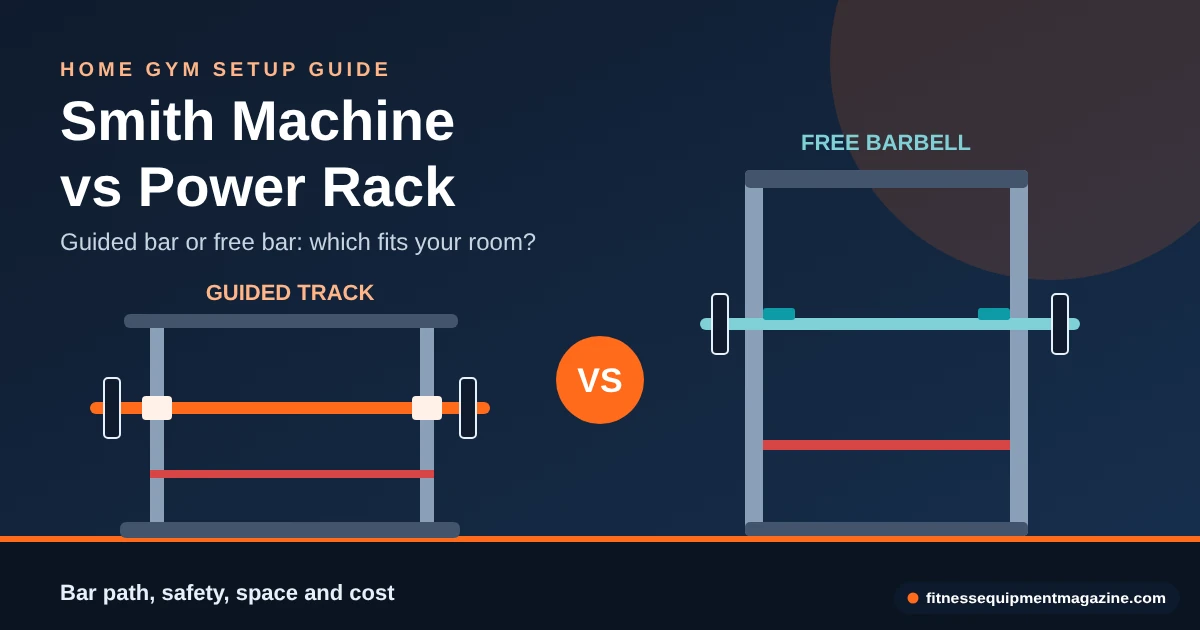
Smith machine vs power rack is the argument that starts in almost every home-gym plan, usually right after someone prices a barbell. One option gives you a bar that glides on rails and locks anywhere with a twist of the wrist. The other gives you four steel posts, a free barbell and a lot more freedom. Both can hold a heavy squat. They just ask very different things of you, your room and your wallet.
Picture the first month after you buy. Maybe you’re alone in the garage at 6 a.m. with a bar on your back and nobody to call if the rep stalls. Maybe it’s a spare bedroom where the ceiling is lower than you hoped. Or maybe two people share the space and one of them has never squatted before.
Those scenes decide the Smith machine vs power rack question far more than any spec sheet. This Smith machine vs power rack guide walks through bar path, safety, exercise range, footprint, cost and build quality. Then it turns all of that into a short decision routine you can run in an evening.
In the Smith machine vs power rack matchup, a power rack is the better long-term base for most home gyms. It takes a regular barbell, supports far more exercises, and lets you train alone with safeties set at the right height. A Smith machine wins in a few specific situations: very tight budgets for a single all-in-one station, brand-new lifters who want a guided path, or households where simplicity beats variety.
- Who the rack fits: lifters who plan to squat, bench and press for years, people who want to grow into barbell training, and anyone who might add attachments later.
- Who the Smith fits: beginners who feel unsteady under a free bar, lifters who train alone in short sessions, and people who want a fixed path for specific exercises like machine-style presses or calf raises.
- The biggest tradeoff: a Smith machine gives you a guided bar but locks you into one path. A rack gives you freedom but asks you to supply the balance and the technique.
- The common trap: buying a Smith machine as a “safer rack,” then discovering the fixed path feels awkward at your height and limb length.
If you’re still deciding what to buy first for strength, start with our guide to the best home gym equipment for strength training.
How we researched this. This is research-based guidance built from manufacturer specification patterns, federal activity guidance and ownership problems that buyers commonly report. We haven’t hands-tested the machines described here, so you won’t find lab numbers, decibel readings or “our testers” claims. We name no brands and quote no prices for specific products. Figures below are typical ranges, so verify them against the current spec sheet. Last reviewed: October 2026.
Specs, warranties, availability and recalls shift every few months. Treat the numbers here as typical patterns, not quotes. Before buying anything, read the current spec sheet and warranty page. Then check the CPSC exercise equipment recall list for the model you’re considering.
Smith Machine vs Power Rack: What Each Setup Actually Is
The names get thrown around loosely, so let’s pin them down first. A lot of the confusion in the Smith machine vs power rack debate comes from people comparing a fully built-out commercial station with a bare-bones home rack, or the other way around. Once you know the parts, the tradeoffs get much easier to see.
The Smith machine, part by part
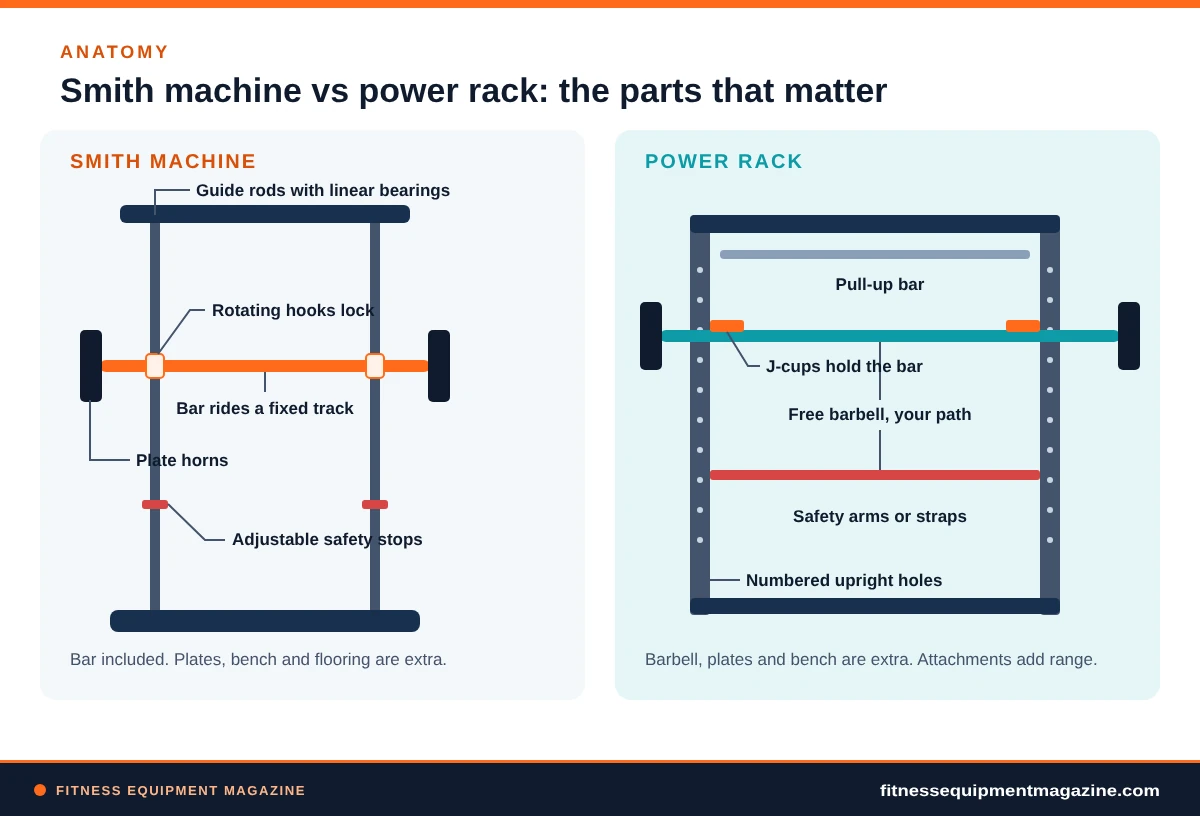
A Smith machine is a barbell fixed between two vertical guide rods. Linear bearings let the bar slide up and down, and a series of hooks along the bar can rotate to catch on matching posts. Twist your wrists at any height and the bar locks. Twist them back and it releases. That one feature explains most of the machine’s appeal.
Some designs run the bar perfectly vertical. Others tilt the rails a few degrees, commonly somewhere around 5 to 10, so the bar travels slightly forward and back as it rises. Many units add adjustable safety stops that catch the bar if you can’t finish a rep. Plates load onto the ends of the bar, though a few models use a separate plate-loaded or counterbalanced carriage.
The power rack, part by part
A power rack, sometimes called a power cage, is four vertical steel posts joined by crossmembers, with numbered holes running up the posts. You drop adjustable hooks, often called J-cups, into the holes to hold a free barbell at the height you want. Then you drop safety bars or straps at a lower height to catch the bar if a rep fails.
The frame does not guide the bar at all. You move the barbell through whatever path your body chooses, and the rack simply stands around you. That’s why a rack is a platform rather than a machine. You can hang a pull-up bar from it, anchor resistance bands, add a landmine, or slide a bench inside. For more on how racks vary, see our guide to the best power racks for home gyms.
Why this isn’t a like-for-like comparison
Here’s the awkward truth. A Smith machine is a machine, and a power rack is a rack. The Smith machine vs power rack choice is really a choice between a guided station that comes with its bar built in and a frame that needs a separate barbell, plates and often a bench. That’s why shoppers who compare sticker prices alone end up surprised later.
It also means each setup asks different questions. With a Smith machine, you ask whether the fixed path suits your body and your exercises. With a rack, you ask whether you have the bar, the plates and the room to use it well. We’ll answer both sets of questions in the sections ahead.
Smith Machine vs Power Rack: Fixed Bar Path vs Free Bar Path
If you only remember one idea from this guide, make it this one. A Smith machine decides where the bar goes. A power rack leaves that decision to you. Almost every other difference in the Smith machine vs power rack debate flows from that single fact, so it is worth a closer look.
What a fixed path actually changes
On a free barbell, your body balances the bar side to side and front to back. Small muscles around the hips, trunk and shoulders work constantly to keep it over the middle of your foot. A Smith machine takes most of that job away. The bar can only travel up and down its track, so you can lean on the guidance and focus on pushing.
That’s a real benefit in some cases. It’s a real limit in others. Because the bar cannot wander, your body can’t either, and not every body wants to move in a perfectly straight line. A very tall lifter or someone with long thighs may find the vertical track forces an awkward foot position.
The “stabilizer” argument, handled honestly
You’ll hear that free weights are better because they train stabilizing muscles, and that Smith machines are weaker for the same reason. There’s truth in it, but the claim gets stretched. Free barbell work asks more of your balance and coordination. A guided bar asks less. Neither one is a magic ingredient for everyone.
What matters more for most home lifters is whether you’ll train consistently. A setup you trust and enjoy beats a theoretically better one you avoid. Some people feel braver under a Smith bar, and they train harder because of it. Others feel boxed in and quietly skip the lift. Be honest about which one you are. That honesty sits at the quiet center of any Smith machine vs power rack decision.
Rail angle, foot position and body fit
Fit is the quiet issue nobody mentions in a product listing. On a vertical track, your hips have to move straight down. If your feet sit directly under the bar, many people feel pulled forward onto their toes. So the common workaround is stepping the feet out in front of the bar. That works, but it changes the shape of the lift, and it needs enough room ahead of the machine.
Angled rails help some lifters by letting the bar drift a little as it rises. Still, the angle is built in. You can’t adjust it, and it may not suit your proportions. If you can, try a machine in person. Stand under it, set the hooks, and check whether a squat and a press feel natural before you commit.
Smith Machine vs Power Rack Safety When You Train Alone
Home lifters ask about safety more than anything else, and it makes sense. There’s usually nobody behind you. A fair Smith machine vs power rack safety comparison has to start from one rule: neither one is safe by default. Both are only as safe as the way you set them up.
How a Smith machine catches a failed rep
The rotating hooks are the headline feature. If a rep stalls, you twist your wrists and the bar locks onto the nearest set of posts. That can be a fast, simple bail-out, and it’s the reason many people see a Smith machine as the safer choice. Most also have adjustable safety stops below the working range that catch the bar if you can’t hook it in time.
The weak points are practical. You need the reflex to hook the bar when you’re tired and rattled. The hooks must engage cleanly, and the stops must sit at the right height for your body, not the factory default. A bar that sticks, a worn hook or a stop set too low can all turn a safety feature into a false comfort.
How a power rack catches a failed rep
A rack uses safeties, either steel arms or flat straps, set just below the lowest point of the lift. If you fail a squat, you sit the bar down onto them. If you fail a bench press, the bar lands on them above your chest, while you slide out. Set properly, they don’t depend on your reflexes. They simply sit there and catch the bar.
The catch is that a rack demands setup discipline. Safeties set too low won’t help. Set too high, they’ll collide with the bar before you reach full depth. Our power rack safety guide covers spotter arms, straps, anchoring and clearances in more detail, and it’s worth reading before your first heavy set.
Set the safeties before every heavy session, not once a month. Test them with an empty bar by lowering it to the catch point and checking that you can slide out. A feature you’ve never tested is a feature you can’t rely on. Also check the CPSC exercise equipment page for recalls on any model you’re considering.
So which one is actually safer?
Our honest read is that the answer depends on the lifter. A beginner who panics under a free bar may be safer on a Smith machine, because the hooks offer an immediate, simple response. An experienced lifter who sets safeties carefully may be safer in a rack, because the catch is automatic and the bar path is natural for their body. The Smith machine vs power rack safety answer is personal, not universal.
There’s one more quirk. The fixed path can let people load more than they could control freely, and that’s sometimes a trap. A heavy bar on a rail still crushes you if the hooks don’t engage. Don’t treat guidance as insurance. In the Smith machine vs power rack safety debate, the lifter who respects the load wins either way.
- Check the bar before each session. It should slide smoothly with no grit, catching or side play.
- Set safeties for your lowest rep. Test with an empty bar, then work upward.
- Keep the floor clear. Plates, bags and water bottles near the base are how people trip.
- Train within your skill. A guided bar doesn’t make an overly heavy load safe.
If you’re new to lifting, an in-person session with a certified trainer is cheap insurance. Federal activity guidance also recommends regular muscle-strengthening work for adults, and you can read the specifics in the HHS Physical Activity Guidelines. For your own health and limits, talk to a qualified professional.
What You Can and Can’t Do With Each Setup
Exercise range is where the Smith machine vs power rack comparison stops being close for many buyers. A Smith machine does a handful of things well. A rack does nearly everything a barbell can do, then keeps going once you add attachments. Still, “nearly everything” isn’t the same as “everything you’ll want,” so let’s go lift by lift.
Squats, presses and benching
Squats work in both setups, but they feel different. In a rack, the bar settles on your back and you find your own balance point. On a Smith machine, you can place your feet forward and sit back into the squat, which some people find friendlier on the knees and others find unnatural. Neither is wrong. Your body picks the winner.
Bench pressing is an easy fit for a Smith machine. The bar can’t drift, the hooks rotate on the spot, and a lifter doesn’t need a spotter. In a rack, benching works equally well with safeties set above the chest line, plus a free bar that lets your elbows and wrists choose their path. Overhead pressing follows the same pattern: smooth and guided on the rail, more demanding in a rack.
Rows, deadlifts and hip hinges
Here the rack pulls ahead. A barbell row needs the bar to travel forward and back, and a vertical track can’t allow that. Deadlifts need the bar to start on the floor and move in a slight arc around your knees, which a fixed track cuts short. Some lifters do Romanian-style hinges in a Smith machine anyway, and with careful foot placement it can work. But it’s a workaround, not the machine’s strength.
A rack handles all of these. You can set pins for rack pulls, work from the floor on a platform, or load a trap bar next to it. If you want a rounded barbell program, a rack is the safer bet. Our barbell buying guide explains what to look for in the bar itself.
Pull-ups, calf raises and accessory work
Most power racks include a pull-up bar, or accept one as an attachment. Many Smith machines don’t, though some all-in-one stations bolt one on. Calf raises, split squats and hip thrusts all work on a Smith machine, and the guided bar makes them easy to load and repeat. A rack can do them too, but the loose bar needs a bit more care.
In a Smith machine vs power rack showdown for accessory work, the Smith bar is easier to load while the rack is easier to expand. The simplest way to think about it: a Smith machine is strongest when you want a stable bar for a few repeatable lifts. A rack is strongest when you want variety. If you plan to add dips, landmine work or band-resisted lifts later, our guide to landmine attachments shows what a rack can grow into.
Smith machine strengths
- Fixed path for presses, squats and calf raises
- Hooks lock the bar at any height
- Easy to load and repeat for beginners
- No separate barbell to buy
Smith machine limits
- Awkward or impossible for rows and deadlifts
- Path may not match your proportions
- Fewer ways to add attachments
- Large footprint for what it does
Power rack strengths
- Works with a real barbell for every lift
- Pull-ups, dips and bands often supported
- Safeties catch the bar without a hook reflex
- Grows with attachments for years
Power rack limits
- You buy the bar, plates and bench separately
- Free bar demands balance and technique
- Setup discipline matters every session
- Ceiling height can rule some racks out
Smith Machine vs Power Rack: Footprint, Ceiling Height and Floor Space
Floor space is where plans meet reality. A rack looks compact in a photo, but a barbell is seven feet long and plates need room. A Smith machine looks like a single clean station, but weight horns and a base can stretch it wider than you’d guess. In the Smith machine vs power rack contest, measure first and fall in love second.
Typical sizes to expect
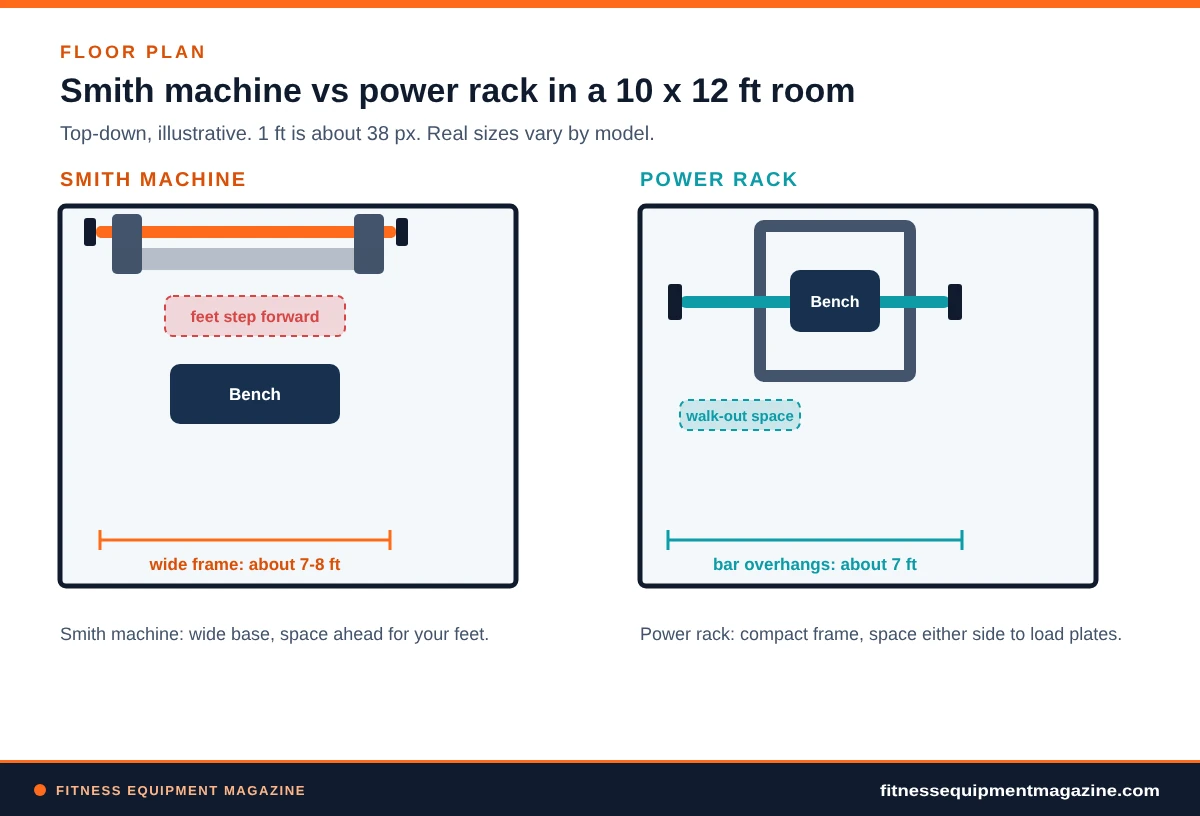
Put the Smith machine vs power rack footprints side by side and the rack is usually the smaller of the two. Sizes vary a great deal, so treat these as ranges and confirm against the spec sheet. Many home power racks measure roughly four to four-and-a-half feet in each direction at the base, with posts commonly between about 80 and 92 inches tall. Many Smith machines are wider, often in the neighborhood of seven to eight feet across, with depth from about four to six feet. Height is frequently around 80 to 90 inches.
Clearance beyond the frame
The frame is only the beginning. On a rack, you need room on both sides to load plates, and room behind for walking out the bar from the hooks. On a Smith machine, you need space in front for stepping your feet forward and behind for a bench. A cramped room gets cramped fast, and loading a bar in a gap that’s too narrow is how people scrape knuckles and ankles.
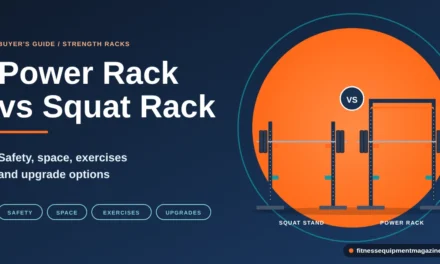
A good rule: add about two feet of clear space on each side of whichever setup you choose. If that doesn’t fit, consider a compact squat stand or half-rack instead. We compare those in our power rack vs squat rack guide.
Ceiling height and the overhead press
Ceilings decide more rack decisions than shoppers expect. A rack that’s 90 inches tall won’t fit under a standard 8-foot ceiling once you add a pull-up bar or a finishing cap. Even if it does, overhead pressing needs extra headroom above the top of the rep. Smith machines have the same problem, since the frame and bar track run tall.
Our guide to home gym ceiling height shows how to measure properly, and it’s the page to read before you order anything tall. Basements with ducts, garages with door tracks and attics with sloped ceilings all need an actual tape measure, not a guess.
Floor protection and weight
Both setups are heavy, and both can point loads into a small area. Rubber flooring, plywood or a lifting platform spreads that load and protects the surface. Our home gym flooring guide goes through thickness and subfloor protection. Upper-floor and apartment buyers should also read about floor loads before placing a loaded rack above someone’s living room.
Smith Machine vs Power Rack: The Full Cost Stack
Price tags tell half the story. A Smith machine usually costs more as a single item, but it comes with its bar and guidance built in. A rack usually costs less on its own, but it needs a barbell and plates before you can lift. Compare complete setups in your Smith machine vs power rack math, not the first line item. We won’t quote figures here, since they move constantly, but we can show what’s included.
Hidden costs on both sides
For a rack, the hidden costs are the bar, the plates, the bench and sometimes the safeties, which some listings sell separately. A cheap bar in a good rack is a poor pairing. For a Smith machine, the hidden costs are shipping on a very heavy item, the plates, and attachments for accessories like pull-ups or cables. Both setups also reward flooring, collars and storage.
That’s why we’d rather you plan a full budget first, then shop to it. Our strength equipment buying order helps you decide what to purchase and what to postpone.
Longevity and resale
Racks tend to keep their usefulness for years. A rack that fits a standard barbell accepts almost any bar, plate set and attachment you add later. Smith machines are more tied to their own design. If the track wears out or the manufacturer changes the bar, parts can be harder to find. That doesn’t make a Smith machine a bad buy. Still, over a decade of ownership, the Smith machine vs power rack gap in flexibility tends to widen in the rack’s favor.
Buying Criteria for a Smith Machine or a Power Rack
Once your Smith machine vs power rack choice leans one way, the next job is spotting good construction. Spec sheets can look similar while the products behave very differently. Use the lists below as a checklist, and verify each point on the manufacturer’s current page. We name no brands, because build quality should speak for itself.
What to check on a Smith machine
Start with the bar and its bearings. A smooth glide is the whole point, and rough, sticky travel makes every set feel worse. Look for linear bearings or bushings that are described plainly, and read owner reports about long-term smoothness. Then look at how the bar is counterbalanced, because that changes how much the empty bar actually feels like.
- Bar weight and counterbalance. Some bars feel light, others close to a full barbell. Know what you’re loading before you add plates.
- Rail angle. Vertical or slightly angled; pick the one that suits your proportions if you can try it.
- Hook spacing. Closely spaced hook points give finer height control and an easier bail-out.
- Safety stops. Adjustable, solid steel and easy to reach; avoid flimsy pins.
- Frame steel and welds. Heavier tubing and clean welds hold up better under repeated loading.
- Weight capacity. Look for a stated limit well above what you plan to lift, and read what it covers.
What to check on a power rack
Rack quality shows up in the posts and the hardware. Thicker steel and wider uprights usually mean less wobble under a heavy rack-and-unrack. Hole spacing matters too, since tighter spacing lets you set hooks and safeties more precisely. Then check how the safeties are built, because those parts matter more than any other single feature.
- Upright size and steel thickness. Common upright sizes run from about 2 by 2 to 3 by 3 inches; bigger tends to feel steadier.
- Hole spacing. Tighter spacing near bench height makes setups easier to fine-tune.
- Safety design. Steel arms or heavy straps, rated for the load, with simple, secure height adjustment.
- Hook quality. Lined J-cups protect the bar’s knurling, and a secure lock keeps them from shifting.
- Stability and anchoring. Look for a footprint wide enough to stay put, and bolt-down options if you can.
- Attachment ecosystem. Check whether pull-up bars, dip bars and storage fit the hole pattern.
If a listing won’t tell you the steel gauge, weight capacity or hole spacing, treat that silence as information. Real details are easy to publish. Vague ones are usually vague on purpose. For a longer shortlist method, see our power rack buying criteria.
Red flags worth walking away from
- No stated weight capacity, or a capacity that depends on fine print
- Safeties that slide, wobble or rely on a single small pin
- Reviews that mention bar binding, cracked welds or hooks that don’t engage
- A warranty that excludes the track, bearings or frame after a short period
- Photos that never show the full frame, only a cropped lifestyle shot
Smith Machine vs Power Rack: Six Hypothetical Shopper Profiles
Theory only goes so far, so let’s run six imaginary shoppers through the Smith machine vs power rack choice. These are hypothetical profiles built from common situations, not real people or case studies. Find the one closest to you and note where your own details differ.
The cautious beginner
For Maya, the Smith machine vs power rack question is really about confidence. She is new to lifting, trains alone, and gets nervous under a loaded bar. A Smith machine gives her a guided bar and an instant way to stop a rep. For her first six months, that confidence may matter more than variety. Our suggestion: pair it with a good bench and plan to reassess when she feels steadier. If she outgrows it, a rack becomes the next purchase.
The long-term barbell lifter
Devon’s Smith machine vs power rack answer is easy. He wants to squat, bench, press and deadlift for years. A power rack is the clear fit, because it accepts a standard bar, supports every major lift and grows with him. He should budget for a decent barbell and plates up front, and spend time setting safeties correctly. A Smith machine would feel limiting within a year.
The small spare room
Priya has a 10 by 10 foot room with an 8-foot ceiling. Neither a tall rack nor a wide Smith machine is an easy fit. A compact half-rack or squat stand may beat both. If she must choose between the two, a short-post rack with fold-away safeties tends to waste less floor than a full Smith station. Our small home gym ideas show layouts that work.
The couple who share a garage
Sam and Jordan treat Smith machine vs power rack as a sharing problem. They train at different levels. One is chasing heavy squats, the other mostly does presses and calf raises. A rack with a bench inside covers both, while a Smith machine would suit only one of them. If waiting for the station is the worry, consider a rack plus a functional trainer, covered in our guide to the best functional trainers.
The older lifter who wants control
In Ray’s Smith machine vs power rack case, predictability counts. He is in his sixties and values predictability. A Smith machine’s fixed path can feel reassuring, and a counterbalanced bar may be easier to start with. But he should still check the machine’s starting weight, safety stops and access height, and talk with a healthcare professional about his plans. Our guide to home gym equipment for older adults goes deeper on stability and ease of use.
The tight-budget builder
Alex has to settle the Smith machine vs power rack question on a strict budget with no equipment yet. A bare-bones rack, a decent bar and basic plates may cost less overall than a full Smith station, and they’ll cover more exercises. If the cheapest rack feels wobbly, a sturdy squat stand is the smarter step. That’s often the best way to start without overspending.
Hybrids, Combos and Upgrade Paths
The Smith machine vs power rack choice isn’t always either-or. Some manufacturers sell racks with a Smith-style bar attachment, and some all-in-one stations pair a Smith bar with cables or a lat pulldown. These can be handy, but they carry tradeoffs. Usually the compromise is quality in one area, a bigger footprint, or fewer upgrade options.
Racks with a Smith attachment
A rack that accepts a Smith-style insert gives you both a guided bar and a free bar in one frame. The upside is flexibility. The downside is that the insert may feel less refined than a dedicated machine, and the frame has to be strong enough to hold it steady. Read the attachment’s stated capacity and fit before you rely on it.
All-in-one stations
All-in-one stations bundle a Smith bar, cables, a pulldown and more. They’re tempting for small spaces, but each function is a compromise. Cable travel may be short, the bench may be basic and storage may be limited. If cables matter to you, read our cable machine buying guide before assuming an all-in-one will cover it.
A sensible upgrade path
The path we’d suggest for most buyers: start with a rack or sturdy stand, add a bar and plates, then a bench, then attachments. If you later want guidance for specific lifts, you can add a Smith insert or a separate machine. Going the other way, from a Smith machine to a rack, usually means buying new gear. That’s why the rack-first order feels more economical for most households.
Setting Up and Caring for Your Smith Machine or Power Rack
Whichever way the Smith machine vs power rack decision lands, the first week of ownership matters more than most buyers expect. A heavy frame that’s assembled loosely or placed on a bad floor will cause trouble for years. Spend an afternoon on setup, and the equipment pays you back every session.
Assembly and the first-week routine
Read the manual before you open the hardware bags. Lay out the parts, count the bolts and leave every bolt finger-tight until the frame is fully assembled. Then go back and tighten each one in a cross pattern, the way you would lug nuts on a wheel. Frames that are tightened too early often end up slightly twisted, and that shows up later as wobble.
Next, level the base and check it with a bubble level. If the machine has a bolt-down option, use it, since a heavy lift on a sliding frame is a hazard. Finally, run the empty bar through its full range. On a Smith machine, listen for grit and watch the hooks engage. On a rack, test every safety and hook at the heights you plan to use.
Ongoing care that keeps either setup honest
Maintenance is simple but easy to forget. Wipe sweat off pads and metal after sessions, and recheck bolts every month or two. Smith machine rods and bearings usually want a light, manufacturer-approved lubricant, while rack posts mostly need a dry cloth and a look for chips in the finish. Our guide to strength equipment maintenance covers bolts, bearings and rust prevention in more detail.
One more habit is worth building. Before every heavy day, spend thirty seconds checking the safety system. For a Smith machine vs power rack owner, that means a quick hook test or a safety arm check. Small, regular checks catch the loose pin or worn hook before it becomes a problem.
Noise, dropped weights and neighbors
Both setups make noise when the bar meets the stops or the floor meets a plate. A Smith machine clanks when hooks catch, and a rack clangs when the bar settles onto steel safeties. Lined safeties, rubber flooring and controlled lowering all help. If you share walls or floors with neighbors, plan for that early. Dropping a loaded bar is rarely a good idea in either setup.
Mark your usual safety and hook heights with a strip of tape or a note on the frame. When you share the space, or when you’re tired, the mark saves a guess. It’s a tiny fix that prevents the most common setup mistake.
Myths and Facts About Smith Machines and Power Racks
Few pieces of gym equipment attract as many strong opinions as these two, and the Smith machine vs power rack argument carries more folklore than most. Some of it is gym-floor folklore. Some is a half-truth that deserves a closer look. Here are the claims we hear most, along with what the evidence really supports.
“Smith machines are useless”
This is the loudest myth, and it’s too strong. A Smith machine is a tool with a narrow range, not a toy. It suits guided presses, controlled squat variations, calf raises and solo training with a built-in catch. It doesn’t suit rows, deadlifts or lifters who want the bar to move naturally. Used for what it does well, it’s a perfectly respectable addition to a home gym.
“A rack makes you safe automatically”
Also false. A rack with safeties set at the wrong height is just a tall frame. Picture a lifter who sits the bar on the pins mid-squat, only to find they were set three holes too high. Safe training comes from setup, testing and good habits. Hardware only helps if you use it right.
“Free weights always beat machines”
Free weights ask more of your balance, and that’s a real training effect. But “always” overreaches. For some lifters, a guided bar allows harder, more focused sets because they aren’t worried about balance. Others find that fear holds back effort. In the Smith machine vs power rack debate neither approach has to win; many experienced lifters use both, depending on the exercise and the day.
“Beginners must start on a Smith machine”
Not true either. Beginners learn well with a bare bar in a rack, especially with safeties set properly and a coach or reliable video guidance. A Smith machine can build confidence, but it can also hide poor positioning, since the machine masks sloppy balance. For many novices, the better path is a rack with light loads and patience.
“A Smith machine saves space”
Sometimes, but not usually. One station can replace several machines, and that’s real space-saving. But a Smith machine standing alone often occupies more floor than a compact rack. Compare footprints, not assumptions, and remember the room you need around each. Our home gym layout guide shows clearances for racks, benches and storage.
A Decision Routine for Smith Machine vs Power Rack in Five Questions
When the Smith machine vs power rack debate still feels foggy, a short routine usually clears it. Answer these in order and stop at the first clear result. The flowchart below shows the main branches, and the steps after it fill in the details.
- Measure the room and the ceiling.Write down width, depth and height, then subtract about two feet on each side for loading. If the ceiling is under about 8 feet, a full rack or Smith machine may not fit.
- List the lifts you actually want.Be specific. If rows, deadlifts or rack pulls appear on the list, lean toward a rack. If your list is presses, squats and calf raises only, a Smith machine becomes realistic.
- Decide how you handle a failed rep.Honestly rate your comfort under a free bar. Then plan a safety system you’ll really use, whether that’s hooks or safeties.
- Add up the complete Smith machine vs power rack setup.Include bar, plates, bench, flooring and shipping. Compare total, not sticker.
- Check support and returns.Read the warranty, return window and recall history. Finally, search the CPSC page for the model.
If you want a single recommendation and your ceiling allows it, we’d start most households with a power rack, a decent barbell, plates and an adjustable bench. It leaves the most room to grow. In the Smith machine vs power rack contest, choose a Smith machine on purpose, not because it looked safer in a photo. For the wider buying order, see what to buy first for strength training.
Before you pay: questions for the seller
- What are the posted dimensions of the frame, including base and bar overhang?
- What is the stated weight capacity, and what does it cover?
- Does the price include safeties, the bar and any hardware?
- What is the warranty on the frame, welds, bearings and moving parts?
- What are the return terms for a very heavy item, and who pays shipping?
Questions Buyers Ask About Smith Machine vs Power Rack
Is a Smith machine or a power rack better for a home gym?
For most home gyms, a power rack is the better long-term base because it works with a real barbell and supports more exercises. A Smith machine fits specific cases: beginners who want a guided bar, solo lifters who value the built-in hooks, or buyers who want a few repeatable lifts. The Smith machine vs power rack answer depends on your room, goals and comfort under a free bar.
Is a Smith machine or a power rack safer for lifting alone?
Not automatically. A Smith machine lets you twist the bar onto hooks anywhere, which helps in an emergency. A rack catches a failed rep on safeties set below your lowest position. Each works only when set up correctly and tested. A beginner may feel safer on the Smith bar, while an experienced lifter may prefer safeties. Treat both as tools that need good habits, not guarantees.
Can you deadlift or row on a Smith machine?
You can attempt some hinge-style lifts, but the fixed vertical track makes deadlifts and barbell rows awkward. The bar needs to travel forward and back around your body, and a rail doesn’t allow that. For these lifts, a power rack with a free barbell, or a platform next to it, is a better fit. Many buyers who want rows and pulls end up preferring a rack.
Does the Smith machine vs power rack choice change which muscles you work?
Largely the same prime movers, but the guided path shifts how much your balance muscles contribute. A free barbell asks for more coordination and stabilization; a Smith bar asks for less. Neither is a bad training choice for everyone. Many lifters use both. If you have specific goals or health concerns, a qualified coach or healthcare professional can advise you better than a general article can.
How much space does a Smith machine vs power rack setup need?
Plan for the frame plus about two feet of clear space on each side. Many home racks are roughly four feet square, while Smith machines are often wider at seven to eight feet. Both can stand 80 to 90 inches tall or more, so ceiling height matters. These are typical ranges, so confirm exact dimensions on the spec sheet and measure your room before ordering.
Is there a Smith machine vs power rack hybrid that does both?
Sometimes. A few racks accept a Smith-style bar attachment, and a few brands sell compatible inserts. Check the attachment’s rated capacity, the hole pattern and whether it fits your specific rack. Quality varies, and a bolt-on may feel less refined than a dedicated machine. If guided work matters a lot, shop with that in mind before buying the rack.
What should a beginner buy first: a Smith machine vs power rack or something else?
For beginners weighing a Smith machine vs power rack, many do well with a sturdy rack or squat stand, a decent barbell, plates and an adjustable bench. That combination covers the major lifts and leaves room to grow. If a free bar feels intimidating, a Smith machine can build early confidence. Start with a clear budget, and see our strength equipment buying order for what to purchase first and what to wait on.
Does a Smith machine need a bench and plates too?
Usually yes. A Smith machine includes the bar and track, but you still buy plates, and you typically want a bench that fits inside the frame. Some stations include a bench or storage pegs, so read the listing carefully. A power rack needs those items plus a barbell. Compare the full list, not just the headline item, when you price the Smith machine vs power rack choice.
Bottom Line: Smith Machine vs Power Rack for Your Home Gym
The Smith machine vs power rack decision comes down to freedom versus guidance. A power rack gives you a real barbell, a wide range of lifts and a platform that grows with you. A Smith machine gives you a fixed path, a built-in catch and simplicity, at the cost of variety. Most households will end up happier with the rack, though a handful have excellent reasons to choose otherwise.
Here are your next steps. Measure the room and the ceiling tonight. Write down the lifts you want, and rate your comfort under a free bar honestly. Price the complete Smith machine vs power rack setup, then check recalls and return terms before you pay. For the bigger picture, start with our strength equipment guide, and keep reading below for the details on racks, safety and layout.
Sources and Further Reading
- HHS Physical Activity Guidelines — federal guidance on muscle-strengthening activity for adults
- CPSC exercise equipment recalls — check model safety history before you buy
Some links on this site may be affiliate links. If you buy through them we may earn a commission at no extra cost to you. Recommendations are based on the criteria in the article, not payout. This article is general information about equipment and isn’t medical advice; talk to a qualified professional about your own health and training. Last reviewed: October 2026.