The best heavy duty treadmill isn’t the one with the biggest number printed on the box. It’s the one whose frame, motor, deck and warranty leave you headroom above the load you’ll really put on it. Day after day, for years. That holds whether you’re a larger runner, a tall walker, or part of a household where three people share one machine and nobody babies it.
Here’s the awkward truth about shopping in this corner of the market. Most treadmill spec sheets were written as if the owner were a single, average-size adult who walks for thirty minutes. Heavier users, taller users and busy households sit outside that script. They’re also the people who find out first which machines were built to a price and which were built to last. This guide is meant to save you that lesson. It’s practical, it’s blunt about machines, and it’s never about bodies.
The short answer
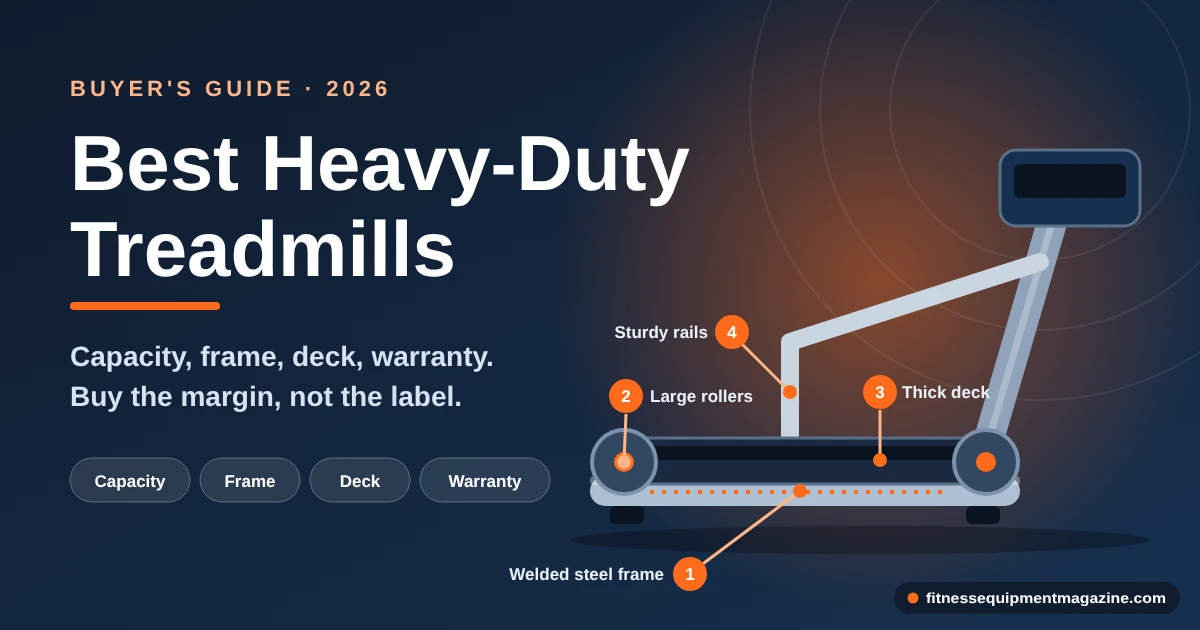
To find the best heavy duty treadmill for your situation, start with a rated user capacity well above your body weight. Then confirm what that number can’t tell you. Look for a rigid, welded frame, large rollers and a thick deck. Add a motor rated for continuous duty, a deck long and wide enough for your stride, and a warranty that covers the frame and motor for years, not months.
- Who it fits: larger-bodied walkers and runners, tall users and shared household machines. It also suits anyone who would rather buy once than replace a wobbly machine in two years.
- The biggest tradeoff: sturdiness costs money, weight and floor space. A strong machine can run well over 250 pounds shipped, so delivery and placement need planning.
- The common trap: trusting the capacity number alone. A 300 lb rating on a flexy frame is a weaker promise than a 275 lb rating on a stiff one.
Still deciding what kind of treadmill you need at all? Start with our home treadmill guide, then come back here to stress-test the shortlist.
How we researched this. This is research-based guidance. We built it from manufacturer specification patterns, federal guidance and ownership problems that buyers commonly report. We haven’t hands-tested these machines, so you won’t find lab results, decibel readings or “our testers” claims. We name no brands or models and quote no prices for specific products. Numbers below are typical ranges for the US market in late 2026; always verify against the current spec sheet. Last reviewed: October 2026.
How current is this?
Specs, prices, warranties and recalls change every few months. Treat everything here as a typical pattern, not a quote. Before you buy, read the maker’s current spec sheet and warranty page. Then check the CPSC exercise equipment recall list for the exact model.
What the Best Heavy Duty Treadmill Really Means
“Heavy duty” is a marketing phrase with no legal definition. A seller can put it on a budget folding walker and nobody will stop them. So before comparing machines, it helps to agree on what the words should mean, in plain mechanical terms.
Three things people mean by the best heavy duty treadmill
Shoppers use the phrase for three different needs, and they don’t always overlap. A machine can be excellent at one and mediocre at another.
Load
Built for more body weight
The frame, rollers and motor stay stiff and cool with a heavier user, including at running impact. This is the meaning most people have in mind first.
Size
Built for a bigger body
A longer, wider deck and enough headroom for a tall stride. A tall runner can be light and still need a heavy-duty machine, simply because a short deck forces a cramped stride.
Life
Built for many hours
Components that survive a household of daily users, or years of long sessions. Duty cycle matters here more than the headline capacity.
If you are shopping for the best heavy duty treadmill, name your own need first. Most of the time you want all three at once. That’s why the best heavy duty treadmill usually turns out to be a mid- to upper-priced residential machine with serious steel in it. It’s rarely the cheapest option wearing a bigger number.
Why the best heavy duty treadmill isn’t a niche pick
Plenty of people feel awkward searching for a machine “for heavier people.” There’s no reason to. Treadmill durability is a physics problem. Every buyer benefits from a more rigid frame, so the same checklist works for a 140 lb tall runner, a 300 lb walker and a family of four. Think of this guide as buying margin. You’re paying for extra material and extra tolerance, not for a label.
That framing also keeps the conversation honest. We won’t tell you what weight to aim for or promise outcomes from exercise. For general activity context, the HHS Physical Activity Guidelines describe how much movement federal guidance suggests for adults. A clinician can tailor that to you. Our job is narrower. We want to help you pick a machine that doesn’t flex, overheat or fail under you, which is what the best heavy duty treadmill is for.
User Capacity Decoded: Rating, Headroom and Dynamic Load
Every treadmill lists a maximum user weight. It’s the first number most shoppers filter by, and it’s also the easiest one to misread. Let’s pull it apart.
What a capacity rating actually is
A rated capacity is a manufacturer’s claim about the heaviest user the machine is meant to carry. Some makers back it with testing to recognized fitness-equipment standards. Others use internal testing, and a few offer little more than a comparison to a competitor’s number. There’s no single public test that every seller follows, so two machines both marked 300 lb may have been proven very differently.
Two more details trip people up. First, the rating usually describes walking or general use. Many makers apply a lower number, or simply stay silent, for running. Second, the rating covers the user, not the user plus a loaded backpack, a weighted vest or a child holding on. Read the manual, not just the listing, because the manual is where limits by activity tend to appear.
The headroom rule for the best heavy duty treadmill
Here’s the rule we’d give a friend. It’s our editorial rule of thumb, not an industry standard, so treat it as a starting point.
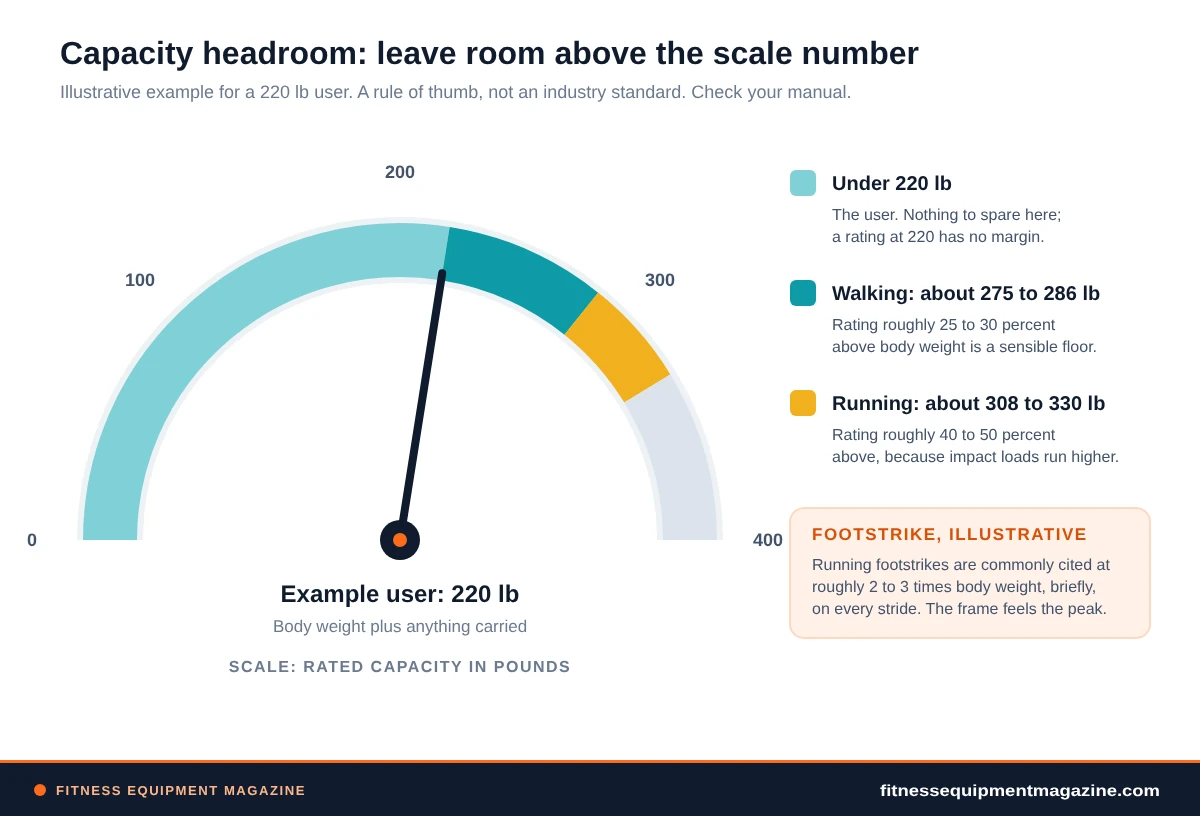
- Walking only: look for a rated capacity at least 25 to 30 percent above your weight, plus anything you carry.
- Jogging or running: aim for roughly 40 to 50 percent above, because impact loads are much higher than standing weight.
- Shared by several people: size the machine to the heaviest regular user, then add the headroom for the activity.
So a 220 lb walker would start looking at machines rated near 300 lb. A 220 lb runner would look closer to 325 to 350 lb. The extra margin isn’t wasted. Components that run at 60 or 70 percent of their design limit last longer, run cooler and feel quieter than components living at 95 percent.
Dynamic load: what running does to the math
When you stand on a treadmill, the deck carries your weight. When you run, each footstrike briefly carries a multiple of it. Biomechanics research commonly cites ground reaction forces of roughly two to three times body weight at running speeds. The multiple climbs with speed and with a harder landing. The frame feels that as a repeated hammer, thousands of times per session.
That’s why a machine can feel perfectly fine for walking and then start to shake the moment you jog. It’s also why a walker-class machine with a generous capacity rating isn’t automatically a runner. Check what the maker says about running at your weight, and if the manual is vague, ask support in writing. For a closer look at running-specific traits, see our guide to the best treadmill for running.
Mind the gap
Suppose a listing says “300 lb capacity,” but the motor is a walking-class unit and the deck is a thin single layer. Then the number is aspirational. Capacity is only as good as the weakest part. Look for a manufacturer that states the weight limit alongside the frame and motor specs. Be wary of one that makes the figure the only spec it publishes.
Capacity for tall users and shared machines
Height and body weight travel together often enough that the two get lumped in one category, but they stress different parts. Weight loads the frame, the motor and the deck. Height loads the stride, which means deck length and ceiling clearance. A tall person at a modest weight may want the best heavy duty treadmill for its long deck and tall rails, not for its capacity number.
Shared machines add a wrinkle. If one person runs and another walks, you size the frame to the runner and the motor to the hardest session. If a teenager is about to hit a growth spurt, size for the adult they’re becoming. The best heavy duty treadmill for a family is rarely the one that fits today’s household exactly. It’s the one with enough margin to still feel solid in three years.
Four capacity mistakes worth skipping
- Buying at the limit.A machine rated for exactly your weight has no margin for a heavier day, a held bag or a growing household. Leave the gap described above.
- Forgetting the second user.The machine’s real limit is the heaviest person who will ever stand on it, including a partner who “only walks a little.”
- Ignoring the activity split.One number often covers walking. Ask separately about jogging, running and incline use.
- Assuming a higher number means a better frame.Some machines are rated generously and engineered thinly. Verify with frame, roller and deck specs, not capacity alone.
Frame, Rollers, Deck and Belt: What Carries the Load
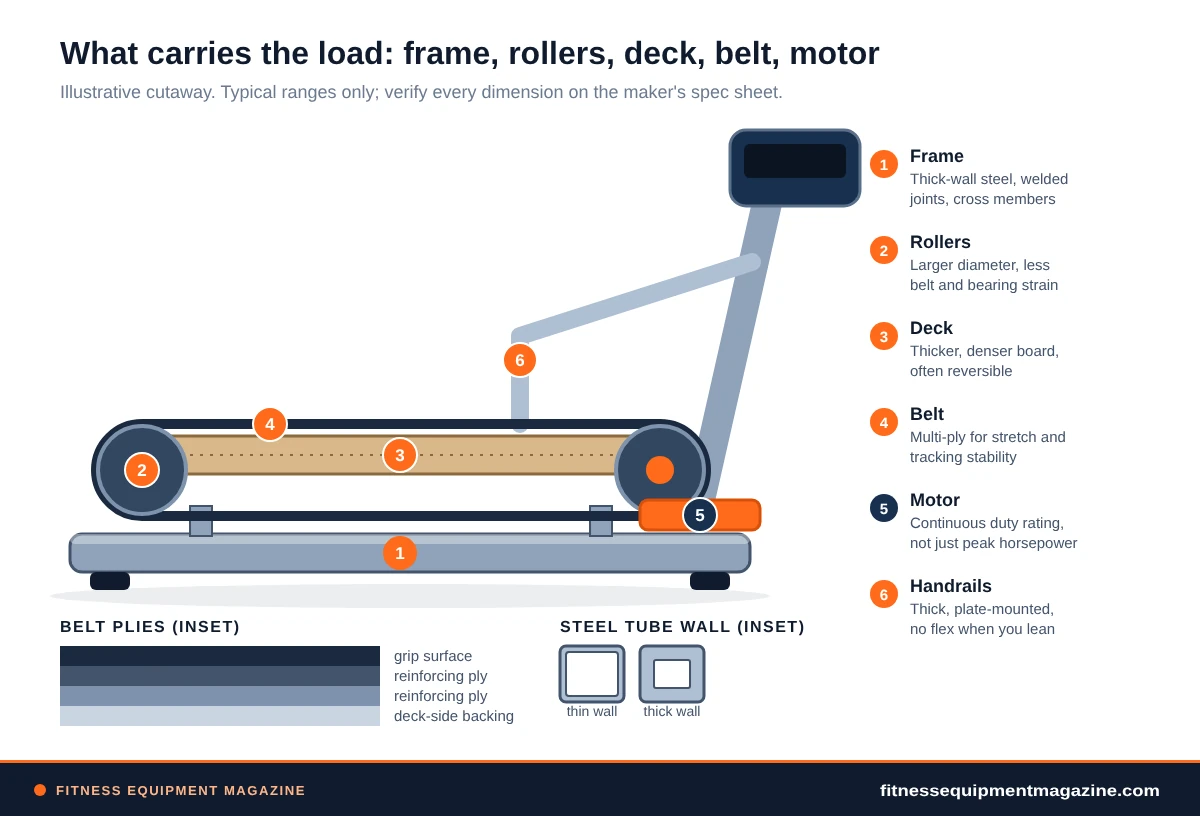
If capacity is the promise, these four parts are the evidence. A heavy treadmill is mostly a stiff steel structure with a motor attached. The quality of that structure is the quietest, least photogenic spec on the page. The good news is that you can read it from a spec sheet if you know where to look.
The frame: stiffness over style in the best heavy duty treadmill
Stiffness is what stops a treadmill from flexing under impact. It comes from the shape of the steel tubing, the wall thickness, the number of cross members and, crucially, how everything joins. Welded joints generally hold better than bolted ones over years of vibration. A well-designed bolted joint with lock hardware can still be fine. Look for a base of thick-wall tubing or heavy-gauge plate, plus a brace or cross member under the deck.
Listings rarely give wall thickness, so weight is a rough clue. As a pattern, treadmills built for heavier loads tend to ship far heavier than walking-class machines of similar footprint. A big spread in shipping weight between two similar-looking models usually reflects steel, motor mass and deck material. It isn’t proof of quality, but a very light box paired with a large capacity claim deserves a question.
Roller diameter: the quiet durability spec
No one buys the best heavy duty treadmill for its rollers, and yet rollers are where cheap builds often give themselves away.
Rollers carry and drive the belt. Larger rollers turn more slowly for a given belt speed. They put less bending stress on the belt and run the bearings at lower strain. Entry machines commonly use rollers around 1.5 to 2 inches across, while sturdier models are often described at 2.5 inches or more. Treat those as typical ranges and verify on the spec sheet.
Roller diameter also affects belt tracking. A bigger, well-machined roller with a crowned surface keeps the belt centered more forgivingly. That helps when a heavier user’s gait pulls slightly to one side. Because makers differ on whether they publish this number, its presence is itself a small trust signal.
Deck thickness and construction
The deck is the board your belt slides over. Thicker, denser decks resist sagging and spread impact over a larger area. Many sturdier residential decks are advertised at roughly three-quarters of an inch to one inch or more. Some use a reversible design, so you can flip the board when one side wears. That’s a nice sign for long-term ownership.
Cushioning is a separate conversation. Soft, springy decks feel pleasant but can reduce stability at higher loads. Some cushioning systems also lose their feel faster when pushed. If you plan to run, read our treadmill cushioning explainer before you let a squishy deck sway you.
Belt construction and ply
A multi-ply belt, often described as two-ply or four-ply, is simply a thicker, more layered belt. More plies typically mean better resistance to stretching, fraying and tracking drift. They often give a quieter, steadier feel under a heavier stride. The belt should also be easy to buy as a replacement, since it is the one wear item you will eventually need. If you want to match belt dimensions to your stride, our guide to treadmill belt size covers it.
Spec sheet shortcuts
A machine worth shortlisting for load tends to list several of these: roller diameter, deck thickness, belt ply, shipped weight and separate frame and motor warranty terms. A listing with only “heavy duty frame,” a capacity number and a horsepower figure hides the evidence.
Motor Duty for the Best Heavy Duty Treadmill
A strong frame with a tired motor is just a sturdy way to be disappointed. The motor has to move the belt under load without straining. A heavier user, plus incline, plus speed, asks more of it than the average spec sheet assumes.
Continuous horsepower, not peak
Look for continuous duty horsepower (CHP), the output the motor can sustain. “Peak” horsepower describes a short burst and is often inflated. As a loose pattern, walkers on lighter machines do fine at modest CHP, while runners and heavier users do better with a higher continuous figure. In the US market, serious home runners often shop at around 3.0 CHP and up. Heavier users may want to start there even for brisk walking with incline. These are typical ranges, not rules.
Our dedicated treadmill motor guide explains CHP, motor types and cooling in depth. The short version is simple. Pick the motor for the hardest session you’ll do, not the average one.
Here is a practical way to think about it. The best heavy duty treadmill is not the one with the largest motor on paper. It is the one whose motor stays cool, keeps belt speed steady under your stride and carries a long warranty on top.
Signs a motor is working too hard
- The belt slows or hesitates when your foot lands, especially on incline.
- A hot or electrical smell appears after a longer session.
- The motor housing is hot to the touch, or the machine trips its breaker.
- Speed drifts slightly from what the display says.
Any of these means the motor is near its limit for your load. Do not push through an overheat smell. Stop, let the machine rest and check the manual’s guidance on duty cycle. If it happens repeatedly, that is a machine problem. Treat it as a warranty claim, not as normal.
Duty cycle and the shared machine
Some makers state a duty cycle, such as continuous use for a set number of hours or a daily limit. Picture a household where one person walks in the morning, another runs after work and a third paces during calls. That’s a high-duty home, even if each user is modest. If the machine will run several hours daily, favor motors with a stated high continuous rating and a cooling design the maker actually describes.
Deck Size and Stride for the Best Heavy Duty Treadmill
Deck size is the part of the best heavy duty treadmill that gets overlooked, because it sounds like comfort rather than durability. In practice it’s both. A deck that is too short makes a tall user shorten their stride. A deck that’s too narrow forces careful foot placement and leaves little margin for a heavier or wider stance.
Length: the tall runner’s priority
Typical walking decks run about 48 to 55 inches long. A common starting point for running is 55 to 60 inches. Many tall runners prefer 60 inches or longer for a relaxed stride. Anyone with a long stride or a faster pace should treat 60 inches as a practical target rather than a luxury. Reading our belt guide before you buy can save you from a deck you’ll outgrow.
Width: stability margin, not just comfort
Width rarely tops a shopper’s list when they start looking for the best heavy duty treadmill, and it should rank higher.
Typical deck widths run from about 16 inches on slim walking machines to 20 inches on most mainstream runners. Some wide-deck models reach 22 inches or more. A wider deck gives a larger person room to move without clipping the side rails. It also lessens the worry about foot placement, which helps you relax. Wide decks come with heavier frames and bigger footprints, so check your room before you fall for one.
Standing height, incline and ceiling clearance
A tall user on an inclined treadmill raises their head by the deck’s rise plus the height of the base. Add a few inches for arm swing and headspace, and your 8-foot ceiling may be tighter than you think. Measure from the floor to the lowest point above where you’ll stand. Then add the machine’s deck height at full incline and your own height. If the sum approaches the ceiling, you are choosing between less incline, a different room or a different machine. Our treadmill buying guide has a walk-through of the measurements.
Handrails and Wobble: Where Shake Comes From
Wobble is a complaint that heavier and taller owners report often. It’s rarely the fault of a single part. A machine can have a thick frame and still shimmy because the handrails flex, the feet are uneven or the console sits on a slim mast. Knowing the usual suspects lets you separate a fixable annoyance from a design problem.
The six suspects
Even the best heavy duty treadmill can feel off when one of these is out of order, so run through the list before you blame the machine.
- Floor and feet.An uneven floor, a thick rug or a worn leveling foot can make a solid machine rock. Check with a bubble level before blaming the frame.
- Loose fasteners.Assembly bolts can settle after the first few weeks. Re-tighten the base and upright hardware at the intervals the manual suggests.
- Roller and bearing play.A rhythmic thump tied to belt speed can mean a loosening roller bearing or mount. This usually needs parts or a technician.
- Belt and deck tracking.A belt drifting to one side can cause a lurch that feels like wobble. Tracking adjustments are routine and covered in the manual.
- Upright and console mount.Tall, slender uprights flex under a user’s leaning or a quick stop. This is a design limit and the one you should judge before you buy.
- Handrail attachment.Hold the rails and push. They should feel as one with the machine. Rails that flex or rattle are a common complaint on lighter builds.
Handrails: a safety part, not trim
Handrails exist for balance. Many heavier users lean on them harder than average, especially during incline walking or at the start of a session. Rails should be thick and welded, or bolted through a plate rather than clipped to a thin shell. They should also sit at a comfortable height for your frame. If you’re taller, check that the rails are high enough that you aren’t hunching.
Check, too, that the safety key and stop mechanism are easy to reach and clearly marked. For general safety, the CPSC exercise equipment recall page shows whether a model has been flagged for a hazard. Recheck it after you buy.
The showroom push test
If you can handle a machine in person, hold the rails, bounce gently and rock the console. Then do it again with some of your weight on it. A good frame feels like furniture. A weaker one telegraphs every shift through the handles. If you can’t test in person, read the return policy first. A home trial with a generous return window is the next best thing.
Weight, Assembly and Delivery Logistics
The best heavy duty treadmill is a heavy object, and heavy objects have logistics. Buyers who skip this step often meet the machine on a porch, with a carton that won’t clear a doorway. A few minutes of planning beats an afternoon of regret.
What “heavy” means in a box
The best heavy duty treadmill is, almost by definition, one of the heaviest things you will ever carry through your front door.
Typical shipped weights for sturdy residential treadmills run from about 200 to 350 pounds, sometimes more. The carton can be 6 feet long and nearly 3 feet wide. A folding heavy machine may still be bulky when folded. Many retailers offer white-glove delivery for an added fee. That brings the machine into the room, assembles it and hauls away the packaging. Others deliver to the curb and leave the rest to you.
Assembly: two people and a plan
Assume two adults for assembly, even if the manual mentions one. Lifting the deck, aligning the upright and tightening hardware in the right order all go smoother with a second pair of hands. A heavy part dropped on a toe or a floor does real damage. Build it in the room where it will live when you can. Moving an assembled machine needs wheels, floor protection and often a helper.
Keep the box and all packing materials until after your return window closes. If the machine has a defect, a missing carton complicates a return. It will definitely complicate a freight pickup.
Questions to ask before you order
- Is delivery curbside, room of choice or white glove, and what does each cost?
- What are the carton dimensions and shipped weight?
- Is assembly included, optional or my job?
- What happens if I refuse the delivery or the carton arrives damaged?
- Is there a restocking or return freight fee for a machine this size?
Floor Loading and Placement
Floors are stronger than most people fear and more demanding than most people assume. The best heavy duty treadmill on a solid ground-level slab is usually a non-event. Upstairs, the picture changes a little, because vibration travels through joists and into the room below.
What the floor sees
Residential floors are generally designed for a live load on the order of 40 pounds per square foot in living spaces. That’s a design figure for the building, not a promise about your joists. A machine plus a user can weigh several hundred pounds. Still, that weight spreads across a footprint of around 15 to 20 square feet, so the static load is usually modest. Running is different. Its dynamic load comes through four small feet and is more concentrated and vibratory.
Planning to use an upper floor, an older house, a wood-frame addition or a span with visible bounce? Ask a qualified contractor or structural professional. We can’t judge your joists, and neither can a product page.
None of this means a heavy machine is a bad idea upstairs. It means the best heavy duty treadmill deserves a deliberate spot, not whichever corner happened to be free on delivery day.
Mats, noise and vibration
A dense rubber mat protects the floor, evens out small irregularities and takes the edge off vibration. Pick one thick enough to resist denting under the feet. It should also reach past the deck, so a stray step doesn’t land on bare flooring. If you share walls or floors with neighbors, our guide to treadmill noise in an apartment covers isolation in more depth.
Power and the cord
Heavier motors draw more current. Many makers recommend a dedicated 15 or 20 amp circuit with no other large appliance on it. Some warn against extension cords and surge strips. Follow the manual. A tripping breaker is a safety signal, not an inconvenience to ignore. A long, thin cord can also overheat. If the plug location forces a cord across a walkway, move the machine or have an electrician add an outlet.
Warranty for the Best Heavy Duty Treadmill, and Commercial Cautions
When you compare the best heavy duty treadmills, the warranty is the easiest place to separate them. A warranty is the manufacturer’s written opinion of how long the machine should last. It’s the clearest tell of how confident they are. For heavy-duty buyers it matters twice. You put more strain on the machine than the average owner does. And the expensive failures are the ones a short warranty won’t touch.
The warranty layer stack
Most treadmill warranties are not one promise but four, each with its own length. Reading them separately is the whole trick.
Frame
The longest layer
Look for years, ideally a long term or lifetime, and read what counts as a frame defect. A heavy user cares most about this line.
Motor
The big-ticket part
Motor failures can cost hundreds to fix. A longer motor term is worth paying for, as long as the exclusions are clearly stated.
Parts and labor
The shorter layers
Parts often run a few years, labor much less. A cheap fix after the labor period ends can still cost you a service call, so ask who performs repairs.
Commercial versus residential: the cautions
“Commercial” on a listing can mean a true gym-grade machine or only a marketing label. Two cautions apply. First, many manufacturers shrink the warranty dramatically if a machine is used in a commercial setting. That can mean a shared apartment gym, a small studio or a workplace. Some void it entirely. If your household is busy but still a household, read the exact clause. Second, “light commercial” machines sit between categories. They are sturdier than most home models, but the terms differ, sometimes with shorter parts coverage and different service paths.
A truly commercial treadmill can suit a household that runs hard. It also brings tradeoffs. Expect more weight and a higher price. The power requirement may need a dedicated circuit, and service sometimes assumes a technician visit. Don’t buy “commercial” as a magic word. Buy the spec, and the warranty that matches how you’ll use it.
Fine print that matters more at higher loads
- Exclusions for “excessive use,” “abuse” or exceeding the weight limit without defining them.
- Coverage that applies only to the original purchaser or only when registered within a short window.
- Requirements for professional assembly, or for specific maintenance records you must keep.
- Labor coverage that excludes in-home service, so you must ship a heavy machine yourself.
- Voiding language for modifications, extension cords or use in unheated spaces such as garages.
None of these are automatic deal-breakers, but all of them deserve a read before you buy. When a term is vague, email support and save the reply. Our treadmill buying guide includes a short warranty-reading routine that works for any model.
Register and document
After the machine arrives, take photos of the serial label, keep your receipt and register the product. If you ever need a claim, photos of the delivery condition and a list of maintenance dates can settle a dispute quickly. This is boring paperwork, and it is also the best insurance policy you have.
Service Access and Maintenance Burden
Every treadmill needs care. The best heavy duty treadmill needs a little more. And a heavy one that is hard to service becomes a lifetime of small annoyances. The goal isn’t zero maintenance. It’s maintenance you can actually do.
A realistic routine
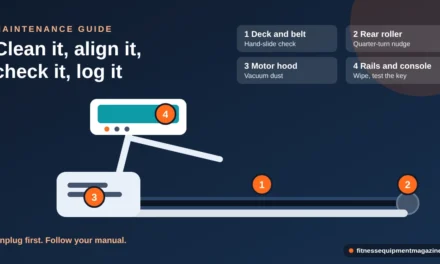
- After each use.Wipe the console, rails and belt edges with a lightly damp cloth. Keep sweat and dust off the motor hood.
- Weekly.Look under the belt edges for debris, check that the belt sits centered and listen for new sounds.
- Monthly.Vacuum around the motor area with the machine unplugged, and check the visible bolts for looseness.
- Every few months or per the manual.Lubricate the deck if the maker calls for it. Check belt tension and tracking. Use only the lubricant the manual allows.
- Yearly.Do a full inspection, including the power cord and plug, and review your warranty and registration paperwork.
Some belts and decks are advertised as low-maintenance or pre-lubricated. Believe the manual rather than the headline, since using the wrong product can harm the belt or void coverage.
Can anyone actually fix it?
Before you buy, find out three things. Does the company offer in-home service in your area, or do you ship the machine in? Are replacement parts, including belts, decks and rollers, sold directly, with part numbers? Is there a phone number or a chat option that reaches a human during normal hours? A very capable machine with unavailable parts is a poor purchase. Compare the service notes across your shortlist, right next to the frame and warranty details.
Safety note
Always unplug the treadmill before cleaning under the hood or touching the motor area. Don’t bypass the safety key, and don’t lubricate with unapproved products. If something smells hot, sounds grinding or feels unstable, stop using the machine and contact support. Check CPSC for recalls on your model.
Used and refurbished: a cautious word
Used commercial machines tempt heavier and taller buyers, because they offer big frames at lower prices. Sometimes that works. The risks are worn rollers, a stretched belt, a tired motor and no warranty. If you go this route, ask for a service history, run the machine under load before paying and budget for a belt and possibly a deck. Delivery of a used commercial machine can be harder than a new one, since few sellers will carry it upstairs.
For many households, a new mid-range model with a real warranty is the safer way to get the best heavy duty treadmill. A used model is the right call only if you can inspect it in person and you accept the repair risk.
Five Machine Types: The Best Heavy Duty Treadmill by Buyer
Instead of ranking brands, here are five archetypes of the best heavy duty treadmill. Each describes a type of machine and the buyer it suits, plus the criteria that earn it a place. They’re not product recommendations, because we haven’t tested products, and pricing and models move quickly. Use them to describe what you’re looking for when you search.
Archetype 1
The reinforced all-rounder
A sturdy, mid-priced residential runner with a strong frame, a continuous-duty motor and a roomy deck. For most households that want one machine for walking, jogging and the occasional hard session, this is the best heavy duty treadmill.
Archetype 2
The tall-runner deck
A longer deck (often 60 inches or more) and plenty of ceiling clearance. For tall users and anyone with a long stride, this is the best heavy duty treadmill, regardless of weight.
Archetype 3
The wide-deck stability pick
A broader belt and a wider frame that give a larger body more room and a calmer feel. For larger bodies who want calm, this is often the best heavy duty treadmill, at the price of floor space.
Archetype 4
The high-capacity walker
A walking-focused machine with a high rated capacity, a solid frame and sturdy rails but a more modest motor. It’s the sensible choice for long, steady walks, perhaps with incline, when you don’t intend to run.
Archetype 5
The light-commercial-style residential
A near-gym-grade machine sold for home use, with heavier steel, bigger rollers and longer motor and frame terms. Expect more weight, more cost and a stricter power requirement.
Reinforced all-rounder and tall-runner deck
The reinforced all-rounder is the default answer if you want the best heavy duty treadmill without a commercial-grade budget. Its virtue is balance. You get a rated capacity with healthy headroom, a motor that doesn’t run out of breath on a hill, and a warranty that treats the frame like a long-term promise. Its weakness is that balanced machines sometimes compromise on deck length, so a tall runner needs to check that one detail.
The tall-runner deck puts length first. It’s a particularly sensible choice for a runner who finds themselves shortening their stride on a standard 55-inch belt. Longer decks need more floor space and ceiling room, so measure carefully.
Wide-deck stability and the high-capacity walker
The wide-deck stability machine appeals to anyone who feels cramped on a narrower belt. It often has broader side rails and a heavier base, which is why it feels calm. The cost is footprint, so check your doorway and your room before you decide.
The high-capacity walker is the most overlooked category. Many people don’t plan to run. They do plan to walk for an hour a day, and they want a frame that doesn’t groan. A walking-class motor with a strong frame, sturdy rails and a high rated capacity is often the right match. It usually costs less than a runner-grade machine. Just be clear about the limits: do not assume it will survive running, and check the manual’s stated activity limits.
Light-commercial-style residential
This is the “buy once, cry once” machine. It carries heavier components, deeper service support and sometimes a longer warranty, in exchange for a higher price and greater weight. It suits households with several daily users or serious runners. Before you go this route, check the circuit requirement, the delivery logistics and the residential warranty terms. Some machines sold as light commercial reduce coverage on home use or demand professional installation.
Budget reality check
Sturdiness costs money, and it’s usually not available at the lowest price tier. On a tight budget, read what to expect in our guide to best budget treadmills before you stretch a thin machine to a heavier job. Stretching a lightly built machine past its limits is the most expensive mistake in this category.
Shortlist Checklist for the Best Heavy Duty Treadmill
You now have the pieces. Here is how to turn them into a decision. First comes a checklist for any listing. Then three hypothetical shoppers show how the tradeoffs play out. The shoppers are invented for illustration and don’t represent real customers or test results.
The ten-point check for the best heavy duty treadmill
- Rated capacity with headroom.Compare it with your weight plus the headroom rule for your activity.
- Activity limits.Find any separate limit for running or incline in the manual.
- Frame details.Look for weld or joint descriptions, thick-wall steel, shipped weight.
- Roller diameter.A published number is a good sign; bigger is usually better.
- Deck thickness and construction.Thicker, denser and reversible earn points.
- Belt ply and size.Multi-ply belt; length and width suited to your stride.
- Continuous horsepower.CHP rather than peak, sized for your hardest workout.
- Warranty by layer.Frame, motor, parts, labor, with the commercial-use clause read.
- Service and parts.In-home service or shipping, parts sold directly, support contact.
- Logistics.Carton size, weight, delivery type, assembly and electrical need.
Three hypothetical shoppers
Shopper A
The long-walk plan
Weighs a little over 280 lb, plans one hour of brisk walking most days, no running. Needs a high rated capacity, a sturdy frame, strong rails and a decent warranty. The best heavy duty treadmill for this shopper is probably the high-capacity walker. A motor with modest continuous power is fine, provided the maker states it can handle a long session.
Shopper B
The tall jogger
Stands 6 foot 4, weighs about 200 lb, wants to build up to easy running. The deck length matters more than the capacity. A 60 inch deck, a motor with healthy CHP and a ceiling check are the priorities. The best heavy duty treadmill here is a reinforced all-rounder with a longer deck.
Shopper C
The busy household
Three adults of different sizes, one runs, two walk, used daily across the week. Size the machine to the heaviest runner. Pick a high duty cycle and a frame and motor warranty that reads like a long-term promise. The best heavy duty treadmill for this home may be a light-commercial-style machine, and the stretch can be worth it.
Questions to send the seller
When the specs are vague, a short, polite email can settle it. Save the replies. A written answer is worth far more than a verbal one if you later file a claim.
- “What is the continuous duty horsepower and the stated duty cycle?”
- “Is the rated user capacity the same for walking and for running?”
- “What are the roller diameter, deck thickness and belt ply?”
- “How long is the frame warranty, and what exactly does it exclude?”
- “Does the warranty change if more than one person uses the machine, or if it sits in a shared space?”
- “Do you offer in-home service, and are replacement belts and decks sold directly?”
Red flags in a heavy-duty listing
- A very high capacity claim next to a very low shipped weight.
- Only “peak” horsepower, with no continuous figure.
- No roller, deck or belt specifications at all.
- A frame warranty of one year while the listing leans on the “heavy duty” label.
- Reviews that mention wobble or belt drift in the first weeks, from owners at your weight or height.
Reading owner feedback at your size
Reviews are useful when you read them for patterns instead of ratings. A machine with fifty comments about a “squeak” in the first month tells you something. One lone complaint tells you almost nothing. Search the reviews for words like “wobble,” “shake,” “belt slips,” “rail,” “hot” and “support,” and notice who is writing. A 130 lb walker and a 280 lb runner experience the same frame differently.
Look for owners who describe your height, your weight band or your use. If you can’t find any, treat the capacity rating with extra caution. The best heavy duty treadmill for you is usually one that other people near your size have lived with for a year or more, not a new arrival with a few dozen glowing posts. Be careful with reviews that read like ads, and remember that a review from the first week says little about durability.
When a heavy-duty treadmill is the wrong purchase
Sometimes the honest answer is a different machine. If you only walk a little, a sturdy treadmill may be more machine than you need, and our treadmill buying guide can help you size down. If your space is tight, a heavy machine may not fit through the door at all. And if you are unsure you’ll keep up the habit, try a return-friendly retailer before committing to a 300 lb carton. Searching for the best heavy duty treadmill is only worthwhile if the room, the route and the routine all line up.
Three myths worth retiring
Myth: a higher capacity is always a stronger machine. The number is a claim, and it needs to be backed by the frame, the roller, the deck and the warranty. Myth: heavier users need to avoid treadmills. A well-built machine used within its limits is perfectly reasonable equipment. What suits your body is a conversation for your clinician. Myth: commercial is automatically better at home. It may be sturdier, but the warranty, power need and service model can make it a poor fit for a house.
Questions Buyers Ask
What is the best heavy duty treadmill for a heavier runner?
There is no single winner, but the pattern is consistent. Look for roughly 40 to 50 percent capacity headroom for running. Add a stiff welded frame, large rollers, a thick deck, a continuous-duty motor and a long frame and motor warranty. Then verify the maker states how the rating applies to running. The best heavy duty treadmill for you is the one that meets all of those, not one that wins on a single number.
How much weight capacity should the best heavy duty treadmill have?
As a rule of thumb, aim for a rating at least 25 to 30 percent above your weight for walking. For running, aim for about 40 to 50 percent above. Add anything you carry. If several people use the machine, size to the heaviest. This is an editorial guideline, not an industry standard, so check the manual for the maker’s own limits by activity.
How do I choose the best heavy duty treadmill for a tall runner?
Start with deck length. Tall runners usually want 60 inches or more, plus enough ceiling room for incline. Then add the usual load checks: a stiff frame, a continuous-duty motor and a warranty you can read in two minutes. The best heavy duty treadmill for a tall runner is often defined by stride room more than by the capacity number, so measure your ceiling before you order.
Is a 400 lb capacity treadmill always better than a 300 lb one?
Not necessarily. The number is a manufacturer claim, and it doesn’t reveal frame stiffness, roller size or motor strength. A well-built 300 lb machine can feel steadier than a thinly built one rated higher. Compare shipped weight, roller diameter, deck thickness and warranty terms, and read owner feedback from people at your size.
Does the best heavy duty treadmill need a special outlet?
Often a dedicated circuit is recommended for the best heavy duty treadmill, commonly 15 or 20 amps, with no other large appliance on it. Heavier motors draw more current, and extension cords or surge strips can cause trouble. The manual lists the exact requirement. If the outlet is far or shared, ask an electrician rather than guessing.
Will the best heavy duty treadmill damage my floor?
On a solid ground-level floor it rarely does, particularly with a thick rubber mat. Upstairs, the concern is vibration and joist span rather than raw weight. Dynamic load from running matters more than static load. If you have doubts about an upper floor or an older house, a contractor can assess it. Our guide to apartment treadmill noise covers vibration control.
What warranty should the best heavy duty treadmill have?
For the best heavy duty treadmill, you’ll typically see a long frame warranty (many years, sometimes lifetime) and a motor warranty of several years or more. Parts coverage is shorter, and labor coverage is the shortest. Read the exclusions around excessive use, weight limits and commercial settings. A one-year frame warranty on a machine marketed as heavy duty is a mismatch worth questioning.
How long should the best heavy duty treadmill last?
No maker can promise a number of years, and lifespan depends on use, care and the machine. As a pattern, sturdier builds with long frame and motor warranties tend to hold up better, and wear parts such as the belt and deck will need replacing along the way. Routine cleaning and lubrication per the manual matter more than most owners expect, so plan for maintenance from the start.
Can I run on a treadmill built for walking?
Sometimes, but check the manual. Many walking-class machines list a lower limit for running or specify a maximum speed. Running adds higher impact loads and asks more of the motor. A machine that is great for walking may feel fragile or overheat when you jog. If running is in your plan, buy for it from the start.
Is a commercial treadmill a good idea for home?
It can be, if you accept the tradeoffs. Expect more weight, a higher price, stricter power needs and sometimes service that assumes a technician. Also read the warranty for commercial-use language. For many households, a strong light-commercial-style residential model gives most of the benefit with fewer headaches.
Bottom Line: Buy Margin, Not Just a Number
The best heavy duty treadmill gives you margin in every direction. That means more rated capacity than you need and a stiffer frame than average. It means a deck that fits your stride, a motor that doesn’t labor and a warranty that treats the structure as a long-term promise. None of that is glamorous. All of it shows up months after unboxing, when a cheaper machine would start to rattle.
Your next steps are short, and they will get you to the best heavy duty treadmill faster than another night of scrolling. Write down your weight, the heaviest user in the home, your activity and your height. Measure the route and the room. Run each shortlisted listing through the ten-point check and email the seller about anything vague. If you’re comparing across the whole market, the best treadmills for home use guide is a good companion.
Sources and further reading
- HHS Physical Activity Guidelines — federal general guidance on activity for adults
- CPSC exercise equipment recalls — check any model before and after purchase
- Manufacturer spec sheets and warranty pages — the authoritative source for capacity, roller, deck, motor and coverage details
Some links on this site may be affiliate links; if you buy through them we may earn a commission at no extra cost to you. Recommendations are based on the criteria in the article, not payout. This article is general information, not medical or engineering advice, and it was last reviewed in October 2026. Specifications, prices and warranties change, so verify before you buy.