This folding treadmill guide starts with an uncomfortable truth: a treadmill that folds is not a normal treadmill that happens to be convenient. It’s a treadmill with a hinge, a lock and a lighter-than-ideal frame. Every one of those parts is a trade you make for floor space. Sometimes the trade is brilliant. Sometimes it’s the reason a machine rattles at 6 mph.
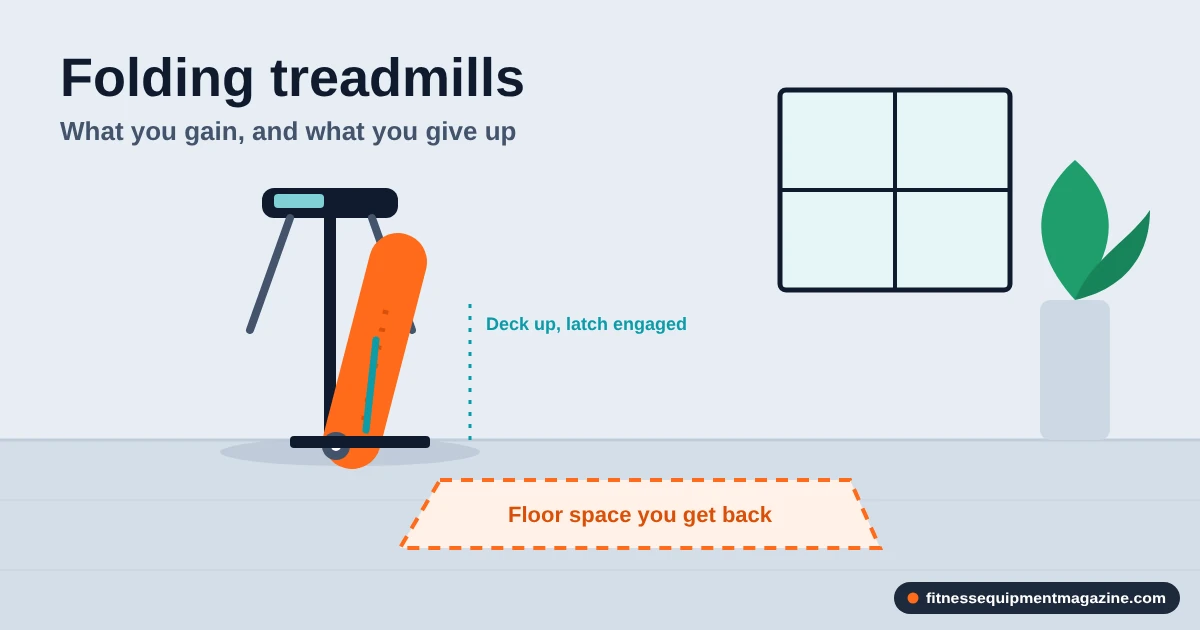
Picture the usual scene. You’ve measured the spare corner, you’ve counted the steps from the front door, and the listing promises that the machine “folds away in seconds.” What the listing doesn’t mention is that the folded machine may still weigh as much as a washing machine, that the hinge is the part most likely to loosen after a couple of years, or that the fold mechanism has its own, shorter warranty. This folding treadmill guide covers those details so that you decide with open eyes.
The short answer
The short version of this folding treadmill guide: buy a folding treadmill if floor space is your real constraint and you’ll fold it often enough to benefit. You gain a much smaller stored footprint, an easier fit in apartments and shared rooms, and a wider choice at friendly price points. You give up some frame rigidity, usually some deck and motor headroom, simpler maintenance, and a bit of peace of mind around the hinge.
- Who it fits: walkers, light joggers, apartment dwellers and anyone sharing a room with a bed, desk or sofa.
- The biggest tradeoff: stiffness. A fixed frame has no joint to flex, so hard running tends to feel steadier on a non-folding machine.
- The common trap: assuming “folds” means “light.” Most folding treadmills are still heavy, and you’ll tilt and roll them, not carry them.
If you run hard, weigh a lot, or never plan to fold the thing, a non-folding frame is usually the better buy. We explain the exact thresholds below.
How we researched this folding treadmill guide. This is research-based guidance. We built it from manufacturer specification patterns, federal guidance and ownership problems that buyers commonly report. We haven’t hands-tested the machines described here, so you won’t find lab numbers, decibel readings or “our testers” claims. We name no brands and give no prices for specific products. Weights, footprints and warranty terms below are typical ranges, so check each against the current spec sheet. Last reviewed: October 2026.
How current is this?
Designs, specs and warranty terms change every few months. Treat the numbers here as typical patterns, not quotes. Before you buy, read the manufacturer’s current spec sheet and warranty page, then check the CPSC exercise equipment recall list for the model on your shortlist. Fold mechanisms and latches show up in recall notices more often than shoppers expect.
Folding Treadmill Guide Basics: Four Ways Treadmills Fold
“Folding” covers at least four different designs, and they behave differently in a room. Before you compare any two listings in a folding treadmill guide or a store, work out which kind each one is. Otherwise you’ll compare a space-saver with a storage compromise and wonder why the numbers don’t line up.
Deck-up: the one most people mean
On a deck-up machine, the running deck pivots about a hinge near the front and swings up toward the console. Most home treadmills that fold work this way. The upright and console stay in place, so the stored machine is as tall as before. Its depth, though, shrinks from around six feet to somewhere near two. A gas strut or hydraulic damper usually helps the deck rise and, on better designs, controls its descent.
Two-fold: deck up, console down
A two-fold design also hinges the uprights or the handrail so the console drops toward the deck. The stored height falls, sometimes enough to slide the machine under a tall bed or into a closet. The price is an extra hinge in a place that carries your hands, your weight and your balance every workout. More joints mean more places for play to develop, so look closely at how well those joints lock.
Vertical storage: the narrow tower
Some machines stand almost straight up on a small base once folded, with the deck vertical and the frame designed to balance there. They save the most floor area per square foot, but the stored height is the tallest of any design. In an apartment with eight-foot ceilings, that usually works. Under a sloped attic roof, it doesn’t.
Slim fold: the walking-pad style
Slim machines fold in half or simply fold flat so they slide under a sofa or lean behind a door. They tend to have no handrails, lower top speeds and shallow motors. That’s why we treat them as a separate category in our guide to the best walking pads. If a “folding treadmill” is really a slim pad with a handle, judge it by walking-pad rules.
One rule of thumb from this folding treadmill guide saves a lot of confusion. If your main problem is depth (the room is long enough only when the machine is folded), a deck-up machine solves it. If your problem is height (a loft bed, a low ceiling, a closet), the two-fold design is the one to look at. And if your problem is “I want it invisible,” you’re really shopping for a slim pad. Our comparison of a walking pad versus a treadmill is a better starting place for that.
What You Gain: The Upside in This Folding Treadmill Guide
Let’s give the upside its due first, because it’s real, and every honest folding treadmill guide should. A folding design earns its place when it changes how you live in a room, not just how the listing photo looks.
A stored footprint that matters in any folding treadmill guide
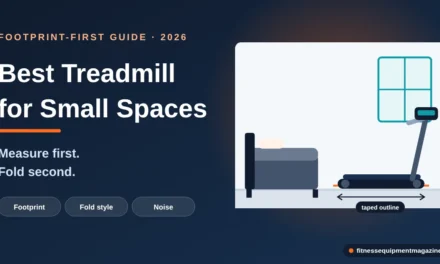
A typical full-size treadmill takes up something like 6 to 7 feet of length and close to 3 feet of width while open. Folded, a deck-up machine often shrinks to about 2 to 3 feet of depth. That’s the difference between “a treadmill lives in this room” and “a treadmill visits this room.” If you share a bedroom, a home office or a living area, the second version is far easier to live with.
More choice at friendlier price points
Folding is common in the lower and middle price tiers of the US market, so you’ll find more options if you’re working to a budget. That’s not an accident. A smaller stored size ships more cheaply, fits more apartments, and sells to more people. If you’re still setting a ceiling, our guide to the best budget treadmills shows where the money goes.
A room that can change jobs
The nicest benefit is the one nobody photographs. A folded treadmill lets the same room serve as a guest bedroom on weekends, a yoga corner in the morning, or a play area when the grandchildren visit. It also makes cleaning easier. Vacuuming under a folded deck takes ten seconds; under a fixed machine, you usually give up.
Easier moves and deliveries
Delivery crews, stairwells and tight door frames respect folded dimensions. A folded machine can often pass through a standard interior door that an open one never could. That doesn’t make it light, which we cover in the moving section, but it does cut the odds of scraping a wall or getting stuck on a landing.
What You Give Up: The Honest Side of Any Folding Treadmill Guide
Now the part that listings skip and that a trustworthy folding treadmill guide shouldn’t. Every folding design pays for its convenience somewhere, and the bill arrives in four places: the frame, the deck, the motor and your own maintenance routine.
Stiffness: a joint is a joint
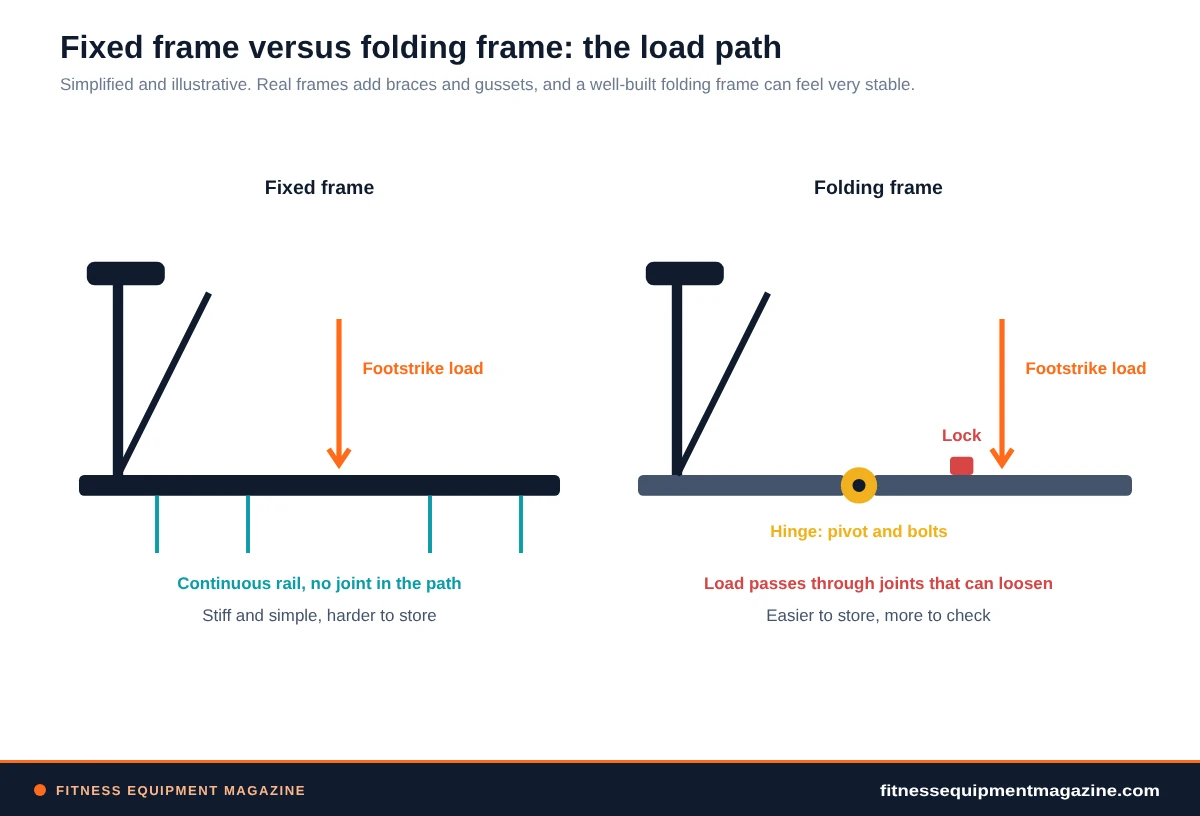
A fixed frame is a rigid structure; the load goes straight from the deck rails into the floor. A folding frame has a hinge, a lock and often a second set of uprights bolted around them. Each joint can flex a tiny amount. Tiny amounts add up as a subtle wobble at the console, a click at footstrike or a feeling that the machine moves with you. Manufacturers build good hinges, but they can’t build away the physics.
Deck compromises
To fold, the deck has to shorten, thin out or add a hinge point somewhere. Many folding models therefore carry a deck a bit shorter or narrower than non-folding machines in the same tier. For walking that rarely matters. For running, it does. A taller runner with a long stride needs room, and a short deck turns every hard sprint into a gamble. Our treadmill buying guide explains stride length and deck size in detail.
Motor headroom
Space in a folding frame is tight. The motor sits low and close to the front roller, and the housing has to clear the deck as it swings up. That tends to limit motor size and cooling airflow. It’s one reason many folding machines are rated for walking and light jogging rather than daily hard running. None of this makes them bad. It makes them honest about their job.
More to check, more to tighten
A non-folding treadmill needs a belt, a deck and a roller checked from time to time. A folding one adds hinge bolts, a lock, a gas strut or damper and sometimes a latch pin to the list. None of it is hard. But it’s extra, and a part you don’t inspect is a part that fails when you don’t expect it.
What folding gives you
- A small stored footprint and easy room sharing
- More models at lower and middle prices
- Better odds of fitting through doors and stairwells
- A cleaner, less cluttered room between workouts
What folding costs you
- Some frame stiffness, especially at higher speeds
- Deck and motor headroom, depending on the tier
- Extra parts to inspect and tighten
- A fold-mechanism warranty that may be shorter than the frame’s
Frame Rigidity in a Folding Treadmill Guide: Fixed Versus Folding
This is the heart of the whole question, so let’s slow down. When you run, each footstrike sends a load of a few times your body weight through the deck and into the frame. A rigid frame absorbs that and stays put. A frame with a hinge shares the load between the hinge, its bolts and the lock. If everything is tight and well made, you may never notice. If something has loosened, you will.
Who actually notices the difference
Body weight and speed decide this. A 140-pound walker at 3 mph loads the frame very lightly, so a good folding machine feels identical to a fixed one. A 230-pound jogger at 6 mph loads it hard and often, so slack in a hinge is likelier to show. Stated weight limits help only a little here, because they say what the machine will survive, not what will feel steady. For more on that, see our guide to the best heavy-duty treadmill, which explains why non-folding frames dominate that corner of the market.
A quick wobble test you can run at home
You don’t need instruments. Once the machine is assembled, grab the handrails and rock them gently side to side with the belt off. Then walk at a moderate pace and watch the console. A tiny bit of motion is normal on any treadmill. Visible shaking, a clunk with each step or a console that buzzes against your hand deserves a bolt check. If it persists, call support while you’re still inside the return window.
Rule of thumb
Match the frame to your heaviest regular workout, not your average one. If an occasional fast interval session is the use that shakes the console, you’ve learned what the machine is for, and what it isn’t.
Matching a Folding Treadmill to Your Workout: A Practical Guide
Rigidity talk gets abstract fast, so let’s turn it into a decision. The question isn’t “folding or fixed?” in the abstract. It’s this: what will I do on this machine most weeks, and how hard will I lean on it? A folding treadmill guide that skips that question is selling you a category instead of helping you choose, so we start with use.
If you mostly walk
Walking is where a folding treadmill guide gets its easiest answer, because it’s the folding treadmill’s home turf. Loads are light, speeds stay low, and a motor sized for steady walking will run cool for hours. Here the fold mechanism hardly matters for performance; it matters for storage and safety.
Spend your attention on the latch, the deck length (a longer stride at brisk walking pace still needs room) and a quiet belt. If you walk while you work, remember that a treadmill and a walking pad overlap here, and our list of walking pad criteria shows when the slimmer option wins.
If you jog a few times a week
Light to moderate jogging is where the better folding machines earn their keep. You’ll want a continuous-duty motor rated comfortably above your needs, a deck that doesn’t cut your stride short and a frame that feels planted when you hit your usual pace. Do the wobble test early and keep the return window in mind. A machine that feels solid on day three will usually feel solid on day three hundred, as long as the bolts stay snug.
If you run hard
Fast intervals and long weekly miles push every part of a treadmill. A folding frame can handle some of that, but you’ll be working near the edge of its design, and any slack in a hinge will announce itself. If speed work is central to your training, a non-folding frame gives you more margin. If you’re also tall, the deck-length compromise becomes a second reason to go fixed.
The meters above are this folding treadmill guide’s editorial rule of thumb for how comfortably a typical folding design fits each use, not test results. Individual machines vary a great deal.
Body weight changes the math
Heavier users load the hinge, the lock and the deck harder on every step. That doesn’t rule out folding, but it moves the thresholds. A folding machine for a heavier user should show a high rated capacity and a substantial shipping weight. Its warranty should treat the hinge as frame, not as a minor part. When you can’t find those, the safer path is a fixed design.
Folding Treadmill Guide to Gas Assist, Hydraulics and Latch Safety
The fold mechanism is the single most important part of any folding treadmill, and buyers tend to spend the least time on it. Two ideas matter: what lifts and lowers the deck, and what keeps it from moving when you don’t want it to.
What helps the deck move
A folded deck can weigh a good fraction of the whole machine, often tens of pounds. Without help, lifting it would be a chore and dropping it a hazard. Manufacturers solve this in a few ways, and the names vary from brand to brand:
- Gas strut. A sealed cylinder of pressurized gas, like the one behind a car hatch, pushes the deck up and resists it coming down. It’s compact, common and quiet.
- Hydraulic or damped lowering. A damper slows the deck’s descent so it eases down instead of slamming. On many designs the strut and damper work together as one assembly.
- Spring assist. A coil spring offsets some of the weight. It’s simple, but it can feel abrupt and tends to lose strength with age.
- Manual lift only. No assist at all. You lift the deck by hand and often hold it while a latch catches. Heavy, but simple and cheap.
For most households, a gas strut with a controlled-lowering feature is the sweet spot. It means the deck won’t crash into the floor if your grip slips, which matters when a child or pet is nearby. If the listing doesn’t say how the deck descends, ask before you buy. A brochure phrase like “easy fold” is not a specification.
The latch is a safety part, not a convenience
The assist moves the deck. The latch holds it. Those are two separate jobs, and a good design keeps them separate. When the deck is folded, a lock pin, hook or catch should secure it so a bumped strut or a leaking seal can’t let it drop. When the deck is open, a second lock should prevent the machine from folding under you while you run. Look for a design that makes the locked state obvious. A visible pin, an audible click or a color indicator you can see from the side all help.
Safety
Never rely on the gas strut alone to hold a folded deck, and never leave a folded treadmill unlatched where children or pets can reach it. A strut can lose pressure over time, and a deck that drops can pinch fingers or crush a paw. Engage the storage latch every time, and check the lock before you step on an open machine. The CPSC exercise equipment recall page is worth a look before you buy, since folding and locking failures have appeared in notices over the years.
How to judge a latch: a folding treadmill guide to spec sheets and photos
You can’t hold the machine, but you can learn a lot from the listing. Photos of the folded machine often show the latch. Customer questions usually reveal how it works in real life. A few signs point the right way:
- The listing names the fold mechanism and describes how the deck lowers, not just that it “folds.”
- The manual is available to read before purchase, with a clear fold and unfold section and warnings.
- There’s a distinct storage lock and a running lock, not one shared catch.
- The latch looks metal, with a pin or hook that visibly engages.
- The listing shows a folded machine with nothing visibly holding the deck.
- Reviews mention the deck “creeping” down, popping loose or needing to be wedged.
- The manual is missing or reads like an afterthought.
Long-Term Wear at the Hinge: What a Folding Treadmill Guide Should Warn You About
Let’s talk about year three. Most folding treadmills are fine in the first month, and a good number are fine at the one-year mark. The hinge and its neighbors are where age tends to show, because they handle the same stress cycles as a fixed frame plus the extra cycle of folding.
How hinges usually age
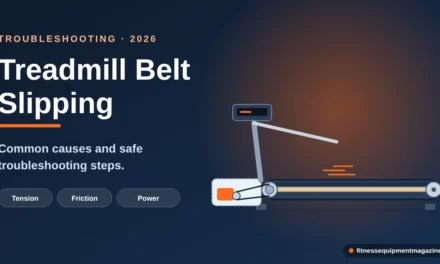
Wear shows up in predictable ways. Bolts that carried a load loosen, because vibration slowly backs them off. A metal sleeve or washer wears and adds a hair of play. A lock pin rounds off and stops seating cleanly. Grit and dust collect around the pivot, and the folding action starts to feel gritty. Meanwhile, the gas strut may lose pressure, so the deck sits lower or drifts down overnight. None of this is dramatic. It’s the sound of a machine slowly asking for attention.
Maintenance habits that help, from this folding treadmill guide
You don’t need a toolbox of special parts. A few habits go a long way:
- Look and touch monthly.With the machine unplugged, wiggle the hinge area and check the first four hotspots from the figure above.
- Tighten what is supposed to be tight.Use the wrench from the manual and follow its torque guidance. Over-tightening can crack a bracket or strip a thread, so snug is the goal.
- Keep the pivot clean.Wipe dust from the hinge and latch. Add lubricant only where the manual says to, because some products attract grit.
- Treat strange sounds as data.A new click or creak means something has shifted. Find it before the next run.
- Fold on purpose.Fold and unfold smoothly. Slamming the deck or forcing a stuck latch causes more wear than a hundred gentle folds.
Surprisingly, a machine you never fold also wears the hinge. Vibration alone can loosen bolts, so the monthly check applies whether you fold daily or never.
Noise and Vibration When You Run: Folding Treadmill Guide Notes
Folding treadmills often get a reputation for being louder, and the reputation is half fair. The motor and belt make about the same sounds as any treadmill. The difference is that a hinge and lock add extra places for sound to start, and a lighter frame is less able to damp what the deck produces.
Where the extra sound comes from
If you hear a rhythmic knock with each footstrike, think hinge or loose bolt before you think motor. A buzz that rises with speed often means a panel or cover resonating against a frame member. A creak when you step on or off usually points to a lock or pivot. Compare that to the steady whir of the motor and the soft slap of the belt, which are normal.
What reaches the floor and the neighbors
Impact noise travels through the floor, not through the air, and a folding frame doesn’t change that fact. A heavy fixed machine on a mat may transmit less than a light one with the same cushioning, simply because mass resists movement. If you live above someone, put a thick mat under the machine, level it carefully and favor lower speeds. Our treadmill noise in an apartment guide walks through mats, placement and timing in detail.
Quick fix list
Before you blame the machine, check four things in order. Start with the hinge bolts and the handrail bolts. Then see whether the machine sits level on all feet and whether the mat edge touches the frame. Those four fixes solve a surprising share of “my folding treadmill is loud” complaints.
The Warranty on the Fold Mechanism: A Folding Treadmill Guide to the Fine Print
Here’s a habit worth building. When you read a treadmill warranty, find out which parts the long number covers, then ask which parts it doesn’t. The headline frame warranty may stretch for years, while parts like the strut, latch and wiring sit in a shorter bracket.
What a typical structure looks like
In the US market, a common structure is a long frame warranty, a shorter motor warranty, a still shorter parts warranty and a brief labor warranty. The fold mechanism often lives in the parts bucket, but some manufacturers list it separately or exclude wear items. The names differ, but the logic is the same: structural pieces get the longest coverage, moving pieces get less.
Often longer
Frame
Welded or bolted structure. Check whether the hinge bracket counts as “frame” or “parts.” It matters.
Often shorter
Parts
Gas struts, latches, pins, wheels and wiring tend to sit here, with a window much shorter than the frame’s.
Often brief
Labor
Repairs at home can cost more than the part. A short labor term shifts that bill to you.
Folding treadmill guide questions to ask before you rely on a warranty
- Is the hinge covered under frame, parts or neither?
- Does the warranty exclude “normal wear” on struts or latches, and how is that defined?
- Who pays for shipping a replacement part, and how long do parts usually take?
- Does moving the machine to another address or using it in a different room affect coverage?
- Does commercial or heavy use void it? Some terms treat a gym or office as commercial.
For a wider look at how warranties are built and where the traps are, read the warranty section of our full guide to motors, belts and warranties. And if you’re comparing two machines that look close, give the better fold-mechanism terms real weight. They tell you how much the maker expects that hinge to be tested.
When the Fold Misbehaves: Four Common Problems in a Folding Treadmill
Every owner of a folding treadmill meets at least one of these eventually. This part of the folding treadmill guide exists to keep a small annoyance from becoming a repair bill. It also tells you when to stop troubleshooting and call support.
The folded deck creeps down
If the deck settles a little overnight, the gas strut may have lost pressure, or the latch may not be fully seated. First, re-engage the latch and test it with a gentle push. If the deck still sinks when you let go, treat the strut as suspect. Stop using the machine’s fold feature until the part is replaced, because a deck that drifts can also drop. Most manufacturers sell replacement struts, and the warranty may cover them.
The deck feels heavy to lift
A deck that was easy at first and now feels like a chore usually points to a weakening strut or a stiff pivot. Clean the hinge area, check for bent brackets and look for any visible binding. A new strut often makes the difference between “I fold it daily” and “I never fold it,” so don’t wait until the machine becomes annoying to use.
The latch won’t catch or release
A stiff latch is often a sign of misalignment, grit or a bent pin. Don’t force it. Look for debris, check that the deck sits fully in its stored position and consult the manual. Forcing a latch can bend the very part you need to trust. If it still binds, contact support and leave the deck down in the meantime.
A clunk when you run
A knock that repeats with each footstrike usually comes from a loose hinge bolt, a worn running lock or a bracket that has started to shift. Stop, unplug the machine and inspect each of the hotspots from the wear figure. Tighten what’s loose and retest at walking speed. If the clunk returns, you’ve found something worth a support call.
Know when to stop
If a part is bent, cracked or leaking, or if the deck won’t stay where you put it, don’t keep fiddling. Take photos, note the model and serial number, and contact the seller or manufacturer while you’re still inside the warranty. Using a damaged fold mechanism is how small defects turn into injuries.
Floors, Mats and Where the Folded Machine Lives
Where the machine sits matters as much as how it folds, and any folding treadmill guide worth reading covers placement. Hard floors need a mat to protect the finish and cut vibration. Carpet may feel gentler but can hide a machine that isn’t quite level. Either way, set the mat down first, then roll the open machine onto it and level all four feet.
For storage, a corner against a solid wall is usually safest. Leave a few inches of space for ventilation near the motor, and don’t tuck the folded deck behind a door that swings into it. Renters should check lease terms about floor loads and quiet hours. Anyone on an upper floor should remember that the machine’s weight and impact reach the neighbors below. A folded treadmill that’s out of the way gets used more, so choose the spot you’ll walk past every day, not the one you’ll avoid.
Setting Up and Folding Safely: A Folding Treadmill Guide to Daily Habits
The injuries a folding treadmill guide should worry about are not dramatic crashes. They’re pinched fingers, a deck that drops on a foot or a pet that wanders under a raised deck. Sometimes it’s a toddler who pulls a lever just to see what happens. The good news is that a short, repeatable routine takes care of nearly all of it.
Day one: set it up where you’ll actually use it
Choose the open spot first and the storage spot second. The open spot needs a level floor, a clear zone behind the belt and a dedicated outlet away from extension cord traffic. The manual will name a rear clearance, often a few feet, and the number is there for a reason. If you fall off a treadmill, you want a runway, not a wall.
The storage spot needs its own checks. Is the floor level there too? Will the folded machine rest against a wall that can take its weight and not scratch? Can you reach the latch without twisting? Is it out of sight lines for small children? Fold-and-store points that fail one of these tests lead to machines left half-open in the middle of a room.
The fold sequence, step by step
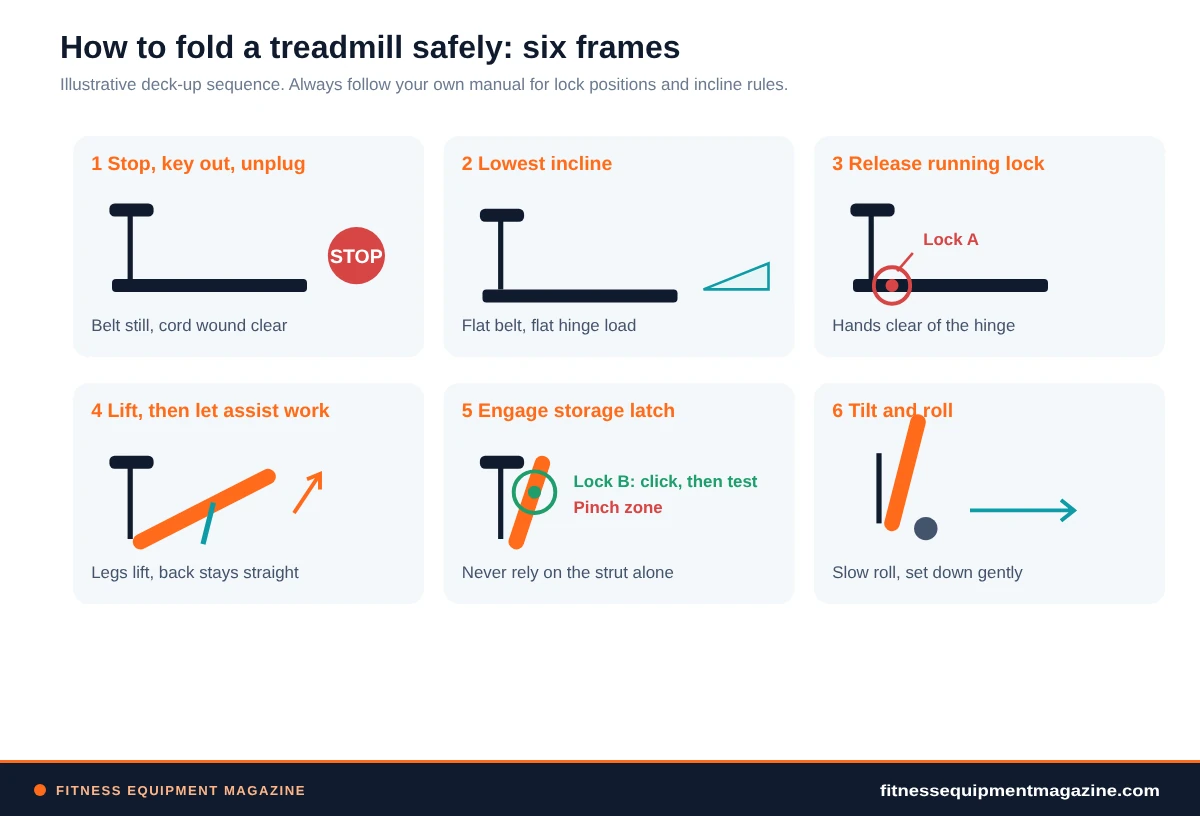
Models differ, so read your manual and treat the sequence below as a general pattern, not a replacement. The fold is the same idea in nearly every deck-up design.
- Stop and power down.Bring the belt to a full stop, remove the safety key, switch the machine off and unplug it. Wind the cord clear of the hinge so it can’t pinch.
- Reset the incline.Many machines need to be at their lowest incline before folding. Check your manual; folding on an incline can strain the mechanism.
- Clear the area.Look for kids, pets and loose items. Make sure nothing sits under the deck or behind the machine.
- Release the running lock.Find the lock that holds the deck flat and release it as the manual describes.
- Lift with your legs.Keep your back straight, grip the deck’s lift point and raise it until the assist takes over. Let it settle; don’t swing it.
- Engage the storage latch.Listen for the click, look for the pin and give the deck a gentle push to confirm. Only then let go with both hands.
- Roll it into place.Tilt the machine back as the manual instructs and roll it on its wheels to the storage spot. Set it down gently.
Kids and pets: the hazards people forget
A treadmill is an attractive nuisance. Kids want to press buttons, and pets want to sleep in the shade of a raised deck. A few rules keep everyone safe:
- Remove the safety key and store it out of reach every time, not just at the end of the day. A belt that starts when a child hops on is a real hazard.
- Keep children and animals out of the room during a fold or unfold. The deck is at its most dangerous while it moves.
- Latch the folded deck, then check it. A folded machine that isn’t latched can come down on a child who climbs it.
- Don’t store the folded machine where a pet can crawl behind the deck. Block the gap or choose another spot.
- Explain the key rule to everyone in the household, including teenagers who borrow your gym.
The Consumer Product Safety Commission lists exercise-equipment recalls on its public page, and treadmill incidents involving children and pets appear there regularly. Reading a few notices is a sobering, useful way to learn which failure modes are real.
Before each run: the five-second check
Open machines are only safe when the running lock is engaged. A good habit is to look at the lock, give the console a gentle shake, clip on the safety key and start slowly. If any step feels off, stop and sort it out before you step onto the belt.
Weight, Wheels and Moving Your Folding Treadmill: A Practical Guide
“It folds” is often heard as “it’s easy to move.” The two have little to do with each other. A folded treadmill is more compact, but its weight hasn’t changed, and weight is what decides whether moving it is a minor chore or a two-person job.
How heavy are they, really?
A slim walking-pad style machine may weigh somewhere around 40 to 70 pounds. A lighter full-size folding walker often falls somewhere around 100 to 150. A sturdier folding runner can reach 200 or more. Check the shipping weight and the product weight on the spec sheet, and treat any listing that hides them with suspicion.
Wheels, floors and stairs
Transport wheels usually sit at the front of the base. They work best on hard flooring and shallow thresholds. On thick carpet they bog down, and across a gravel garage floor they can crack. If your storage spot sits on carpet, plan for a mat or a rolling path. Stairs are another matter. Don’t try them alone with anything over about a hundred pounds. Get a second person, a hand truck or a pro mover.
Habits that save your back and your floor
- Latch the deck first, then check it again before you tilt. A deck that drops mid-roll is the classic accident.
- Clear the path. Measure door widths and turning angles for the folded machine, not the open one.
- Roll slowly and keep the machine under control. Pushing it off a threshold is where wheels fail.
- Lift with your legs and keep the load close to your body. If you can’t, you need help.
- Protect the floor. A thin mat or cardboard under the wheels prevents scuffs and gouges.
If you’ll move the machine every day, weight matters more than footprint, and our guide to the best treadmill for small spaces shows how to balance the two.
The Folding Treadmill Guide Verdict: Who Should Buy One, and Who Shouldn’t
After all of the above, the decision becomes simpler. Folding treadmills reward people whose space is the real problem, and they punish people who ask more of the frame than the design offers. The folding treadmill guide profiles below are hypothetical shoppers, written to show how the logic works.
Profiles where folding makes sense
Hypothetical
The apartment walker
Lives in a one-bedroom, walks 30 to 60 minutes most days, and needs the room back for guests. A folding deck-up with a latch she trusts is exactly right.
Hypothetical
The shared-room jogger
Jogs at a moderate pace in a spare bedroom that doubles as an office. A sturdier folding design with a good strut and a clear warranty works, as long as he checks bolts monthly.
Hypothetical
The seasonal user
Uses the treadmill during winter or bad-weather weeks only. Folding means it vanishes the rest of the year. Fewer cycles, so less hinge wear.
Profiles where a fixed frame is better
Hypothetical
The daily hard runner
Runs fast intervals five days a week with a long stride. Wants maximum stiffness and deck length, and has a dedicated corner. A non-folding frame is the safer match.
Hypothetical
The heavy-duty user
Weighs well over 250 pounds and trains regularly. Needs the stiffest frame he can find, not the lightest. See our heavy-duty treadmill picks for what that looks like.
Hypothetical
The never-folder
Has a basement with plenty of room and plans to leave the machine open all year. Paying for a fold mechanism that never moves is paying for risk with no reward.
Decision rule
The folding treadmill guide rule of thumb is simple. If you will fold the machine at least a few times a week and your top speed stays modest, folding is a smart choice. If you rarely fold, or you push the frame hard, buy a non-folding machine and save yourself the extra joint.
A Pre-Purchase Folding Treadmill Guide Checklist
You’ve read the trade-offs in this folding treadmill guide. Now turn them into a short list you can carry into any product page. Work through it in this order, because the early steps rule out more machines than the later ones.
Folding treadmill guide homework: measure four things before you shop
- Open space.Measure the length and width of the spot where you will run, then add the rear clearance in the manual. Mark it on the floor with painter’s tape. Standing in the taped rectangle for a minute tells you more than any listing.
- Stored space.Measure the corner, closet or wall where the folded machine will live, including the height and the swing of any door nearby.
- The path.Measure every doorway, hall turn and stair between the delivery door and the room. Compare them with the folded dimensions and the shipping box, which is usually larger.
- The ceiling.Open machines need headroom for your stride. Vertical towers need even more when stored. Eight-foot ceilings are usually fine, but check.
Read the spec sheet with this folding treadmill guide’s questions
- What is the product weight, and what is the shipping weight? Neither should be missing.
- What are the open and folded dimensions, with height included?
- How does the deck lift and lower, and is there a separate storage lock?
- What are the deck dimensions? Folding machines can cut length, so compare them against your stride.
- What is the continuous motor rating, and what top speed is the machine designed for?
- How is the fold mechanism covered, in years, and does it count as frame or parts?
- What does the return window look like for a heavy item, and who pays for return shipping?
Want a broader foundation for those motor, belt and cushioning questions? Our guide to the best treadmills for home use covers all of them in more depth than a folding-specific article can.
Red flags a folding treadmill guide would walk away from
- A folding machine marketed for “serious running” with a short deck and a light frame.
- Photos of the folded machine that never show the latch.
- No manual available before purchase.
- Reviews mentioning the deck falling, drifting down or locking unreliably.
- A “max user weight” far higher than the machine’s own shipping weight would suggest.
- A warranty page that excludes the fold mechanism or the strut without saying so up front.
Four myths a folding treadmill guide should retire
Myth
“Folding means weak.”
Not necessarily. A well-built folding frame can be steady for walking and light jogging. It just has less margin at the hard end of the range.
Myth
“Folding means light.”
Many folding machines weigh well over a hundred pounds. Plan on tilting and rolling, not carrying.
Myth
“The strut holds it.”
A strut helps the deck move. A latch holds it still. Treat them as separate parts with separate jobs.
Myth
“Fold it daily and it will wear out.”
Careful folding adds modest wear. Vibration, loose bolts and a neglected lock do more harm than regular, gentle use of the fold.
Weighing the extra cost in a folding treadmill guide
Folding is often cheaper up front, but the true cost includes mats, possible repair parts and the time you spend checking bolts. The budget view in our best budget treadmills guide applies here too: spend where you feel it every workout, which is the frame and the hinge, not the screen.
The bars above are an editorial rule of thumb for where a folding treadmill’s budget does the most work, not a measurement.
Folding Treadmill Guide FAQ: Questions Buyers Ask
Is a folding treadmill as good as a non-folding one?
For walking and light jogging, a well-built folding machine can feel just as good. For hard daily running or very heavy users, a non-folding frame usually offers more stiffness and headroom. The honest answer in any folding treadmill guide is that it depends on your speed, body weight and how often you fold the machine.
How long do folding treadmills last, according to a folding treadmill guide?
There is no single figure in any folding treadmill guide, and anyone quoting one is guessing. Lifespan depends on use, weight, speed, maintenance and build quality. Hinge bolts, struts and latches tend to need attention before the motor does. A monthly check therefore extends the machine’s life far more than most buyers expect.
Can I run on a folding treadmill, and what does a folding treadmill guide say?
Yes, many are designed for jogging and some for running. Check the continuous motor rating, the deck length and the frame’s stated design for your top speed. If you run fast or have a long stride, a longer deck and a stiffer frame are worth prioritizing. Our detailed treadmill buying breakdown covers stride and deck length.
Is it safe to fold a treadmill with kids or pets in the house?
It can be, and a good folding treadmill guide keeps the rules simple. Remove the safety key, keep children and animals out of the room while the deck moves, and always engage the storage latch. Don’t store a folded machine where a child can climb it or a pet can crawl behind it. Check CPSC recall notices before buying.
Do folding treadmills need more maintenance than a fixed machine?
A little more, and any folding treadmill guide should say so. Alongside belt and deck care, you’ll check the hinge bolts, latch, strut and wiring near the fold. A short monthly inspection is usually enough. Skipping it is where small problems become loud or unsafe ones.
Are folding treadmills louder?
Not by default. The motor and belt sound the same as on any treadmill. The extra noise usually comes from a loose bolt, a worn lock or a light frame that resonates. Tighten the hardware, level the machine and use a good mat. For apartment tips, see our guide to treadmill noise.
How heavy is a folding treadmill?
Slim folds may weigh roughly 40 to 70 pounds, while full-size folding machines often weigh 100 pounds or more and sturdier ones can pass 200. Always read the spec sheet. “Folds” describes the shape, not the effort needed to move it.
Should I choose a folding treadmill or a walking pad?
If you want handrails, higher speeds and a more full-size feel, choose a folding treadmill. If you mostly walk and want the machine to disappear, a walking pad may fit better. We compare both in our walking pad versus treadmill comparison.
Bottom Line: Is a Folding Treadmill Right for You?
Here’s the short version of this folding treadmill guide. A folding treadmill is a trade: you gain space and flexibility, and you give up some stiffness, some headroom and a bit of simplicity. When the space is your actual problem, that trade is usually a good one. When you push the frame hard or never fold the machine, it isn’t.
If you only keep one line from this folding treadmill guide, keep the decision rule above. If you’re ready to move forward, here’s a sensible next sequence. Measure your open and stored spaces and write down your heaviest regular workout. Then shortlist two or three machines whose fold mechanism you can understand from the listing, and read each warranty for the strut, latch and hinge.
Then check the CPSC page, confirm the return policy for heavy items and buy the one whose details hold up. The broader criteria for motor, belt and cushioning are in our overview of the best treadmills for home use, and the small-space treadmill guide is the natural next read.
Finally, remember why you’re reading a folding treadmill guide at all: to move more. Regular movement is the point, and general guidance such as the HHS Physical Activity Guidelines describes how much activity is typically recommended for adults. The best treadmill is the one you’ll actually use, and a folding design helps most when it removes the excuse of a cluttered room.
Sources and Further Reading
- U.S. Consumer Product Safety Commission: exercise equipment recalls — check any model before you buy.
- HHS Physical Activity Guidelines for Americans — general federal activity guidance.
- Treadmill buying basics on this site — motor, belt, incline, cushioning and warranty basics.
Some links on this site may be affiliate links. If you buy through them we may earn a commission at no extra cost to you. Recommendations are based on the criteria in the article, not payout. This article is general information and research-based guidance, not medical advice. Last reviewed: October 2026.