The best functional trainer is the machine that lets you pull, press, row and rotate from almost any angle without swallowing the whole room. That’s a bigger promise than it sounds. Two weight stacks, two pulleys that slide up and down a track, and a handful of handles can stand in for a dozen single-purpose machines. But the spec sheet hides the details that decide whether it feels smooth or sticky, and whether the numbers on the stack mean what you think they mean.
Picture the home gym you actually have. Maybe it’s the far half of a two-car garage. Maybe it’s a spare bedroom with an 8-foot ceiling and a closet full of resistance bands you stopped using in March. You want cable work for your back, shoulders and arms, and you want it without a commercial-gym footprint.
The best functional trainer is a strong answer, but only if you buy the right one. Plenty of models look alike in photos. They differ in pulley ratio, usable stack weight, how far the cable travels, and how many ways the handles can move. This guide shows you how to read those differences so you can pick the best functional trainer for your space, your body and your training.
The best functional trainer for most home gyms is a dual-stack machine with a stated pulley ratio, a stack that gives you enough usable weight at the handle, and pulleys that glide through a wide range of heights. Look for a stable steel frame, smooth sealed pulleys, easy pin adjustments and a warranty that spells out frame, parts and cables separately.
- Who it fits: lifters who want rows, pulldowns, presses, curls, triceps work and rotational moves in one footprint, plus households where two people train at once.
- The biggest tradeoff: a 2:1 ratio gives longer, smoother travel but halves the weight you feel. A 1:1 machine delivers the full stack, with a shorter reach. Read the ratio before you read the stack number.
- The common trap: buying on headline stack weight. A 200 lb stack at 2:1 is a 100 lb stack at your hand.
If you’re still deciding what to buy first, our guide to the best home gym equipment for strength training puts a functional trainer in context.
How we researched this. This is research-based guidance built from manufacturer specification patterns, federal activity guidance and ownership problems that buyers commonly report. We haven’t hands-tested the machines described here, so you won’t find lab numbers, decibel readings or “our testers” claims. We name no brands and quote no prices for specific products. Figures below are typical ranges, so verify them against the current spec sheet. Last reviewed: October 2026.
Specs, warranties, availability and recalls shift every few months. Treat the numbers here as typical patterns, not quotes. Before buying anything, read the current spec sheet and warranty page. Then check the CPSC exercise equipment recall list for the model you’re considering.
What the Best Functional Trainer Really Is
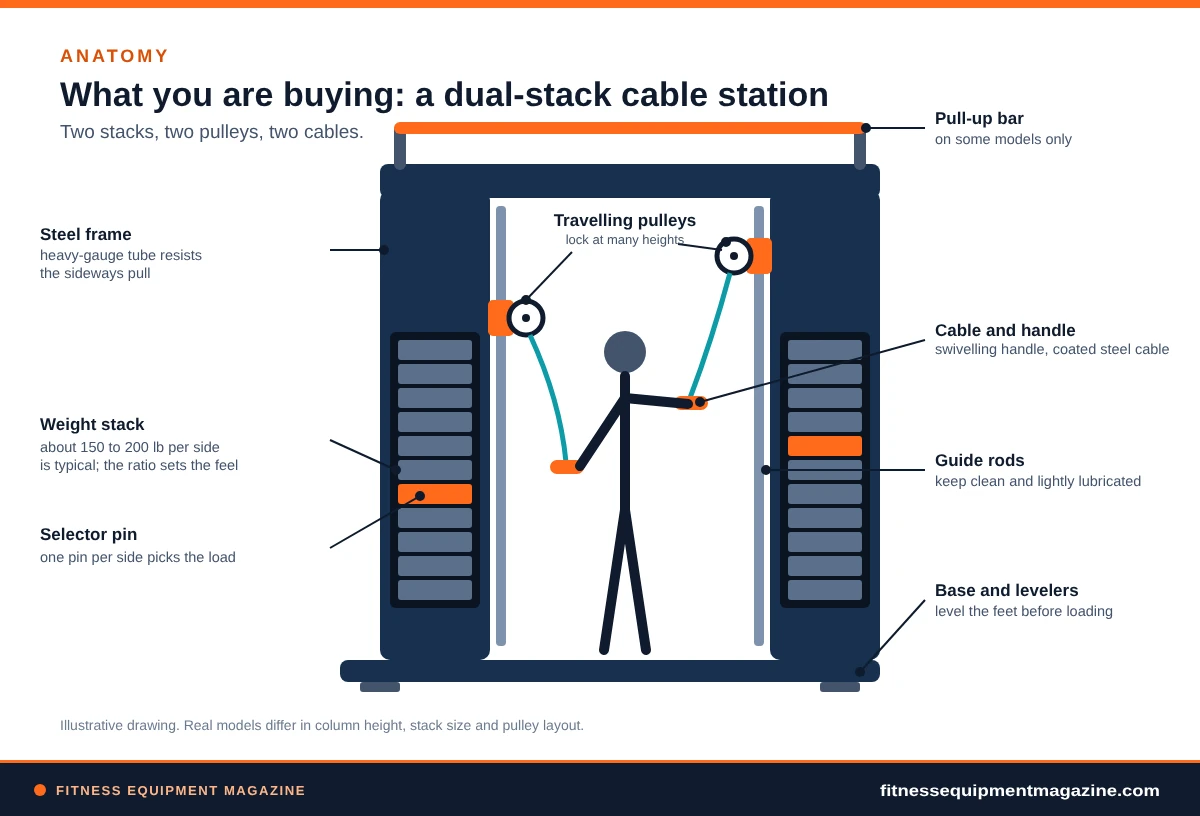
The name is a little grand. Strip away the marketing and a functional trainer is a cable machine built around two adjustable pulleys. Each pulley rides on its own vertical track and connects through a cable to its own weight stack. You clip a handle to the end of the cable, pick a height, and pull. Because the pulley moves, the line of pull can come from your ankle, your hip, your chest or above your head.
That flexibility is the whole point. A fixed lat pulldown only pulls down. A fixed row only pulls back. The best functional trainer lets one machine do both, and a lot more besides.
What one machine can cover
Think in movement patterns rather than exercise names. A good dual-stack machine handles most of the following without much fuss.
- Vertical pulls. Lat pulldowns from a high pulley, usually standing or kneeling, and single-arm variations that are hard to copy on a fixed machine.
- Horizontal pulls. Seated or standing rows with the pulleys at chest height, plus face pulls for the upper back and rear shoulders.
- Presses and flies. Standing chest presses, cable crossovers and overhead presses with a split stance.
- Arm work. Curls from a low pulley and triceps pushdowns from a high one, with plenty of angle options.
- Rotation and anti-rotation. Woodchops, lifts, Pallof presses and carries that train the trunk to resist twisting.
- Legs and hips. Kickbacks, hip abduction and adduction with an ankle strap, and pull-throughs.
The federal guidance is straightforward on why this matters. The HHS Physical Activity Guidelines recommend muscle-strengthening activity that works all major muscle groups on at least two days a week, and cables make that easy to organize. You can read the details on the HHS Physical Activity Guidelines page.
What it won’t do for you
The best functional trainer isn’t a rack. It won’t hold a loaded barbell for squats, and it isn’t built for heavy bench presses. If heavy barbell work is the center of your plan, a rack comes first, and our guide to the best power racks for home gyms covers that decision. Many buyers eventually own both.
It also isn’t a magic fix for a tiny space. Even a compact unit needs open floor on both sides, because the handles travel outward and you stand in front of them. We’ll draw that out later in the footprint section.
Say out loud the three lifts you’d do most on this machine. If two of them are squats or bench presses, you’re shopping for a different category. If they’re rows, pulldowns and presses at odd angles, keep reading.
What “functional” means on a spec sheet
The word has no regulated definition. In practice it signals freedom of movement: pulleys that adjust, handles that rotate, and a path of travel that isn’t locked to one track. Some brands apply it to anything with a cable. So the label itself tells you almost nothing. What matters is whether both arms can move independently, how many height positions you get, and how smooth the cable runs when you reverse direction mid-rep.
One more naming wrinkle is worth clearing up. You’ll see “cable crossover,” “dual adjustable pulley,” “functional trainer” and “cable machine” used almost interchangeably. Roughly speaking, a cable crossover has two high pulleys, while a functional trainer adds adjustability along the full height. Our cable machine buying guide sorts out the wider family, and this page stays focused on the adjustable dual-pulley type.
Pulley Ratio: The Spec That Changes Everything
If you only learn one number from this guide, make it the pulley ratio. It tells you how far the handle travels for each inch the weight stack moves, and therefore how heavy the stack feels at your hand. Most shoppers skip it. Then they get the machine home and wonder why 100 lb feels like a warm-up.
How 1:1 and 2:1 differ in plain language
With a 1:1 ratio, the cable runs from the stack up to the handle with no extra pulley doing multiplication. Pull one foot of cable and the stack rises one foot. You feel the full plate weight, minus a little friction.
With a 2:1 ratio, the stack hangs from a moving pulley, so it rises half as far as your hand travels. You pull two feet of cable to lift the stack one foot. The handle feels half the stack weight, and you get twice the reach from the same column height. Some compact units use 3:1 or even 4:1 designs, though those are less common at home.
Keep one thing straight, because it trips people up. The ratio doesn’t make the machine easier or harder in any absolute sense. It trades load for travel. A 2:1 machine with a 200 lb stack and a 1:1 machine with a 100 lb stack can feel similar at the handle, but the first one lets your arm travel twice as far before the stack bottoms out.
Which ratio suits the best functional trainer for you
For home use, 2:1 is by far the most common arrangement, and for good reason. A column that fits under a standard ceiling can still deliver the long cable runs a standing row or a crossover needs. The cost is that you need a heavier stack to challenge strong lifters, and you accept a little more friction from the extra pulleys.
A 1:1 design tends to feel more direct and loads you with the real stack weight. It suits shorter movements, such as curls and triceps work, and it appeals to lifters who like predictable numbers. The catch is limited reach. Long pulls like a full-height lat pulldown may run out of cable before your arms finish the stroke.
So how do you decide? Start with the exercise you care most about. If it’s anything with a big range of motion, lean toward 2:1. If it’s mostly strength work through shorter paths, 1:1 may be worth a look. Many mid-priced dual-stack units use 2:1, and few spec sheets shout about it. Hunt for it in the manual or ask the seller directly.
Stack Weight, Increments and Effective Load
Once you know the ratio, the stack number starts to make sense, and the best functional trainer becomes easier to spot. Manufacturers usually print the weight of one full stack, and many home models fall somewhere around 150 to 200 lb per side, with some going higher. That’s the number on the box. It isn’t the number your hands feel.
Turning stack numbers into hand numbers
The arithmetic is short. Divide the stack weight by the ratio, then subtract a little for friction. A 200 lb stack at 2:1 gives roughly 100 lb at the handle. A 150 lb stack at 2:1 gives roughly 75 lb. At 1:1, the same stacks give you close to the full figure.
Friction matters more than most people expect. Every pulley, every cable bend and every sliding guide rod steals a little. Depending on the design, you may lose a modest slice of the load before it reaches your hand, and the loss is often larger at the lowest weights where the stack barely moves. That’s why a good machine feels the same at 10 lb and at 80 lb, and a poor one feels sticky at the light end.
Increments and the first plate
Pay attention to how the stack climbs. Many stacks use 10 lb plates, which become 5 lb jumps at the handle on a 2:1 machine. That’s a sensible step for rows and pulldowns. For lateral raises, face pulls and rehab-style shoulder work, it can be too big. A small add-on weight, commonly 2.5 or 5 lb, lets you move in smaller steps. Check whether it’s included and whether it takes an actual pin or just sits on top.
Also look at where the stack starts. A machine whose first selectable position is 10 lb at the handle suits most beginners. One that starts at 20 lb may feel punishing on light face pulls. The best functional trainer for a mixed household has a gentle floor and a generous ceiling.
How much stack does the best functional trainer need?
Here’s an honest rule of thumb, not a prescription. Upper-body pulling uses your biggest muscles, so strong lifters outgrow a lightly loaded stack sooner on rows and pulldowns than on curls or lateral raises. If you already row or pull down meaningful weight, look for a stack and ratio that give you comfortable headroom at the handle. If you’re newer to training or mostly want fitness and joint-friendly variety, a 2:1 machine with a mid-sized stack can last for years.
Since the manufacturer’s maximum may exceed what suits you, ask two questions. What’s the heaviest single-arm cable row you imagine doing in a few years? And would you ever press from the cables? Cables rarely replace heavy barbell work, so most buyers of the best functional trainer don’t need an enormous stack. Consider an optional weight upgrade only if the unit supports one cleanly.
“200 lb weight stack” can mean 200 lb total on each side, 200 lb in combined total, or 200 lb at the handle after the ratio. Ask which, in writing. Whichever way it’s phrased, divide by the ratio before comparing two machines.
Cable Travel and Pulley Height Positions
Travel is the quiet sibling of the pulley ratio. It describes how far the handle can move before the stack bottoms out or the cable runs out. Height positions describe how many places the pulley can lock along the column. Together they set the exercise menu for the best functional trainer.
How much travel the best functional trainer needs
Think in terms of your arms, because the best functional trainer has to match your reach. A long pull like a standing pulldown or a straight-arm pushdown asks for a long run, often several feet. A short curl barely needs two feet. Machines with a 2:1 ratio generally deliver the longer figures from the same column height, which is why so many dual-stack models use it. Look for the handle travel in the spec sheet, not just the stack travel, and note whether the figure is per side.
If the manual lists only stack travel, double it for a 2:1 design as a rough estimate. Then picture your body. Tall lifters and anyone who reaches overhead need more room. Shorter lifters may find a high starting pulley sits comfortably out of reach and needs a step stool or a lower minimum.
Height positions: count them and check the spacing
Adjustment ranges commonly run from near floor level to above head height, with pin or lever positions every few inches. More positions help you find the angle that suits your own shoulder. Wider gaps between holes mean fewer choices, so compare spacing as well as the count. Check the lowest position too. If it starts several inches above the floor, ankle straps and low rows get awkward.
Smooth swivel and angle in the best functional trainer
A pulley that can’t swivel is just a roller. Look for pulleys that rotate freely on their carriage, so the cable can leave at an angle without binding. This is what lets you do a high-to-low chop or a cross-body press. Without it, the cable rubs against its housing and the movement feels gritty. Ask whether the pulleys swivel a full range or only partway, and whether the carriage can slide even when loaded.
Frame, Footprint and Room Fit
A functional trainer looks compact in a showroom photograph. In a real room, it’s a tall, heavy object with moving parts on both sides. The number to care about isn’t only its footprint. It’s the footprint plus the space you need to stand and pull.
Typical dimensions and why they mislead
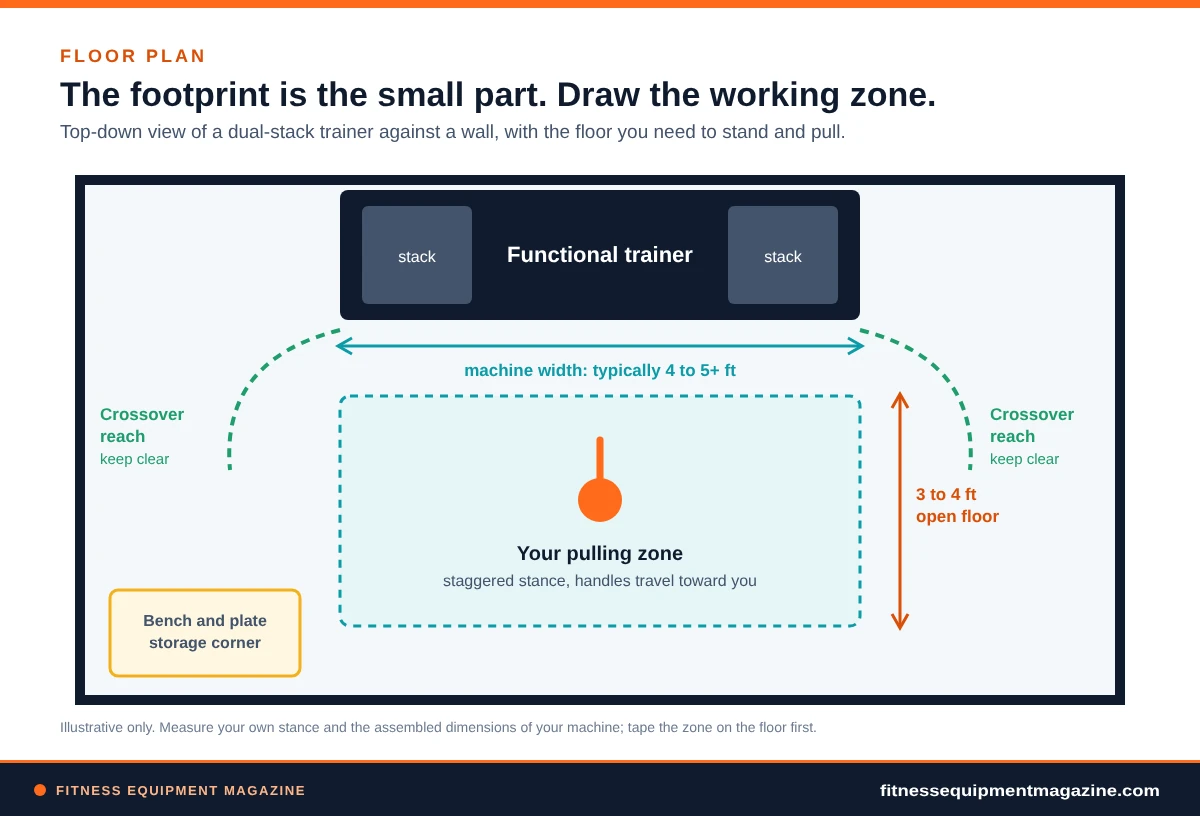
Compact dual-stack machines are often somewhere around 4 to 5 feet wide, with larger ones stretching further, and commonly stand roughly 7 feet tall. Depth varies a lot, sometimes only a few feet with the base plates included. Weights of several hundred pounds are normal once the stacks are loaded. Always check the assembled dimensions on the spec sheet, then add margin.
Published footprints rarely include the working zone. You step forward to pull, backward to row, and sideways to cross over. Treat the machine’s own rectangle as the smallest part of the space you’ll need. Our guide on how much space a home gym needs gives example layouts by room size.
Ceiling height
Most columns end around the 7-foot mark, so a standard 8-foot ceiling usually clears them. But a machine with a built-in pull-up bar, or a lifter who wants to do overhead movements nearby, can run short. Measure your ceiling at the exact spot, and check for beams, ducts and light fixtures. Then read our primer on home gym ceiling height before you commit.
The working zone around the best functional trainer
Draw it on the floor with painter’s tape before you buy. Start with the machine’s width and depth. Then add roughly an arm-span of open floor in front, because the handles travel toward you and you take a staggered stance. Leave room on each side for crossover moves, where your hands meet in the middle. Behind the machine, a few inches of wall clearance helps with cooling the cables and with maintenance access.
Frame stability and floor load for the best functional trainer
A cable machine pulls toward itself, and some units pull sideways too. A rigid frame with a wide base resists that. Look for thick steel tubing, commonly in the 11 to 14 gauge range, reinforced joints, and wide base feet with adjustable levelers. Wobble in the showroom becomes rattle in the garage.
The unit’s weight also matters if your room sits above another one. A loaded functional trainer concentrates several hundred pounds on four small feet. On a ground-floor slab, that’s rarely a worry. On an upper floor, check the manufacturer’s weight figure and read our guide on home gym flooring, which explains how mats spread load and cushion noise.
Some manuals call for wall or floor anchoring, especially for tall units or those with a pull-up bar. Follow the instructions for your model. If you rent, ask the landlord before drilling, and consider a model rated for freestanding use.
Pulleys, Cables and Adjustment Mechanisms
Two machines with the same ratio and stack can feel completely different. The difference usually lives in the parts you can’t see in a photograph: pulley wheels, bearings, cable quality and the way the carriage locks into place. That’s where a lot of long-term ownership problems begin, and where the best functional trainer separates itself.
Pulley wheels and bearings
Pulleys commonly measure somewhere around 3 to 5 inches across. Larger wheels bend the cable less sharply, which reduces wear and friction. Materials vary: nylon or polymer wheels run quietly and are gentle on cables, while aluminum or steel wheels can be more durable but noisier if a cable rubs. Sealed bearings help the wheel spin freely and keep dust out.
Ask what kind of bearing the pulleys use, and whether the wheel has a cable guard. A guard keeps the cable from jumping off the wheel when it goes slack, which is one of the most common nuisances on any cable machine. It also protects your fingers.
Cable type and sheathing
Most home units use coated steel aircraft cable, often around 3/16 inch (5 mm) in diameter, though sizes vary. The coating reduces fraying and noise. Higher-strand-count cables bend more easily around small pulleys. Whichever you get, find out if replacement cables are sold, and how long a replacement run needs to be. A cable that frays is normal wear, not a defect, but a manufacturer who stocks spares makes a difference.
Inspect cable ends and clips at assembly. Many early failures trace back to a crimp or fitting that was never fully seated. The CPSC page on exercise equipment is a sensible place to check whether similar units have drawn recalls.
Pin, lever and quick-release adjustment
Height adjustment is the feature you’ll touch the most. Pop-pin carriages require you to pull a pin, slide the pulley, and release. Lever or quick-release carriages let you do it with one hand. Both work. What matters is how reliably the carriage locks. A pulley that creeps downward under load is a safety issue and an annoyance. Test it empty and loaded if you can, and watch for flex or play in the track.
Speed matters too. If you plan to superset rows and presses with a short rest, a slow adjustment mechanism will drive you quietly mad. Think about how many times per workout you’ll change heights. If the answer is “constantly,” favor a smooth single-hand design over a fiddly pin.
Whenever you can, listen. Pull a handle slowly through a full rep and reverse. A smooth machine hums. A rough one ticks, squeaks or catches at the turnaround. Reviews that mention noise from the pulleys within the first months are worth taking seriously.
Attachments: In the Box and Worth Adding
The handles you get decide what the machine can do on day one. Some bundles are generous, others include a single pair of D-handles and a short bar. Since attachments are cheap to add later, don’t let a thin starter set eliminate an otherwise good machine. Do check that the connection standard is common, so accessories fit.
A sensible starter set
You can cover a surprising amount with a short list. Most lifters get the best value from the following.
- Two single handles. The workhorse for rows, presses, crossovers and chops, ideally with a rotating swivel.
- A straight or slightly curved bar. For pulldowns, curls and pushdowns.
- A rope. Face pulls and triceps work feel better with a rope than with a bar.
- An ankle strap. Opens up leg work and hip movements.
- A close-grip or V-handle. Handy for seated-style rows if you add a bench.
Our detailed rundown of cable attachments and what each one changes goes further. It’s worth reading before you add anything beyond this list.
Pull-up bars, benches and landmine adds
Some trainers include a pull-up bar on top or a bench option. A bar is useful, but check the ceiling clearance first, because a bar on top of a 7-foot column may leave you hitting the ceiling. Some units offer a bench or a bar for dips. These can be handy, though the design compromises are worth reading about. Treat them as bonuses, not selling points.
A few machines accept a landmine pivot or barbell holder. That can extend the range, but only if the manual says so. Never improvise a mount.
Dual Stack, Single Stack, Plate-Loaded or Rack-Mounted
“Functional trainer” covers a few different designs. They overlap in what they can do, but they differ in cost of ownership, noise, footprint and how they feel. Picking the right type often matters more than choosing between two similar models.
Dual weight-stack machines
This is the classic. Two columns, two stacks, two independent cable paths. Because each side has its own weight, you can do unilateral moves, alternate arms and train with a partner. Pin-selected weights make changes quick. The drawbacks are size and weight, and stack machines often cost more than the other types.
For most readers asking which type is the best functional trainer, this is the answer to start from. It’s the type the rest of this guide assumes.
Single-stack and compact trainers
Some compact models share one stack between two pulleys or use a single stack with a cable that splits. They save space and money. They also limit independent two-arm work, and the same weight loads both hands. If your plan is mostly single-arm moves, that’s no real loss. If you want a crossover where each side moves a separate load, it can feel limiting. Check whether the machine’s pulleys really operate independently.
Plate-loaded trainers
Plate-loaded units replace the stack with plates you already own. Pulleys redirect the cable to a plate horn or loading pin. They tend to be lighter on the budget and easier to move, and they suit lifters who already own a stack of plates. The trade is slower changeovers. You load and unload by hand, which turns supersets into chores. Friction and ratio can vary a lot between designs, so ask for them in plain numbers.
Rack-mounted and wall-mounted cable systems
If you already own a power rack, a cable attachment that bolts to the frame can give you pulley options without a second large machine. A pulley that clips onto the uprights adds a lat pulldown or low row. These solutions are space-efficient and often modular. They rarely match the adjustability of a full dual-stack unit, though. Our guide to the Smith machine versus power rack decision shows how to think about spending the same floor space on different tools.
Most flexible
Independent arms, fast pin changes, the largest footprint and weight. The type most people mean by the best functional trainer.
Most compact
Saves space and money. Limits independent two-arm loading, so check the pulleys’ true freedom.
Most economical
Uses plates you may already own. Slower changeovers, and the feel varies by design.
Most modular
Turns a rack into a cable station. Less adjustability than a full trainer.
Six Shopper Archetypes (Hypothetical)
These profiles are invented to show how the criteria play out. They aren’t reviews of real people or products. Find the one nearest to your situation, then use its checklist as a shortcut.
The garage lifter with a rack already
For Maya, hunting the best functional trainer is about space. She owns a rack, a bench and plates. She wants cable work for her back and arms without losing garage floor she needs for the car. For her, a rack-mounted add-on or a slim single-stack unit may beat a full dual-stack monster. If she wants independent loading, she should measure carefully, because the second column eats width.
The couple who train together
Devon and Priya train on the same schedule and hate waiting, so they want the best functional trainer that two people can share. A dual-stack machine lets both use a column at once, or one person works cables while the other uses a bench. They should prioritize a gentle starting weight, since one of them is newer to lifting, plus fast adjustment so the stack setup doesn’t hold up the session.
The tall lifter with a low ceiling
Sam is 6’4″ in a basement with a shallow ceiling. The pulley height range matters, and so does the pull-up bar question. A high pulley that sits on the ceiling is useless. He should measure the highest position, factor in his reach, and prefer a unit that lowers the maximum pulley point without compromising stability.
The apartment renter
Lena rents a second-floor flat. Weight and noise count here. A stack machine’s weight stays modest compared with a rack, but dropped stacks thump through floors. She should favor a quiet design, a thick mat, and a machine she can unbolt and carry out. Our page on building a home gym as a renter covers the practical side.
The returning lifter in his sixties
Walt hasn’t trained seriously in years and wants joint-friendly variety from the best functional trainer he can find. A 2:1 trainer with a low starting weight, smooth cables and a clear pin system makes sense. He benefits from the controlled path of a cable more than a free bar. Because he may have limited mobility, he should check the machine’s access height and make sure no part is hard to reach. General activity guidance is on the HHS page, and he should talk to a clinician before starting a new program.
The tight-budget builder
Noor has a small budget and a spare corner, and she needs the best functional trainer for the least money. She doesn’t need a showroom unit. A plate-loaded or single-stack trainer with a good warranty can cover her needs. She should avoid models with a sky-high stack and tiny frame, since that combination hints at corner-cutting. A modest, solid machine beats a flashy, wobbly one.
We don’t name brands or quote prices because we haven’t hands-tested products, and because both change quickly. Use these profiles as a way to sort your own priorities, then compare real spec sheets against the checks in this guide.
What to Ignore, and How to Stay Safe
Marketing pages love certain numbers. Some deserve a glance, others deserve to be skipped. The following are the ones that most often mislead shoppers hunting for the best functional trainer.
Specs and claims to discount
- Headline stack weight without a ratio. It tells you nothing about the load at your hand.
- “Commercial-grade” with no explanation. The phrase has no legal definition. Ask for frame gauge, bearing type and the warranty structure instead.
- A giant exercise count. “Over 100 exercises” is arithmetic with attachments. Any adjustable cable machine can claim it.
- Glossy photos of a lifter in a perfect gym. Look at the floor space around the machine, not the machine alone.
- Reviews that praise the delivery and ignore the pulleys. Search for comments about sticky stack travel, cable fraying and pulley noise after six months.
Assembly and first-week checks
Plan on a few hours with a helper. These machines have many bolts, and a missed washer turns into a rattle. Tighten fasteners in the order the manual gives, and don’t fully tighten anything until the frame is square. Run the stacks empty and listen. Then add weight in steps and recheck pulley tracking. Within the first couple of weeks, re-check the bolts, because settling often loosens them.
Safety habits for the best functional trainer
Cables are forgiving until they aren’t. Never release a handle under load and let the stack drop. Don’t stand in the path of a moving cable. Keep children and pets away, because a weight stack is a hazard when a pin is loose. If a cable looks frayed, stop using the machine. Replace it using parts from the manufacturer. Similar equipment has been recalled in the past, and the CPSC exercise equipment page is where to check.
For upkeep, wipe down the guide rods, check cable tension and look at the pulleys every month or two. Our primer on strength equipment maintenance walks through bolts, cables and rust prevention in more detail.
Is the Best Functional Trainer Worth It Versus Other Options?
A fair question before you commit floor space: what else could the same money and room buy? Cable training isn’t the only route to a strong back and balanced shoulders. Here’s how the alternatives stack up, so you can judge whether the best functional trainer is really the right first purchase for you.
Versus resistance bands
Bands are cheap, light and portable, and they teach a lot of useful patterns. They also get harder as they stretch, and the load changes through the rep. A cable keeps the resistance steady from start to finish. Bands can’t be numbered with a pin, so tracking progress is vague. If you travel or live in a tiny space, bands win. If you want repeatable loading, a cable machine pays you back.
Versus a lat pulldown or a seated row machine
Single-purpose machines do one pattern well and take a fixed amount of room. A functional trainer swaps depth for breadth. You give up some of the locked-in comfort of a seat and back pad, and gain dozens of angles. People who dislike standing cable work sometimes prefer a dedicated machine. People who want variety usually prefer the trainer. Our cable machine buying guide explains where each style shines.
Versus spending on a rack and free weights
Free weights are efficient, cheap per pound and endlessly scalable, but they demand more skill and often a spotter or safeties. A cable stack is self-spotting, since you can simply let go and the weight returns. Honest advice: if you have budget for only one big item and your goal is general strength, a rack and a bar usually give more training per dollar. If your priorities include joint-friendly variety, shared use or a shoulder-friendly angle, the best functional trainer makes a strong case. Many home gyms end up with both, in whichever order the budget allows.
Warranty and Ownership Problems to Expect
Every machine with moving parts has wear items. Knowing which ones, and how the warranty treats them, makes the difference between a pleasant five years and an irritating one. The patterns below come from ownership problems commonly reported across cable equipment, not from our own testing.
How warranties are usually structured
Frame coverage often runs long, sometimes a decade or more. Parts coverage tends to be shorter, commonly a year or two. Cables, pulleys and similar wear items may carry the shortest term or be excluded as consumables. Labor is often a separate matter. Read each category, not the headline. A “lifetime warranty” that covers only the frame still leaves you paying for the parts most likely to fail.
Problems owners commonly report
- Cable fraying or stretching. It shows up first at the ends and where the cable bends over a small pulley.
- Cable jumping off a pulley. Usually a missing guard or a loose bolt, and easy to fix once you catch it.
- Sticky stack travel. Dry or dirty guide rods, or misalignment from an unlevel floor.
- Pins that don’t seat. Worn holes or a bent pin cause the weight to slip.
- Creeping carriages. A height adjuster that slowly slides down under load.
- Missing or wrong hardware. Check the parts list on delivery day, not three weeks later.
Most of these are manageable with regular checks. Still, if a product’s review pages are full of complaints about the same part, believe the pattern. Then weigh whether the seller sells spares, answers email and honors claims. A reasonable machine with a responsive manufacturer beats a great one with silence.
Your First Month on the Best Functional Trainer
Buying the machine is half the job. The other half is using it in a way you’ll keep up. What follows is general programming context, not a prescription, and it doesn’t replace advice from a qualified coach or clinician.
Week one: learn the machine
Use light weight and spend the first sessions learning the setup. Find the pulley heights that feel right for rows, presses and pulldowns, and note them somewhere. Practice a controlled tempo, because cable work punishes jerky reps. Keep a notebook by the machine, or a note on your phone, with the height and weight for each movement. You’ll thank yourself in week four.
Weeks two to four: build a simple routine
The HHS guidelines for adults call for muscle-strengthening work on at least two days a week, covering all the major muscle groups. A functional trainer makes that easy to plan. One approach splits the session by pattern: a pull, a push, a hinge or leg movement, a trunk movement, and one arm exercise. Two or three sessions a week of that kind is a reasonable starting point for many people. Add weight gradually, and stop a set if your form falls apart.
If you’re sharing the machine, agree on a rotation. One person can finish a set of rows while the other sets up a trunk exercise. That’s one of the quiet advantages of the best functional trainer in a two-person household.
Write down the pulley height you use for each exercise. Changing it by one hole can change the whole feel of a move, and the note saves you from experimenting from scratch every session.
Tracking progress on the best functional trainer
Because the ratio halves the number on the stack, log the stack setting and the ratio together, or log the handle load. Mixing the two makes your numbers meaningless when you switch machines or visit a gym. Consider repeating a simple benchmark, such as a controlled row for a set number of reps, every few weeks. If the benchmark moves up, the program works. If it stalls, change one thing at a time.
A Shopping Routine for the Best Functional Trainer
Good buying is mostly elimination. You aren’t looking for a perfect machine so much as a shortlist with no deal-breakers. This sequence takes an evening and saves a lot of regret when you choose the best functional trainer.
- Measure the room and the ceiling.Use tape on the floor. Mark the machine’s footprint, then the working zone. Note the lowest point of the ceiling above it.
- Decide the type.Dual stack, single stack, plate-loaded or rack add-on. Settle this first, because it removes half the market.
- Write down the ratio and the handle-weight.For each candidate, divide the stack by the ratio. Compare the results, not the printed numbers.
- Check travel and positions.Handle travel per side, number of height positions, lowest and highest points.
- Read the warranty line by line.Frame, parts, cables and pulleys are usually covered for different lengths. Wear items often carry the shortest term.
- Read complaints before praise.Scan reviews for cable fraying, pulley noise, pin problems, missing hardware and slow customer service.
- Check the return terms.Heavy freight can be costly to send back. Ask who pays and how the pickup works.
- Look up the recall history.The CPSC page takes a minute to search and can save you months of trouble.
Questions to ask a seller
Some answers aren’t on the product page. Ask them in writing, and keep the reply.
- What’s the pulley ratio, and what is the maximum load at the handle after the ratio?
- What’s the handle travel per side, and how many height positions are there?
- What are the assembled dimensions and the shipping weight?
- What’s covered by the warranty, for how long, and who pays for freight on a claim?
- Are replacement cables, pulleys and pins sold separately, and are they in stock?
- Does the manual require anchoring, and is the unit safe to use freestanding?
Where the money should go
We won’t quote prices, since they move constantly. But the order of importance holds steady. Put your budget first into frame stability and smooth pulleys. Next, buy a stack and ratio that suit your strength. Then comes warranty coverage, followed by attachments. Skip features that look impressive on a listing but don’t change how the machine feels, like a large exercise chart or a digital counter.
If funds are tight, a simpler machine with a strong frame beats a feature-rich model with questionable parts. And if you haven’t built the rest of your gym yet, consider the order: a rack and bench often come first, as laid out in our guide to what to buy first for strength training.
Questions Buyers Ask About the Best Functional Trainer
What is the best functional trainer for a small home gym?
The best functional trainer for a small space is usually a compact dual-stack or single-stack model with a stated 2:1 ratio, a modest footprint and a ceiling-friendly height. Measure the working zone as well as the machine, because you need room to stand and pull. A rack-mounted cable add-on can also work if you already own a rack. Always compare spec sheets, not photos.
Is a 2:1 or 1:1 pulley ratio better in the best functional trainer?
Neither is better in every way. A 2:1 ratio gives longer cable travel and a smoother feel, but you feel about half the printed stack weight. A 1:1 ratio delivers the full stack with a shorter reach. Most home machines use 2:1 because it fits more motion into a smaller column. Choose by the exercises you do most, and always check the ratio before comparing stack numbers.
How much stack weight does the best functional trainer need?
It depends on how strong you are and the ratio. Divide the printed stack by the ratio to find the load at the handle. Many home lifters find a mid-sized stack at 2:1 enough for years of rows, presses and arm work. Strong lifters who plan heavy cable rows should look for headroom or an upgrade option. Also check that the first plate is light.
Can the best functional trainer replace a power rack?
Not for heavy barbell work. A functional trainer excels at cable rows, pulldowns, presses, flies and rotational moves, but it can’t safely hold a loaded barbell for squats or bench presses. Many lifters end up owning both. If you can afford only one and want barbell lifts, start with a rack. If your plan is cable-based, the best functional trainer may serve you well.
How much space does a functional trainer need?
Compact dual-stack units are commonly around 4 to 5 feet wide and stand roughly 7 feet tall, with larger models taking more. Add open floor in front, often 3 to 4 feet, plus space at the sides for crossover moves. Verify the assembled dimensions on the spec sheet, then tape the area out on your floor before you order.
Is the best functional trainer a good choice for beginners?
Yes, if the machine has a low starting weight and clear adjustments. Cables offer a controlled path and let you work one side at a time. A beginner should favor smooth pulleys, easy pin changes and a manual that explains setup. For general guidance on strength activity, see the HHS page, and consider asking a qualified trainer to check your form.
Which attachments does the best functional trainer need first?
Start with two single handles, a straight or curved bar and a rope. Add an ankle strap if you want leg and hip work. These cover the bulk of cable exercises. Check that the connector style matches your machine, and avoid improvised parts. Our cable attachments guide explains what each handle changes.
How do I maintain the best functional trainer?
Every month or two, wipe the guide rods, check cable tension, look for fraying, and make sure the pulleys spin freely. Re-tighten bolts after the first few weeks and again occasionally. Replace worn cables promptly with manufacturer parts. Keep the machine dry to limit rust, and follow the lubrication advice in your manual.
Bottom Line: Choosing the Best Functional Trainer
The best functional trainer is a calm, stable machine whose numbers mean what they say. It has a ratio you understand, a stack that gives you real load at the handle, pulleys that move without drama and a frame that doesn’t walk across the floor. It fits your room with space left to stand. And it comes with a warranty you’ve read.
Your next steps are simple, and they apply to any best functional trainer shortlist. Tape out the footprint, divide the stack by the ratio, and shortlist two or three machines that pass. Check the CPSC list, read the complaints, and ask the seller your questions in writing. If you want more context first, our guide to strength equipment for a home gym shows where cables fit, and the page on cable machine buying compares the wider family.
Sources and Further Reading
- HHS Physical Activity Guidelines — federal guidance on weekly muscle-strengthening and aerobic activity
- CPSC exercise equipment recalls — check model safety history before you buy
- ACSM fitness trends — an annual look at which fitness categories are popular
Some links on this site may be affiliate links. If you buy through them we may earn a commission at no extra cost to you. Recommendations are based on the criteria in the article, not payout. This article is general information about equipment and isn’t medical advice; talk to a qualified professional about your own health and training. Last reviewed: October 2026.