The best treadmill for small spaces is rarely the smallest treadmill you can find. It’s the one whose footprint you’ve actually measured, in use and in storage. Measure it against the room, the doorway and the stairwell it has to survive. Shop for a number on a spec sheet and you’ll end up with a box that fits the closet but not the hallway.

Here’s a scene most apartment shoppers recognize. You find a listing that says “space saving.” The photo shows a tidy folded unit leaning against a wall, and the dimensions say it’s about the size of a suitcase. Then the box arrives and won’t turn the corner at the top of the stairs. Worse, the folded machine turns out to be taller than your bedroom closet. Nothing in that story is a scam. It’s a measuring problem, and measuring problems are fixable before you pay.
The short answer
Pick the best treadmill for small spaces by working backward from three numbers. First, the floor area it needs while you use it. Second, the floor and height it needs while stored. Third, the narrowest point on the route from your front door to the room. Then match the machine type to how you actually move, which is how you spot the best treadmill for small spaces in your own home. Walkers can go very slim. Runners need a longer deck and have to give up some compactness.
- Who it fits: studio and apartment dwellers, anyone with a spare bedroom that doubles as an office, and households where the machine has to disappear between workouts.
- The biggest tradeoff: the smaller the footprint, the shorter and narrower the belt usually gets. A slim walking-first machine is easy to live with and awkward to jog on.
- The common trap: trusting “folded dimensions” without checking the clearance you need in use, the ceiling above the console and the width of the delivery route.
If you never run and want the smallest possible footprint, read our walking pad vs treadmill comparison before you commit to a full folding frame.
Why Footprint Comes First in Any Best Treadmill for Small Spaces Search
Most buying guides rank machines by motor, screen and price. This one ranks your room first, because a treadmill that doesn’t fit gets returned, resold or ignored. Footprint is also the one spec you can check yourself with a tape measure and a free afternoon. Each section that follows turns that idea into a concrete check.
We’ll cover how to measure operating and stored space and how to get the box inside. Then we’ll look at how folding mechanisms really differ and what belt size your stride needs. Then comes the apartment problem of noise, a set of five machine archetypes and a few room scenarios. By the end you’ll have a short list of numbers, not brand names. That’s the right way to find the best treadmill for small spaces in your home.
How we researched this. This is research-based guidance. We built it from manufacturer specification patterns, federal guidance and ownership problems that buyers commonly report. We haven’t hands-tested the machines described here, so you won’t find lab numbers, decibel readings or “our testers” claims. We name no brands and quote no prices for specific products. Dimensions below are typical ranges, so verify every figure against the current spec sheet. Last reviewed: October 2026.
How current is this?
Specs, folding designs, warranties and recalls change every few months. Treat the dimensions here as typical patterns, not quotes. Before you buy anything, read the manufacturer’s current spec sheet and check the CPSC exercise equipment recall list for the model you’re considering.
What the Best Treadmill for Small Spaces Really Means
“Small space” covers a lot of ground. A 450-square-foot studio, a spare room that’s also a desk and a guest bed, a hallway nook and a walk-in closet each impose a different limit. Because the limits differ, the best treadmill for small spaces in one home can be the wrong buy in the next. So before you compare a single machine, decide which kind of small you have.
Three kinds of small
Most tight homes squeeze you in one of three ways. Knowing which one is yours narrows the field fast.
Floor-limited
Not much open floor
Studios and shared rooms. You need a machine that folds up and rolls away, or one slim enough to slide under a bed or behind a sofa.
Height-limited
Low ceilings or low closets
Basements, older apartments, lofts with a sloped ceiling. Incline and a tall console cost you head clearance, and vertical storage may not fit at all.
Route-limited
Hard to get in
Narrow stairs, tight elevator, a door that opens against a wall. The room is fine, but the box and the machine have to travel through something smaller.
Plenty of people shopping for the best treadmill for small spaces have two of the three. A third-floor walk-up with a low bedroom ceiling is floor-limited, height-limited and route-limited all at once. That’s not a reason to give up. It just means a slim, light, horizontally folding machine will beat a bigger one that looks better in the product photos.
Small does not have to mean weak
A common assumption says the best treadmill for small spaces must be a flimsy one. Sometimes they are. Yet the compact end of the market also includes sturdy folding frames with solid motors. The engineering problem is mostly about hinges and weight distribution, not about making everything cheaper. The honest rule is simple: the more a machine folds, the more you should look at the joints, the latches and the warranty on them. Our broader treadmill buying guide covers motors, belts and warranties in depth, so here we focus on what changes when floor space is the main constraint.
Measuring Operating and Stored Footprint for the Best Treadmill for Small Spaces
Spec sheets love the word “dimensions,” and they usually list two sets: one for the machine unfolded and one for it folded. Neither number describes the space you really need. The unfolded length leaves out the safety zone behind the belt. The folded height leaves out the gap you need to reach the latch. Therefore, the first job in finding the best treadmill for small spaces is to draw your own numbers on the floor.
The operating footprint
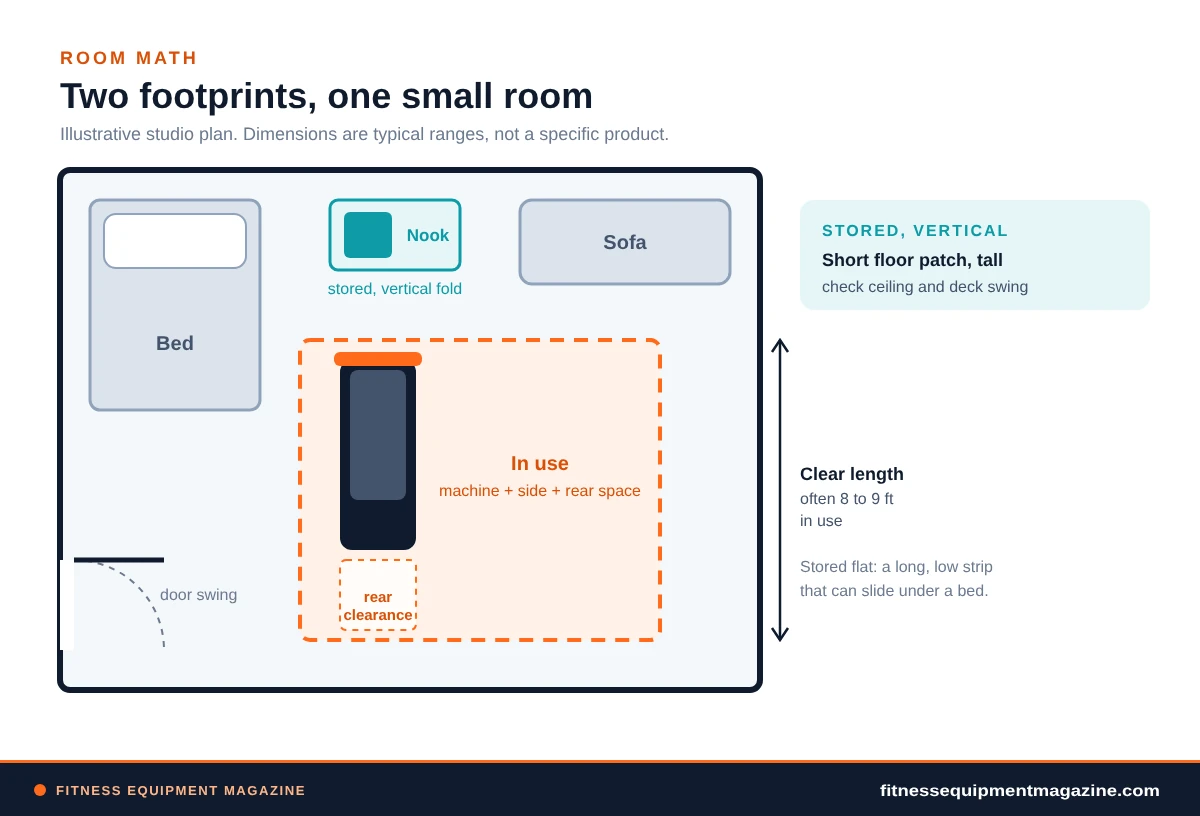
While you use the treadmill, three zones matter. First comes the machine itself, typically somewhere around 55 to 75 inches long for a full-size folding frame and shorter for a walking-first model. Second is the width, usually in the high 20s to mid 30s of inches once handrails are counted. Third, and most overlooked, is the clear zone at the rear of the belt.
Manufacturers commonly recommend open floor behind the machine so a stumble doesn’t send you into a wall or a dresser. Exact figures vary by manual, and some call for several feet. We’d rather you read your own manual than trust a rule of thumb, but plan on a rectangle that is noticeably longer than the machine. The clearance matters more for runners than walkers, and it matters most for anyone who steps on and off at speed.
Safety note
Don’t push a treadmill’s rear end tight against a wall because the room is small. Rear clearance is there so a fall or a quick step-off has somewhere to go. Check the manual’s stated clearance for the exact model. If your room can’t give you that space, choose a smaller or slower machine instead of ignoring the number.
The stored footprint
Folded dimensions come in two flavors, and the difference decides whether a closet works. A horizontal fold lifts the deck so it sits roughly flat above or tilted slightly off the floor, which keeps the machine low. A vertical fold swings the deck up beside the uprights, which shrinks the floor area but adds height. We look at both below. For now, measure two things in your storage spot: the floor area you can spare and the clear height.
Don’t forget the access gap. You need room to grip the deck or the latch, lift or release it and roll the wheels out. A nook that fits the folded machine to the inch is a nook where you’ll stop folding it after two weeks.
The painter’s tape method
The cheapest tool in the whole process is a roll of blue painter’s tape. Mark the operating rectangle on the floor, including the rear clearance, then mark the stored rectangle separately. Walk through the daily routine. Can you step on without brushing a bed frame? Does the door still swing? Is the tape outline blocking the path to the bathroom at 6 a.m.? Leave it down for a weekend. You’ll learn more from three days of tape than from an hour of reading spec tables.
- Tape the unfolded footprintMachine length and width from the spec sheet, plus the rear clearance from the manual.
- Tape the folded footprintUse the folded length and width, and note the folded height on the wall with a sticky note.
- Live around it for two daysOpen the door, carry laundry, walk to the kitchen. Adjust.
- Write the keepersThe numbers that survived the weekend are your shopping filters.
Want a deeper comparison of frame designs? Our folding treadmill guide goes through them one at a time. Use it after you’ve settled the room numbers, not before.
The Delivery Path: Doors, Stairs and Elevators
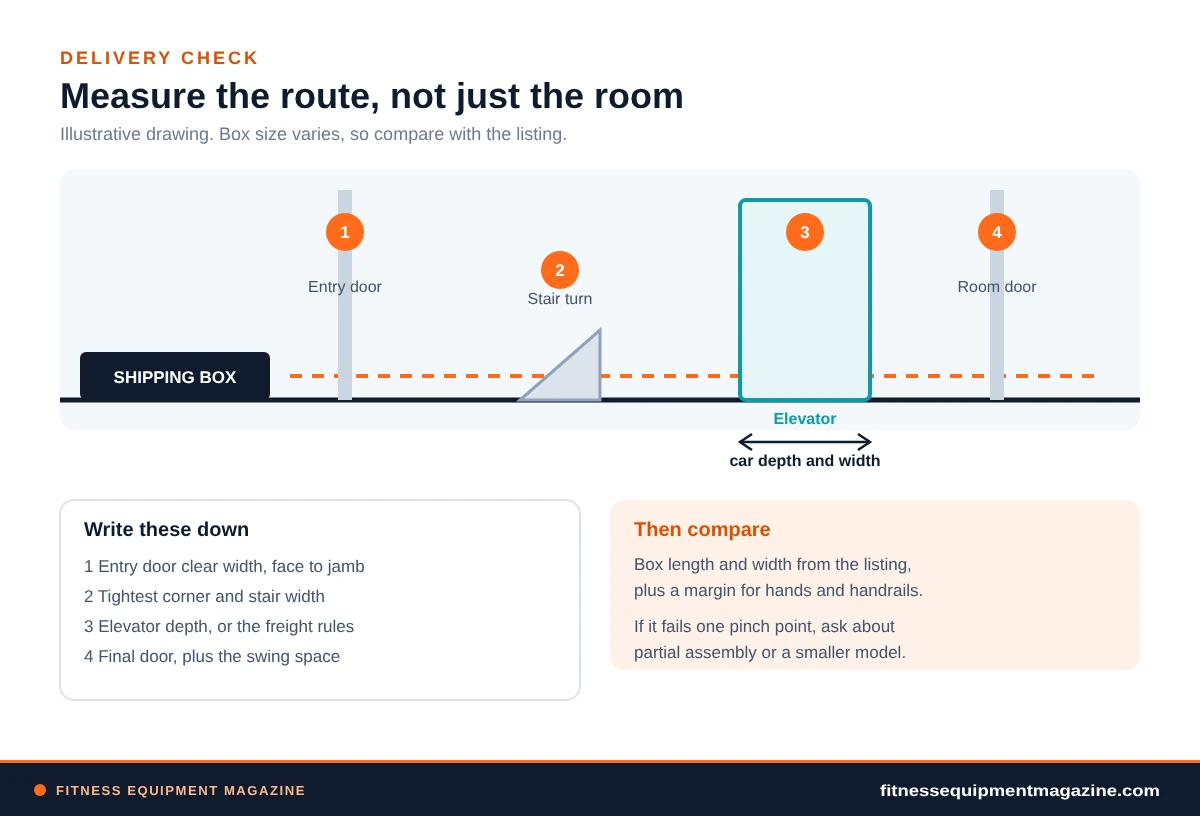
A treadmill for small spaces has to get into the small space first. Shipping boxes for folding treadmills are often heavy and long, commonly well over a hundred pounds and well over five feet. Carriers usually drop them at the curb or the front door. After that, the route is yours, and that’s where the best treadmill for small spaces on paper becomes the worst one in practice.
Measure these six things
- Entry door clear width. Measure from the door face at 90 degrees to the opposite jamb, not the nominal door size.
- Hallway turns. A long box can pivot in a wide hallway and jam in a narrow one. Check the tightest corner with a tape.
- Stair width and headroom. Look at the handrail, the ceiling slope and any landing turn, since each one steals inches.
- Elevator interior. Many buildings publish car depth. If yours doesn’t, ask the property manager or measure once.
- Final door. The bedroom or office door is often narrower than the front door.
- Box dimensions and weight. Compare the shipping box listed on the product page against your numbers, plus a margin.
Two more details trip people up. First, ask whether the seller offers a “white glove” or room-of-choice option, and what it covers in your building. Some carriers won’t climb stairs. Second, find out whether the box can be opened in the hallway so you can carry the machine in pieces or at least tilted. A partially assembled treadmill is much easier to move than a sealed brick, but only if the warranty doesn’t care who unpacked it.
Tip
Landlord rules matter here. Some buildings restrict freight elevator hours, require a deposit for large deliveries or limit equipment above a certain weight on upper floors. A short email before you order can save a refusal at the door.
Folding Mechanisms: What the Best Treadmill for Small Spaces Needs
“Foldable” is a category, not a feature. Two machines can both claim it and behave totally differently the day you try to put them away. Understanding the mechanism helps you predict that day, and it’s a big part of choosing the best treadmill for small spaces.
Horizontal versus vertical folds
Most home folding treadmills use one of two layouts. In a horizontal or flat fold, the deck lifts a modest amount, often staying roughly parallel to the floor, and the whole machine stays low. In a vertical fold, the deck swings up beside the uprights, so the unit stands on its end and the footprint shrinks while the height grows. Neither is better in general. They answer different room problems.
Flat fold: strengths
- Stays low, so it fits under some furniture or along a wall below a window
- Easier to nudge and slide on a carpet or hard floor
- No tall tipping risk if it gets bumped
Flat fold: tradeoffs
- Still occupies a long strip of floor
- The lifted deck can catch on a bed frame or low shelf
- Often heavier near the middle, which affects lifting
Vertical fold: strengths
- Very small floor area, which suits a closet corner
- Clears the middle of a room fast
- Stored height is predictable, so you can measure for it
Vertical fold: tradeoffs
- Needs ceiling height and a clear swing of the deck
- Raises and lowers a heavy deck, so latch and assist quality matter
- Can feel top-heavy if the wheels are small or the floor is uneven
Hydraulic assist, latches and wheels
The hardware matters more than the label. A hydraulic or gas-assist cylinder, sometimes called soft-drop, takes much of the weight when you lower the deck. Without it, you’re managing a heavy deck by hand, and a deck that drops fast can pinch fingers or crack a floor tile. If you plan to fold the machine daily, assisted lowering is a feature we’d count as close to essential.
Latches come in a few flavors: a pull pin, a foot-release lever, a spring catch and a strap. The question isn’t which sounds nicest. It’s whether the latch is clearly engaged when you step on. A good design gives a visible or audible sign, and the manual describes a check you can do every time. Treat a latch that feels vague as a safety problem, not a quirk.
Wheels deserve their own paragraph. Small transport wheels at one end are common, and they behave differently on carpet, hardwood and tile. Look for wheels that stay put while you exercise and roll freely when the machine is tilted. Ask yourself whether you’ll tilt a heavy machine alone on a staircase landing, because that’s the test the product page never shows.
Safety note
Keep children and pets out of the room whenever the deck is raised or being lowered, and never leave a treadmill with the deck half-latched. Review the manual’s lock and transport instructions, and look the model up on the CPSC exercise equipment recall page before you buy.
How often will you really fold it?
Be honest about this one, because it changes which is the best treadmill for small spaces for you. If you fold the treadmill every night, you want light weight, good assist and a latch you can operate half-awake. If you fold it twice a month because the room is a guest bedroom, almost any decent mechanism will do. Plenty of shoppers overpay for a daily-fold design they will never use daily. Others buy a fixed frame, plan to leave it open and then resent it every time a visitor stays over.
Compact Belts Versus Your Stride
The belt is where small spaces and real exercise collide. A shorter deck saves floor, but it also gives you less room to land. Whether that’s fine depends entirely on how you move.
Typical deck sizes and who they suit
Walking pads and some slim folding walkers often have belts around 14 to 18 inches wide and in the low 40s to mid 50s of inches long. Compact folding treadmills commonly sit in the 16 to 20 inch width range and the 48 to 55 inch length range. Full-size running decks tend to be 20 inches wide and 55 to 60 inches long or more. These are typical patterns, not promises, so check the actual belt size on the spec sheet. If you want the full explanation, our guide to treadmill belt size breaks down the numbers.
Walking strides are shorter and your feet never leave the belt at the same time. Running adds a flight phase, a longer reach and more drift. Shorter people at a gentle jog may do fine on a compact deck. Taller people, or anyone who sprints, tend to feel boxed in. That feeling makes you hesitate, which is the opposite of what you want at speed.
Width matters less than people fear
A narrower belt feels fine for walking in a straight line and fine for steady running if you stay centered. It feels tight when you glance at the console, reach for a water bottle or have a wobbly day. Because anyone hunting for the best treadmill for small spaces can’t give much floor to width anyway, accept a bit of narrowness and spend the savings on length. That one trade fits most apartment runners better than the reverse.
Not sure which end of the range you need? Our overview of the best treadmills for home use sorts deck size by training style, and it’s a good place to check your instincts against.
Five Archetypes for the Best Treadmill for Small Spaces
We don’t name brands or models in this guide. Instead, think in archetypes: machine types defined by footprint, fold style and the kind of person each one serves. Each card below lists the criteria that earn a spot on your shortlist. The best treadmill for small spaces in your home will almost certainly match one of them.
A · Flat-folding compact
The all-rounder for shared rooms
A folding frame whose deck lifts low. Look for assisted lowering, a deck near 16 to 20 inches wide and a motor that suits your top speed. It slides under or beside furniture. Best for walkers who sometimes jog.
B · Vertical-fold
The closet-corner machine
Swings upright and takes the smallest floor patch. Confirm ceiling height, wheel quality and latch design. Best when floor is the scarce resource and you have one reliable spot to park it.
C · Slim walking-first
Light, narrow, easy to move
A shorter belt, a simple console, often foldable at the handrail. Check the top speed, since many stop below jogging pace. Best for daily walking and TV time.
D · Under-desk style
The alternative, not a replacement
A flat belt without handrails or an incline, meant for slow walking while working. Read the under-desk treadmill guide and our page on choosing a walking pad.
E · Compact runner
The longest belt that still folds
A folding frame with a 55 to 60 inch deck, a sturdier base and enough motor for real running. It trades storage ease for running comfort. Best for a dedicated room corner.
Matching archetype to habit
Walk, mostly: C, D or A will usually be the best treadmill for small spaces for you. Jog sometimes, fold often: A. Corner-parked daily walker with a tall closet: B. Runner who just doesn’t have a garage: E. If you want a cleaner breakdown of when a flat belt beats a folding frame, our walking pad versus treadmill page walks through the decision rules.
Honest middle ground
Many small-space buyers end up with archetype A and are happy. It isn’t glamorous, but it sidesteps two big regrets. One is a runner’s machine you can’t store. The other is a walking pad that can’t handle the pace you grow into.
Noise and Floor Vibration in an Apartment
The best treadmill for small spaces often lives above somebody else’s ceiling. That changes the noise question. Airborne sound (the motor hum, the belt) is only part of it. Impact and vibration travel through the floor structure and can carry far more than you’d guess from the sound in your own room.
Where the sound goes
Here’s what tends to help when the best treadmill for small spaces sits over a neighbor’s ceiling. A dense mat under the whole footprint spreads the impact, and a thicker or denser layer usually does more than a thin sheet. Machines with softer decks and good belt lubrication tend to be quieter than rattling ones. Folding frames add joints that can buzz if the hardware loosens, so a quick bolt check every few months is cheap insurance. And keep in mind that a runner’s footfall is far louder to the floor below than a walker’s.
Be a decent neighbor
Time of day matters as much as the machine. A calm walk at 8 p.m. may be fine. Running at 6 a.m. above a nurse who works nights is a different story. If the lease has quiet hours, treat them as part of your shopping spec. For a longer walk through isolation mats and building rules, see our guide to treadmill noise in an apartment.
Tip
Test the floor before you buy. Walk briskly across the spot where the treadmill will sit and ask someone below, or just listen from the unit below if you can. If the sound carries at walking pace, plan on a heavier mat or a walking-first machine.
Power, Outlets and Setup Details
Small rooms hide small problems. A cord that doesn’t reach, a power strip that trips and a bedroom outlet shared with the heater can all turn a good purchase into a headache. Before you order, plan the electrical side of the best treadmill for small spaces with the same care you gave the floor.
Outlet and cord basics
Most home treadmills are designed for a standard US household outlet. Even so, the manual may call for a dedicated circuit, since the motor draws noticeable current at startup. Plug the machine straight into the wall if the manual says so, rather than into a daisy-chained strip. If you aren’t sure, ask an electrician. Avoid extension cords unless the instructions explicitly allow a specific gauge and length.
The cord also decides where the machine can sit. A short cord pushes you toward the wall outlet, which might not be where the clear zone is. Measure from the outlet to the spot, add a margin, and check where the cord will rest while the treadmill is folded. A cord that drapes across a walkway is a trip hazard waiting for a bad morning.
Small-room setup habits
- Park the machine where the deck can fold without hitting a ceiling fan, light fixture or sloped ceiling.
- Check the floor surface. Vertical-fold machines on cheap vinyl can dent, and thick carpet may let a tall frame wobble.
- Keep a small towel, a water bottle holder and a safety key within reach, since reaching behind you on a short belt is awkward.
- Wipe the console and handrails after each workout, because sweat in a small, poorly ventilated room travels farther than you expect.
- Leave the room’s door open while you exercise. Heat and humidity build faster in small spaces.
That last point deserves a mention. Compact rooms heat up, so a window, a fan or an open door is part of the workout setup, not an extra. For general movement guidance, see the HHS Physical Activity Guidelines. They cover how much activity adults are generally encouraged to get, which helps you decide how much machine you really need.
Stability, User Weight and the Compact-Frame Tradeoff
Shrinking a treadmill means removing something: length, width, weight or all three. Weight is the one buyers forget. A lighter frame is easier to carry up stairs and easier to fold. It’s also easier to shake. So the best treadmill for small spaces has to balance two opposite wishes, and the balance point depends on who is using it.
Reading the user weight rating
Every treadmill lists a maximum user weight. Treat that figure as a ceiling, not a target. Many manufacturers advise leaving a margin below it. Heavier users who run will load the frame much harder than walkers of the same weight. If you land within roughly the top fifth of the rating, move up a class. A compact machine that wobbles under you is neither compact in spirit nor safe in practice.
Folding hinges are the weak link here. A fixed frame spreads force through welded tubing. A folding frame passes that force through pivots and bolts, which is why the warranty wording on those parts matters. The best treadmill for small spaces is not the lightest one in the listing. It’s the lightest one that still feels like a single piece when you step on it.
Illustrative pattern for a very light compact frame compared with a heavier one. It describes a tendency, not a measurement of any product.
The feel test, without testing
You can’t lean on a machine through a screen, but you can read for clues. Look for a stated frame material and weight, a wide base with leveling feet and a description of the hinge hardware. Also read owner reports for words like “wobble,” “rattle,” “creak” and “drift.” Patterns matter more than any single comment. If three different people describe the same fold-joint creak after six months, believe them.
If you’re torn between a lighter machine and a sturdier one, ask where the heavy part will actually be moved. A heavy frame that stays put in a spare bedroom is fine. A heavy frame that you drag out of a studio closet each morning is a bad match. Our treadmill motor guide covers the other half of the stability picture: how much motor a compact frame can use without strain.
Trials, returns and the cost of being wrong
Small-space buyers face an unusual risk: the machine can be fine and still not fit. Because of that, return terms should rank next to price in your shortlist. Large-item returns can involve return shipping, repackaging and restocking fees, and a heavy box is hard to repack in an apartment. Some sellers offer pickup, and others don’t.
Before you order, read the return window, check who pays for pickup and ask whether the machine can be returned once it’s been assembled. If the terms are unclear, treat the listing as higher risk. A longer trial window on the best treadmill for small spaces in your price range is worth more than an extra feature.
Hypothetical profile: the third-floor walk-up
Picture a shopper in a third-floor walk-up with a narrow, turning staircase, a seven-foot-six bedroom ceiling and a downstairs neighbor. Nearly everything is a constraint. The best treadmill for small spaces here is a light, flat-fold machine in a box that clears the stair turn. Add a dense mat and a plan to walk, not run, in the evening.
Notice what that plan gives up: vertical storage, a runner’s deck and daytime noise freedom. It also avoids the three most common regrets here: a box that sticks on the stairs, a ceiling that blocks the console and a complaint from below. A good small-space decision often looks like subtraction.
Room Scenarios: Picking the Best Treadmill for Small Spaces by Room
Rooms are more useful than categories. Below are four common situations, plus one that never works. The shopper profiles are hypothetical, built to show how the logic plays out, and they aren’t real customers or reviews.
Studio apartment: the best treadmill for small spaces stows in two minutes
Imagine a 420-square-foot studio. The bed sits against one wall, the sofa faces a TV and the only open floor is a strip between them. In this room, the best treadmill for small spaces folds flat, rolls on wheels and moves out of the way in under a minute. Think archetype A, or archetype C if the user only walks.
The tricky part isn’t the machine. It’s the habit. If folding takes ten awkward minutes, the treadmill becomes a clothes rack by February. So test the process in your head: where does the deck go, which hand lifts it, and where do your shoes live? A shopper who works from home and walks while taking calls might do better with a slim walking-first model that stays open next to the sofa.
Studio rule
If a machine can’t be stored in under two minutes by one person, assume you’ll leave it open. Then the real question becomes whether you can live with it open.
Closet-fit: when the best treadmill for small spaces stands on end
Closet storage sounds elegant, and sometimes it is. A vertical-fold machine can stand in the end of a deep closet, door closed, nothing visible. But closets lie. The shelf above takes inches, the door swing blocks access and the floor may not be level. Measure the closet’s depth, the clear height under the shelf, the door opening and the clear floor in front.
Then add the cost of the roll-out. A machine that lives in a closet has to roll out and set up each time. If the hallway is narrow, you may drag it through a doorway with a tight angle. For that reason, many closet-fit shoppers choose a flat-fold machine that slides under a bed, with a low profile and no ceiling issues.
Spare bedroom or office: the best treadmill for small spaces shares the room
Here, space isn’t the problem so much as role clashes. The room is also a desk, a guest bed, maybe a craft corner. The best treadmill for small spaces in a spare bedroom usually stays open most of the week and folds when guests come. That actually frees you to spend your effort elsewhere: a stable frame, quiet operation and a place for the console to be readable.
Hypothetical profile: a 40-year-old remote worker, five feet eight, who walks briskly and jogs a few times a month. The room is eleven feet by ten, with an eight-foot ceiling. A compact folding runner with a belt around 55 inches is workable, and a flat fold means the guest bed stays reachable. If she moves to a bigger place later, the machine still works. For sizing a general-purpose model, our guide to the motor, belt and warranty basics helps you check she isn’t underbuying.
The balcony and other places to avoid
Short version: don’t. Balconies expose a treadmill to rain, dust, humidity swings and sun. The warranty usually doesn’t cover outdoor use, and the structure may not be rated for the load of a heavy machine in motion. Vibrations that feel fine inside can bother a whole building when the machine sits on a cantilevered slab.
Garages are a milder case, and basements can work if they stay dry. Cold, damp or dusty spaces still wear on belts and electronics, so check the manual’s stated operating conditions. If a room shifts between hot and cold, plan to cover the machine when you’re not using it and keep it off bare concrete when possible.
Watch out
Treadmills are heavy, and floors have limits. If you’re in an older building, ask your landlord or building manager about floor loading, particularly on an upper floor with a wide span. This isn’t a common worry for standard folding treadmills, but a quick question beats a cracked tile or a soft spot.
Hypothetical profile: the apartment runner
Now picture a 30-year-old who runs three times a week and has a one-bedroom apartment. They want the best treadmill for small spaces that doesn’t feel like a toy. That points to archetype E, a compact runner with a 55 to 60 inch deck, a strong frame and a vertical or heavy flat fold. The real cost is storage: expect a machine that needs a dedicated corner. If the apartment can’t spare one, the honest answer is that a walking-first machine plus outdoor runs might serve better than a cramped treadmill.
When you’re still choosing between a folding frame and something flatter, the comparison in our guide to folding treadmill designs covers heavier frames and daily folding in depth, and it’s worth reading before you shortlist.
Red Flags and Questions to Ask Before You Buy
Small-space marketing leans on the same phrases again and again. A few of them deserve a raised eyebrow. None of these means a machine is bad, but each should send you back to the spec sheet or to the seller with a question.
Listing red flags
- Only folded dimensions are listed. You need the unfolded length, the width and the deck size too.
- “Compact” with no belt size. A tiny footprint with a very short belt is a walking machine, whatever the headline says.
- No stated top user weight or an inflated one. A stability claim without a number is not a claim.
- Vague folding description. If the page doesn’t say how the deck is held when folded, the mechanism may be an afterthought.
- Warranty language that excludes the frame hinge or latch. Folding parts are where wear concentrates.
- Photos that never show the machine open next to a person. Scale tells you everything.
Questions to ask the seller
- What are the exact unfolded and folded dimensions?Length, width and height, in inches, with handrails and console included.
- How does the deck lock when folded, and when open?Ask for the manual’s description, not the marketing line.
- What are the box dimensions and weight?Match them to the route you measured.
- What does the return policy cover for large items?Look for return shipping costs, restocking fees and a time limit.
- Which parts does the warranty cover on a folding frame?Hinges, latches and the assist cylinder should be named.
- Is assembly included, and what does it cover?Some services stop at the curb or the first floor.
If an answer takes more than a day or feels evasive, treat that as information. The seller who answers cleanly now is likelier to answer cleanly after the sale. And while you wait, check the model against the federal recall lists, since a recall on a similar frame can reveal a design weakness worth knowing about.
Myths about the best treadmill for small spaces
Myth
Folded means gone
A folded treadmill still takes up room. It just takes up a different shape of room, and you still need access to it.
Myth
Smaller is always quieter
Noise depends on motor, belt and floor. A light, compact frame may transmit more vibration than a heavier one.
Myth
Walking pads replace treadmills
For slow walking, they can. For running, incline and a console that works, a folding frame still wins.
Upkeep that matters more in a small room
A folding treadmill that gets folded often needs a little more attention than a fixed one. Check the hinge bolts every few weeks at first, then every couple of months. Look at the latch before each use. Listen for new squeaks, since a quiet frame that suddenly rattles is telling you something. Keep the belt lubricated according to the manual. A dry belt gets noisy and strains the motor, and that matters more when the walls are close.
Dust collects in small rooms faster than you’d think. Vacuum around the motor cover now and then, and never use harsh cleaners on the belt. Compact machines are usually lighter, so they can shift slightly during use. Check that the feet are level and that the mat beneath hasn’t crept. These aren’t dramatic chores. They are what keep a small treadmill feeling like a small treadmill, rather than a rattle in the corner.
A Step-by-Step Way to Choose the Best Treadmill for Small Spaces
Everything above folds into a single process. It works whether you buy online, in a showroom or from a local shop. Notice how the machine comes last, not first.
- Define your smallFloor-limited, height-limited, route-limited, or some mix. Write it down in one sentence.
- Tape the footprintsOperating, stored, and the walkway between them. Live with the tape for two days.
- Measure the routeEntry door, hallway turns, stairs or elevator, and the final door. Record the narrowest point.
- Be honest about useWalk, jog, run or all three. How many days a week, how fast, how long?
- Pick an archetypeUse the grid in this guide to choose A to E, and a runner-up.
- Filter by spec sheetsUnfolded and folded dimensions, belt size, top user weight, fold mechanism, warranty parts.
- Read the return policyLarge items often cost money to send back. Know the terms before you click.
- Check recallsSearch the CPSC list for the model and for similar frames.
Where to put the money
Small-space shoppers often over-focus on shrinkage and under-invest in the frame. A strong frame with sensible folding hardware beats an extra-tiny machine that wobbles. If budget is tight, our page on the best budget treadmills shows which features are worth paying for, and which can be skipped. The best treadmill for small spaces on a modest budget is usually a flat-fold compact with a decent warranty, not the most “advanced” listing.
When a treadmill is the wrong answer
Sometimes the honest recommendation is not to buy one. Maybe your floor is shared with a nap schedule. Maybe the building has strict quiet rules, or you only want gentle daily steps. In any of those cases, a walking pad, an under-desk belt or a neighborhood loop may serve you better. The best treadmill for small spaces is not always a treadmill. A machine that sits unused in a closet is the most expensive item in the room.
Questions Buyers Ask About the Best Treadmill for Small Spaces
Fit and footprint
What is the best treadmill for small spaces if I want to run?
For running, the best treadmill for small spaces is a compact folding runner with a deck near 55 inches long, a sturdy frame and an assisted fold. Shorter belts can work for slower jogging, but taller runners tend to feel cramped. Measure your stored and operating footprint first. If the room can’t spare a dedicated corner, outdoor runs plus a walking-first machine may be the better combination.
How much floor space does the best treadmill for small spaces need?
In use, many folding treadmills need roughly the machine’s length and width plus clear floor behind the belt, so a rectangle noticeably longer than the spec sheet suggests. Stored, a flat fold stays long but low, while a vertical fold shrinks the floor area and adds height. Always use the manual’s stated clearances, and tape the outline on your floor before you order.
Is a walking pad or a folding frame the best treadmill for small spaces?
It depends on pace and features. When you weigh the best treadmill for small spaces against a pad, a walking pad is usually lighter and slimmer, and it suits slow daily walking. A folding treadmill is better for jogging, incline and a stronger frame. If you’re deciding between them, our walking pad versus treadmill page lays out the tradeoffs. The guide to folding frames explains what you gain in return for the extra bulk.
Will the best treadmill for small spaces fit through a standard door?
Often, but not always. With the best treadmill for small spaces, the shipping box is usually wider and longer than the machine, and hallway turns can jam it. Measure the entry door’s clear width, the narrowest corner, the stairs or elevator and the final room door. Then compare them with the listed box dimensions. Ask the seller whether the machine can be moved partly assembled.
Noise, power and living with it
Is the best treadmill for small spaces too loud for an apartment?
They can be, mostly because of footfall impact, not the motor. A dense mat, a quieter walking pace and sensible hours make a big difference. Running above a neighbor is the toughest case. Our guide to treadmill noise in an apartment explains how to reduce vibration, and a walking-first machine is typically easier to live with than a runner’s frame.
Do I need a dedicated outlet for the best treadmill for small spaces?
Check the manual. Many home treadmills, including the best treadmill for small spaces, call for a standard grounded outlet. Some recommend a dedicated circuit because the motor draws more current at startup. Avoid daisy-chained power strips and extension cords unless the instructions allow them. If you are unsure about your wiring, a licensed electrician can confirm what the circuit supports.
Can I store a treadmill vertically in a closet?
Only if the closet is deep enough, tall enough and has a door that clears the machine. Measure the folded height against the shelf, and check the swing of the door and the clear floor in front. Then ask whether you will really roll the machine out each time. If not, a flat fold under a bed may fit better.
Which features make the best treadmill for small spaces?
For the best treadmill for small spaces, put stability, a reliable fold, a latch you trust and a belt that suits your stride at the top of the list. Features like large screens and many preset programs rarely help when space is the limit. A good warranty on the hinge and assist cylinder also matters more on a folding frame than on a fixed one.
Bottom Line: Choosing the Best Treadmill for Small Spaces
The best treadmill for small spaces is the one you measured for. Tape the footprints and check the route. Pick the fold style that matches your room and habits, then let the belt size follow your stride. If that sounds less exciting than a ranked list, it is. It also keeps you from returning a heavy box.
For your next step, read the full guide to choosing a home treadmill if you’re still weighing machine types. Or jump to the folding and noise pages above for the specifics. Then, once your numbers are written down, compare current spec sheets and return policies. Choose the machine that you will actually open and use.
Sources and Further Reading
- HHS Physical Activity Guidelines — federal guidance on weekly activity for adults.
- CPSC exercise equipment recalls — check any model before you buy.
- Manufacturer manuals and spec sheets — for clearances, belt size, fold mechanism and warranty terms.
Some links on this site may be affiliate links. If you buy through them we may earn a commission at no extra cost to you. Recommendations are based on the criteria in the article, not on payout. This guide offers general information and isn’t medical advice; talk to a qualified professional before starting a new exercise program. Last reviewed: October 2026.