The best treadmill for running is not the one with the biggest screen or the loudest horsepower number. It’s the one whose belt, motor and frame stay calm at the pace you actually run, on the day you actually run it. That sounds simple. It isn’t, because a machine that feels perfect at a 12-minute mile can turn into a rattling, wandering, hot-smelling problem at an 8-minute mile.
Picture two people shopping on the same evening. One jogs three easy miles, three times a week, and watches a show while she does it. The other is eight weeks into a marathon block, with a tempo run on Tuesday and a long run on Saturday that eats ninety minutes of belt time. Both type “treadmill” into a search bar. They need different machines, and the listings are written as if they don’t.
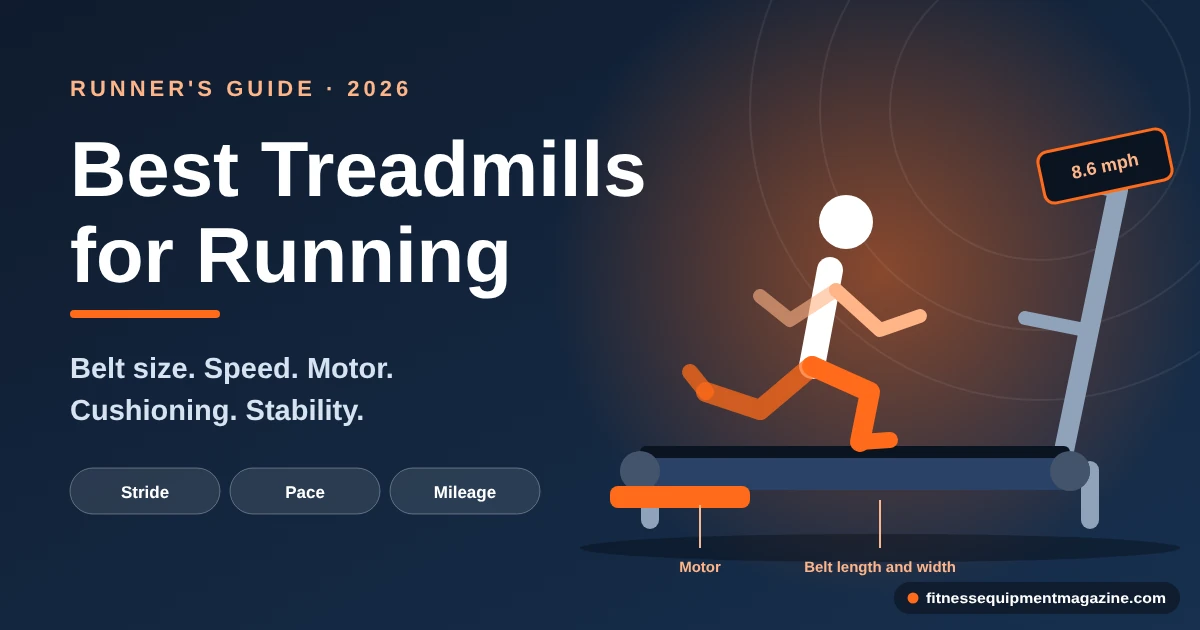
So this guide skips the brand parade and works from the runner outward, because the best treadmill for running depends on who is doing the running. We’ll look at six types of runner, then the parts that matter most for running: belt length and width, speed and incline range, continuous-duty motor sizing, cushioning, frame stability, handrails, cooling, console accuracy, safety features, noise and the slow wear that high mileage causes. Along the way you’ll find five drawn diagrams, a pre-purchase checklist and a list of questions to put to a retailer.
The short answer
The best treadmill for running pairs a belt that fits your stride at your fastest planned pace with a continuous-duty motor that has headroom, a frame that stays quiet at speed, and cushioning you can live with. Chase those four things before you chase programs, screens or app memberships.
- Who it fits: anyone who plans to run, not just walk, on the machine at least a couple of times a week.
- The biggest tradeoff: a long, wide, stable running treadmill is heavier, bigger and costlier than a folding walker. Folding and compact designs can run, but they ask you to be honest about pace and mileage.
- The common trap: buying for peak horsepower and a screen, then finding the belt is too short once your pace picks up.
If most of your workouts are brisk walks with the occasional jog, you may be better served by the walking-focused advice in our guide to the best treadmills for home use.
How we researched this. This is research-based guidance. We built it from manufacturer specification patterns, federal activity guidance and ownership problems that buyers commonly report. We haven’t hands-tested the machines described here, so you won’t find lab numbers, decibel readings or “our testers” claims. We name no brands and quote no prices for specific products. Ranges below are typical and they change, so check the current spec sheet and return policy before you buy. Last reviewed: October 2026.
Why running changes every spec
Walking is forgiving. Your feet land one at a time, you’re always touching the belt, and the forces are modest. Running adds a flight phase, a harder landing and a longer stride, and every one of those details pushes on a different part of the machine. That’s why a treadmill that earns a happy review from walkers can feel flimsy under a runner. The listing didn’t lie. It just described a different job.
Federal guidance gives a useful frame for how much activity adults are advised to do, and it treats walking and running as ways to get there. If you want the official wording, the HHS Physical Activity Guidelines are the source to read. They don’t tell you what to buy, though. That part is engineering, and it is what the rest of this page covers.
What actually changes when you run
Four things change at once. First, the stride gets longer, so the belt has to be longer. Second, the machine spends more time near its working limit, so the motor and drive have to cope with sustained load instead of short bursts. Third, impact rises, so the deck’s cushioning and the frame’s rigidity both matter. Fourth, you’re moving more, so the handrail position, the fan and the console layout become part of the workout rather than decoration. Those four shifts are why the best treadmill for running isn’t the same machine as the best walking treadmill.
Treadmill running versus outdoor running
Treadmill running isn’t identical to running outside, and pretending otherwise causes disappointment. On a belt, the surface moves under you, there’s no wind, and the ground is the same every step. Many runners find the rhythm easier to hold. Others find it dull or odd for the first few sessions. Your pace display also reads differently from a watch outdoors, because the two measure speed in different ways.
There’s a practical side. Indoors, weather, darkness and traffic stop mattering, and you can pace a workout to the second. Outdoors, terrain varies and you steer around things. Neither is better in general. If you’re building a plan around the treadmill, the best treadmill for running is the one that lets you copy the pattern you’d run outside, including intervals, long steady efforts and hills. If you want a deeper look at the kinds of belt movement available, our explainer on the curved treadmill covers the self-powered alternative.
Pace displays
Treadmill speed and outdoor GPS pace rarely match to the second. Many runners add a small incline to approximate outdoor effort, but that’s a coaching habit, not a rule. Treat the display as a consistent indoor yardstick and compare it with itself, not with last year’s race.
The three questions to answer before any spec
Write these down before you open a single tab. What’s the fastest pace you expect to run on this machine in the next two years? How many minutes a week will you spend on it? And who else in the house will use it, including the person who is taller, heavier or shorter than you? Every spec in this guide reads differently once you have those answers, and they’re how you narrow the best treadmill for running to a handful of real candidates.
A small example helps. Say you run easy at 10 minutes a mile, sometimes finishing a workout at 8:30. You’re 5 foot 7. You’ll run about three hours a week. That’s a moderate profile: a 60-inch belt is comfortable, a motor with plenty of continuous headroom is enough, and you don’t need extreme top speed. Now change one detail. You’re 6 foot 3 and you want to do repeats at 6:30 pace. The same shopping list now fails on belt length, top speed and frame. One sentence changed, and so did the machine.
Six runners, six different machines
Most buying guides sort by price. We think the best treadmill for running is better sorted by runner. Here are six profiles with the specs that matter most for each. They’re hypothetical shopper types, not real people, and you may fit more than one.
Easy-pace jogger
Comfort first
Runs 9:30 to 12:00 per mile, a few times a week. Needs a belt around 55 to 60 inches long, a smooth start and a quiet deck. Cushioning and a stable handrail matter more than a very high top speed.
Tempo and interval runner
Headroom first
Pushes to 7:30 or faster for blocks of time. Needs a long belt, a continuous-duty motor with real margin, quick and accurate speed changes, and a frame that doesn’t shake under repeated hard efforts.
Taller, long-stride runner
Length first
Over about 6 feet, or running fast with a long reach. Needs a 60-inch or longer belt, a deck wide enough for a relaxed arm swing and enough space behind the belt for a safe stop.
Heavier runner
Rigidity first
Needs a machine rated well above body weight, a thick deck, large rollers and a solid frame. User-weight ratings are not the same as running ratings, so ask what the number assumes.
Marathon-block mileage
Durability first
Logs many hours a week. Needs a motor rated for continuous duty, a belt and deck designed for wear, easy lubrication access, a fan, and a warranty that treats heavy use fairly.
Sprint and hill worker
Range first
Wants high top speed and strong incline. Needs rapid, controlled incline motors, secure emergency stop, and a frame built for impact at the edge of its limits. A curved or manual option may suit sprints.
When you fit more than one profile
Plenty of runners are mixed. A marathon trainee is also tall. A heavier runner also does hill repeats. The rule that handles every blend is simple: the best treadmill for running is the one built for the most demanding profile you actually fit, with everything else checked afterward. If you’re tall and doing high mileage, you need the long belt and the durable motor, and you shouldn’t try to trade one for the other.
The opposite mistake is common too. Plenty of casual joggers shop for a marathon machine because it feels responsible, as if that were always the best treadmill for running. A big, heavy, high-speed treadmill is a fine buy if you’ll use it, and a pricey room-eater if you won’t. Check how much floor space and electrical capacity you have, and compare against the broader criteria in our treadmill buying guide.
Belt length and width for the best treadmill for running
The belt is the first place a running treadmill proves itself. A short belt forces you to shorten your stride, hover near the console or glance down for your foot placement. None of those are fun at pace. For the best treadmill for running, the belt length that suits most adults is commonly in the 55 to 60-inch range, and many taller or faster runners prefer 60 inches or more. Always verify the figure on the manufacturer’s spec sheet, since “deck length” and “belt length” are sometimes used loosely.
Matching length to stride and speed
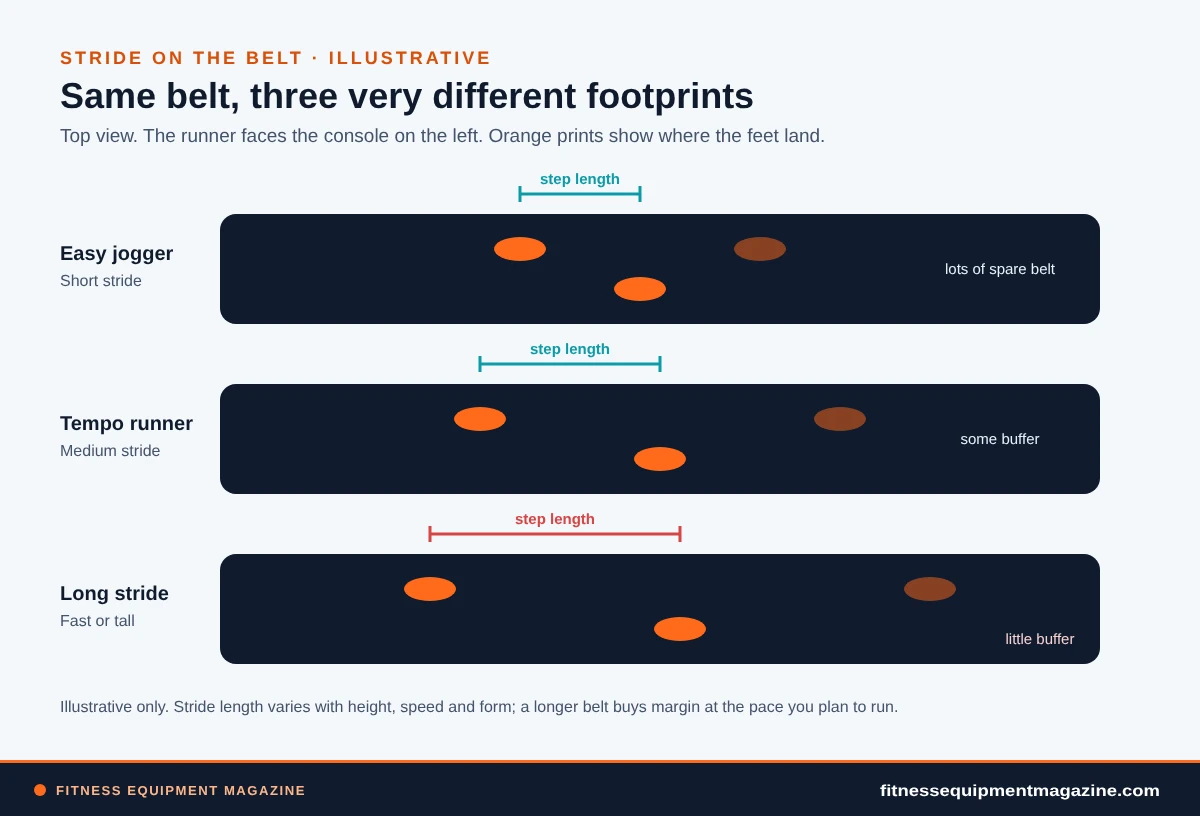
Stride length isn’t fixed. It grows as you speed up, and it grows with height. A short-legged easy jogger may cover only a couple of feet per step at a relaxed pace. A tall runner doing repeats may reach well beyond that. The belt has to hold both footprints plus a safety margin behind you, in case a step lands a little long or you need to step off.
A rough rule many runners use when judging the best treadmill for running: take your usual running stride, add a comfortable buffer behind the back foot, and make sure the usable belt is longer than the total. If you’re unsure, the drawing above is the logic in picture form. For the full measurement walk-through, including how to check on a showroom floor, our dedicated page on treadmill belt size explained goes deeper.
- Find your fastest planned pace.Not your average. The belt has to fit the version of you that finishes a hard interval.
- Estimate your step length.Mark two points on the floor a normal running step apart, or watch a short video of yourself from the side and compare with your shoe length.
- Add a buffer.Leave generous room behind your back foot, and enough in front that you’re not crowding the console.
- Compare with the spec sheet.Use belt length, not overall machine length. Treat anything marginal as too short.
Belt width and the arm swing
Width matters less than length, but it still counts. A narrower belt, around 16 to 18 inches, suits walkers and compact runners. Around 20 inches is the common sweet spot on the best treadmill for running, since it leaves room for a natural foot path and a little drift when you’re tired. Wider belts exist, and they can feel generous, but they also add weight and cost.
Some runners worry about arm swing. In practice, the rails sit outside the belt edges, so the real question is whether your elbows stay inside the handrails when you pump your arms at speed. If you run with a wide arm carriage, check the rail spacing in person if you can, or in photos with a person for scale.
Showroom test
Stand at the front of the belt and run in place with your normal arm swing, then take a few steps as if you were at the end of an interval. If you instinctively lean, shorten your stride or reach for the rails, the belt is telling you something.
Can the best treadmill for running be compact or folding?
Yes, for some runners, and a compact machine can be the best treadmill for running in a small home. A folding machine with a 55-inch belt can handle an easy jogger, provided the frame is solid and the motor is rated for continuous duty. It’s the tall runner and the fast runner who get squeezed. If space is the deciding factor, check our small-space treadmill guidance and be honest about the pace you expect to hold.
Top speed, pace and incline range
Top speed is easy to misread. A listed maximum of 10 mph sounds plenty for most people, and it is. It equals a 6-minute mile. A listed maximum of 12 mph is a 5-minute mile. Few recreational runners will ever touch either. What matters more is whether the machine feels settled at the pace you actually use, and whether it ramps speed smoothly instead of lurching. That’s why the best treadmill for running is judged at your pace, not at its brochure maximum.
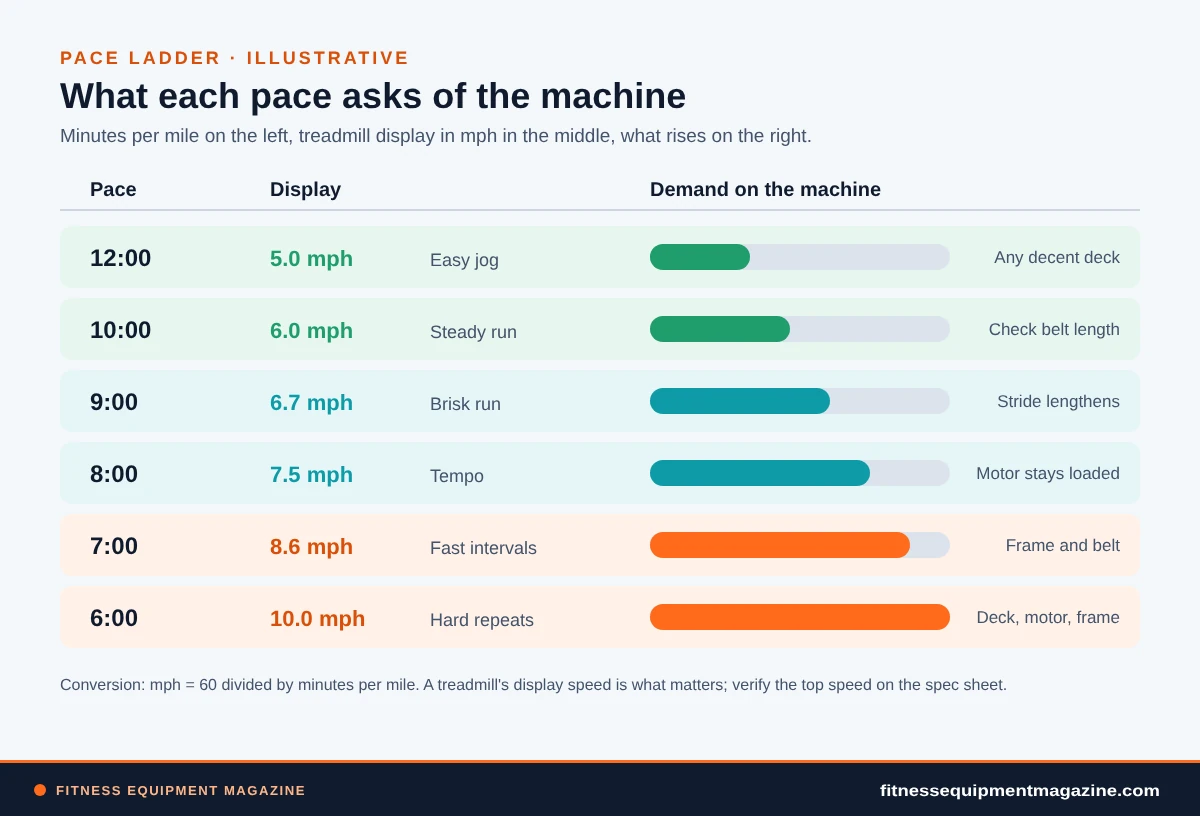
The pace ladder in plain numbers
The conversion is straightforward. Divide 60 by your minutes per mile, and you get miles per hour. Ten minutes a mile is 6.0 mph. Eight minutes is 7.5 mph. Seven minutes is about 8.6 mph. The ladder above also shows what rises as you climb it. At a slow jog, almost any decent deck copes. As the pace increases, the belt length, motor load and frame stability all become more important, usually in that order.
A practical rule of thumb: choose a top speed at least a couple of mph above the fastest pace you plan to run. That keeps you out of the top end of the motor’s range, where heat and noise tend to show up first. It’s not a guarantee of anything, only a sensible margin.
Speed response and increments
Interval runners care about how fast the belt changes speed, and the best treadmill for running intervals responds quickly. If a machine takes ten seconds to move from 6 to 9 mph, your “30-second repeat” turns into a smear. Look for quick-set buttons, fine increments (often 0.1 mph) and descriptions of ramp behavior. Since we haven’t tested the machines, we can’t tell you which ones respond well, and we won’t pretend to. What we can say is to read reviewer comments for words like “lag”, “surge” or “hesitate”.
Incline range for running
Incline is a training tool and a comfort tool, and the best treadmill for running hills pairs range with a quick, quiet incline motor. Many runners use a small grade for easy runs and steeper grades for hill repeats. Typical motorized ranges go from 0 up to 10 to 15 percent, while some machines go higher and a few go below flat to simulate a decline. Whether you need more than 10 percent depends on how you train.
Incline brings a ceiling-height issue that new buyers miss. At a steep grade the front of the deck rises several inches and your head rises with it. If you have an 8-foot basement ceiling and you’re tall, measure before you commit. We go further on this in our guide to the best incline treadmill, which compares steep-grade machines by space and use.
Decline and gimmicks
Some listings advertise “decline” for downhill running. It can add variety, but it also changes how your legs work. Treat it as an optional extra, not a reason to choose one machine over another, and approach it gradually if you try it.
Continuous-duty motor sizing for the best treadmill for running
Motor shopping is where marketing noise gets loudest. The number on the box is often “peak” horsepower, which describes a burst the motor can reach briefly, not what it delivers hour after hour. For the best treadmill for running, the figure that matters is continuous-duty horsepower (CHP) or, more usefully, a statement that the motor is rated for continuous use at the speeds you plan to run.
For a thorough walk-through, see our treadmill motor guide. Here’s the version for runners.
Typical continuous horsepower by runner type
Commonly, a light runner doing easy miles may be comfortable with a continuous rating in the neighborhood of 2.0 to 2.5 CHP. A regular runner doing tempo work often looks for roughly 2.5 to 3.5 CHP. Heavy-use or heavier runners often look toward the upper end, and sometimes beyond. These are shopper rules of thumb, not engineering law. Weight, belt friction, deck design and how the motor is cooled all shift the real-world answer.
Illustrative relative headroom that shoppers typically look for. Not a rating scale; the bars show direction, not values.
Signs a motor is undersized
You’ll rarely see an undersized motor fail on day one. You’ll see it as a slow decline. The belt hesitates under your foot strike, the speed display drifts, a warm smell appears after a long run, or the machine trips an error code in the middle of a workout. Any of those, repeated, is a reason to contact the seller and check the warranty terms.
- Listings that only show “peak” horsepower and never state a continuous figure.
- A very small motor paired with a very high top speed and a heavy user rating.
- No mention of motor warranty length, or a short motor warranty on a machine sold for running.
- Reviews that mention the belt “surging” or “stuttering” during hard runs.
Power supply and the household circuit
Most home treadmills run from a standard household outlet, and many manufacturers advise a dedicated circuit. A running treadmill pulls more current when it’s working hard, and sharing the circuit with a space heater or a microwave is a recipe for tripped breakers. Check the plug and circuit requirement in the manual before delivery, and avoid long or thin extension cords entirely. If something smells hot or looks scorched, stop and unplug the machine. Plan the circuit before delivery, since the best treadmill for running is no use if it trips the breaker every Sunday.
Cushioning versus ground feel
Every treadmill brand talks about cushioning, and almost none of them agree on what the word means. In practice it describes how the deck flexes when your foot lands. A softer deck absorbs more of the landing. A firmer deck gives a more road-like feel and a more stable platform. There’s no single right answer, and anyone who tells you there is probably has something to sell. That’s true even for the best treadmill for running, which will feel different to different people.
We’ll avoid injury claims here. What we can say is that runners describe the feel differently, that preferences vary a lot, and that the choice interacts with your weight, your shoes and the type of run. For a complete explainer on the types of deck systems, our page on treadmill cushioning explained goes through them one by one.
Soft, firm or adjustable
A softer deck feels forgiving for easy runs and long sessions, and many runners like it for recovery days. A firmer deck, in contrast, tends to feel more responsive at speed. Some machines offer adjustable cushioning, either with swappable elastomers or a simple dial. That’s a nice feature if you share the machine with someone who prefers a different feel, though it adds a part that can wear or loosen.
Softer deck
- Feels gentle at easy and recovery paces
- Often preferred for long steady sessions
- Can quiet some of the landing noise
Firmer deck
- Feels closer to road or track at speed
- Gives a steadier, more predictable surface
- Can feel harsh if you prefer a plush ride
How to read cushioning claims
Look for specifics. “Orthopedic cushioning” is a slogan. A description of deck thickness, the number of cushioning zones, and whether the front or rear is firmer is information. Be wary of any claim that a cushioned deck prevents or treats problems. We haven’t seen strong evidence that a particular deck is right for everyone, and neither should you assume it. If you have a concern about impact, ask a clinician or coach, then use their advice to narrow the options.
One more thing: shoes count. A cushioned shoe on a cushioned deck can feel mushy for some runners, while a firm shoe on a firm deck can feel harsh. If a showroom lets you bring your own pair, do it. Ten minutes at your normal pace tells you more than a page of marketing, and it’s how you find the best treadmill for running for your own legs.
Frame and roller stability in the best treadmill for running
This is the section most listings skip, because stability is hard to put in a bullet point. It’s also the one that decides whether you still enjoy the machine after six months. The best treadmill for running stays put when you accelerate, doesn’t wobble when you grab the rail, and doesn’t set up a hum or rattle at a particular speed.
Clues that a frame can handle running
Since you can’t shake a machine through a screen, you have to read the clues. Weight is one. A running treadmill that is meaningfully heavier than a walking-focused model usually has more steel in the frame. Roller diameter is another, and larger rollers (commonly around 2.5 to 3 inches on better running machines) tend to run quieter and last longer. Thick, wide rails, a broad base and adjustable leveling feet all point the same way.
User weight ratings are a clue too, with a caveat. A machine rated for a high user weight is built to take more load, but that number is usually a walking rating. Ask what weight the manufacturer assumes for running, and whether the motor warranty differs. If the answer is vague, treat the rating as marketing. Heavier runners who want a deeper look at sturdy machines can read our guide to the best heavy-duty treadmill.
Setup choices that help
Even the best treadmill for running needs a good floor. Level the machine, check every foot, and tighten all bolts after the first week, since they can settle. A rubber mat underneath helps with vibration and protects the floor, though it doesn’t cure a wobbly frame. If the treadmill sits on carpet, it’ll rock more easily than on a hard, flat surface. Check for a rocking motion by pressing down at each corner with your hand.
Safety
If a treadmill wobbles, shifts on the floor or makes a new knocking sound, stop using it and check the bolts, the leveling feet and the belt tracking. Look up your model on the CPSC exercise equipment recall page too. Don’t keep running on a machine you don’t trust.
Handrails, fans, console and safety key on a running treadmill
These are the parts of a treadmill you touch, look at and depend on in an emergency. They rarely decide a purchase on their own, but a poor choice can ruin a good machine. Think of them as the cockpit: it should help you run, not distract you from running. Get these right and the best treadmill for running becomes one you actually enjoy.
Handrail position on the best treadmill for running
When you run, you shouldn’t be holding the rails. They’re there for stepping on, stepping off and catching yourself. What matters is where they sit relative to your arm swing and your hands. Rails that sit far forward leave room to run naturally, while rails that start too close to the belt can clip elbows. Look for rails that are firm, set at a comfortable height and don’t flex when you press on them.
Some people also like short side rails that continue alongside the belt so they can reach a hand out. That’s helpful when you’re tired. It becomes a hazard if the rails narrow the belt too much. Photos with a person for scale and a showroom visit are better judges than a spec sheet.
Fans, cooling and ventilation
Running indoors gets hot fast. A built-in fan helps, but its quality varies, and many are little more than a token breeze. A separate floor or wall fan, placed where it blows across your torso, often does more. Think about airflow in the room too. A small closed spare room fills up with warm, humid air in a few minutes. Open a window, run a door fan or set up near an air conditioner if you can.
The machine needs cooling as well. Motors run warmer during long runs, and dust and pet hair near the motor hood can build up heat. Keep the area around the motor clear and follow the manufacturer’s cleaning guidance. If the machine smells hot, stop and let it rest.
Console programs and pace accuracy
The best treadmill for running doesn’t need fifty programs. Its console needs only a few things done well: a clear pace display, quick speed and incline buttons, simple interval programming and a way to save your preferred workouts. Touchscreens look impressive. They also tend to be the first thing to age, and some depend on subscriptions to unlock features. Read the terms closely, and ask what still works if you cancel.
Pace accuracy is more complicated than it looks. Treadmills calibrate belt speed in the factory, and it can drift with wear, belt tension and load. If you train to precise paces, you might calibrate by timing the belt over a measured distance. The owner’s manual may describe a check, and many retailers can advise. Don’t build a race plan on a display you haven’t checked.
Safety key and emergency stop
Every treadmill, and certainly the best treadmill for running, should have a safety key, a magnetic clip that pulls out of the console and stops the belt if you fall or step away. For running, the key must be within reach, and it should clip to your clothing. Check that it stops the belt promptly and that the stop is a ramp-down, not an abrupt halt. If the key is hard to reach, flimsy or optional, that’s a red flag.
- A safety key with a long enough lanyard to clip to your waistband without tugging.
- A large, obvious stop button within easy reach of either hand.
- A belt that decelerates smoothly rather than snapping to a halt.
- Clearance behind the belt for a safe stop, commonly several feet.
Noise, wear and high-mileage maintenance
Running is hard on a treadmill in a slow, steady way. Nothing dramatic happens in week one. By month eight, the machines that were built for the job still feel the same, and the ones that weren’t start to talk. This section covers what you’ll hear, what wears, and the maintenance habits that keep a high-mileage machine out of the repair queue. Choosing the best treadmill for running means choosing the one that ages gracefully.
What running noise really is
Treadmill noise comes from three sources: your footfalls on the deck, the motor and drive, and the machine’s structure resonating. Running raises all three. If you live above someone, or share a wall, plan for it. Thicker mats, a solid floor and a quiet, well-lubricated deck reduce transmitted sound. We haven’t measured any machine and won’t quote decibels. Our short guide to treadmill noise in an apartment goes deeper on neighbors, mats and timing.
How a high-mileage treadmill wears
Wear follows a pattern. The belt and deck rub together, so the low-friction layer between them is the first thing to go thin. The belt can stretch and drift sideways. Rollers and bearings take repeated load. The motor and its control board run warm, and dust finds its way in. None of it is mysterious, and most of it is slow enough to catch early.
Habits for the runner who logs real hours
- Wipe down after every session.Sweat is corrosive. A damp cloth on the console, rails and frame takes one minute and saves metal and electronics.
- Look at the belt before you start.Is it centered? Does it creep to one side? A small drift is easy to fix. A big one wears the edge.
- Vacuum around and under the machine.Dust and hair on the motor hood trap heat. Unplug the machine first.
- Check lubrication on the manual’s schedule.Some decks come pre-waxed and need little; others need periodic treatment. Use only what the manufacturer recommends.
- Listen.A new squeak, tick or whine is information. Most issues are cheaper when caught early.
Log it
Keep a running log of weekly hours and any maintenance you do. When a warranty claim comes up, a short record of care is the best proof that the machine was used and looked after as intended.
Warranty terms that matter for runners
Warranties differ by part. The frame often carries the longest term, the motor a long one, and parts and labor a short one. The detail to look for is whether the terms change for heavy use or commercial-style use. Some warranties shrink if the machine sees more than a stated number of hours a week, which can undercut a marathon trainee. Read the line on “residential use” and ask the seller what counts. For a full walk-through of the paperwork, see our treadmill buying guide.
Curved, manual and other running options
A motorized, belt-driven treadmill isn’t the only way to run indoors. Two alternatives are worth a short look, since they suit certain runners better. Both trade comfort and convenience for something else.
Curved, self-powered
Sprint and interval feel
The belt moves because you push it, so speed follows effort. Many sprinters and interval trainers like the feel. It takes getting used to, tends to be loud and typically costs more. See our curved treadmill explainer.
Flat manual
Simple and budget-minded
No motor, no outlet. It’s fine for short, light sessions, though it usually isn’t built for steady-pace running. Compare it with motorized machines before you commit.
For most people the best treadmill for running is motorized, because it keeps the advantages that matter most to a long-run person: you set the pace, you can hold it as long as you like, and the machine won’t punish you for slowing down. If you’re picking between categories, start with motorized unless you have a specific reason not to.
Choosing the best treadmill for running: a decision path
Now we can put the pieces together and pick the best treadmill for running for your profile. Because we haven’t hands-tested products, you won’t find a brand ranking here. What you’ll find is a way to turn your answers into a machine type, so that whichever spec sheets you open, you know what to look for. This is the evidence-light but honest version of a shortlist.
Evidence note. The profiles below are buyer archetypes based on manufacturer specification patterns and commonly reported ownership problems, not tested rankings. Some links on this site may be affiliate links; if you buy through them we may earn a commission at no extra cost to you. Recommendations are based on the criteria in the article, not payout.
Six machine archetypes for six runners
The compact easy-pace runner
55-inch belt, solid frame
Folding or compact, for the 10-minute-mile jogger. It must pass the wobble test. A continuous-duty motor and a safety key matter more than program count.
The 20 by 60 all-rounder
The default for most runners
A 20-inch by 60-inch belt, 2.5 to 3.5 CHP, thoughtful cushioning and a stable frame. It handles easy days, tempo work and the occasional long run.
The long-deck stride machine
For tall or fast runners
A belt longer than 60 inches, wide rails, a higher top speed and a heavier frame. Plan for floor space and delivery.
The heavy-duty runner’s machine
Built for load
A thick deck, big rollers, a continuous-duty motor with plenty of margin and a clear running weight rating. Expect weight, size and cost.
The mileage machine
For marathon blocks
Durability and serviceability first: good motor cooling, easy access for maintenance, a fan, a warranty that handles heavy hours and a retailer with real support.
The hill and sprint specialist
Range and response
A fast incline motor, strong frame, high top speed and quick controls. For pure sprinting, consider a curved option.
The pre-purchase checklist
Save this list to your phone. If a machine fails more than one line, it probably isn’t the best treadmill for running in your house.
- Belt length verified against my fastest planned pace and my height.
- Continuous-duty horsepower stated, not just peak.
- Top speed at least a couple of mph above my fastest pace.
- Running weight rating, and a motor warranty that fits heavy hours.
- Safety key within reach, plus a clear stop button.
- Floor space, ceiling height, power outlet and delivery route checked.
- No recalls on the model at the CPSC exercise equipment page.
- Subscription terms read, and the treadmill still works without one.
Questions to put to a retailer
You’re not trying to catch anyone out. You’re gathering facts that the listing hides. These questions get useful answers from a decent seller and awkward silence from a poor one.
- What is the continuous-duty horsepower, and is the motor warranted for running hours?
- What is the running weight rating, as opposed to the walking weight rating?
- What is the usable belt length, measured from roller to roller?
- What’s the return policy if the machine wobbles or is too short for my stride?
- Who handles assembly, and is white-glove delivery included?
- What features stop working without a paid subscription?
Five mistakes runners make
Most regrets about the best treadmill for running come from the same handful of errors. First, buying for the screen. Second, believing peak horsepower. Third, ignoring belt length until it’s too late to return. Fourth, putting the machine in a cramped corner with no room behind it. Fifth, skipping the first-week bolt check and then wondering why it rattles.
If you want a broader view of machines that suit more than runners, our guide to the best treadmills for home use covers walkers, families and small-space buyers.
Three hypothetical shoppers and the machines they should pick
Specs make more sense with people attached, so here are three invented shoppers. They aren’t real customers or reviewers. They’re composites, built to show how the same criteria produce different answers when someone looks for the best treadmill for running in a different situation.
The apartment jogger
Maya runs about 10:30 per mile, three mornings a week, on the second floor of an older building. Her floor is thin, her neighbor is a light sleeper, and her closet is the only storage. For her, the best treadmill for running is not the longest or the strongest. It’s a folding machine with a belt of roughly 55 inches, a quiet motor, a firm frame and a thick mat underneath. She should skip steep incline and extreme speed, and she should read the noise tips in our apartment guide before the machine arrives.
The trap for Maya is price-first shopping. A very cheap folder often saves money by trimming the frame and the motor, and those are the exact parts she needs. She’d do better to pay for stability and give up the touchscreen.
The marathon-block runner
Dev is 6 foot 2, runs 40 miles a week in the months before a spring race, and plans to use a spare-room treadmill for the dark, icy weeks. His long runs last well over an hour, and his tempo workouts sit near 7:20 per mile. He needs a long belt, a continuous-duty motor with plenty of margin, a fan and a service-friendly design. When he searches for the best treadmill for running, he should filter by belt length first, then warranty hours, and only then by console.
His likely mistake is trusting a headline top speed. A machine that tops out at 12 mph might still run hot and loud at 8 mph if the motor is borderline. Dev should ask the seller for the continuous rating, and he should plan a monthly maintenance check from day one.
The heavier runner returning to running
Sam weighs well over 250 pounds, wants to run intervals of one to two minutes inside a mostly walking session, and is building up gradually. The best treadmill for running for Sam is a heavy-duty frame with a thick deck, large rollers, a motor with generous continuous headroom and a running weight rating that sits comfortably above body weight. Cushioning is a personal call, so Sam should try a few decks if possible.
Sam’s risk is trusting a single “max user weight” number. Ask how the manufacturer defines it, whether it applies to running and what the warranty says about heavier users. If the answers are vague, move on. Consider the broader advice in our heavy-duty treadmill guide as a companion read.
Setting up and breaking in a new running treadmill
The first week sets the tone for the next five years. A machine that arrives perfectly built can still be set up badly, and a machine that arrives slightly off can be fixed in an afternoon. Treat the first seven days as a small project, not an afterthought.
- Pick the spot before delivery.Measure the doorway, stairs and landing. Leave clear space behind the belt, and keep the outlet within easy reach without an extension cord.
- Build it on a hard, flat floor.Follow the manual in order. Hand-tighten everything first, then do a final pass with the right tools.
- Level the frame.Press at each corner for rocking. Adjust the leveling feet until the machine sits solid.
- Center the belt.Run it empty at a slow speed and watch the edges. Fix tracking with small adjustments, as the manual describes.
- Do a walk-in session.Start at a walking pace, then build to a gentle jog. Listen for knocking, rubbing or any burning smell.
- Re-check bolts after a week.Parts settle. A second tightening pass is the cheapest maintenance you’ll ever do.
Your first runs on the new machine
Even experienced runners need a few sessions to feel at home. The belt moves, the surface is consistent and your sense of pace can feel slightly off. Give yourself some easy runs before you attempt a hard workout. Keep your hands near the rails for the first few minutes, practice clipping the safety key and learn where the stop button sits without looking.
Myths about choosing the best treadmill for running
A handful of beliefs show up in nearly every shopping conversation. Some are half-true, and some will cost you money. Here are the ones we’d retire.
Myth
“More horsepower always means a better running machine.”
Not quite. Continuous rating, drive design, cooling and warranty matter more than a peak figure. A well-built 3.0 CHP motor can beat a poorly matched larger one.
Myth
“A bigger screen means a better workout.”
A screen shows content, and it ages quickly. A stable frame and a fitting belt shape your run far more than any display.
Myth
“Softer cushioning is always safer.”
Preference varies, and no deck is right for everyone. We don’t make safety promises about decks, and you shouldn’t trust sellers who do.
Myth
“Any treadmill that folds will run just fine.”
Some do. Many are built for walking and light jogging. Check the belt length, motor rating and frame before you assume a folder is the best treadmill for running at your pace.
Spotting these myths is half of choosing well. The other half is being willing to spend your budget on parts you can’t see in a photo, such as bearings, frame thickness and motor quality. That’s unglamorous. It’s also where durable machines come from.
Frequently asked questions
What is the best treadmill for running at home?
There’s no single winner, but the best treadmill for running at home usually has a belt of about 20 by 60 inches, a continuous-duty motor with headroom over your pace, a rigid frame and cushioning you like. Match those four to your height, speed and weekly minutes, then compare spec sheets, warranties and return policies instead of brand names.
How long should a treadmill belt be for running?
Many adults are comfortable on a belt of 55 to 60 inches, while tall or fast runners often prefer 60 inches or more. The right length depends on your stride at your fastest planned pace plus a safe buffer behind you. If a belt feels marginal in a showroom, it won’t be the best treadmill for running on race-pace days.
How much horsepower do I need for running?
Look at continuous-duty horsepower, not peak. Commonly, easy joggers look for roughly 2.0 to 2.5 CHP, and regular tempo runners for about 2.5 to 3.5 CHP, with higher figures for heavier or high-mileage users. Treat these as shopper rules of thumb and check the manufacturer’s statement about continuous use.
Is a soft or firm deck better for runners?
Neither wins for everyone. Softer decks feel gentler on easy days, while firmer ones feel closer to the road at speed. If you can, try a machine in person with your own shoes. Avoid any listing that promises a cushioned deck will prevent problems, and talk to a clinician if you have specific concerns.
Can the best treadmill for running be a folding model?
Often yes, if the frame is solid, the motor is rated for continuous duty and the belt is long enough for your stride. Folding designs commonly trade a little rigidity for convenience, so they suit easy and moderate paces better than hard intervals. Check the weight rating for running and the hinge design before you buy.
Does the best treadmill for running need incline?
Not strictly, but many runners like a small incline for variety and hill work. Typical ranges run from 0 to about 10 or 15 percent. Check your ceiling height at steep grades, and see our best incline treadmill guide if hills are central to your training.
How often should I maintain a running treadmill?
Wipe it down after sessions, check belt tracking and cleanliness monthly, and follow the manual’s lubrication and tension schedule. Heavier mileage shortens every interval. Keep a short log, since it helps with warranty questions and shows you when something has started to change.
Is a treadmill as good as running outside?
They’re different. A treadmill gives you a consistent surface, exact pacing and no weather, while outdoor running adds terrain, wind and steering. Many runners use both. So the best treadmill for running is simply the one that lets you copy the sessions in your plan reliably.
Conclusion and next steps
The best treadmill for running isn’t a model number. It’s a match between a belt, a motor and a frame, and the way you actually run. Decide your fastest pace and weekly minutes first. Then check belt length, continuous horsepower, deck feel and stability, in that order, and let the console and extras wait their turn.
Whatever you pick, the best treadmill for running is the one you’ll use and trust. Your next steps are simple. Write down your height, pace and weekly hours. Use the checklist above to screen listings. Read the warranty and return policy before you fall in love with any machine, and look up the model on the CPSC recall page. If you want the wider decision, start with our treadmill buying guide, which this page is built to complement.
How current is this?
Specs, prices, warranties and recalls change, and so do retailers’ return terms. This guide was last reviewed in October 2026. Verify every number against the manufacturer’s current spec sheet, and check CPSC for recalls before you buy.
Sources and further reading
- HHS Physical Activity Guidelines — federal guidance on adult activity levels
- CPSC exercise equipment recalls — check a model before buying or after a problem
Some links on this site may be affiliate links; if you buy through them we may earn a commission at no extra cost to you. Recommendations are based on the criteria in the article, not payout. This article is general information, not medical advice.