A good treadmill motor guide starts with one uncomfortable fact: the horsepower number printed biggest on the box is usually the one that tells you least. Peak horsepower sounds impressive and costs nothing to claim. Continuous horsepower, heat tolerance and the quality of the parts around the motor decide whether the machine still feels strong in its third winter.
Picture two machines that look nearly the same online. One lists “4.0 HP peak duty.” The other lists “2.5 CHP.” Which one is stronger? Honestly, you can’t tell from those two numbers alone, and that is the whole problem. This treadmill motor guide gives you the vocabulary, a few simple tests and a fair way to compare, so a spec sheet stops feeling like a magic trick.
The short answer
Judge a treadmill motor by continuous horsepower (CHP), the output it can hold for a full workout, not by peak horsepower. Match that figure to your weight, speed and incline habits, then check the warranty, the thermal protection and the 120V circuit it plugs into.
- Who it fits: anyone shopping for a home treadmill who wants to compare machines honestly, especially runners, heavier users and households where several people share one machine.
- The biggest tradeoff: more motor means more cost and weight, but a motor sized with headroom runs cooler, lasts longer and stays quieter than a small one pushed to its limit.
- The common trap: trusting “peak” or “max” horsepower. It is a marketing figure, not a promise about a 45-minute run.
Rough starting points appear later in this treadmill motor guide. They are approximate and vary by manufacturer, so treat them as a way to ask better questions, not as a rulebook.
How we researched this. This treadmill motor guide is research-based guidance. We built it from manufacturer specification patterns, federal guidance and ownership problems that buyers commonly report. We haven’t hands-tested the machines described here, so you won’t find lab numbers, decibel readings or “our testers” claims. We name no brands and give no prices for specific products. Ranges below are typical and approximate, and they change, so verify them against the current spec sheet. Last reviewed: October 2026.
How current is this?
Specs, warranties and model lineups change often, and a spec sheet that was accurate last spring may not match this fall’s version of the same machine. Verify every figure on the manufacturer’s own page, and check the CPSC exercise equipment recall list before you buy. If you want the whole buying picture first, our treadmill buying guide covers belts, incline, cushioning and warranty in one place. This treadmill motor guide goes deeper on one part only.
What a treadmill motor actually does all day
A treadmill motor has one job. It turns the belt at the speed you set, no matter how hard you push against it. That sounds simple until you notice a few things. The belt drags across a deck, your body weight lands on it every stride, and the incline tilts the whole thing uphill. The motor doesn’t get to pick its battles.
The motor is a speed holder, not a speed maker
Here’s the part most shoppers miss. When you press the speed button, the controller tells the motor what rotation rate to hold. Every footstrike then tries to slow the belt, and the controller answers by sending more power to hold it steady. The motor’s real task is resisting that constant tugging. A motor that can’t keep up produces the hesitation, the “stutter” some runners describe at higher speeds.
Think of it like a cyclist holding 20 miles per hour. Riding on flat ground takes little effort. Hold the same speed up a hill, with a headwind, and the legs work much harder for the same number on the computer. A treadmill motor lives with that hill every time someone steps on.
The cast of parts around it
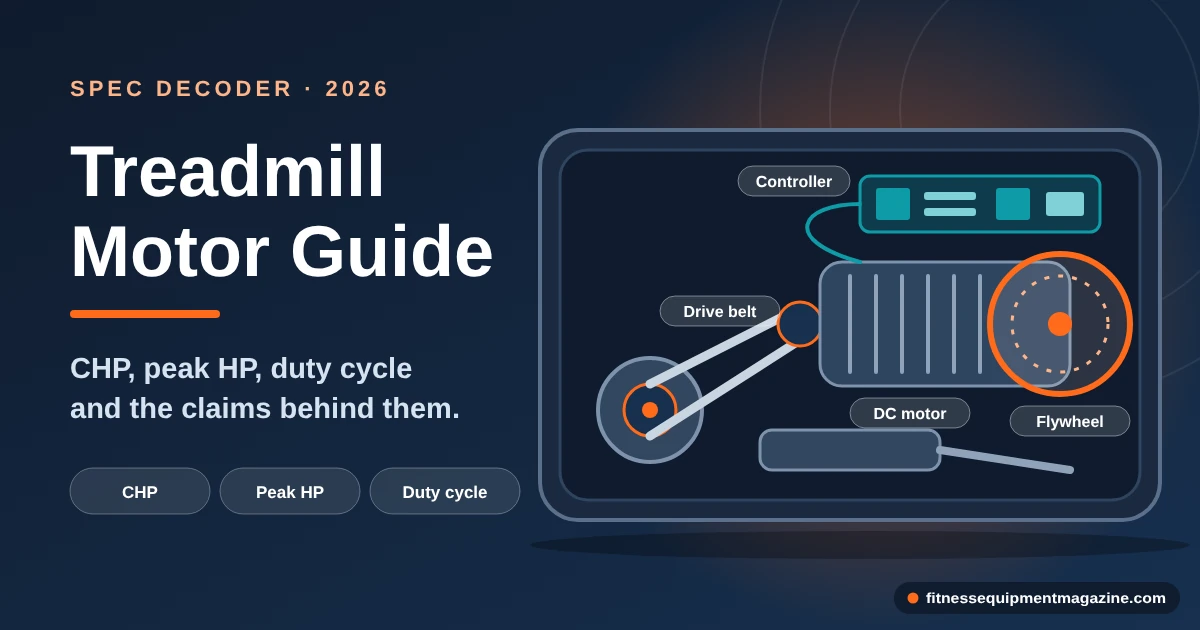
The motor never works alone. It sits in the front hood, usually behind a plastic cover, with a drive belt that links it to the front roller. A heavy flywheel on the motor shaft smooths out the pulses. A controller board sends measured power to the motor, and a separate small motor tilts the deck for incline. We’ll draw all of this later in the section on drives.
Why does that matter for a purchase? Because any honest treadmill motor guide has to treat “motor quality” as a system. A strong motor on a weak controller, a loose drive belt or a dry deck behaves like a weak motor. Conversely, a modest motor in a well-built system can feel perfectly solid for a walker. When you read a spec sheet, you’re judging the whole chain, even if the sheet only prints one number.
Quick mental model
Picture the motor as a person pulling a rope that has a hundred-pound sack tied to the end. Peak horsepower is how hard they can yank once. Continuous horsepower is how long they can keep pulling without sitting down. You are buying the second one.
Why this matters more for some people than others
A person who walks at 2.5 miles per hour for half an hour barely stresses a motor. A 220-pound runner doing intervals at 8 miles per hour on a 5 percent grade stresses it a great deal. Both can buy a machine labeled “3.0 HP” and have wildly different experiences. That is why this treadmill motor guide keeps returning to use, not just numbers. If you mostly walk, you can read the budget advice in our guide to the best budget treadmills and relax a little. If you run, keep reading closely.
DC vs AC treadmill motors: the real differences
Almost every home treadmill uses a DC motor. Many commercial machines use AC motors. That single sentence explains a lot about price, weight and lifespan, but it hides some interesting detail. Let’s unpack it without turning this treadmill motor guide into an engineering lecture.
DC motors: the home treadmill standard
A permanent-magnet DC motor is compact, inexpensive and responds quickly to the controller. It also has strong torque at low speeds, which is exactly when a belt needs to start moving under a person’s weight. Most home machines use a brushed version, in which small carbon blocks called brushes press against a spinning part to carry current. Brushes wear down like pencil erasers, slowly, over years of use.
That wear is not a flaw so much as a known trade. Brushed DC motors are cheap to build and easy to control. But the brushes make a little dust, create a little electrical noise and eventually need attention on heavily used machines. Some newer designs use brushless DC motors, which skip the brushes entirely and tend to run cooler and quieter. They also need a more sophisticated controller, so cost moves from the motor into the electronics.
AC motors: the gym machine approach
An AC induction motor has no brushes at all. A drive, often called an inverter, changes the frequency of the power to set the speed. The result is a motor that is heavier and more expensive, yet can run for long stretches at high load with little fuss. This is why commercial gyms favor them. A machine that runs ten hours a day needs a motor that treats continuous duty as normal.
For a home shopper, the practical catch is that AC-driven treadmills are less common and often cost noticeably more. They may also expect a dedicated circuit. If you see one in a home model, it is usually a sign the manufacturer is aiming at serious runners or very heavy use. The spec sheet will probably say so plainly.
Where DC motors shine
- Lower cost, which keeps the machine in reach for most households
- Strong low-speed torque for smooth starts under load
- Light enough for folding frames and easier shipping
- Quick response when you change speed mid-workout
Where AC motors shine
- No brushes to wear, so less routine upkeep
- Better tolerance for long, hot, high-load sessions
- Commonly quieter under heavy use
- Built for machines that several people use daily
Which motor type does this treadmill motor guide favor?
Neither is automatically better. A well-built DC motor with honest continuous ratings serves most walkers, joggers and moderate runners for years. An AC drive earns its cost when the machine will be shared, used for long daily sessions or pushed by a heavy runner. The label “DC” is not a warning sign, and the label “AC” is not a quality guarantee. What matters is the continuous rating, the cooling and the warranty that stands behind them.
One more nuance: some listings stress “commercial-grade motor” without saying whether it’s AC or DC. Treat that phrase as a prompt to ask, not as an answer. A genuinely commercial motor will come with a spec to prove it, usually a stated CHP, a duty rating and a long motor warranty. If the listing has none of those, the phrase is decoration. Our guide to the best heavy-duty treadmill options goes through what truly heavy use demands.
CHP vs peak HP: the number a treadmill motor guide should trust
Horsepower on a treadmill listing comes in three flavors: continuous horsepower (CHP), peak horsepower and a vague “HP” with no label at all. They are not interchangeable. In fact, the gap between them is the single most useful thing to understand before you spend money.
What continuous horsepower means in a treadmill motor guide
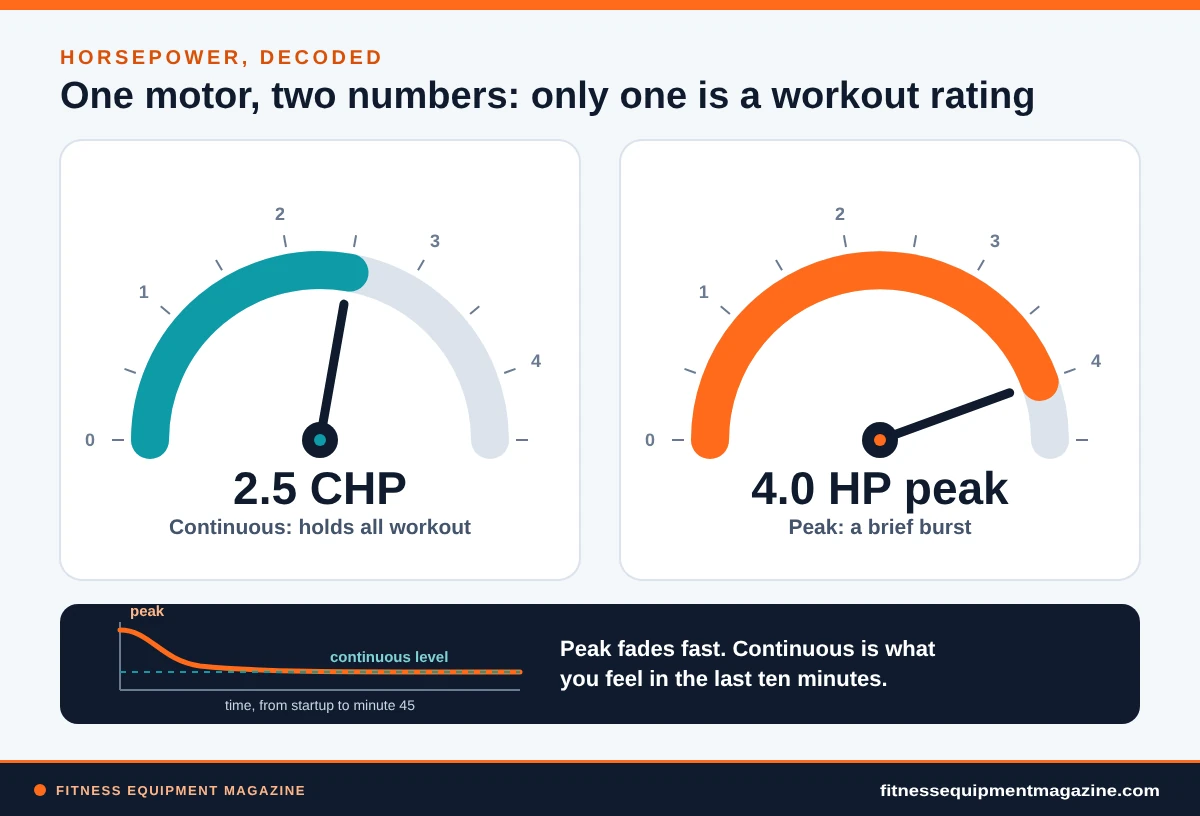
CHP is the power the motor can deliver for a sustained period without overheating. Think of it as the pace a marathoner can hold for hours. It is the figure that tells you how the machine will feel at minute 40 of a run, which is the only minute that really tests a motor. A manufacturer that prints a CHP number is at least making a claim you could, in principle, hold them to.
There is a catch. As far as we can tell from published specs, no single test is followed by every maker, so one company’s 2.5 CHP may be more conservative than another’s. That is why we suggest using CHP to compare within a rough band, not to rank machines to the decimal. A 2.0 versus a 3.0 tells you something. A 2.5 versus a 2.6 tells you almost nothing.
What peak horsepower really is
Peak horsepower, sometimes written “peak duty” or “max HP,” describes the highest output the motor can reach for a brief moment. It can be derived from a quick measurement at startup, from the maximum current the motor can draw, or from a calculation the maker chooses. Nothing about it says the motor can hold that output for ten seconds, let alone ten minutes. For a plain-spoken definition, peak is a sprint figure printed on a marathon product.
The gap is often large. Listings commonly show a peak figure that is somewhere between one and a half and two times the continuous one, and some skip the continuous number entirely. If a page leads with a big peak figure and buries or omits CHP, that tells you which number the seller would rather you remember.
Why peak figures stay on listings
Because they work. Shoppers compare numbers, and bigger numbers win clicks. A “4.0 peak” beats a “2.5 continuous” on a quick scan even when both describe the same motor. Retailers also copy manufacturer text, so the figure spreads. Any fair treadmill motor guide has to point this out, and none of it makes the motor bad. It just means the headline number was chosen for the shopper’s eye, not for the shopper’s workout.
Myth
“More peak HP means a stronger machine.”
Peak says almost nothing about sustained output. Two machines with different peak ratings can share nearly the same motor.
Fact
CHP is the comparison figure.
It is closer to how the machine behaves during a real workout, as long as the maker states it clearly.
Fact
Unlabeled “HP” is a question.
If the listing says only “3.0 HP,” ask which kind it is. A seller who can answer quickly is usually a good sign.
Duty cycle and heat: why motors need to rest
Every motor turns electricity into motion and a good deal of heat. The heat is the real enemy. It softens the varnish on the copper windings, dries out grease and wears brushes faster. Duty cycle is simply the term for how much working time a motor can take before it needs a break. That is why a treadmill motor guide spends as much time on heat as on horsepower.
Continuous duty versus intermittent duty
A continuous-duty motor is built to run at its rated load indefinitely, because it sheds heat as fast as it makes it. An intermittent-duty motor is built to run hard for a while and then cool off. Many home treadmills sit somewhere in between: fine for a 30-minute walk, noticeably warm after an hour of running at speed. Spec sheets rarely say which one you’re getting, which is why a treadmill motor guide leans on the warranty and the stated CHP.
Some makers publish a duty statement such as a maximum recommended session length or a rest period between long sessions. That is a good sign, even when the limits seem strict. A company that tells you honestly how long the machine likes to run is a company that has measured it.
Why heat shortens motor life
Engineers often cite a rule of thumb that insulation life roughly halves for every 10 degrees Celsius of sustained extra heat. We can’t promise it holds for any particular treadmill, and you shouldn’t treat it as a precise law. The takeaway is directional and sensible: a motor that runs a little cooler lasts a lot longer, and the easiest way to run cooler is to have more motor than you need.
That is the quiet argument, in any treadmill motor guide, for buying a bit above your minimum. A 3.0 CHP motor loafing along at moderate load runs cooler than a 2.0 CHP motor working near its ceiling, even when you ask both to do the same job.
Habits that protect against heat
You can’t change the motor, but you can change how you use it. Short habits add up across years of ownership, which is why this treadmill motor guide lists them.
- Let a hot machine rest for ten or fifteen minutes between long, hard sessions in a warm room.
- Keep the room ventilated and leave a few inches of clearance behind the hood so air can move.
- Avoid stacking back-to-back runs for several people without a break on a lighter motor.
- Start slow and ramp up speed, because sudden jumps ask the motor for a surge of current.
What loads the motor: weight, speed, incline and friction
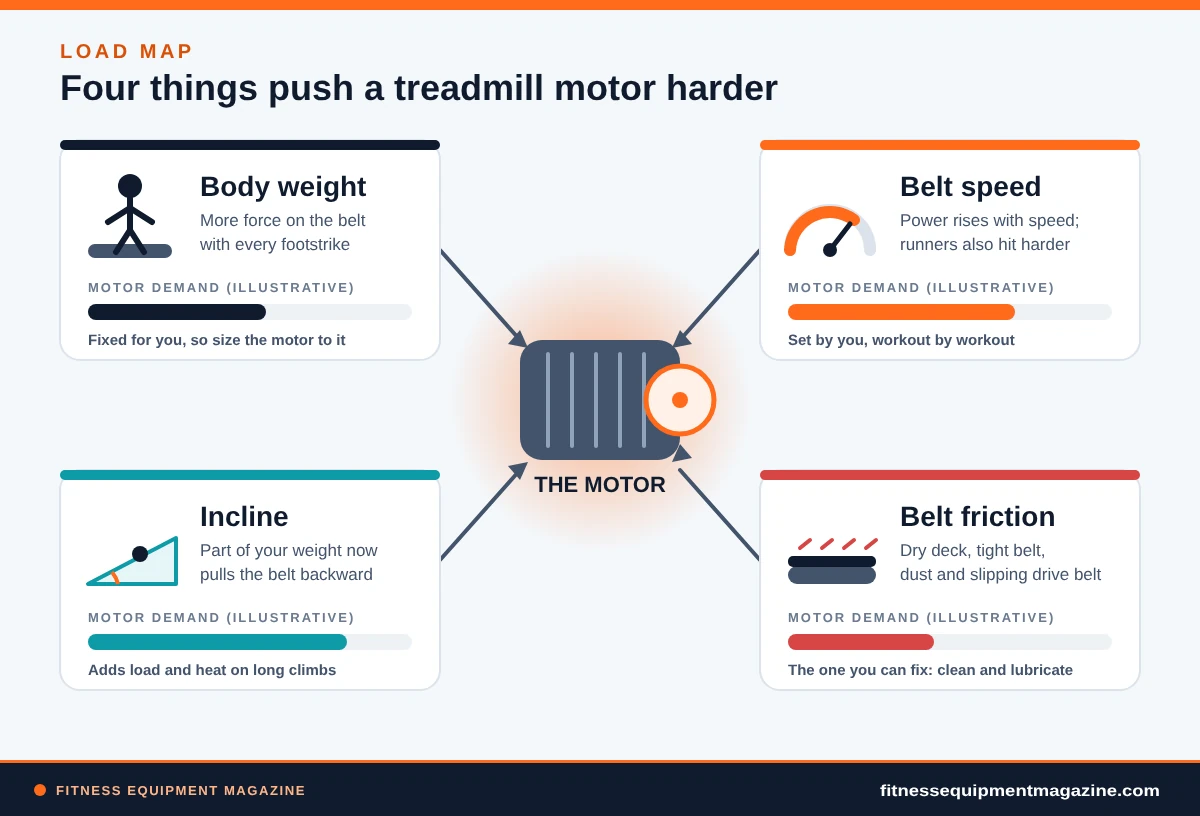
Motor demand isn’t a fixed number, and a treadmill motor guide that treats it as one will mislead you. It moves with the person on the belt and with the machine’s own condition. Four drivers do most of the work, and one of them is entirely within your control.
Body weight and stride
Heavier users pull harder on the belt with every stride. More weight means more force that the motor must overcome to hold speed, and the effect grows with the belt’s friction on the deck. A heavy-footed runner stresses the motor in sharp bursts, while a smooth walker stresses it far less, even at the same body weight. That is why “max user weight” on a spec sheet is a frame rating, not a motor rating. They are different limits.
Speed
Power equals force times speed, so doubling the belt speed roughly doubles the power needed to hold the same drag. Running at 8 miles per hour asks far more of the motor than walking at 3. But speed also changes behavior: runners strike harder and more often, which adds shock load on top of the steady load. Fast users should lean toward higher CHP for this reason alone. Our guide to the best treadmill for running looks at the rest of what runners should check.
Incline
Tilting the deck adds a new force: part of the user’s weight now tries to drag the belt backward. A back-of-envelope example makes it concrete. A 200-pound person at 6 miles per hour on a 10 percent grade needs roughly a third of a horsepower of useful work just to fight that slope. It sounds small, and it is only the useful part. Friction, motor inefficiency and controller losses sit on top, which is why electrical demand is a multiple of it.
If you plan to train on steep grades, read the best incline treadmill guide. Incline workouts stack heat on top of load, so a motor that coped on flat ground can feel strained at 12 percent. Treat that example as rough physics, not a measurement of any specific machine.
Belt and deck friction
This is the one you control. A dry deck, an over-tight belt or a belt that has slipped off-center all raise friction, and the motor pays for every bit. In practice, a poorly maintained treadmill can ask its motor for noticeably more effort than a clean, lubricated one. Many “failed motor” stories begin as a friction problem that nobody noticed for a year. We’ll return to this in the maintenance part of this treadmill motor guide.
Try this
With the machine off and the belt at rest, lift one side of the belt by hand near the middle of the deck. It should rise a couple of inches without much effort. If it barely lifts, the belt may be too tight, and a tight belt is a motor workout nobody asked for. Check your manual for the right tension procedure before adjusting.
Controller, drive belt and the 120V ceiling
A motor is only as good as what feeds it and what it pushes. Between your wall outlet and the running belt sit a controller, a drive belt and a flywheel, and each can make a strong motor feel weak. The drawing below, the centerpiece of this treadmill motor guide, shows how they fit together under the hood.
The controller decides what the motor feels
The controller, often called the motor control board, turns your speed setting into precisely measured power. It watches for slowdown and corrects it many times a second. A cheap or poorly tuned controller makes the belt surge or lag, and that can feel like a weak motor even when the motor is fine. Controllers also run warm, so they are one more reason to keep dust out of the hood.
Drive belt and flywheel
The drive belt is a small, ribbed band that carries the motor’s turning force to the front roller. Over time it can stretch, glaze or pick up debris. A slipping drive belt wastes motor effort, makes a squeal on startup and, in the worst case, leaves you with a motor that spins happily while the running belt hardly moves. The flywheel stores momentum so each footstrike doesn’t cause a hiccup. A heavier flywheel generally means a smoother feel, and it’s a quiet sign of a more thoughtful design.
The 120V ceiling most home buyers forget
Here is some plain arithmetic. A standard 15-amp household circuit at 120 volts can supply about 1,800 watts at most. Electricians generally plan for continuous loads at around 80 percent of that, or roughly 1,440 watts. One horsepower is about 746 watts of mechanical output. So a motor that truly delivered 3.0 horsepower continuously would need well over 2,200 watts of electrical input, even before motor and controller losses.
What does that tell us? Not that the motor is lying, exactly. A CHP rating describes what the motor is built to produce, and a person on a belt rarely asks for the full rating. But it does suggest that big home numbers are best read as capacity, not as something the outlet will always deliver. It is another reason this treadmill motor guide steers shoppers toward realistic CHP bands rather than chasing the highest figure.
Watch the circuit
Plug a treadmill into a circuit shared with a space heater, a window air conditioner or a microwave and you may trip the breaker. Or you may blame the treadmill for slowing down when the problem is voltage sag. Manufacturers often recommend a dedicated circuit. Follow the manual, and skip extension cords and cheap power strips unless the manual specifically allows them.
Lower-voltage machines and walking pads
Walking pads and some compact folding treadmills use a different setup: a small brushless motor fed by a power adapter that outputs lower-voltage direct current. That design is quiet and light, and it suits a person walking at a gentle pace. It also has a hard limit. A small adapter can only supply a few hundred watts at most, which is nowhere near the 1,500 watts needed for a true 2 horsepower of mechanical output.
So when a walking pad advertises a “2.5 HP peak” motor, do a quick sanity check. Find the adapter’s label, multiply volts by amps and compare the result with the claim. If the numbers don’t come close, the horsepower figure is marketing. Our guide to the best walking pads explains what honest ratings look like at that scale, and the comparison in walking pad vs treadmill covers when a pad stops being enough. Any treadmill motor guide should apply the same skepticism at the small end of the market.
Motor size by user type: a treadmill motor guide to rough ranges
People always ask for a number. This treadmill motor guide offers approximate CHP bands, with a big warning attached: they vary by manufacturer, they depend on how each company rates its motors and they assume a reasonably well-built machine. Use them to narrow a search, then confirm with the spec sheet and the warranty.
Walker
Roughly 1.5 to 2.0 CHP
Steady walking up to a brisk pace rarely stresses a motor. A modest, honestly rated motor is usually fine here. Quiet running matters more than raw power.
Jogger
Roughly 2.0 to 2.5 CHP
Light jogging, mixed walk-run sessions and occasional faster efforts. This band leaves breathing room without paying for a runner’s motor.
Runner
Roughly 2.5 to 3.25 CHP
Regular runs at 6 mph and faster, with some hill work. A bit of headroom keeps heat down and the stride steady at higher speeds.
Heavier user
Roughly 3.0 to 4.0 CHP
Larger users, heavy strides or frequent steep incline need margin. Pair the motor with a sturdy frame, since the frame limit usually bites first.
Shared machine
Roughly 3.0 to 4.0 CHP
When several people use one treadmill, total hours matter more than any single session. Duty rating and warranty weigh heavily.
When to size up
Move toward the top of your band if you weigh more than the average adult, train on steep incline, run in long sessions or share the machine. For machines built for that kind of load, see the criteria in our heavy-duty treadmill criteria, though keep the frame and deck in view too. A big motor on a flimsy frame wastes money.
When a smaller motor is fine
If you walk at a relaxed pace, use the machine a few times a week and never touch incline, a modest motor is a sensible choice. The money saved can go toward a better deck or a longer warranty. There’s no prize for buying a runner’s motor to stroll through a podcast. That said, don’t drop below the band to save a few dollars if your habits might grow.
Reading a motor spec sheet: the treadmill motor guide decoder
A trustworthy spec sheet isn’t long. It simply answers the questions you would otherwise have to guess at. Here is what this treadmill motor guide would want to see, and what its absence tells you.
The lines a treadmill motor guide wants on a spec sheet
- Continuous horsepower, labeled as such, not just a bare “HP.”
- Motor type: DC or AC, and whether the motor is brushless.
- Motor warranty length and what it covers: parts, labor, in-home service, shipping.
- Input power: voltage and amperage, plus any circuit advice.
- Thermal protection, described plainly, even if it is a single sentence.
- Intended use: home, light commercial or commercial, with a stated duty note if available.
What a missing line tells you
Absence isn’t proof of a bad motor. It does tell you the seller either doesn’t know or doesn’t want to say, and that’s useful information when you are comparing two otherwise similar machines. Email the manufacturer’s support line with two questions: what is the continuous horsepower, and what does the motor warranty cover? The speed and clarity of the answer is a decent preview of how a future warranty claim goes.
Noise, smell and other signs of motor strain
Motors rarely die without warning. They complain first, usually in ways you can hear or smell weeks before anything fails. Learning the difference between a normal sound and a worrying one is cheap insurance, and this part of the treadmill motor guide needs no tools at all.
What the sounds mean
A healthy motor sounds like a steady, even hum with a whir from the belt and roller. A short squeal when you start, especially after the machine has sat for a while, often points to a slipping drive belt. A rhythmic thump that matches the belt’s pace is usually the running belt seam or a rough roller. A grinding or rumbling noise is different. It suggests worn bearings and needs attention.
One more clue: change over time. A noise that appeared last Tuesday and is slowly getting louder matters more than a constant sound that was there on day one. If noise is a daily concern in your home, our guide to treadmill noise in an apartment covers the building side of it.
What the smells mean
A new machine often gives off a faint plastic and lubricant smell for the first few uses, which usually fades. Dust burning off a warm motor can smell stale for a minute. But a sharp, hot-varnish or burning-rubber smell is not normal. It means insulation or a belt is overheating, and the right response is to stop right away.
Safety first
If you smell burning, see smoke or hear sparking, stop the machine, unplug it and don’t use it again until the manufacturer has looked at it. Do not open the hood and poke around while it is plugged in. If there are flames or heavy smoke, leave the area and call emergency services. You can also check the CPSC exercise equipment page to see whether your model has a safety notice.
Performance signs that look like laziness
Sometimes strain shows up in behavior, not noise. The belt surges when you land, slows as you hold a pace, or takes a moment to catch up after you change speed. Some consoles show an error code. Lights in the room may dim briefly, which hints at a circuit problem more than a motor problem. Notice these early and write down the date and your settings, because a clear log makes a warranty call faster.
Thermal protection and what a trip really means
Good motors protect themselves. A thermal cutoff is a small safety device, built into the motor or controller, that cuts power or slows the belt when temperatures climb too high. On some machines a resettable breaker sits near the power inlet and does a similar job for electrical overload. Neither is a fault by itself. They are the machine saying, “that’s enough.” Any treadmill motor guide should count them as a feature, not a flaw.
What to do when it trips
- Step off and stop the belt.Don’t try to restart immediately. A hot motor that keeps going is exactly what the cutoff exists to prevent.
- Let it cool.Many manuals suggest waiting twenty to thirty minutes. Follow your own manual’s number if it gives one.
- Look for the cause.Was the session unusually long, hot or steep? Is the belt dry, tight or off-center? Is dust piled up inside the hood?
- Resume gently.Restart at a lower speed and incline, and watch for a repeat.
- Call support if it repeats.A second trip under the same conditions is a pattern. Report it while the warranty is active.
Why you shouldn’t bypass it
Forums sometimes suggest jumpering a nuisance cutoff. Please don’t. It removes the very thing between a hot motor and a damaged one. A machine that trips constantly is telling you it’s too small for the job, too dirty to cool or too friction-bound to run well. Fix the cause, or consider a more capable motor next time. For help sizing one, jump back to the rough bands in this treadmill motor guide’s section on motor size by user type.
Maintenance that protects the motor
You don’t need to be handy to keep a motor healthy. Most of the benefit comes from three plain habits: keep it clean, keep the belt happy and keep the machine on a sensible surface. Always follow your manual first, because intervals and lubricants differ by machine, and this treadmill motor guide can only describe general habits.
Dust, pet hair and the hood
Dust is an insulator, and insulators trap heat. A coat of lint on the motor and controller turns a cool-running machine into a warm one. Pet hair is worse, since it winds around rollers and rubs against the belt. Unplug the machine, wait for the console to power down fully, then vacuum around the hood opening. If your manual shows how to lift the cover, do a gentle clean once or twice a year. If it doesn’t, leave the hood closed and ask the manufacturer.
Placement matters too. A treadmill sitting on thick shag carpet can pull fibers into the hood. Put it on a firm mat or a hard floor with a little clearance behind it. That also helps the motor shed heat and keeps the cooling vents clear.
Lubrication and belt tension
The running belt glides over the deck, and friction there is paid for by the motor. Many decks need a silicone-based lubricant applied under the belt at intervals the manual lists, commonly measured in months or hours of use. Other decks are sold as pre-treated and want little or none. Don’t guess. The wrong product can gum up the deck, and petroleum-based sprays can damage the belt.
Belt tension has a sweet spot. Too loose and the belt slips on the roller, producing squeals and a surging feel. Too tight and the motor and bearings work harder than they should. The manual shows a simple adjustment procedure, usually with an Allen key and small, equal turns on both sides. If the belt drifts to one side, correct the alignment first, since a rubbing belt edge adds drag.
Keep a log
Jot the date of each cleaning, lubrication and adjustment on a sticky note inside a cabinet or in your phone. If the motor ever needs a warranty claim, a clean maintenance record answers the first question support will ask.
Motor warranty and electricity use
These two topics aren’t glamorous, but in any treadmill motor guide they decide what the motor costs you after the checkout page. One is about the risk you carry. The other is about the small bill that arrives every month.
How to read a motor warranty
Warranty structures differ, but a pattern shows up often. Frames and motors tend to carry the longest terms, while parts and labor sit much shorter, sometimes a year or two for parts and less for labor. A motor warranty ranging from a few years to the “lifetime” label is common, with longer terms usually on pricier machines. The number is only the headline. The fine print is where the real value lives.
- Does it cover parts only, or parts and labor, and for how long each?
- Is service done in your home, or must you ship a heavy machine at your own expense?
- Does “lifetime” mean the original owner for as long as they own it, and is it residential use only?
- Is registration or proof of purchase required, and by when?
- Does it list exclusions such as damage from power surges, dust or missed lubrication?
In this treadmill motor guide’s view, a shorter warranty with clear terms and local service can beat a “lifetime” promise buried under exclusions. If your budget is limited and you’re weighing this trade, the priorities in our budget treadmill priorities guide show how to spend on motor and warranty before screens.
What a treadmill costs to power
Electricity use is small compared with most household appliances. The formula is simple: watts times hours, divided by 1,000, gives kilowatt-hours; multiply by your local rate. These sample figures use made-up but plausible assumptions, and a rate of 17 cents per kilowatt-hour, so adjust for your own bill.
Those figures are yearly estimates built from assumptions, not measurements. The walker draws roughly 250 watts for 30 minutes, five days a week. Standby draws about 5 watts all year. The runner draws roughly 600 watts for 45 minutes, four days a week. The heavy user draws roughly 900 watts for an hour, six days a week. In other words, a treadmill motor guide can safely call the motor’s electricity a minor cost. Your machine’s real running expense is the repair bill you avoid with good habits.
Standby power is worth a glance. Many consoles stay awake while plugged in. Unplugging the machine between workouts, or using a switched outlet, trims that small drain and also protects the electronics from stray surges. If you like a no-power option, a manual treadmill uses none, as explained in our comparison of manual vs motorized treadmill designs.
Red flags in treadmill motor marketing
Marketing pages are written to sell, not to teach, and a treadmill motor guide has to read them with that in mind. Still, they leave fingerprints. Here are the patterns that, in our reading of spec sheets and ownership complaints, signal that the horsepower story deserves a harder look.
- Only peak horsepower is listed, with no continuous figure anywhere on the page or in the manual.
- “Commercial-grade motor” appears with no AC or DC type, no CHP and no duty rating.
- The HP claim outruns the power supply, such as a big figure on a walking pad with a small adapter.
- “Lifetime motor warranty” shows up with the terms hidden or only available after purchase.
- Different pages disagree. The retailer says 3.5 HP, the manufacturer says 2.5 CHP, and the box says neither.
- Heavy user weight limits sit beside a tiny motor, with no mention of how the motor is rated for that load.
- No thermal protection is mentioned, and owners’ reviews keep describing burning smells.
- Support is hard to reach, or parts availability is unclear for a motor that will eventually need service.
One red flag isn’t a verdict. Three or four on the same product is a different conversation. Keep this treadmill motor guide’s list handy when you read listings. Use it as a prompt to ask the seller questions, and pay attention to whether the answers are specific or evasive.
How to compare treadmills fairly on motor
Comparing two motors on a screen is harder than it looks, because the listings rarely use the same words. A fair comparison means translating each page into the same few questions. This treadmill motor guide boils that translation into a short routine you can run in about fifteen minutes per machine.
A six-step routine
- Find the continuous number.Look on the manufacturer’s page, the manual PDF and the box photos. If no CHP appears anywhere, note that, and move on to question two.
- Write down your own load.Your weight, your typical speed, how often you use incline and how many people share the machine. This is what the motor must carry.
- Place yourself in a band.Use the rough CHP ranges earlier in this guide, then move up one notch if you run, climb steep grades or share the machine.
- Check the warranty fine print.Compare motor term, parts and labor terms, and whether service happens in your home.
- Read the power requirements.Confirm voltage, amperage and whether the manual calls for a dedicated circuit. Make sure your space has one or can get one.
- Scan ownership complaints.Search reviews for “burning smell,” “stopped mid-run,” “error code” and “support.” Patterns matter more than one angry post.
Notice what isn’t on the list: peak horsepower, screen size and the number of workout programs. Those aren’t irrelevant, but none of them decides whether the machine still runs well in three years. If you are shopping at the lower end of the price range, our guide to the best treadmills for home use can help you weigh motor against deck size, space and training style.
Evidence note. The shortlist routine in this treadmill motor guide is research-based, built from specification patterns and commonly reported ownership problems. We haven’t hands-tested any machine, and the CHP bands are approximate. Confirm everything on the manufacturer’s own pages.
Keeping the comparison honest
Two traps catch careful shoppers. The first is comparing a CHP figure from one maker against a peak figure from another, which makes the cheaper machine look stronger than it is. Convert everything to the same label or exclude the machines that won’t state one. The second trap is comparing motors in isolation. Take a 2.5 CHP motor on a stable frame with a long deck and a clear warranty. It can be a better buy than a 3.0 CHP motor on a wobbly frame with a thin warranty.
If two machines are truly tied, choose the one with the clearer documentation. That sounds like a tiebreaker for bureaucrats, but a company that writes a plain, complete manual usually builds and supports the machine with the same care.
Three hypothetical shoppers
These are invented profiles for this treadmill motor guide, not real customers, and the numbers are only a way to show the reasoning. Your own result will differ.
Hypothetical
The podcast walker
Walks about 30 minutes at an easy pace, five mornings a week, never uses incline. A modest, honestly rated motor with a clear warranty is the sensible buy. Savings can go toward a better deck or a quieter machine.
Hypothetical
The weekend runner
Runs 40 minutes at around 6 mph three days a week, with some hills. A mid-band CHP with breathing room beats a small motor near its limit. Thermal protection and a motor warranty of several years are the priorities.
Hypothetical
The shared household machine
Three adults, different weights, some running, some walking, almost daily. Total hours decide here. A higher CHP, a stated duty rating, a strong frame and a warranty that covers in-home service are worth paying for.
Myths this treadmill motor guide retires
Myth: a bigger motor makes the belt faster
Top speed is a setting limit, decided by the controller and the console. A bigger motor holds speed under load more easily. It does not raise the ceiling.
Myth: a bigger motor always wastes electricity
A motor draws power in proportion to the work it does, not to its size. A larger motor loafing along often runs cooler and a little more efficiently than a small one straining. The difference on your bill is tiny either way.
Myth: the motor is the thing that fails
Motors do fail, but many “motor problems” start elsewhere: a dry deck, a slipping drive belt, a worn controller or a power problem at the outlet. Diagnose before you replace.
Treadmill motor guide FAQ
What is a good CHP for a home treadmill?
It depends on who is using it. Here are rough, manufacturer-dependent bands from this treadmill motor guide. Walkers often do well with about 1.5 to 2.0 CHP, joggers with 2.0 to 2.5, regular runners with 2.5 to 3.25 and heavier or shared-machine use with 3.0 to 4.0. Move toward the high end of your band if you train on steep incline. Verify against the maker’s own continuous rating and warranty rather than relying on a single number.
Is peak horsepower ever useful?
Only a little, and a treadmill motor guide should treat it as a footnote. Peak horsepower describes a brief burst, so it can hint that the motor tolerates startup surges, but it says nothing reliable about sustained output. If a page lists both peak and continuous figures, read the continuous one. If it lists only peak, ask the seller for the CHP before you compare that machine against any other. Treat an unanswered question as information.
Should I choose a DC or an AC treadmill motor?
Most households do fine with a well-built DC motor. AC drives, common in gyms, tolerate long daily sessions and need less routine upkeep, but they cost more and may expect a dedicated circuit. If the machine will be shared, used for long runs or pushed by a heavy user, an AC drive may be worth the premium. Otherwise, the continuous rating and warranty matter more than the type.
How should I use a treadmill motor guide when I’m shopping?
Use it as a translation tool. Write down your weight, speed and incline habits, then find each candidate’s continuous horsepower, motor type, warranty terms and power requirements. Ignore headline peak figures. If a spec is missing, email the manufacturer and note how clearly they reply. A good treadmill motor guide helps you ask sharper questions, not hand you a single winning number.
Why does my treadmill smell like it’s burning?
A sharp, hot smell can come from an overheating motor, a slipping drive belt or a worn controller. Stop the machine, unplug it and don’t restart until the manufacturer has checked it. A faint new-machine smell that fades after a few uses is different, as is a brief stale-dust smell from a warm motor. If you’re unsure, treat it as serious and call support, as the safety section of this treadmill motor guide advises.
How long does a treadmill motor last?
There isn’t a trustworthy single number, and no treadmill motor guide can promise one. Lifespan depends on motor type, how hard the machine is used, how clean and well-lubricated it stays and how much margin the motor has. Many owners report years of use from a motor that was properly sized and cared for. The warranty term is a rough hint at what the maker expects, but read the exclusions before relying on it.
Can a treadmill motor be too powerful?
Not in a harmful way, which is why most treadmill motor guide advice says to buy margin rather than excess. A larger motor costs more, weighs more and may need a stronger circuit, but it doesn’t make the belt unsafe or faster than your setting. The real risk is paying for motor you don’t need while skimping on the frame, deck or warranty. Match the motor to your load, add a little margin and put the rest of your budget where you’ll feel it.
Does incline damage a treadmill motor?
Incline raises the load, which raises heat, so repeated long climbs on a small motor can wear it faster. A motor sized with margin handles it comfortably. If you plan to train on steep grades, size up, keep the belt lubricated and give the machine rest between sessions. Our guide to treadmill incline goes into how grade changes the workload.
Does a treadmill use a lot of electricity?
Usually not. For a treadmill motor guide, the short answer is that running cost is small. Running a typical home treadmill for a workout often costs only a few cents to maybe a dime or two, depending on the machine and your local rate. Standby draw from the console adds a small amount over a year. Heavy daily use costs more, but electricity is rarely the main expense of ownership. The upfront price and repair costs matter far more.
Conclusion: use this treadmill motor guide as a checklist
The short version of this treadmill motor guide fits on a sticky note. Trust continuous horsepower, not peak. Match it to your weight, speed and incline. Give the motor some margin. Read the warranty’s fine print, and keep the belt and deck clean so the motor doesn’t pay for problems it didn’t cause.
Next steps depend on where you are. If you’re still narrowing machines, start with our complete treadmill buying guide for the full spec picture, and use the questions above on each shortlisted model. If you already own a machine, spend ten minutes this week on the habits in the maintenance section and note anything that smells, squeals or surges. Before you buy anything, check the CPSC list one last time.
And remember why you’re buying the thing in the first place. The HHS Physical Activity Guidelines describe general weekly activity targets for adults, and a treadmill is simply a convenient way to meet them. The best motor is the one that quietly lets you show up, week after week, without thinking about it.
Sources and Further Reading
- HHS Physical Activity Guidelines — federal guidance on weekly activity for adults
- CPSC exercise equipment recalls — check model safety history before you buy
Some links on this site may be affiliate links. If you buy through them we may earn a commission at no extra cost to you. Recommendations are based on the criteria in the article, not payout. This article is general information about equipment and isn’t medical advice; talk to a qualified professional about your own health and training. Last reviewed: October 2026.