A curved treadmill has no motor pulling the belt for you. You push it, with your own legs, on a curved deck of metal slats, and the machine goes exactly as fast as you do. That one idea changes the feel, the noise, the price logic, the learning curve and the list of people who should actually buy one.
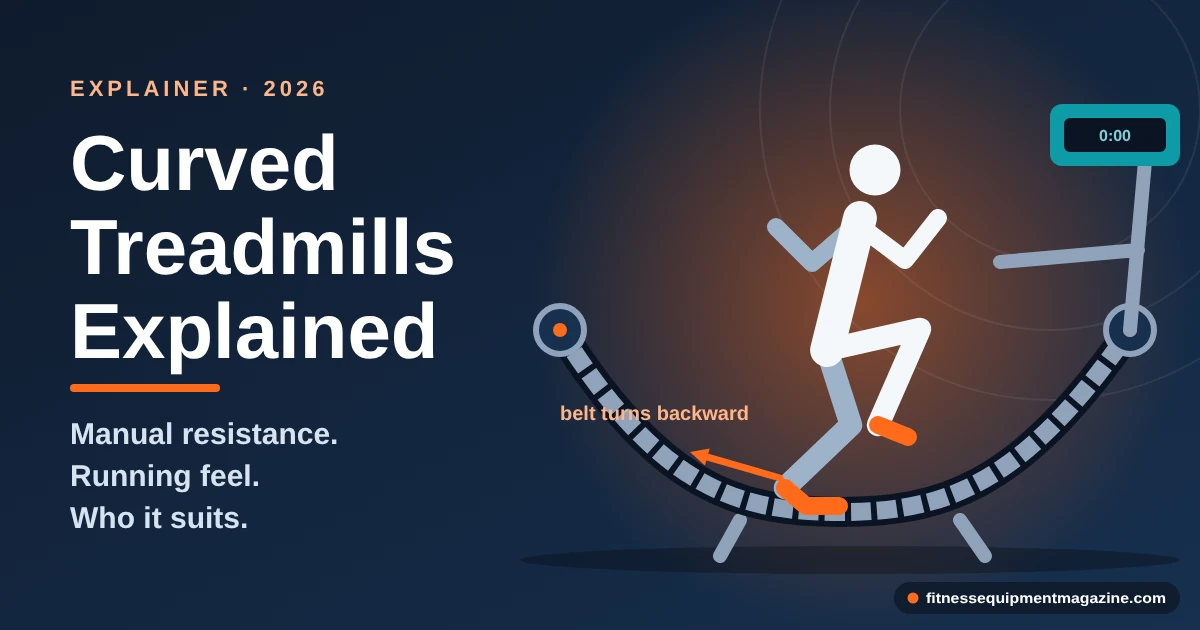
Picture a gym floor in the evening. The motorized treadmills hum in a row, each one set to a pace somebody typed in. Then there is the odd one in the corner, scooped like a skate ramp, making a rhythmic rumble of slats and nothing else. Nobody is standing at a console.
The person on it is simply running, and when they stop pushing, the belt stops too. That is the machine this guide explains. It looks like a gimmick from across the room. Once you step on, it behaves like something else, so it’s worth understanding before you spend a dollar.
The short answer
A curved treadmill is a self-powered or user-driven treadmill whose slat belt rides on a curved track. Your stride moves the belt, so speed follows effort and there is no set pace. It suits runners, sprinters and interval trainers who want a gym-style, effort-led session at home. It is a poor fit for casual walkers, first-time exercisers and anyone on a tight budget or in a thin-floored apartment.
- Who it fits: runners who like to vary pace, people who train in short hard intervals, and households with space, a sturdy floor and a floor-level budget that is not tight.
- The biggest tradeoff: it is more demanding and less forgiving than a motorized machine. At the same pace it generally feels harder, and you cannot simply hand control to a preset.
- The common trap: buying one for relaxed walking or for a very first running routine, then finding the learning curve and the noise put you off.
If that already sounds like your situation, jump to the fit map. If you are still deciding between a manual and a plug-in machine in general, the manual versus motorized treadmill comparison covers the wider question.
How we researched this. This is research-based guidance. We built it from manufacturer specification patterns, federal guidance and ownership problems that buyers commonly report. We haven’t hands-tested these machines, so you won’t find lab results, decibel readings or “our testers” claims here. We name no brands and give no prices for specific products. Dimensions, weights and price tiers below are typical patterns, not quotes, so verify them against the current spec sheet. Last reviewed: October 2026.
How current is this?
Specs, prices, warranties and recalls shift every few months, and the curved category is newer and less standardized than ordinary treadmills. Treat the numbers here as typical patterns. Before you buy anything, read the manufacturer’s current spec sheet and warranty page, then check the CPSC exercise equipment recall list for the model you are considering.
What a Curved Treadmill Is, and What It Isn’t
Start with the plainest description. A curved treadmill is a treadmill whose running surface bends upward at both ends instead of lying flat. The surface is not a rubber belt wrapped around a deck. It is a chain of individual slats, usually metal or metal with a grippy coating, that links together and rolls over rollers at the front and back. Your weight sits on the lowest part of the bow, and your feet push the slats backward along the curve.
Because you supply the force, the machine does not need a drive motor to turn the belt. In many designs there isn’t one at all. That is why people often call it a manual or self-powered treadmill, and why the terms get used loosely. Not every curved machine is purely manual, though.
Some add a small electronic console that runs on a battery or on energy captured from the belt. A few add a motor-assisted mode. Those details matter when you read a listing, so we will come back to them in the buying section.
Curved versus flat manual treadmills
There is a second family that confuses shoppers. Flat manual treadmills have a belt you also drive by hand, but the deck is flat or very slightly inclined, and the belt is a continuous rubber loop. They are usually cheaper and lighter. They tend to feel like a stiff, resisted walk, and most people find them unpleasant to run on.
The curved design solves that problem with geometry. The bow lets gravity and your own body weight help keep the belt turning once you are moving. That is why a curved deck feels more like running than shuffling.
Curved, self-powered
Slat belt, bowed deck
Runs only when you push it. Speed is whatever your effort produces. Usually heavy, with a distinct rumble, and priced above basic flat machines.
Flat manual
Rubber belt, level deck
Also user-driven, but flatter and lighter. Better for slow walking against resistance than for real running.
Motorized flat
The familiar home treadmill
A motor sets the pace and you match it. Covered in depth in our treadmill buying guide.
One more distinction is worth drawing early. A curved treadmill is not an incline trainer, even though the front of the bow can look like a hill. An incline trainer lifts a flat deck on a motorized mechanism. The curved deck has no adjustable angle. Your position on the bow, not a motor, decides how steep it feels at any moment.
How a Curved Treadmill Works
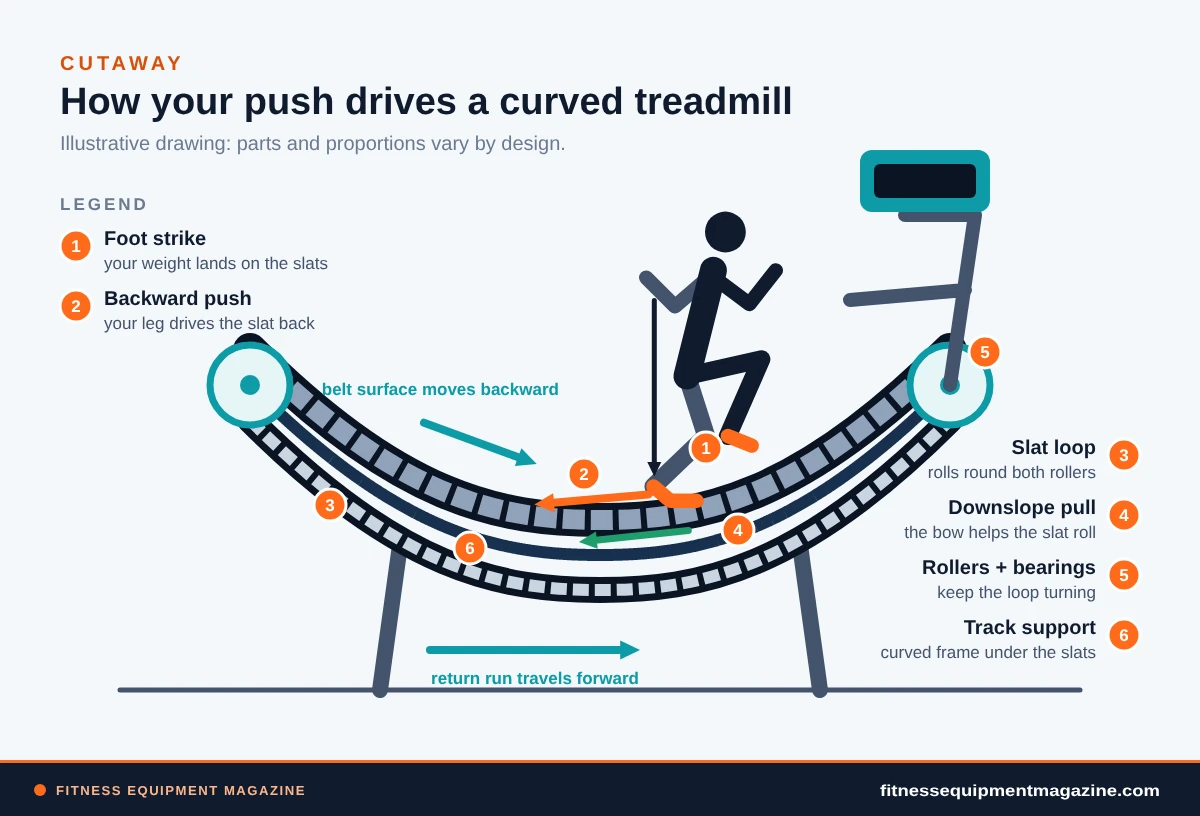
It helps to picture the machine from the side. The slats form a loop. The top run of that loop travels along a curved track made of rollers or a low-friction support. The front of the track climbs up a little, the middle is the shallow floor of the bow, and the rear climbs again. You stand roughly in the middle or slightly forward of it.
Gravity, geometry and your foot
Here is the mechanical story in order. First, your foot lands on the slats ahead of the lowest point. Second, because that part of the track slopes downward toward the middle, the slat under your foot wants to roll back and down. Third, your push, which is a backward drive through the forefoot and leg, adds to that and accelerates the loop. Finally, the rollers keep the loop turning for a moment after your foot leaves, so the next foot lands on a belt that is already moving.
This is the heart of the design. A flat manual belt has to be dragged against friction every step. A curved one uses your position on the slope to supply part of the rolling tendency. So you are not fighting the whole mass of the belt with each stride. You are still doing all the work, though. Nothing here is free energy, and nothing makes the belt move unless you push it.
Why speed follows effort
On a motorized treadmill the console says what speed you will run, and the motor keeps that speed whether you are fresh or fading. A curved treadmill reverses that arrangement. Your effort sets the pace. Push harder and the belt speeds up, which moves you toward the front of the bow. Ease off and the belt slows, which lets you drift back. That feedback loop is why many runners describe the machine as responsive: it follows what they do rather than leading them.
The practical meaning is simple. There are no preset speeds to hide behind and no console that will talk you into a pace you didn’t earn. If you’ve ever run with a friend who sets an honest tempo, this is that. If you’ve relied on a motor to drag you through the last five minutes, the experience can come as a shock.
What about the display and the electronics?
Most buyers wonder whether a machine without a motor can still show speed, distance and time. The answer is usually yes, in a limited way. A sensor reads the belt’s movement, and a small console shows readouts. Power comes from a battery, from a small generator driven by the belt, or occasionally from a plug. Some machines add Bluetooth for a phone app. Others show almost nothing, on purpose.
Treat the console as a convenience. The numbers depend on how the machine measures the belt and how well it is calibrated. Readouts can differ between machines. So use them to compare your own sessions on the same machine, not to compare across brands. If you want to hit exact paces, a motorized treadmill remains the more precise tool.
Running Feel on a Curved Treadmill: Stride, Cadence and Effort
Ask ten people who have run on one and you’ll hear the same two words: harder and honest. Harder, because you do the driving. Honest, because the machine never lets you coast at a pace the motor invented. Underneath those impressions sit a few real mechanical differences, and it’s worth separating them from the hype that surrounds this category.
Stride mechanics compared with a flat motorized belt
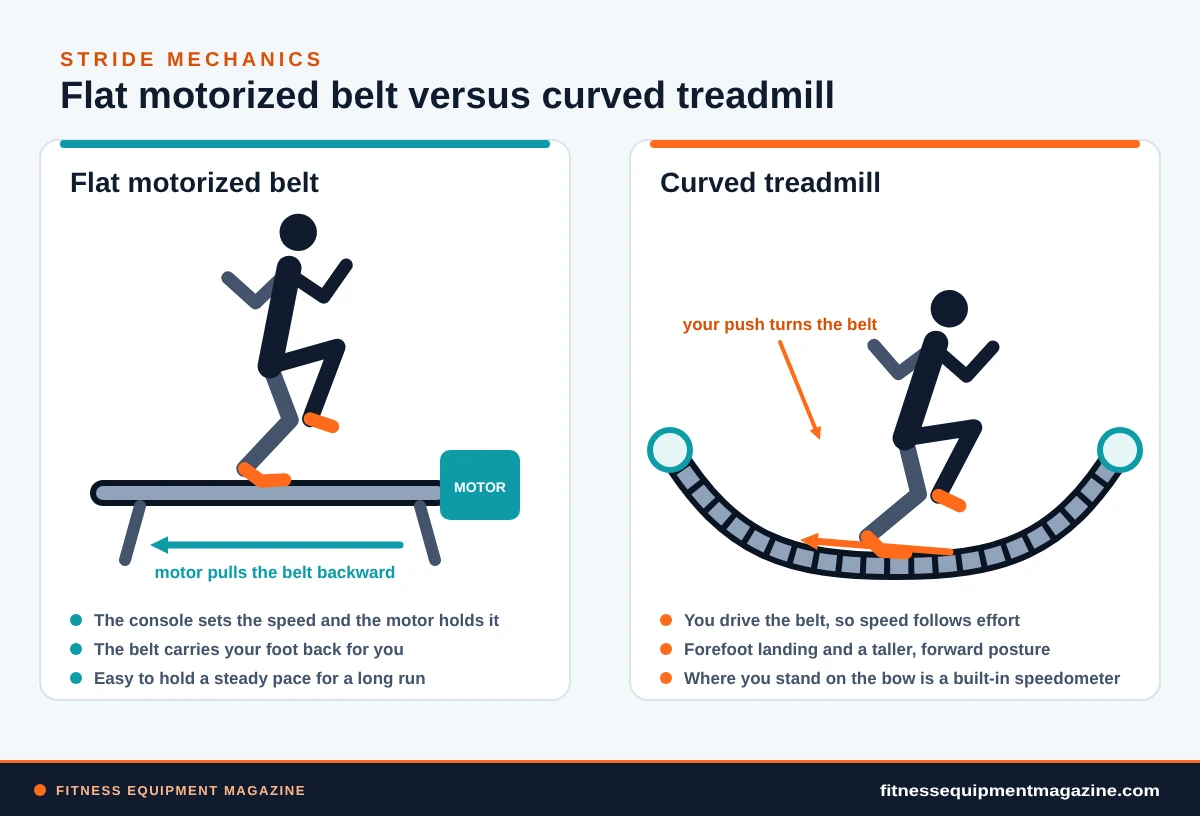
On a motorized treadmill the belt moves under you at a fixed speed. Your foot lands, the belt carries it backward, and you lift off. The surface is being pulled for you, which many coaches describe as a slightly assisted stride. You still run, but part of the backward travel of your foot comes from the machine rather than from you.
On a curved deck, nothing is being pulled. Your foot lands, your leg drives it back, and the slat loop spins up because of that push. Runners generally describe landing a little farther toward the ball of the foot, standing a touch taller and leaning slightly forward from the ankles. That pattern often shows up naturally, since a heel-first landing tends to brake the slats instead of driving them. We say “often” and “tends to” deliberately. Everyone’s gait differs, and the machine rewards some styles more than others.
Cadence and rhythm
Cadence, meaning steps per minute, is where many runners notice a change. Because the belt only accelerates when you drive it, and it decelerates the moment you ease off, there’s little room for lazy, overstriding steps. People often settle into a quicker, lighter rhythm. Again, this is a pattern, not a rule. Some runners find their natural cadence barely shifts, while others feel they’ve been forced to rebuild it.
If you track cadence with a watch, you may see it rise at first and then settle. We don’t offer numbers here because the figures depend heavily on the person, the machine and the day. What you can do is compare your own steps per minute on the curved treadmill to your outdoor runs and use that as a private baseline.
Why it feels harder at the same pace
This is the claim people repeat most, so let’s handle it carefully. It’s widely reported that holding a given pace on a curved treadmill feels more demanding than the same pace on a flat motorized belt. There are plausible mechanical reasons, and none of them requires a lab number to understand.
- You supply the whole drive. On a flat belt, the motor does the belt’s work. On a curved deck, the belt’s mass and the friction in its bearings are your job.
- The stride is different. Staying forward on the bow, driving through the forefoot, and keeping your posture upright recruit the calves, glutes and hamstrings a little differently than an easy stride on a flat belt.
- There is no pacing aid. A motor never lets you slow without immediate consequences, so fatigue shows up as a slower belt, not a held pace.
- Feel isn’t measurement. Heart rate and perceived effort are individual. Two people of similar fitness can report quite different experiences.
A word on comparisons
You will see articles claiming a curved treadmill burns a specific percentage more energy than a motorized one. We do not repeat figures like that, because they vary by machine, by person and by how a study was run. The safer takeaway is directional: the same pace usually feels harder, so start by matching effort, not speed.
Running feel versus walking feel
Walking is where the design gets awkward. At slow speeds the slat loop’s inertia and the bearing friction are hardest to overcome. Walking on a curved deck can feel like pushing a heavy cart that doesn’t quite want to start. Speed comes in lurches. It is usable, and plenty of people walk on them for warm-ups. But if the plan is a steady easy walk in front of the television, a curved treadmill is the wrong tool.
That’s a big reason this machine suits runners better than walkers. It’s also why the guide to the best treadmill for running is a better starting point if your goal is a more conventional running setup.
The Curved Treadmill Learning Curve: Your First Four Sessions
Almost every owner story starts the same way: the first session feels strange, the second feels better, and by the fourth the machine starts to make sense. Plan for that arc rather than being surprised by it. Treat the first week as a skills week, not a fitness test.
- Session one: stand, hold, shuffleStep on carefully with your hands on the front bar or side rails. Take small steps and let the belt build up. Walk for a few minutes, stop, and walk again. The goal is to learn how the slats respond and how far forward you need to stand.
- Session two: add a gentle jogKeep a light hand on the rail for the first minute, then let go once the belt is turning smoothly. Jog easily for short blocks with walking breaks. Notice that the belt can slow suddenly if your push fades.
- Session three: find your zoneExperiment with where you stand. Too far back and the belt feels heavy and drags you off the rear. Too far forward and you feel like you’re climbing. The comfortable middle is narrower than it looks.
- Session four: test a few pickupsDo a short block of faster running followed by an easy recovery. If it feels controlled, you’re ready to treat the machine as a normal training tool.
Common first-week mistakes
- Stepping on with the belt not at rest, or hopping on mid-motion like it’s a flat treadmill.
- Landing heel-first and braking the belt, then wondering why every step feels like a drag.
- Grabbing the rails hard and leaning back, which stalls the belt and strains the shoulders.
- Judging the machine by session one, before the stride has adjusted.
- Pushing to a hard sprint on day one, with no warm-up and no familiarity with how it slows.
Be patient with the warm-up, too. A flat treadmill lets you ease in at 3 mph with nothing but a button press. Here, your own warm-up becomes the pace. Five to ten minutes of easy walking and light jogging is a common approach, and it gives the legs and the belt time to wake up together.
Sprints, Intervals and Steady Work on a Curved Treadmill
If the machine has a signature strength, it’s short, hard efforts. Because the belt follows your drive, a sprint begins the instant you push and ends the instant you stop. There’s no waiting for a motor to ramp up, and no worry about being thrown off a belt that’s still running at maximum. That structure is a big reason intervals, hill-style efforts and sprint repeats show up so often in how these machines are marketed.
A sample interval session
The graphic below shows one example of how a session can be structured. It’s a sketch of rhythm, not a prescription, and it isn’t a medical or training plan for any individual. If you have a health condition or you’re returning to exercise after a long break, talk to a qualified professional before you try hard efforts.
Steady running and long efforts
Long, steady runs are possible but a different experience. Holding a constant pace means holding a constant push, and the belt will wander a little as your effort drifts. Some runners find that strangely engaging, a bit like running on a trail. Others find it tiring or tedious. Say a typical week for you is one long easy run and a couple of shorter ones. A motorized treadmill will probably serve your pace targets better, while a curved one may serve as the harder day.
Hills, resistance and the “built-in incline”
Many curved treadmills offer an adjustable resistance setting. Often this is a magnetic or friction setting that makes the belt harder to turn, which simulates running into a headwind or up a gentle slope. It isn’t an incline in the strict sense, because the deck angle stays put. It does give you a way to scale the difficulty without changing speed.
Check the setting range on any machine you consider, and note that not all models offer it. If a true adjustable grade matters to you, the separate treadmill incline guide explains how motorized incline works and when it’s worth paying for.
Walking and warm-ups
We’ve said walking feels clumsy, but a short walk to start is still common practice, and many owners accept it as part of the warm-up. Keep it brief, keep hands near the rails, and treat the first minute as the stiffest. If you find yourself walking for most of a session, take that as a hint about which machine you should have bought.
Who a Curved Treadmill Suits, and Who Should Skip It
The honest way to decide is to sort yourself on two questions. How much do you want the machine to demand of you? And how much do your home, your floor and your neighbors tolerate? The map below places the typical buyer types on those two axes. It’s a sketch of patterns, not a measurement, but it makes the big picture clear in a few seconds.
Good fits for a curved treadmill
Strong fit
The interval runner
Short hard efforts with short recoveries suit a belt that starts and stops with you. If your weekly plan already includes sprints or hill repeats, the machine matches it.
Strong fit
The cross-training athlete
Court and field sport athletes often want sprint work without a track. A curved treadmill gives them acceleration practice indoors, with a self-regulating belt.
Good fit
The garage or basement gym owner
A room with concrete floor, ceiling room and tolerant neighbors takes the noise and weight in stride. Space is what makes the rest of the list workable.
Good fit
The runner who dislikes motors
Some people simply prefer an effort-led machine, and some like not needing an outlet. If that sounds like you, the curved design is a natural match.
Who should skip a curved treadmill
Strengths worth the price
- Effort-led, responsive running with no motor to service
- Works for sprints and intervals without a ramp-up
- Often does not need a wall outlet for the belt itself
- Self-regulating: stop pushing and the belt stops
Tradeoffs that bite
- Awkward and tiring for easy walking
- Steeper learning curve than a motorized machine
- Loud rumble and a lot of weight on the floor
- Usually costs more than a basic flat treadmill
Here’s who should look elsewhere, and why. Casual walkers get the least from this design. A steady, even walk at a set pace is exactly what a curved deck is bad at, and a walking pad or a standard folding treadmill will serve better. People who are brand new to exercise, or returning after a long layoff, will probably find the effort-led feel discouraging.
The machine does nothing to make the first minutes easier. Tight budgets usually fit better with a conventional treadmill, because the curved category tends to cost more for what it offers in features. Apartment dwellers with thin floors or neighbors below should think twice, since the slats can be loud and the machine is heavy.
Four hypothetical shoppers
These are made-up profiles, written to show how the decision tends to go. They aren’t real customers or reviews.
Dana, intervals in a garage. Dana runs track-style sessions twice a week and has a concrete garage floor and an understanding household. A curved treadmill lets her do sprint repeats without leaving the house. She accepts the noise as the price of admission, and she wouldn’t mind that it feels harder, because she wants it to.
Marcus, apartment on the third floor. Marcus likes the idea but lives above a neighbor with a thin ceiling. The rhythmic rumble of slats and the weight of the machine could cause friction long before any workout benefit shows up. For him, a quiet motorized treadmill, with a mat, is the safer pick, and the guide to treadmill noise in an apartment is the better read.
Priya, wants to walk and watch a show. Priya mostly wants a daily walk while she’s on a call. A curved deck would be a poor tool for that, as it’s clumsy at low speed and demanding to hold a steady pace. The walking pad versus treadmill comparison will point her toward something simpler and quieter.
Sam, first-time runner on a budget. Sam wants to build a running habit. A curved treadmill adds a steep learning curve exactly when motivation is fragile, and its price probably doesn’t fit his ceiling. A modest motorized machine with a long enough deck is the more forgiving start.
Noise, Footprint, Weight and Assembly
The physical facts of a curved treadmill shape the buying decision as much as the running feel does. Because there’s no motor under a plastic shroud, the machine’s mass sits in the frame, the rollers and the slats. That’s one reason these units tend to be heavy and solid. It’s also one reason they can be hard to move, hard to assemble alone and hard on a weak floor.
Noise: what to expect
The sound is mechanical, not electrical. There’s no motor whine. Instead you hear the slats clacking over the rollers, the rolling noise of the loop and the thud of your own footfalls. Many owners describe it as a steady rumble, louder at faster speeds and noticeable through a floor.
We have no decibel readings and won’t invent any. The practical advice is to assume it’s louder than a quiet motorized treadmill at walking speed. Plan around that with a dense rubber mat and a concrete or ground-floor location where possible. Then think honestly about who sleeps nearby.
Footprint and clearance
Curved treadmills commonly occupy a footprint comparable to, or a little shorter than, a standard treadmill, but they often stand taller at the handrails and cannot fold. Because the belt moves backward, you also need clear space behind the unit. Always measure the machine’s listed length and width, then leave extra room at the rear and sides. A common planning habit is to leave a generous strip behind the belt in case you step off in a hurry.
Weight and your floor
Heavy frames are a feature, since a stable machine feels better under sprint loads. They’re also a concern on upper floors and older wooden joists. Are you placing a curved treadmill anywhere other than a slab or ground-floor room? Then check the unit’s shipping weight on the spec sheet, and ask someone who knows your floor structure about the load. The same caution applies to getting the box up stairs. The crate may be large and awkward, and a second person is not optional.
Assembly and delivery
Plan for two people and a half day. The frame is heavy, the rollers and slats need to align, and the tension has to be set correctly. Some units arrive mostly assembled with only the uprights and console to attach, while others need more work. Read the assembly manual before you order, if it’s posted, and check whether white-glove delivery is offered. A tipped box or a bent frame at the curb is a bad start.
Safety on a Curved Treadmill
Safety is a different conversation on a machine that has no motor deciding your speed. There’s a lot to like, such as the belt stopping when you stop pushing, and a few important cautions that don’t apply to ordinary treadmills.
Safety first
Many curved treadmills have no safety key or tether, because there’s no motor to cut. That removes one of the usual fail-safes. So the responsibility moves to you. Wear flat, supportive shoes, step on and off at rest, and keep your hands near the rails until you know how the belt behaves.
Stopping, stepping off and slipping
When you stop pushing, a curved treadmill doesn’t halt instantly. The slat loop has momentum and may keep moving backward for a moment. That’s the reason you should never step off while it’s turning. Slow down, hold the rails and let the belt come to rest. Some machines include a brake or resistance setting that shortens the coast; check whether yours does and test it at an easy pace.
Handrails, grip and shoes
Use the rails when you’re learning, and treat them as a reference, not a crutch. Leaning back on them will stall the belt. Pick shoes with a flat, grippy sole, as the slat surface can be less forgiving than rubber if you wear slick soles. Some machines use textured slats and some use coated ones, so look at the surface description and any user-reported slipperiness.
Children, pets and the open belt
The open slat design leaves moving metal at the sides and rear. Keep children and pets away from the machine, even when it’s idle, because the loop can move if someone pushes it. If you have a toddler who treats the garage as a playground, think about a door or a gate, and about parking the machine against a wall.
Recalls and general checks
Before you buy, check the CPSC exercise equipment recalls for the make you’re considering. Once the machine is home, a short monthly check of bolts, rails and slats is a sensible habit. If something feels loose or noisy in a new way, stop using the machine until you’ve found the cause.
Health note
This guide is general equipment information, not medical advice. Hard interval work may not be appropriate for everyone. If you have a health condition, are pregnant or have been inactive for a while, speak with a qualified professional first. For general federal guidance on weekly activity, see the HHS Physical Activity Guidelines.
Setting Up a Curved Treadmill at Home
Because the machine is heavy, loud and unforgiving about alignment, the first hour of ownership matters more than it does with a motorized treadmill. A careful setup now saves you from the wobble, drift and rattle that owners often report later.
Level, mat and position
Start with the floor. A flat, level, solid surface lets the slats track straight and the frame sit without rocking. If the floor slopes, use the adjustable feet if the machine has them, and check again after a few sessions, because heavy machines settle. A dense rubber mat under the unit does three jobs: it protects the floor, it dampens some of the vibration and it stops the frame creeping when you sprint. Pick a mat that’s larger than the footprint so you have solid footing beside the rails.
Position matters as well. Keep the unit away from a wall at the rear, because the belt direction means you may step backward off the machine. Leave room beside it so you can get on and off without squeezing past a shelf. If you share the room with anyone, consider where your family walks, since moving slats are not a hazard you want at the end of a hallway.
Day-one checks
- Re-tighten every boltFactory assembly or your own can leave fasteners snug but not fully tight. Go around the frame, the uprights and the handrails after the first use.
- Spin the belt by handWith nobody on it, push the loop and listen. It should roll smoothly and quietly, without scraping or a hitch at the same point each turn.
- Check slat spacing and trackingThe slats should sit evenly and stay centered. If the loop drifts to one side, stop and consult the manual, not the internet forum.
- Test the consoleMake sure the display wakes up and reads sensibly. Replace the batteries if the manual says so, and note what the machine does when power drops out.
Shoes, clothing and a towel
A flat, grippy running shoe is the safe choice. Avoid anything with a smooth leather sole, and avoid shoes with long laces that can catch the rollers. Fitted clothing is better than loose, trailing fabric. Keep a towel and a water bottle within reach, but not on the belt side. Wipe down the rails after use so sweat doesn’t build up where your hands go.
Fitting it into a training week
Plenty of owners treat a curved treadmill as the hard-day tool. They use something else for the easy days. That’s a sensible split, because the machine is at its best when you want effort and at its worst when you want comfort. If you also have a motorized machine, an outdoor route or a walking pad, you can match the tool to the day.
If the curved unit is your only equipment, plan some easy sessions anyway. Use short, gentle efforts with long walking breaks, and watch how your legs feel the next morning. The unfamiliar stride can leave calves and hamstrings sorer than a flat belt does.
Maintenance Without a Motor
The pitch you’ll hear most often is that a curved treadmill is low maintenance because it has no drive motor to burn out. That’s true as far as it goes. You won’t replace a motor controller, and you won’t smell hot electronics. But the machine still has moving parts, and they wear in ways that are different from a conventional belt. A realistic picture saves frustration, so here it is.
Slats and bearings
The slats take your impact on every step, so expect surface wear over time. Look for chips in any coating, loose fasteners and slats that sit unevenly. The bearings in the rollers deal with the loop’s rotation and your weight, so they’re the other long-term wear item. Warning signs are grinding, a rough feel when you spin the belt by hand, or unusual heat after a session. Replacement parts availability is a legitimate pre-purchase question, and we’ll return to it below.
A simple routine
- After each sessionWipe the slats and the rails with a barely damp cloth. Sweat is corrosive over months, and salt builds up in the gaps.
- MonthlyCheck that the frame bolts, handrail fixings and console mounts are snug. Vibration loosens fasteners slowly and unevenly.
- Every few monthsSpin the belt by hand and listen. A smooth, even roll is good, and any scraping or catching deserves a closer look.
- Per the manualFollow whatever lubrication or tension guidance the manufacturer provides. Don’t spray random lubricants into the rollers or onto the slats, which can make the surface slippery.
Keep the machine on a hard, level surface and out of damp spaces. A garage that floods or a basement that sweats can corrode metal parts faster than a heated spare room. Dust under the rollers is also worth a quick look every so often.
Warranty and parts
Warranties for this category vary widely. Some manufacturers list separate terms for the frame, the moving parts and the electronics, and some are short on the console while generous on the frame. Read the actual terms, ask who pays for shipping on a heavy part and find out whether replacement slats and rollers are sold separately. A long frame warranty with no parts supply is a lot less comforting than it sounds. For a refresher on how to read these documents, the treadmill buying guide walks through the usual structure.
What to Check Before Buying a Curved Treadmill
You can’t walk into most stores and try one. That makes careful reading of the spec sheet and the return policy more important than usual. This section gives you the questions to ask and the logic behind price tiers, with all figures hedged on purpose.
Evidence note. Everything in this shortlist section comes from specification patterns and commonly reported ownership issues, not from hands-on testing. Check current specs, prices and warranty terms before you decide.
Price tier logic
In the US market in late 2026, curved treadmills commonly sit above basic flat treadmills. They sit below premium commercial-feeling motorized ones. The spread is wide, though, and it shifts with sales and shipping costs. Think in tiers, not exact figures.
Lower tier
Simpler self-powered units
Lighter frames, basic consoles and fewer adjustments. Fine for casual interval work if you accept more flex and noise. Check the stated max user weight carefully.
Middle tier
Sturdier frames, better parts
Heavier steel, better bearings, adjustable resistance and longer warranties tend to appear here. This is where many serious home buyers end up.
Upper tier
Commercial-style builds
Heavier-duty construction, more refined consoles and sometimes motor-assist or connected features. Worth it only if you will use them.
Higher prices don’t always buy better running. Sometimes you pay for a bigger display or a brand name. Compare weight, frame build, bearing quality, warranty and parts availability first, then decide whether extras matter to you.
Spec questions to ask
- Powered or not? Confirm whether the console uses batteries, a plug or belt-generated power, and what still works when it’s off.
- Resistance range. Find out whether the resistance is adjustable, how many steps it has and how it’s changed.
- Deck length and width. Check the usable running area and compare it with your stride. A longer runner or sprinter needs more room.
- Max user weight and unit weight. Both matter, the first for stability and the second for your floor.
- Slat and track material. Ask what the slats are made of, whether they can be replaced individually and what finish they use.
- Brake or stop feature. See if the machine has a way to arrest the belt, and how well users say it works.
- Return and delivery terms. A heavy machine can carry hefty return shipping, so read this twice.
Myths versus facts
Myth
“A curved treadmill never needs maintenance.”
Fact: there is no motor to service, but slats, bearings and fasteners still wear. Budget a little time every month.
Myth
“Everyone burns far more on one.”
Fact: it usually feels harder, and effort matters, but claims about exact extra energy vary and are easy to over-read.
Myth
“It’s just an expensive gym fad.”
Fact: for sprinters and interval runners, the effort-led belt is a real feature. For walkers, it truly isn’t.
Alternatives to a Curved Treadmill Worth a Look
If the curved design turns out to be wrong for you, don’t give up on treadmill training. Several alternatives cover the gap, and each trades something different.
A motorized flat treadmill
Some people want steady running at set paces, fairly quiet operation and the ability to fold. For them, a good motorized flat treadmill is simply the easier machine to live with. Start with the home treadmill selection guide if you want the broad picture, then narrow down by space and training style.
A flat manual treadmill
If your attraction to the curved design is mostly about having no motor and no outlet, a flat manual machine is the cheaper, lighter cousin. Just accept that it feels different and is rarely a good running surface.
A walking pad
When your main need is easy daily walking in a small space, a walking pad is the opposite of a curved treadmill: quiet, light and slow. It’s covered in depth in our best walking pads guide.
A cushioned motorized machine for joint comfort
If impact on your legs is a worry, the deck’s cushioning matters more than the drive. The treadmill cushioning explained page covers how decks absorb force and what claims to treat with caution. We don’t make health claims about cushioning, so talk to a qualified professional about your own situation.
Running outside, or a track
The cheapest sprint workout is a flat stretch of road, a field or a school track. A curved treadmill is for the days when weather, darkness or schedule take that away. If you can run outside most days, ask whether you need the machine at all.
Curved Treadmill Questions Buyers Ask
What is a curved treadmill?
A curved treadmill is a treadmill with a slat belt that runs on a curved track. You drive the belt with your own steps, so the speed matches your effort. Many have no drive motor at all, while some add a battery-powered console or a motor-assisted mode. It is used mostly for running, sprints and interval training rather than casual walking.
Does a curved treadmill need electricity?
Often the belt itself does not, because you power it. The console may use batteries, a small generator driven by the belt or a plug, depending on the design. A few machines add motor assistance that does need power. Check the spec sheet to see what works when the machine is unplugged, and whether the display is optional.
Is a curved treadmill better than a motorized one?
Neither is better in general. A curved treadmill is better for effort-led running, sprints and intervals, and for people who dislike motors. A motorized machine is better for set-pace running, steady walking, quiet use and folding storage. Decide based on how you train and where you live, and read our manual versus motorized comparison for the full tradeoff.
Why does a curved treadmill feel harder?
You supply the force that turns the belt, there is no motor to set your pace, and the stride is different from a flat belt. Most runners report that the same pace feels more demanding. How much harder depends on the person and the machine, so start by matching effort, not speed, and avoid relying on any single percentage claim.
Can beginners use a curved treadmill?
They can, but it is not the gentlest start. The learning curve is steeper than on a motorized machine, walking feels awkward and nothing sets an easy pace for you. If you are new to exercise, a standard treadmill is usually friendlier. If you are determined, start with short sessions and keep a hand on the rails.
Are curved treadmills loud?
They are mechanical rather than electrical, so you hear slats, rollers and footfalls instead of a motor. Many owners describe a steady rumble that carries through floors. We have no decibel measurements. If you live above or beside neighbors, a heavy mat and a ground-floor location help, and a quiet motorized treadmill may fit better.
Can you walk on a curved treadmill?
Yes, but it is the machine’s weakest use. At slow speeds the belt can feel heavy and jerky, and holding a steady walk takes effort. It works as a warm-up. If most of your sessions will be walks, a walking pad or a folding motorized treadmill is a better match.
How much does a curved treadmill cost?
Prices commonly sit above basic flat treadmills and below premium motorized ones, with a wide spread between simple and commercial-style builds. They change with sales, shipping and tariffs, so we give no figures. Compare weight, frame, bearings, warranty and parts supply, and verify the current price before you buy.
How long does a curved treadmill last?
That depends on build quality, use and care. With no motor, wear shifts to slats, bearings and fasteners, which you can inspect and sometimes replace. Heavier frames and better bearings generally help. Ask about parts availability and read the warranty terms rather than trusting any lifespan claim.
Bottom Line: Is a Curved Treadmill Right for You?
A curved treadmill rewards a particular kind of person. Maybe you like to run by feel and train in short hard bursts. Maybe your home has the room, the floor and the patience for a loud, heavy, honest machine. Then it can be one of the more interesting pieces of home equipment you can own. If you want an easy daily walk, a gentle start, quiet operation or a tight budget, it will probably frustrate you.
So make the decision in order. First, write down how you will use it. Second, check your floor, your neighbors and your measurements. Third, read the spec sheet and warranty with the questions from this guide. If the answers point away from a curved treadmill, no harm done. The broader guide to treadmills for home use will help you find a machine that fits, and the CPSC list is worth one last look whichever way you go.
Sources and Further Reading
- HHS Physical Activity Guidelines — federal guidance on weekly activity for adults
- CPSC exercise equipment recalls — check model safety history before you buy
Some links on this site may be affiliate links. If you buy through them we may earn a commission at no extra cost to you. Recommendations are based on the criteria in the article, not payout. This article is general information about equipment and isn’t medical advice; talk to a qualified professional about your own health and training. Last reviewed: October 2026.