
Rubber vs urethane vs iron dumbbells looks like a fight over coatings, but it’s really a fight over three everyday annoyances. What happens to your floor? What happens to your nose? And what happens to your wallet five years from now? The metal inside is usually the same. What wraps it, and how the head is shaped, decides almost everything you’ll feel after the box is opened.
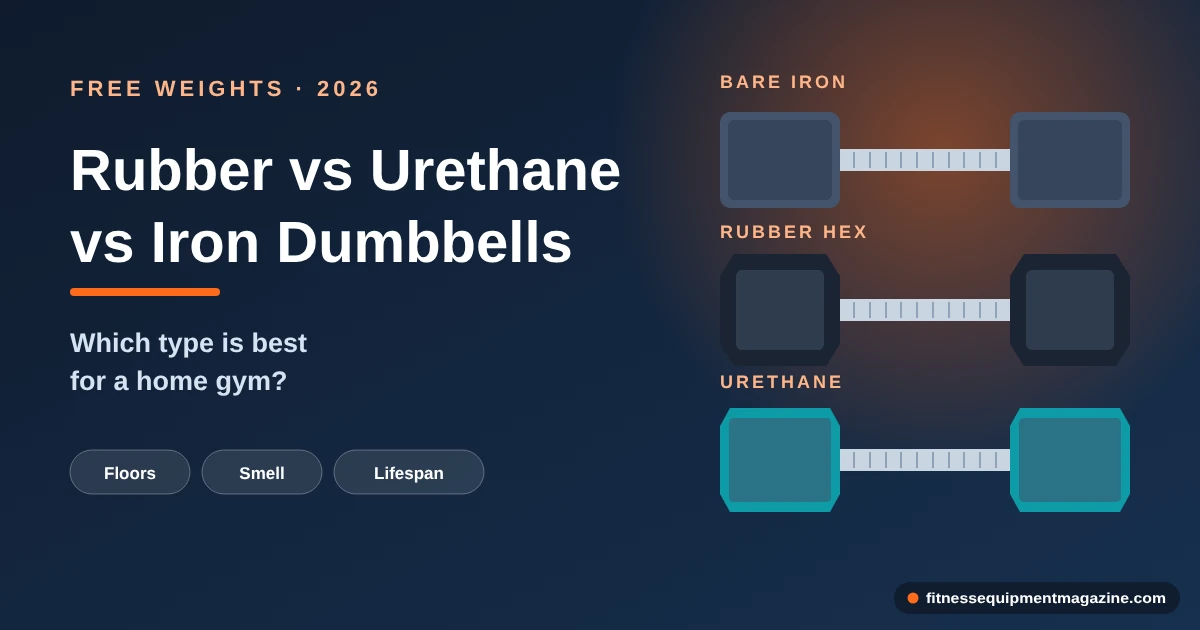
Think of the last time you walked through a commercial gym’s dumbbell area. Rows of black hex heads, a few chrome relics, maybe a polished set near the mirrors. Somebody chose each of those materials on purpose. Now imagine the same decision in your spare room, where the “floor” is a vinyl plank you’d rather not dent and the neighbor below works nights.
That’s the real scenario behind the comparison. A home buyer isn’t running a facility with a replacement budget and a maintenance crew. You’re buying once, hoping to keep the set for a decade, and trying not to regret it on the first drop. This guide to rubber vs urethane vs iron dumbbells walks through how each type is built and how it behaves on floors and in hands. Then it covers what each costs over time and which kind of household each one suits.
For most home gyms weighing rubber vs urethane vs iron dumbbells, rubber hex is the sensible default. It protects floors better than bare metal and costs less than urethane, and the flat sides keep it from rolling. Urethane earns its premium when you want a cleaner, longer-lived finish with little smell. Plain iron is for the garage lifter on a budget who owns a rubber mat and doesn’t mind a little rust-watching.
- Who each fits: rubber hex suits shared rooms and mixed floors. Urethane suits people who want a set that looks new for years and tolerates frequent drops. Iron suits cost-focused lifters on tough flooring.
- The biggest tradeoff: money against maintenance. Iron is cheapest per pound but needs the most care and the most floor protection. Urethane asks the most upfront and the least afterward.
- The common trap: buying a set because the coating sounds premium, then finding the handles too thin or too slick, or the increments too coarse for your progress.
If you haven’t settled what to buy first, our guide to the best home gym equipment for strength training puts dumbbells in context.
How we researched this. This is research-based guidance built from manufacturer specification patterns, federal guidance and ownership problems that buyers commonly report. We haven’t hands-tested the dumbbells described here, so you won’t find lab numbers, decibel readings or “our testers” claims. We name no brands and quote no prices for specific products. Figures below are typical ranges, so verify them against the current spec sheet. Last reviewed: October 2026.
Specs, coatings, warranties and recalls change every few months, and the same marketing word can mean different things at different sellers. Treat the ranges here as typical patterns, not quotes. Before buying, read the product’s spec sheet and return terms, then check the CPSC exercise equipment recall list for the product category.
What Rubber vs Urethane vs Iron Dumbbells Really Decides
Strip the marketing away and a fixed dumbbell is a handle with two lumps of metal on the ends. A cast-iron lump is the oldest recipe, and it’s still the core of most sets. Rubber and urethane are jackets around that core. So the debate over rubber vs urethane vs iron dumbbells is less about strength and more about the skin. How does it take a hit? How does it age? What does it cost to make?
That framing helps because it shrinks the decision. You don’t need to compare metallurgy or study torque. You need to answer a few plain questions about your own space and habits. Where will they land when you drop one? Who else lives there? Will they sit in a damp basement? How fast will you outgrow a given weight range?
Three questions that settle rubber vs urethane vs iron dumbbells
Most buyers can resolve the whole choice with three honest answers. First, how hard is your floor, and is it protected? A set that clangs on bare concrete is a different animal from one used over thick rubber flooring. Second, how patient are you with upkeep? Raw iron rewards people who wipe things down. Third, how many weights will you actually own? Because a full set from five to fifty pounds is dozens of pieces, a small premium per pair becomes a big total.
The rest of this guide builds on those three. For the wider picture before you go deeper, our overview of home gym equipment at every budget shows where dumbbells sit in a full plan.
What it doesn’t decide
One more clarification saves confusion. The choice between rubber vs urethane vs iron dumbbells says nothing about whether the dumbbells are fixed or adjustable. Adjustable systems are a separate category with their own tradeoffs, covered in our guide to adjustable dumbbells. Here we’re talking only about fixed pairs, where each weight is its own object.
It also doesn’t decide how much you can lift. A 40-pound urethane dumbbell and a 40-pound iron one are the same weight, give or take manufacturing tolerance. What changes is the size of the head, the feel of the grip and the way the thing treats its surroundings. People sometimes assume a pricier finish buys a more accurate weight, but that’s a separate promise you’d have to find in the spec sheet.
How Each Dumbbell Type Is Built
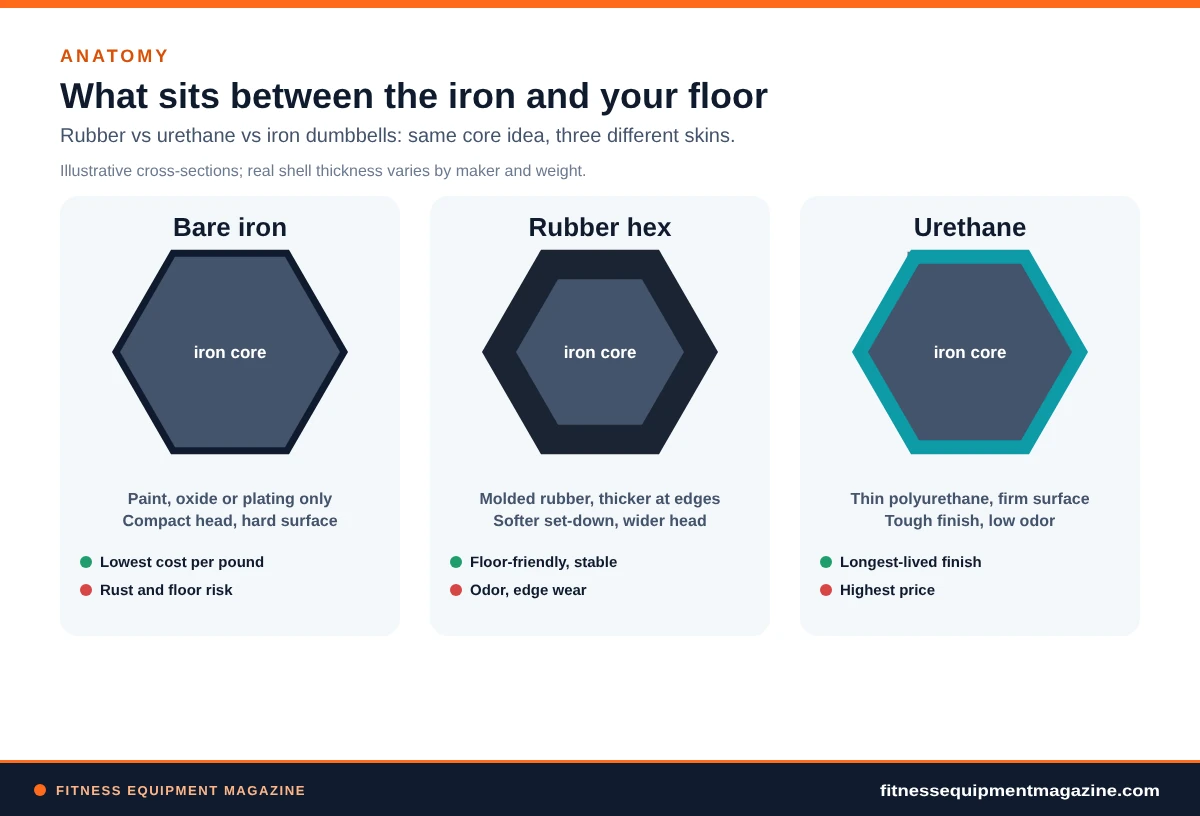
Before you compare behavior, it helps to picture the layers behind rubber vs urethane vs iron dumbbells. All three types start with a metal head, usually cast iron, attached to a steel handle. They differ in what surrounds the head, and sometimes in how the head is attached. The figure below shows a simplified cross-section of each one. It’s an illustration of typical construction, so real products will vary in thickness and detail.
Iron: the original, with nothing between it and the world
A plain iron dumbbell is a cast or machined head, sometimes ground smooth, sometimes left rough. It may wear a coat of paint, a black oxide finish or a thin plating. Because there’s no jacket, the weight is packed into a compact head, which is why iron sets often look smaller than coated sets of the same poundage. You’ll also see “chrome” or “polished” sets, which are iron under a shiny plating.
The honest trade is simple. Iron costs the least per pound in most markets, and it tends to fit more weight on a shorter rack shelf. The price you pay is hardness. A drop onto anything unforgiving sends the energy into the floor or into the dumbbell itself, and exposed metal will eventually rust if moisture finds it.
Rubber hex: the familiar middle
Rubber hex dumbbells wrap an iron head in a molded rubber shell and cut it into a six-sided shape. The rubber can be virgin or recycled, and it can be thin or generous, and that accounts for much of the quality spread between sellers. Handles are usually knurled steel, chrome or black.
The rubber is the point. It softens the sound of a set-down, spares floors a little and protects the iron from casual moisture. The downside is that rubber is a living material in a small way. It can give off an odor when new, scuff, dry out or crack at the edges after years of hard use, especially if the formulation is cheap.
Urethane: the tougher jacket
Urethane, often written polyurethane, is a different polymer. Compared with rubber, it is generally denser, harder-wearing and less prone to odor. A urethane-coated dumbbell wraps a similar iron core in a thinner, firmer shell. It resists chips, scrapes and chemicals better, and it tends to hold its original color and edges after repeated knocks.
What you give up is price, and sometimes a little of the muffled thud that thick rubber provides. Because urethane is harder than rubber, its protection for floors comes more from the shell’s toughness than from softness. In practice you still want a mat under it. That point matters later, when we talk about floors.
“Rubber-coated,” “rubber-encased” and “urethane-coated” are marketing phrases, not standards. Ask the seller what the shell is made of, how thick it is at the edge, and whether the weight is cast into the iron or added elsewhere. A vague answer is information in itself.
Floors, Drops and Noise: Rubber vs Urethane vs Iron Dumbbells in Real Rooms
Everyone drops a dumbbell eventually. Maybe it’s the last rep of a set of shoulder presses. Or a hand sweats through and the grip slides. Whatever the cause, the moment decides how much you value a coating. No coating in the rubber vs urethane vs iron dumbbells lineup can cancel physics. So the question is how much of the hit goes into the floor, how much into the dumbbell and how much into the air as noise.
What actually happens on impact
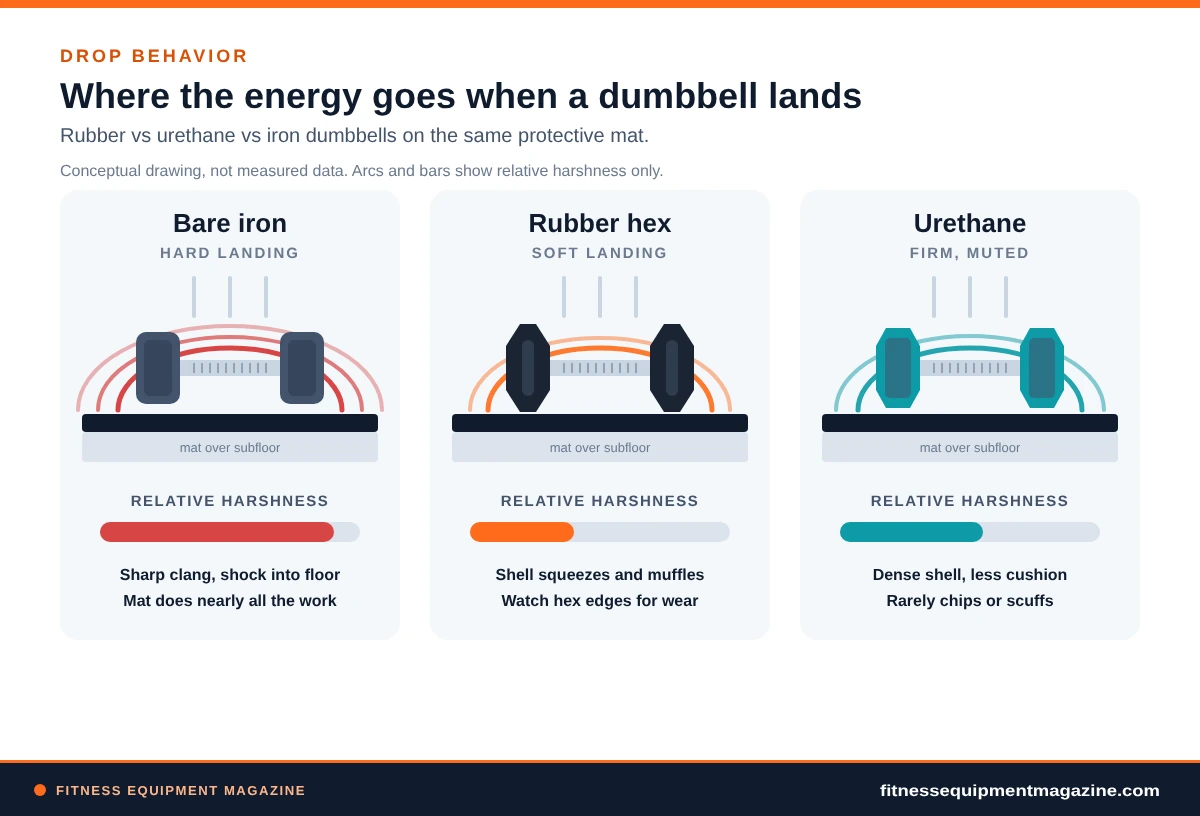
When a dumbbell lands, its kinetic energy has to go somewhere. Bare iron has almost no give, so most of it becomes a sharp transient: a clang you hear, a shock the floor feels and, over time, a dent in whatever is underneath. A rubber shell compresses and spreads the stop over a few milliseconds, which lowers the peak force and the pitch of the sound. Urethane compresses less than rubber, but the shell is tough enough that it rarely chips, and the lower volume of cushion still helps.
None of this makes a dropped dumbbell harmless. A heavy coated dumbbell on a rigid slab can still crack tile or crater a laminate surface. So think of the coating as one layer in a system that also includes your flooring. We cover that system in the home gym flooring guide, and it matters more than the coating choice for most rooms.
Noise, neighbors and the downstairs ceiling
Airborne clang is one thing; structure-borne thud is another. A coated dumbbell lowers the first much more than the second. If someone lives below you, the vibration that travels through the joists is the likelier complaint. That comes from weight plus impact, not from the sound of the shell. Rubber vs urethane vs iron dumbbells will rank in that order for sheer sharpness of sound, with rubber gentlest in most descriptions and iron harshest.
Still, the best noise plan has little to do with the coating. Lower the weights to the floor instead of dropping them. Put a dense mat under your working area. Don’t train directly over a bedroom late at night. Our home gym noise reduction guide goes further into mats, platforms and timing, and the renter-focused home gym guide covers lease and landlord realities.
A dropped dumbbell is a foot and finger hazard, whatever it’s coated with. Keep the area around you clear, wear closed shoes, and don’t let children or pets wander in during a set. Check the CPSC exercise equipment page for recall notices before you buy any strength equipment.
Matching the coating to the floor
Different surfaces forgive different mistakes. On 3/4-inch rubber stall mats over concrete, almost any dumbbell type works, and iron becomes a perfectly reasonable choice. On engineered wood or vinyl plank, the margin shrinks, so a coated type plus extra padding is the safer pairing. On carpet over a plywood subfloor, the main risk is sinking and tripping rather than denting, and heavy iron heads can leave pressure marks if left in one spot.
Upper floors add a different concern: total weight concentrated in one corner. A rack of dumbbells can add up quickly, and the structure under it matters. If you’re planning a full dumbbell wall above living space, read our home gym floor load basics first.
Smell, Wear and Lifespan: How Each Type Ages
The first month and the fifth year tell different stories. In month one, the main difference is odor. By year five, the main difference is the condition of the shell. Looking at both timelines helps you decide whether a lower upfront price in the rubber vs urethane vs iron dumbbells choice is a bargain or a deferral.
The smell question, answered plainly
Many first-time rubber buyers are surprised by a strong smell when they open the box. This is commonly reported with molded rubber, especially lower-grade or recycled compounds, and it tends to fade over weeks, though how long varies. Airing the dumbbells out in a garage or on a balcony usually helps. If you’re sensitive to odors, or the dumbbells will live in a small bedroom, that’s a real factor, not a trivial one.
Urethane is widely described as much lower in odor, which is one of its main selling points. Iron has little smell of its own, though oily preservative on new castings can have a faint scent until you wipe it off.
How each type ages over the years
Iron ages by oxidizing. If the finish chips and the room is humid, surface rust appears, which is cosmetic at first and can be wiped back with attention. Rubber ages by wearing at the corners, drying and sometimes developing a chalky or sticky surface, depending on the compound. Urethane ages slowest in most accounts: it scuffs, but it resists tearing and holds color. None of these is guaranteed, because formulation and use drive the result.
Humidity changes the math
A dry spare room is kind to all three. A basement with a dehumidifier problem is not. Moisture speeds rust on exposed iron, can grow mildew on neglected rubber and urethane surfaces, and tends to corrode handles regardless of the head. If your space runs damp, favor coated heads, wipe handles after sessions and consider a small dehumidifier. Our strength equipment maintenance guide lists simple habits for handles, hardware and rust prevention.
Handles, Hex Heads and Round Heads
The coating isn’t the only thing separating these dumbbells. Head shape and handle design shape how a set behaves in your hands and on the floor. Two dumbbells with identical shells can feel very different if one has a thick, aggressive handle and the other a slim, smooth one.
Why hex heads dominate
The six flat sides of a hex head stop the dumbbell from rolling away. That’s more than convenience. When you set a dumbbell down on its side, a flat face keeps it from drifting into your shin. The same flat sides let you use the pair as a stable base for push-ups and renegade rows. Round heads, including many older iron sets and some urethane designs, roll if the floor isn’t level. They’re fine on a rack, but you’ll want to be deliberate about setting them down.
Hex shape also helps in storage. Hex heads rest solidly in V-cradle rack shelves, and they stack in a tidy line. Across rubber vs urethane vs iron dumbbells, hex is therefore the dominant shape in rubber and urethane sets, while round heads are mostly confined to iron and traditional “studio” sets.
Handle diameter, knurling and balance across rubber vs urethane vs iron dumbbells
Handles are a more personal decision than coatings. Typical fixed dumbbell handles run around an inch or a bit more in diameter, with knurling that ranges from gentle to rough. A thin handle suits smaller hands and lighter weights. Heavier dumbbells often get thicker handles so that the grip doesn’t cut into the palm. Knurling that feels fine for ten reps can feel like sandpaper by rep thirty.
Pay attention to the handle’s length too. A short handle limits how far apart your hands can sit on a goblet squat, and a long one gives room for two-handed work. Neither is better, but a mismatch is annoying. Look for a spec sheet that lists handle diameter and length per weight, and compare to something whose grip you already like.
Head width and exercise clearance
A wide head can bump your thighs on goblet squats, your ribs during rows and each other in a dumbbell bench press when you kick the weights up. Coated sets are often wider than iron sets of the same weight, because the shell adds volume. So when you pick between rubber vs urethane vs iron dumbbells, look at head width at the heavier end. A pair that feels fine at 25 pounds can feel clumsy at 70.
Cost, Footprint and Storage Over the Life of a Set
Price is where most comparisons of rubber vs urethane vs iron dumbbells begin, and it’s rarely where they should end. A fixed set is a long purchase. You’ll pay once per pair, but you’ll live with the choice for years. So the sticker number matters less than what it buys you and what it quietly costs later.
Upfront cost: the usual ordering
In the US market in late 2026, the typical ordering by cost per pound starts with iron at the low end. Rubber hex sits in the middle and urethane at the top. The gaps move around with metal prices, import costs and seller margins, so we won’t quote numbers. What stays fairly steady is the shape of the ladder, and the fact that thick, generous rubber costs more than thin, cheap rubber of the same weight.
Relative position only, not dollar amounts. Real prices vary by seller, weight range and shell quality.
The costs that arrive later
A cheap set isn’t always the cheapest set. Iron may call for a better mat, more frequent wipe-downs and a touch-up kit for flaking paint. Rubber may need replacing sooner if the shell dries out and tears, which is more likely with cheaper compounds. Urethane usually asks for little beyond a damp cloth. So the honest comparison of rubber vs urethane vs iron dumbbells is total cost of ownership: purchase price, floor protection and any early replacement.
That said, don’t overthink the long horizon if your budget is tight. A starter set you can afford and use beats a premium set you postpone. You can always upgrade the weights you outgrow, and heavier pairs last longest because you’ll use them in the middle of a lifting career, not at the beginning.
Footprint and rack space
Among rubber vs urethane vs iron dumbbells, the coated ones are bulkier than iron at the same weight, because the shell has volume. In a rack, that means the longest pair sets the shelf spacing. If you plan a wall rack or a two-tier rack, verify the maximum dumbbell length listed on the spec sheet against the shelf width. A rack designed for compact iron heads may not accept thicker rubber ones at the high end of the range.
Our guide to home gym weight storage covers plate trees, dumbbell racks and wall systems in more detail. For now, remember two things: racks have weight ratings, and dumbbells are denser than people expect. A full run of pairs is heavy, so anchor wall systems properly and keep the heaviest pairs on the lowest shelf.
Weight Increments and Accuracy in Rubber vs Urethane vs Iron Dumbbells
Material gets the headlines, but the weight range quietly shapes your training more. A set that jumps from 30 to 40 pounds in one step can stall an overhead press that only needs two and a half more pounds per hand. That’s why increments belong in any conversation about rubber vs urethane vs iron dumbbells, even though they aren’t a function of the coating.
How jump sizes usually work
Most fixed sets climb in five-pound steps through the light and middle range, then widen to ten-pound steps at the heavy end. Some sellers offer two-and-a-half-pound steps for lighter weights, which cost more and take more rack space. Iron sets often make finer steps affordable because the heads are small and cheap to cast. Coated sets tend to cost more per additional pair, so a fine ladder gets expensive quickly.
If your progress is slow, as it is for most people on overhead and lateral movements, small jumps matter. If you mostly do rows, goblet squats and carries, big jumps are rarely a problem. So match the ladder to the exercises you plan to do, not to a catalog total.
What accuracy actually means
The number stamped on the head is a manufacturing target, not a guarantee. Reputable sellers state a tolerance, and honest ones say it plainly. A small variance between a pair is normal and unlikely to affect training. A large one, where one dumbbell feels clearly heavier in your hand, is worth a scale check and possibly a return. A simple check works here: weigh both dumbbells on the same scale and compare, rather than trusting the label or your wrist.
Choosing jumps by exercise
Heavy compound lifts, such as rows and presses, tolerate bigger jumps because you can adjust reps to compensate. Isolation lifts, like lateral raises, don’t. You can’t easily add half a rep to a raise, so a five-pound jump can feel like a leap. Many lifters solve this by owning a fine ladder at the bottom and a coarse one at the top. It’s an easy way to spend money where it helps most, and it works with any of the three types.
Scoring Rubber vs Urethane vs Iron Dumbbells on Six Things
A scorecard can summarize without pretending to be a lab result. The shape below is a judgment based on how these materials are commonly described in specification patterns and owner reports, not on measurement. Use it for orientation, then let your own priorities decide which corner matters most.
Read the shapes loosely. Iron stretches toward cost and compactness, which is exactly why it keeps its market. Rubber balances floor care and stability at moderate cost, with odor as its weak point. Urethane fills out most of the chart except price. None of the three is a clear winner, and you may find one corner matters so much in your house that it overrides the rest.
Eight Shopper Profiles: Which Type Fits Whom
The following profiles are hypothetical, built from common situations buyers describe. They aren’t case studies of real people. Use them as a mirror for rubber vs urethane vs iron dumbbells: find the one that sounds like you, then adjust for your own floor, budget and household.
The garage lifter on a budget
A detached or attached garage with a concrete slab, rubber stall mats and no neighbors to worry about. The priority is the most weight for the least money, and the lifter is comfortable with a quick wipe-down after sessions. Here, iron makes sense. Keep the mats thick, store pairs on a rack off the slab and treat rust as a maintenance item rather than a disaster.
The second-floor apartment dweller
Floors are wood or laminate over joists, and a neighbor sleeps below. Rubber hex is the natural pick: it’s gentler at set-down and affordable. Add a high-density mat, lower the weights deliberately and avoid training right before bedtime. If odor sensitivity is a concern in a small room, step up to urethane or air the rubber out before bringing it indoors.
The household with kids and pets
Curious hands change the equation. Here the choice mostly comes down to edges and rolling. Coated hex dumbbells are less likely to pinch or scrape small fingers than bare iron with sharp edges, and the flat faces don’t roll under toddlers. Still, any dumbbell is a crush hazard. A closed cabinet or a locked room is the real solution, and our family home gym safety guide covers storage and supervision in detail.
The renter on vinyl plank
Rented floors are the least forgiving, because damage costs you a deposit. A coated hex pair plus a proper platform or thick mat is the sensible path. Urethane’s tougher shell won’t leave residue or chips on the mat, which is a small bonus. Keep receipts and photos of the floor on move-in, and ask the landlord what they’ll accept before you commit.
The damp basement trainer
Moisture is the main enemy here. Urethane’s resistance to wear and low odor makes it the best match, and a dehumidifier is a smart companion purchase. If you go with rubber, check the shell regularly for sticky patches. If you buy iron, plan to wipe it dry and keep an eye on the handles, since knurling hides rust well.
The odor-sensitive bedroom lifter
A spare bedroom doubling as a gym, with a person who notices smells. For this buyer, rubber’s initial odor can be a genuine irritant, and the usual fix, airing it out, isn’t always practical. Urethane is the safer choice. Iron is also fine if its preservative oil is wiped off, though bare metal looks less at home in a bedroom.
The progressive beginner
Someone starting with light weights who expects to move up quickly. Buying a full set now would be a mistake, because the lightest pairs will go unused in a year. Choose a durable type for the pairs you’ll keep longest, and consider a short stack of light adjustable weights for the early months. Our overview of building a home gym on a budget shows how to sequence purchases without overbuying.
The showpiece room builder
When appearance counts, urethane is the type that keeps looking new. A matched, black-and-brushed set on a clean rack makes a home gym feel deliberate. This buyer should confirm handle comfort and rack compatibility before committing, since a beautiful set that hurts the palm gets used less than a humble one that fits.
A Decision Path for Rubber vs Urethane vs Iron Dumbbells
Profiles are useful, but sometimes you just want a path through the questions. The flow below turns the earlier sections into a quick sequence. It won’t replace judgment, yet it’ll catch the big mismatches, such as bare iron over a rented laminate floor or a thin rubber shell in a damp room.
Notice what the flow does not do: it never asks whether you are a beginner or an expert. Lifting level hardly changes which coating suits your floor. It changes how many pairs you buy and how heavy they get, which is a different decision we’ll cover in the section on building a set.
What to Check Before You Pay for Any Dumbbell Type
Once you’ve picked a lane, the shopping begins. Many disappointments with rubber vs urethane vs iron dumbbells come from details nobody checked, not from the material itself. The list below is about turning a product page into facts you can compare.
Spec-sheet checks for rubber vs urethane vs iron dumbbells
- Increments. Five-pound jumps are common for pairs under about fifty pounds, and larger jumps above that. Smaller jumps cost more but ease progress.
- Handle diameter and length. Listed per weight where honest sellers do it. If it’s missing, ask.
- Head dimensions at the top weight. Check width, height and total length against your rack and your body.
- Shell description. Virgin rubber, recycled rubber or urethane, and roughly how thick at the edge.
- Weight tolerance. Some sellers state an allowable variance. A pair that differs a little in weight is normal, but a large mismatch is not.
- Warranty text. Read what covers loose heads, cracked shells and handle rotation, and for how long.
Red flags that deserve a pause
- No stated weight tolerance and no way to confirm weights with a scale on arrival.
- A “rubber” label with no hint of the compound, plus heavy emphasis on price per pound.
- Handles that look glossy or very smooth in photos, which can mean slick grip with sweaty hands.
- Reviews that mention loose heads, rattles or a handle that spins in the head.
- Round heads sold for use as floor-support handles, where rolling can cause a fall.
What to do when the box arrives
- Weigh a few pairs.Use a bathroom or luggage scale to check at least the heaviest and lightest pair. Small differences are normal; large ones are a return reason.
- Air out rubber.If the set smells, leave it in a ventilated space for a few days before moving it into a living area.
- Inspect handles.Look for weld marks, loose knurling or a head that wobbles on the handle.
- Test the grip.Do a few easy reps with each pair. Rough or slick spots show up quickly.
- Set up the rack.Load heavy pairs low, and make sure the rack is level and anchored as the manual advises.
Questions worth asking a seller
You don’t need an interrogation, just a few pointed questions. Ask how the weights are verified, whether the shell material is the same across the range, and what the return policy says about damaged shells on arrival. A seller who answers clearly is usually a seller who stands behind the product. If you’re unsure which questions matter, our guide on what to buy first for strength training frames the order of purchases.
Heavy, bulky items often carry restocking charges or shipping fees on returns. Before ordering a full set of rubber vs urethane vs iron dumbbells, read the policy for returns on heavy goods. A “free returns” banner can apply only to small items.
Mixing Types and Building a Set Over Time
Nothing requires a single material across the whole rack. In fact, a mixed set is often the smartest answer when you compare rubber vs urethane vs iron dumbbells on cost per use. The pairs you’ll use most deserve more of your money, and the rarely used ones can be modest.
Where to spend and where to save
Middle weights get the most abuse and the most use. For many lifters, these are the pairs that appear in presses, rows and carries every week. It makes sense to put your best material there. Light pairs, used for warm-ups and accessory work, can be economical iron or basic rubber. The very heaviest pairs are bought last, if at all, and are often the ones where head size and handle thickness matter most.
Buying rubber vs urethane vs iron dumbbells in stages
Rather than buy a complete run, many people start with three or four pairs that cover their current working weights, then add as they progress. This approach spreads cost and protects against the common error of buying weights you outgrow or never reach. The federal activity guidelines recommend muscle-strengthening activity on at least two days per week for adults. That’s a modest target for most people starting out, and you can read the details in the HHS Physical Activity Guidelines. A short, well-chosen set supports that routine just fine.
Gear that makes any dumbbell set work better
Whichever of rubber vs urethane vs iron dumbbells you pick, the dumbbells are only part of the strength setup. A bench changes what you can do with them, and a stable one matters more than a fancy coating. Our guides to flat bench vs adjustable bench and to adjustable weight benches help you pick one. Flooring and storage matter too, so budget for them early instead of treating them as afterthoughts.
When fixed pairs and adjustables overlap
Adjustable dumbbells shine when space is tight and you want a broad range from one footprint. Fixed pairs shine when you want speed, durability and no mechanism to fail. Plenty of home gyms use both: adjustables for the light-to-middle range and a few fixed pairs where the weights are heavy and used often. The choice between rubber vs urethane vs iron dumbbells then applies only to the fixed side, which keeps the total cost in check.
Care for Each Type: Keeping Rubber vs Urethane vs Iron Dumbbells in Shape
Good care costs minutes, not money, and it’s the cheapest way to stretch whichever of rubber vs urethane vs iron dumbbells you choose. The routines differ a little by material, but a few habits apply to all three: keep them dry, don’t drop them from height, and look them over now and then.
Looking after iron
Wipe handles and heads with a dry cloth after sessions, especially in humid weather. If surface rust appears, a fine abrasive pad and a light coat of machine oil or wax will usually settle it. Touch up chipped paint before moisture finds the bare metal. Store iron off the floor on a rack so air can move around it, and avoid leaving a damp towel draped over a pair.
Looking after rubber
Rubber likes a mild soap solution and a soft cloth, followed by a dry wipe. Avoid solvents and harsh degreasers, which can dry or pit the shell. Keep it out of direct sun for long periods, since heat and ultraviolet light can speed up hardening. If a corner chips, don’t pick at it; the exposed iron beneath is what you want to protect from moisture.
Looking after urethane
Urethane is the easy one. A damp cloth handles most dirt, and the shell shrugs off chalk and sweat better than rubber. Still, handles are metal and still respond to moisture, so give them the same wipe-down as any other set. Avoid abrasive pads on the shell itself, because they can dull the finish.
Handles, hardware and the rack
Across all three, the handle is the part that sees your sweat. Wipe it clean, check for rotation or looseness periodically, and stop using any pair whose head moves independently of the handle. Racks need a glance too: bolts loosen with the vibration of loading and unloading. For a fuller routine, our maintenance guide for strength equipment lists what to check and how often.
Once a month, lift each pair and look at the head-to-handle joint, the shell edges and the handle knurling. It takes a few minutes across a typical set and catches loose heads before they turn into a rattle, a bruise or a dropped weight.
Myths Worth Dropping Before You Buy
The conversation around rubber vs urethane vs iron dumbbells picks up some folklore along the way. A few of these ideas are partly true, which is why they stick, but they mislead when taken as rules.
“Urethane is indestructible”
Urethane is tougher than most rubber, not immune to damage. A heavy dumbbell dropped from overhead onto a hard corner can chip or split any shell. Marketing that implies you can ignore floors is optimistic, and your mat still does most of the protecting.
“Iron always rusts”
Iron rusts when moisture meets bare metal. In a dry, conditioned room with a decent finish, many sets look fine for years. In a damp basement without maintenance, they won’t. The environment decides the outcome more than the material does.
“Rubber always smells”
Some rubber smells strongly, some barely at all. Compound quality, curing and storage drive the difference, and the odor typically fades. It’s a legitimate concern to check before you buy, not a certainty.
“Coated dumbbells are less accurate”
Among rubber vs urethane vs iron dumbbells, there’s no inherent reason a coated dumbbell must be off by more than an iron one. Weight accuracy depends on manufacturing control. A good rubber pair can be closer to its label than a careless iron pair, which is why a quick check with a scale is worth doing on delivery.
“Pay more and you’ll never replace it”
Price correlates with quality, though not perfectly. A premium label can sit on mediocre handles, and a modest brand can ship an excellent shell. Read the specifics, look for repeated complaint patterns in reviews and compare warranties. The best rubber vs urethane vs iron dumbbells purchase isn’t always the dearest.
“Heavier dumbbells are always better” is the myth behind more regret than any coating choice. The right weights are the ones you can lift with control. Progress comes from steady, repeatable training, and the equipment’s job is to make that easy to do.
Questions Buyers Ask About Rubber vs Urethane vs Iron Dumbbells
Which is better for a home gym: rubber vs urethane vs iron dumbbells?
For most homes, rubber hex is the best all-round answer, because it balances floor friendliness, stability and cost. Urethane is better if you want less odor and a finish that ages slowly, and you can afford the premium. Iron is better when cost matters most and your floor is already well protected. The right pick depends mostly on floor, household and budget.
Are urethane dumbbells worth the extra money in the rubber vs urethane vs iron dumbbells debate?
They can be, if odor, long-term appearance and heavy daily use matter to you. Urethane generally resists chips and wear better than rubber, and it smells less. If you rarely drop weights and your room is well ventilated, the extra spend may buy little you’ll notice. Think about how long you’ll keep the set and how it will be used.
Will iron dumbbells damage my floor?
Bare iron can scratch, dent or crack a floor that isn’t protected, especially from a drop. On thick rubber flooring or stall mats over concrete, damage is much less likely. On wood, vinyl or tile, use extra padding or choose coated dumbbells. In any rubber vs urethane vs iron dumbbells decision, the floor system matters as much as the coating.
Do rubber hex dumbbells really smell that bad?
Some do, particularly when new and made with lower-grade or recycled compounds. The smell usually fades over days to weeks, and airing the set in a ventilated space helps. If you’re sensitive or the room is small, ask the seller about the rubber type and consider urethane. Reading reviews for odor comments is a quick way to spot offenders.
How long do rubber vs urethane vs iron dumbbells last?
With reasonable care, all three can last many years, because the iron core is durable. The shell and finish usually give out first: rust on iron, edge wear on rubber, scuffing on urethane. Humidity, drops and cleaning habits change the timeline. No honest source can promise a specific number of years, so look at warranty terms as a rough signal.
Should I buy a full set of rubber vs urethane vs iron dumbbells or build one pair at a time?
For most beginners, building gradually is wiser. A full run from light to heavy costs a lot, and many of the pairs may sit unused. Start with the weights you can use now and the next step up, then add as you progress. If you’re sure you’ll train for years and have storage, a full set can be convenient.
Are hex or round heads better in rubber vs urethane vs iron dumbbells for floor exercises?
Hex heads are better for exercises where the dumbbell touches the floor, such as push-ups or renegade rows, because the flat faces stop rolling. Round heads are fine for standing and bench work but can drift on uneven surfaces. When comparing rubber vs urethane vs iron dumbbells, most coated sets are hex, while round heads are mainly seen on traditional iron.
Can I mix rubber vs urethane vs iron dumbbells in one gym?
Yes. A mixed set is common, and it’s a sensible way to spend more where you lift most. The main practical issue is rack fit, since different shell thicknesses have different lengths. Keep similar-sized pairs together, and make sure shelf spacing handles the widest pair in your collection before you assemble a rack.
Bottom Line: Choosing Between Rubber vs Urethane vs Iron Dumbbells
The rubber vs urethane vs iron dumbbells decision gets simpler when you stop treating it as a ranking and start treating it as a match. Rubber hex suits most homes. Urethane suits buyers who want little odor and a long-lived finish and who accept the cost. Iron suits the budget-minded lifter on a protected floor. Each is a good tool when it’s paired with the right room.
Here are your next steps. Measure your floor and rack space, decide how much odor and maintenance you’ll tolerate, then shortlist two types and compare spec sheets for handle size, increments and warranty. Check the CPSC page for recalls, and read the return terms before you pay. Still working out your overall plan? Start with our guide to strength training equipment to buy first, and use the rest of this page as your checklist for rubber vs urethane vs iron dumbbells.
Sources and Further Reading
- HHS Physical Activity Guidelines — federal guidance on muscle-strengthening and aerobic activity for adults
- CPSC exercise equipment recalls — check product safety history before you buy
Some links on this site may be affiliate links. If you buy through them we may earn a commission at no extra cost to you. Recommendations are based on the criteria in the article, not payout. This article is general information about equipment and isn’t medical advice; talk to a qualified professional about your own health and training. Last reviewed: October 2026.