Shopping for the best incline treadmill is a hardware question first and a training question second. Anyone can tilt a belt. What separates a machine you’ll still enjoy in year four from one that starts grinding, drifting or throwing error codes is the stuff you can’t see in a product photo: the lift motor, the frame, the deck underneath and the warranty behind it.
The short answer
For most home buyers, the best incline treadmill is a motorized machine with a 12 to 15 percent maximum grade, a continuous-duty drive motor with real headroom, a stiff frame with a long base, and a lift warranty that matches the frame warranty. Past 15 percent you’re paying for a specialty hiking experience, and it only makes sense if you’ll actually use it.
- Who it fits: walkers, hikers in training, runners who want hill work indoors, and anyone who’s tired of flat-belt boredom.
- The biggest tradeoff: every extra point of grade adds cost, ceiling-height demands and one more moving part that can wear out.
- The most common mistake: buying a big number on the box without checking the lift mechanism’s warranty and the frame beneath it.
How we researched this. We haven’t hands-tested these machines, and we won’t pretend otherwise. This guide is research-based: it draws on manufacturer specification patterns, federal guidance and the ownership problems that buyers commonly report. Figures here are typical ranges, not promises, and they change. Verify every number on the manufacturer’s spec sheet before you buy. Last reviewed: October 2026.
Why the best incline treadmill is a different purchase
A flat treadmill asks one thing of its frame: hold a person level while a belt slides underneath. An incline treadmill adds a second job. It has to lift one end of the machine and hold it there for an hour. It also has to keep everything square while someone thumps along on top. That’s a real mechanical upgrade, not a menu option, and it’s why the best incline treadmill gets judged on parts a flat model never needs.
What you’re really paying for in the best incline treadmill
When a brand advertises a steeper maximum grade, you’re paying for several parts at once. There’s a lift motor and a screw or actuator that move the frame. There’s a stiffer front structure to take the load. And there’s controller logic that knows where the deck is, so it doesn’t jam against its end stops. Each of those is a place where a cheap machine can cut corners quietly.
Think of it like a pickup truck’s bed lift: the number on the sticker is only believable if the hinge, the cylinder and the frame all agree with it. The best incline treadmill is the one where all three do.
Where this guide fits in the cluster
We’ve split the incline topic into two articles on purpose. This one covers hardware: what to look for in the best incline treadmill, what to question and what to ask a retailer. If you want the training side, meaning how steep to start and how to progress, read our treadmill incline guide instead. For the broader decision about the whole machine, our treadmill buying guide covers motor ratings, belt sizes and warranties from top to bottom.
How to use this page
Read the sections on the lift, the motor and the frame before you look at any specific contender for the best incline treadmill. Then skip to the archetypes and the checklist near the end. That order keeps a flashy console demo from deciding the purchase for you.
What incline can’t fix
A steep grade doesn’t make a weak treadmill strong. If the deck is thin, the motor is undersized or the frame flexes, extra grade just exposes the problem faster. So treat incline range as a bonus on top of a solid base machine. The best incline treadmill starts as a good treadmill, and never uses its range to excuse a mediocre one. Our guide to the best treadmills for home use walks through that base-machine test first.
How the incline lift works: motor, rails, and range
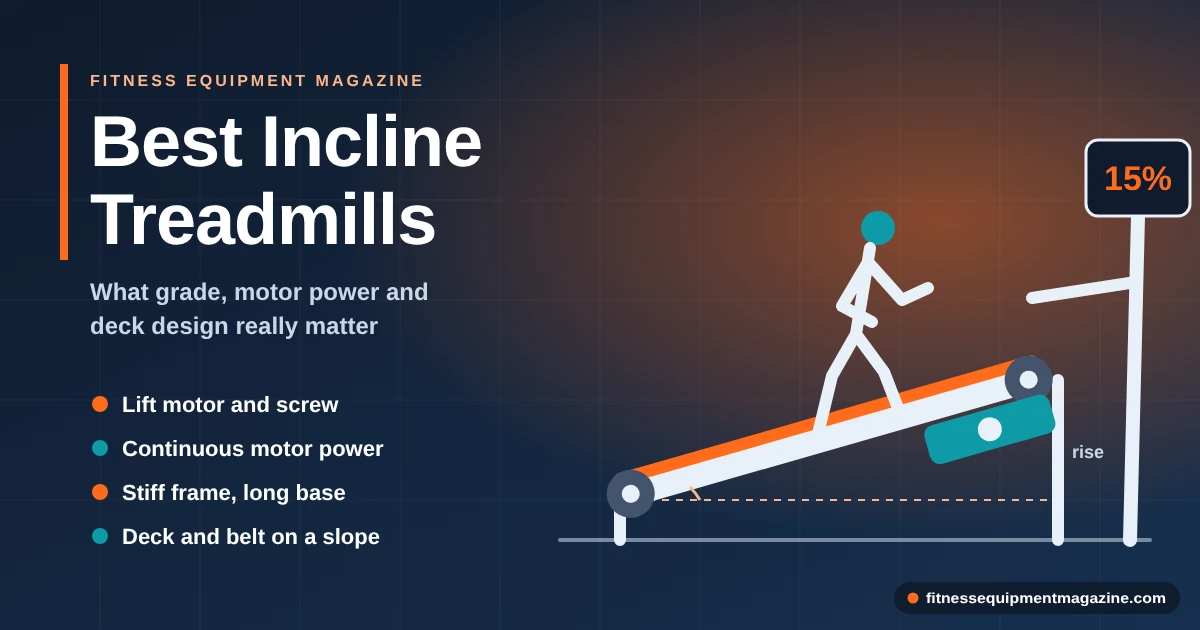
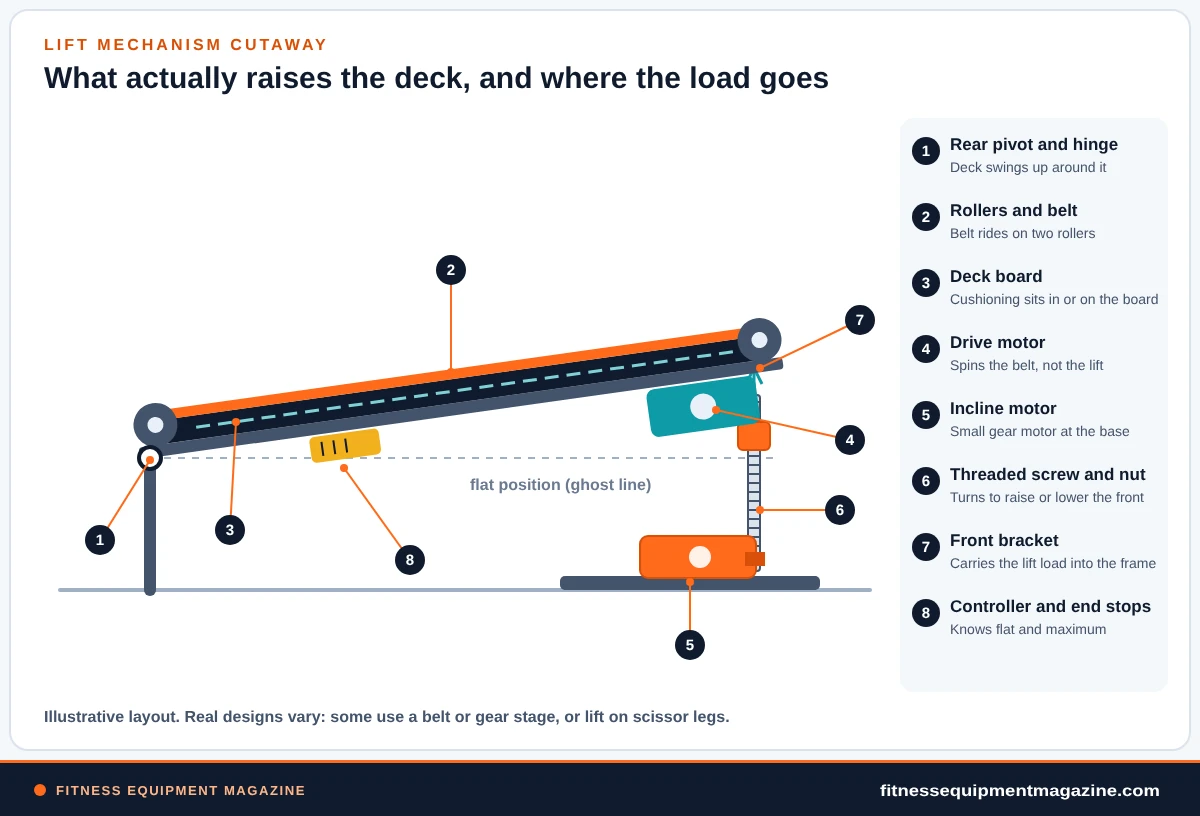
Most motorized incline treadmills raise the front of the frame while the rear stays on its hinge point or rear rollers. The part doing the lifting is a small, separate motor. It turns a threaded rod, or drives a linear actuator, and that pushes the front of the deck upward. The big drive motor that spins the belt has nothing to do with it. They are two different motors with two different jobs, and a treadmill can have a strong one and a weak other. The best incline treadmill pairs two strong ones.
The lift motor and the screw
The common design pairs a small gear motor with a threaded shaft. As the shaft turns, a nut travels along it and tilts the frame. This arrangement holds its position without power, because the thread resists being pushed back. That’s the reason your deck stays put when you step off in the middle of a workout.
Thread, nut and mounting points all wear, though. A screw that’s dry, dirty or running slightly off-axis can groan, jerk or stall. Some machines use a belt or gear stage between the motor and the shaft, and others mount the motor directly. The manual usually shows which, and it often lists whether the owner is supposed to lubricate anything.
Rails, pivot points, and the rear hinge
Where the lifted section pivots matters just as much as how it lifts. A pivot near the rear gives the longest lever arm and the smoothest slope, but it asks more from the lift mechanism at steep grades. Some designs raise the whole deck on a front scissor or on telescoping legs instead. Those can look stable at rest and still wobble under a running load if the joints are loose.
- Look for pivots with bushings or bearings rather than a bare bolt through a bare hole.
- Check that the front legs or rails feel solid when you push sideways at maximum grade.
- Ask whether the incline frame is steel and whether the welds are visible and clean.
Calibration and the range limits
Every motorized lift has a floor and a ceiling: end stops that tell the controller where flat and maximum sit. Many machines recalibrate at startup, running the deck all the way down and back up to a sensor. When that sensor drifts or the lift stalls, you’ll see an error code and an incline that won’t move. That’s one of the most commonly reported service issues on these machines.
So the range number on the box tells you what the machine can do on a good day. The best incline treadmill is the one that keeps doing it after a few hundred hours, and the number alone can’t tell you that.
Retailer question
Ask whether the incline motor, the screw assembly and the controller board share the frame’s warranty term. Or are they on a shorter parts-only term? The answer is often a different number than the headline warranty.
Maximum grade: what the best incline treadmill needs and what extra costs
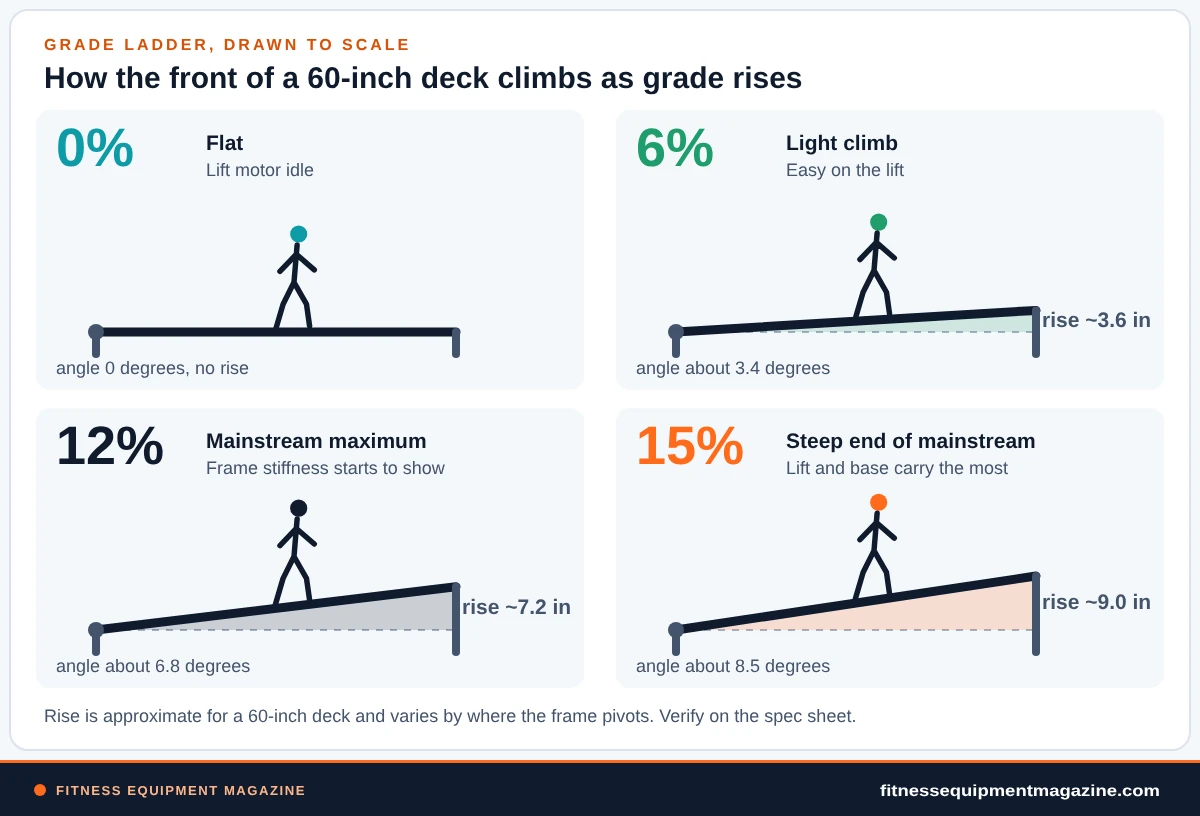
Grade is simply rise divided by run. At 10 percent, every 100 units forward the surface climbs 10. On a typical belt that’s about 5 to 6 inches of rise at the front of the deck, depending on its length. Our guide to treadmill incline for training covers how that feels. Here we’re looking at what it does to the machine, because the best incline treadmill is defined by what it can carry at that grade.
The common range tiers
In the US market, motorized incline commonly falls into rough bands. These are typical, not universal, so confirm each model’s spec sheet.
Where extra range stops paying off
Here’s an honest take about shopping for the best incline treadmill: most people never use the top third of their machine’s incline range. They use it twice, feel their heart rate spike, and settle back at a comfortable grade for the rest of their ownership. If that sounds like you, paying a premium for 20 percent instead of 12 is spending money on a party trick.
That said, steep grade is a legitimate tool for a specific buyer. Someone training for a mountain trip can use 15 to 20 percent at walking speed. That builds a workload flat running can’t match at the same pace. If that’s you, the best incline treadmill is a steeper one. The extra range earns its cost, but only if the machine below it is built to take it.
What the extra range actually costs
The cost isn’t only the sticker. A taller range means a longer travel on the lift, a stiffer front structure and more load on every part of the mechanism. It also means more ceiling height, since the front of the deck rises farther. And it means more things to calibrate, lubricate and, eventually, replace.
Watch the speed trade
On very steep machines, the maximum belt speed is often lower, sometimes well under what a runner wants. That’s usually a deliberate design choice for stability, but it’s a catch if you thought one machine would cover both sprinting and hiking.
The decline option
Some machines also tilt below flat, commonly down to minus 3 or minus 6 percent, and a few go further. Decline is a niche feature with a real purpose. It adds downhill practice for runners and hikers, and it loads muscles differently from level or uphill work. It does not suit everyone. It’s an extra lift range to build, calibrate and warranty, and it changes how the machine’s frame sits at the low end.
If you’re a casual walker, skip it. If you’re a trail runner who wants downhill practice, treat it as the feature that earns the price gap. In either case, check the range on the spec sheet, because “decline” can mean a mere couple of percent. For runners weighing the full package, see our breakdown of the best treadmill for running.
Drive motor power in the best incline treadmill: duty cycle on a slope
The belt motor is the part everyone shops for, so we won’t repeat the full lesson here. Our treadmill motor guide explains continuous versus peak horsepower in detail. What matters when you’re picking the best incline treadmill is how an incline workout changes the demand on that motor. Then comes what to look for because of it.
Why incline workouts are a duty-cycle test
A flat jog tends to vary: you speed up, slow down, hop off for water. An incline session is different. People settle at a steep grade, hold a steady pace and stay there for twenty or thirty minutes. That steady, long, unbroken effort is exactly the pattern that heats up a motor and its controller board.
We can’t give you a measured number, and no one should invent one for a machine they haven’t tested. What the research on ownership patterns does show is that sustained climbs are a common thread in motor and controller complaints. So when you shop for the best incline treadmill, favor headroom. If the product page lists only a vague horsepower figure, treat it as peak and look for the continuous rating in the manual.
A practical headroom rule
Typical guidance for the best incline treadmill in each weight class runs roughly like this. Light walkers often do fine with about 2.0 to 2.5 continuous horsepower. Joggers and heavier users commonly want 3.0 or more. If you plan to hold a steep grade for long sessions, step up one tier from what your body weight and speed alone would suggest. That’s a judgment call, not a rule from a standards body, so ask the retailer for the continuous figure in writing.
Weight rating matters more here
The stated user weight limit assumes the machine is operating as designed, and a steep grade eats into that margin. If you’re near the limit, step up a tier or read our guide to the best heavy-duty treadmill before you commit.
Frame stiffness, base length, and stability
A steep grade changes how the machine carries your weight. At 15 percent the front of the frame sits several inches higher than at flat. The front legs, hinges and welds all carry a bigger share of the load. A stiff frame stays square under that, and the best incline treadmill is built around it. A flexible one twists, creaks and lets the belt walk to one side.
How to spot frame flex
You can’t test a machine at home before buying, but you can learn from the spec sheet and from owners. Look for the frame material (steel is common, and thicker tubing helps), the weld style, the number of cross-braces and the listed unit weight. Heavier isn’t always better, but a very light unit that claims a steep grade should raise a question.
Reports of a wobble at maximum incline, a front corner that bounces or a console that shakes are worth reading closely in owner feedback. One complaint is noise. Five describing the same wobble at the same grade is a pattern.
Base length and the tipping margin
The distance between the rear feet and the front legs sets your room for error. You’ll need it if you stumble, lunge for the rails or shift your weight. Longer is more forgiving. Many incline-focused machines also add wider feet or rear stabilizers. That is a good sign, even if it costs a few extra inches of floor space.
The at-home rock test
Once the machine arrives, do a simple check before you commit to a long first session. Raise the incline to maximum with nobody on it, then push gently on the frame from the sides and the rear. Nothing should shift, creak loudly or rock between the feet. If it does, level the feet and tighten the hardware. If that doesn’t cure it, you’ve got a return or warranty case, and early is the best time to start it.
Deck cushioning and belt behavior on a slope
Cushioning is a comfort feature that gets more complicated on an incline. We’ve written separately about how treadmill cushioning works, so this section sticks to what changes when the deck is tilted.
Less impact, more push
Walking uphill tends to shift the load from your heel to your forefoot. Your stride shortens, your cadence changes and you spend more time pushing than landing. The cushioning that feels great on a flat run is working in a different place now. Most of the action is under the front half, where your foot lands and pushes off.
So the best incline treadmill for a long-haul steep walker needs a deck that’s supportive through the front half. A soft landing zone under the heel isn’t enough. Ask whether the cushioning is zoned or uniform and read owner comments about bounce at the front.
Belt tracking and tension on a tilt
Gravity pulls a little differently on a belt that’s tilted. Belts on elevated decks can drift sideways more readily if the rollers are slightly out of alignment, and a belt that’s too loose may slip under heavy push-off. The manual should describe how to center and tension the belt, and a well-built machine makes that job simple with accessible adjustment bolts.
A deck that’s a little wider and longer helps here too. When you’re pushing against a slope, you’ll feel a belt that’s too short more quickly, because your stride changes. Our explainer on treadmill belt size covers the lengths and widths that suit different strides.
Deck wear and lubrication
Steep, sustained climbs concentrate wear on a narrower strip of belt and deck. Some decks are pre-waxed and need no maintenance, while others call for periodic lubricant. Whichever type you buy, follow the manual’s schedule. Dry friction at the forefoot zone is a heat and wear problem, and it shows up months later as a hot motor or a hesitant belt.
Incline speed, programs, and the console
A spec sheet lists maximum grade, but almost never says how quickly the machine gets there. That’s a pity, because the speed of the lift decides whether an interval program feels sharp or sloppy. Owners mention it in reviews far more often than brands mention it in brochures. It quietly separates one contender for the best incline treadmill from the next.
How fast the lift moves
Lift speeds vary a lot. On many machines it takes somewhere between half a minute and a couple of minutes to travel from flat to maximum. The return trip is often similar. A slow lift is not a defect. It’s usually the price of a quiet gear motor and a strong screw. But if you plan to do hill intervals, it matters.
Programs and controls that earn their place
You don’t need a hundred programs. You need a few that behave predictably. Look for a manual mode with quick incline buttons or preset keys, because tapping a button beats holding one for twenty seconds. After that, a hill or interval program that you can edit is more useful than a long list of canned routines.
- Quick-select incline keys, not just up and down arrows.
- A readout of current grade that updates as the lift moves.
- Programs that let you set your own grade and duration, so the machine doesn’t lock you into a fixed profile.
- A clear way to reset the incline to flat when you finish, and a way to disable auto-reset if you prefer.
Console subscriptions and locked features
Some consoles gate their best workout features behind a monthly plan. Before you buy, find out which functions work with no subscription: manual incline control, speed, basic programs. A machine that turns into a very expensive stand without its app is a bad deal for people who just want to walk uphill. It will never be the best incline treadmill for them.
Manual vs. motorized incline: which makes the best incline treadmill?
This is the first fork in the road for any buyer, and the answer depends on how you plan to use the grade. Don’t confuse this with our separate piece on manual vs. motorized treadmills, which is about how the belt itself is powered. Here we’re talking only about the tilt.
The tradeoffs in plain terms
Manual incline
- Fewer parts that can fail or need service.
- Usually lower price.
- No lift noise or calibration errors.
Manual incline
- You must stop and step off to change grade.
- Few positions, often modest range.
- Poor fit for intervals or programs.
Motorized incline flips that list. You gain range and the ability to change grade mid-stride, and you accept more cost and more to maintain. For the best incline treadmill experience, motorized is the answer for nearly everyone who plans to treat the slope as part of the workout.
Who should pick manual
If you mostly walk at one comfortable setting and want the simplest, cheapest machine, a manual-incline model can be the right call. It may even be the best incline treadmill for your situation. A budget buyer who just needs a gentle tilt for variety might be happy with two or three positions. For that profile, our guide to budget treadmills will point you at the features worth keeping at a lower price.
Safety: stopping on a slope and handrails
A tilted belt changes what happens when something goes wrong. If you stumble on flat ground, you step off sideways or catch the rails. On a steep grade you can slide backward toward the rear roller, and the belt will move you there. That’s not a reason to avoid incline. It’s a reason to treat the safety features as part of the spec, since the best incline treadmill is one you can stop gracefully.
Stopping, pausing, and the safety key
Check that the machine has a magnetic safety key and that it actually cuts the belt when pulled. Also find out what the incline does when you stop. Some machines hold the grade, which is fine, but means the next person who steps on starts on a slope. Others return to flat on stop. Neither is wrong, but you want to know which one you’re buying.
Before you step off
Bring the grade down before you finish, or at least before you stop the belt. Stepping onto and off a steep, stationary deck is a common way to catch a foot on the side rails. Also check the CPSC exercise equipment recall list before buying any model, new or used.
Handrail position and what it does to your stride
On a flat treadmill, rails are mostly there for balance. On a steep incline, people grip them, and that changes everything. Leaning on the rails reduces the effective workload and shifts your posture forward, which defeats the point of climbing and can strain your wrists and shoulders.
So look at rail height and reach when you compare candidates for the best incline treadmill. You want rails positioned where you can rest a fingertip touch without hunching. Side rails that sit low and close to the deck are easier to use at the grade you walk. Front rails that sit too far forward make you lean. If you can, compare dimension drawings for rail height, because it differs more than you’d expect between models.
General activity context
Federal guidance encourages regular moderate activity, and walking uphill is one way to get it. For general information, see the HHS Physical Activity Guidelines. If you have a medical condition or any doubts about steep-grade exercise, ask a clinician before you start. Nothing here is a medical recommendation.
Noise, lift maintenance, and lift warranty
The lift motor is a quiet component compared with the belt, but it isn’t silent. And owners most often put the lift in the “it quit” category. It deserves a separate look, because the best incline treadmill is partly decided by care and coverage.
What the lift should sound like
A healthy lift hums quietly and moves smoothly. A grinding, squealing or clicking sound, or a jerky motion, usually means friction, misalignment or a failing motor. It can be a warning, so don’t ignore it. For the wider noise picture in an apartment, including belt slap and footfall, see our treadmill noise in an apartment guide.
A simple lift maintenance routine
- Run the full range regularly.Move the incline from flat to maximum and back every few weeks. Parts that never move seize.
- Keep the area clean.Dust and carpet fibers collect around the lift housing. Vacuum around the base, and never spray liquids near the motor.
- Follow the manual on lubrication.Some screws need a specific grease at set intervals, and others are sealed. Use only what the manufacturer lists.
- Re-calibrate when it drifts.If the displayed grade stops matching the real slope, run the calibration routine in the manual before assuming a fault.
Reading the lift warranty
Warranties on treadmills typically split into frame, motor, parts and labor, each with its own length. The lift sits in an awkward place. Some brands cover it with the motor, others treat it as a part with a much shorter term. Get the answer in writing, and ask whether in-home service is included or whether you’ll be shipping a heavy component yourself.
A good sign
A warranty that lists the incline motor by name, at a term longer than one year, shows a brand expects the part to last. Vague wording such as “electrical components” should make you ask follow-up questions.
Five myths about the best incline treadmill
Incline marketing leans on a handful of ideas that sound right and aren’t quite. Clearing them up helps you spot the best incline treadmill and saves money, because most of them push buyers toward the top of the price ladder.
Myth: a higher maximum grade always means a better machine
The number on the box is one input. A well-built 12 percent machine with a strong lift and a stiff frame will outlast a flimsy 20 percent machine, and you’ll probably enjoy it more. When you shortlist the best incline treadmill for your home, rank the lift, the frame and the warranty first and the maximum grade last.
Myth: more horsepower fixes everything
A big motor helps, but only if the number is a continuous rating and only if the controller, deck and frame can use it. Plenty of buyers fall for a large peak figure on a machine whose lift is the weak link. Horsepower is one line on the checklist, not the whole page.
Myth: steep incline is a shortcut to results
Climbing raises the effort of a walk, and that’s a fair training tool. But we won’t promise any specific outcome, and neither should a product page. Think of the slope as a way to vary your workout. Then follow the general activity guidance from the HHS rather than a console’s calorie counter, which is an estimate at best.
Myth: a motorized lift is always noisy
A decent lift hums for a few seconds when it moves and is silent the rest of the time. The belt and your footfall are far louder. If noise is your worry, a good mat and a solid floor matter more than the incline type.
Myth: any folding treadmill can handle a steep grade
Folding mechanisms add joints, and joints add flex. Some folders do offer a respectable range, and some are well built. Still, a steep grade stresses a folding hinge more than a fixed frame, so look for notes on reinforced hinges and read the owner feedback about wobble. Our folding treadmill guide explains what to inspect on the fold.
Delivery, setup, and buying used
The day the box arrives matters more for an incline machine than for a flat one. A lift that was nudged in transit, or a frame that was assembled with a skipped bolt, will show itself at the first steep climb.
Assembly and the first calibration
Most heavy units ship in a large carton, and many need two people to unbox. Lay out the hardware, tighten bolts in the order the manual lists and keep the lift cable clear of the frame as you attach the uprights. Then level the feet on a flat floor. Finally, run the incline calibration. That usually means plugging in, letting the deck travel to both limits and confirming that the console reads zero at flat.
- Check that no wiring is pinched where the lifted frame meets the base.
- Run the lift empty, from flat to maximum and back, before the first workout.
- Listen for scraping, and watch for the belt drifting to one side.
- Keep all packaging until the return window has passed.
Power and the outlet
Treadmills draw real current, and the lift motor adds a small, brief load when it moves. A dedicated household circuit is commonly recommended, and a surge protector or extension cord can cause trouble. Your manual states the requirement, so read it before you pick the spot.
Buying used or refurbished
A used incline treadmill can be a bargain, or a heavy lesson. The lift is the first thing to check. Ask to see it run through its whole range, with sound on, and ask when it was last calibrated. Verify the model against the CPSC recall list, find out what service history exists and expect little or no warranty. If the seller won’t let you test the incline, walk away.
As a rule, a brand with accessible parts and a reachable service network is a safer used purchase. A rare model with a discontinued lift motor is not.
The cost of owning a lift
The purchase price is the visible part. Over several years, you may also pay for delivery, a mat, a service call and occasionally a replacement lift motor. Ask what a lift replacement costs and whether the brand sells the part to owners. A transparent answer there is a good signal about how the company treats its customers after the sale. The best incline treadmill on paper isn’t best if the parts are impossible to buy.
Reading a spec sheet for the best incline treadmill
Product pages are written to sell, so the useful numbers sit in the small print. Here’s how to decode the lines that matter for the best incline treadmill shortlist, and what each one hides if you read it too literally. Treat every figure below as a typical pattern, then verify it on the manufacturer’s own sheet.
Incline range and step size
Look for two numbers, the minimum and the maximum. A listing that says “up to 15 percent” without a minimum may be hiding a flat-only floor. One that says “decline” might mean a single percent. Then check the step size. Machines that move in half-percent steps feel smoother than ones that jump a full point, and the difference shows up when you fine-tune a long climb.
User weight limit and unit weight
The weight limit is a rating for a user on a normal workout, and a steep grade eats into the margin. A common habit among careful shoppers is to stay well under the stated limit when an incline-heavy routine is planned. Unit weight is a weak but useful clue. A machine that lists a very low weight yet claims a steep grade deserves another question about steel gauge and bracing.
Deck size, thickness, and belt layers
Deck length and width tell you if your stride fits, and deck thickness tells you about stiffness. Typical home decks run about 55 to 60 inches long and 20 to 22 inches wide, with thicker boards on sturdier machines. Belt layers are a vague number, since brands count them differently, so use them only to compare within one maker’s range.
Warranty lines worth underlining
Copy the warranty terms into a note and underline four lines: frame, motor, parts and labor. Then find where the incline lift appears. If it isn’t named, ask. The best incline treadmill for a long-term owner often has an unglamorous but complete warranty. The lift is explicitly listed, and in-home service is described in plain words.
- A steep grade claim with no minimum grade or step size given.
- Horsepower with no label saying continuous or peak.
- A warranty summary that says “limited” and nothing else.
- A console that needs an account before the incline buttons work.
Comparing two machines fairly
Put the two candidates side by side and compare the same line of each. A machine with a lower maximum grade but a longer lift warranty and a stiffer frame may be the smarter buy. If you can’t find the same line for both, that missing line is a finding too. Brands that publish clear, specific numbers are usually the ones that expect to be held to them.
Ceiling height and floor space when the deck tilts
Room fit is where the best incline treadmill on paper can turn out wrong in practice. The footprint on the floor barely changes when the deck tilts, but the vertical space you need grows a lot. A basement with exposed joists can be fine for a flat treadmill. So can a room with a sloped attic ceiling. Either can be a bad idea for a steep one.
The headroom sum
Add four numbers. First, your height. Next, the deck’s height off the floor when flat. Then the rise under your feet at the grade you’ll use, and finally a safety gap above your head. Running adds bounce, and arm swing adds reach. A common manual recommendation is to leave a generous clearance above the tallest user, but the exact figure differs by brand, so check yours.
Floor space and clearances
Most incline machines have a longer, sturdier base than a basic folding walker, and they rarely fold well. Plan for the machine’s length, plus clearance behind it for a safe dismount and space on each side so you can step on and off. Many manuals call for a couple of feet or more behind the unit. Measure the path from the delivery door to the room, too. A heavy treadmill that won’t turn the corner on the stairs is a classic expensive surprise.
If your space is tight, read our guide to the best treadmill for small spaces first, because steep incline and compact folding rarely go together.
Four buyer archetypes and a shopping checklist
We don’t name brands or models. Instead, these are four types of machine, each a different answer to the best incline treadmill question. Every one comes with the criteria that earn it a place on a shortlist. Match yourself to the closest one, then use the checklist that follows. The same evidence rule applies: this is research-based guidance, so verify specifications and warranties on the manufacturer’s page.
Archetype 1
The manual-incline budget walker
A modest deck, a manual tilt with a few positions and a straightforward console. Best for light walking where a gentle slope adds variety.
Earns its place if: the frame is stable at the highest position and the warranty covers the frame for several years.
Archetype 2
The motorized-moderate all-rounder
A 0 to 12 percent motorized lift, a continuous-duty motor and a mid-size deck. The default pick for most households.
Earns its place if: the lift is named in the warranty and the console works without a subscription.
Archetype 3
The high-grade hiker
A steep 15 to 40 percent lift, slower top speeds and a heavier, stiffer frame. Built for people who train for mountains and stairs.
Earns its place if: you’ll actually climb at those grades and your ceiling and floor can take it.
Archetype 4
The incline-plus-decline trainer
A range that goes below flat and well above it, with fast lift response for intervals. Aimed at trail runners.
Earns its place if: the lift is fast, the deck is long enough to run on and the rails don’t get in the way.
Which archetype is the best incline treadmill for you?
Start with your actual use, not your aspirations. A person who says they’ll hike steep grades four times a week and then walks gentle slopes for a year hasn’t wasted money on a moderate machine. They’ve saved some. In contrast, a trail runner who buys a manual-incline walker will feel the limit within a month.
If your use is mostly running with occasional hills, the full running criteria in our running treadmill guide will weigh deck length and speed more heavily than this page does, and you’ll want to combine both lists.
Three hypothetical shoppers
These are made-up profiles, offered as thinking aids and not as case studies.
- The apartment walker. Lives on the second floor and wants a quiet, gentle workout during a call. She needs low noise, a modest range and a unit that fits a corner. Archetype 1 or a small version of 2 makes sense.
- The weekend hiker. Trains for a summit trip and likes to hold 12 to 15 percent at a walking pace for half an hour. He needs a strong lift, a stiff frame and plenty of ceiling. Archetype 2 at the top of its range, or Archetype 3.
- The hill-repeat runner. Does intervals with quick grade changes and wants downhill practice. Fast lift speed, a long deck and a high continuous motor rating matter most. Archetype 4, with care about the budget.
The pre-purchase checklist for the best incline treadmill
- Confirm the real maximum and minimum grade.Read the spec sheet for both numbers, and check whether decline is included or an add-on.
- Get the continuous motor rating.If the page lists only one horsepower figure, ask which kind it is.
- Ask how the lift is covered.Frame, motor, lift, parts and labor each have a term. Note the shortest.
- Check lift speed in reviews.Owners often mention how long a full travel takes. A minute or two is common.
- Measure the room.Include ceiling height, delivery path and rear clearance. Use the headroom sum from above.
- Check the console without the app.Make sure manual speed and incline controls work with no account or subscription.
- Search for recalls.Look up the brand and model on the CPSC site before you pay.
How current is this?
Specifications, pricing, warranty terms and recalls change often. Treat this checklist as a framework, and check every number against the manufacturer and a current retailer listing in late 2026. Some links on this site may be affiliate links; if you buy through them we may earn a commission at no extra cost to you. Our recommendations are based on the criteria in the article, not on payout.
Frequently asked questions
What is the best incline treadmill for home use?
There isn’t one winner, because the best incline treadmill depends on how you’ll use the slope. For most households, the safest bet is a motorized machine with a 12 to 15 percent range. It should have a continuous-duty motor, a stiff frame and a lift covered by the warranty. Hikers in training may want a steeper specialty model, and budget walkers can do well with a manual tilt. Match the machine type to your real habits first, then compare warranties.
How much incline do I need on the best incline treadmill?
Most people are happy with a maximum of 10 to 15 percent. Walkers rarely spend much time above 10 percent, and runners typically use modest grades for hill work. A higher ceiling only pays off if you plan to hike at steep grades regularly. For the training side of that question, our incline training explainer covers how steep to go and how to build up.
Is a motorized lift worth it on the best incline treadmill?
If you want to change grade during a workout, yes. A motorized lift lets you tap a button instead of stopping the belt, stepping off and moving a pin. It also supports interval and hill programs. The tradeoff is more parts to maintain and a lift motor that needs a warranty. If you only ever set one comfortable slope, a manual incline can save money and complexity.
Does a higher incline need a bigger motor?
It doesn’t need one in a strict sense, but sustained steep sessions are a demanding duty pattern, so extra headroom helps. Look at the continuous horsepower rating, not the peak figure. As a rough guide, step up one tier from what your weight and pace suggest if you plan long climbs. Our motor guide explains how to read the ratings, and the retailer should confirm the figure in writing.
What does decline do on a treadmill, and do I need it?
Decline tilts the deck below flat, usually a few percent, to simulate downhill walking or running. It’s a niche feature. Trail runners and hikers who want downhill practice may value it, while most walkers will never use it. It also adds range for the lift to build and calibrate, so check the minimum grade on the spec sheet and see whether the warranty covers the lift.
Why won’t my treadmill incline move?
The usual suspects are a calibration fault, a worn or jammed lift screw, a failing lift motor or a controller error. First, check the manual for the calibration routine, and try running it. If the incline still won’t move or makes grinding noises, stop using it at a steep grade and contact support. Under warranty, a lift fault is a good reason to ask for service rather than trying a repair yourself.
Can the best incline treadmill work in an apartment?
You can, but check the ceiling and the noise. A steep grade needs more headroom, and the lift adds a bit of hum on top of footfall. A lower-range motorized unit is usually the more neighbor-friendly choice. Our apartment treadmill noise guide covers mats, placement and quiet-running habits in more depth.
How long does an incline lift last?
No one can promise a lifespan. It depends on build quality, how often you change the grade, how well you maintain it and how heavy the user is. What you can do is read the warranty term for the lift, check owner reports for repeat failures and run the full range regularly. A lift covered for more than a year suggests the brand has some confidence in it.
Is it safe to hold the handrails on a steep incline?
Light contact for balance is fine, but gripping and leaning back reduces the workload and can strain your wrists and shoulders. Most people do better by lowering the grade until they can walk with an upright posture and relaxed arms. If you feel unsteady at any grade, slow down and reduce the slope. See a clinician if you have health concerns about steep exercise.
Conclusion: choosing your best incline treadmill
Choosing the best incline treadmill comes down to a few unglamorous questions. Is the lift covered? Is the motor rated for the long, steady effort that climbing creates? Is the frame stiff, and does the base give you room for error? Do you have the ceiling height, the doorway width and the budget for the grade you want? If the answers are yes, the exact brand matters less than you’d think.
For most buyers, the best incline treadmill is a motorized 12 to 15 percent machine on a solid base. For a few, it means a hiker’s machine or a trainer with decline. For some, it means a simple manual tilt and a lower price. Start with the treadmill buying guide for the fundamentals, and come back to this page when you’re comparing lift specs.
Sources and further reading
- Physical Activity Guidelines for Americans (HHS) — federal guidance on general activity levels.
- CPSC: Exercise Equipment recalls — check before you buy any model, new or used.
Some links on this site may be affiliate links. If you buy through them we may earn a commission at no extra cost to you. Recommendations are based on the criteria in the article, not on payout. This article is general information, not medical advice. Last reviewed: October 2026.