The best treadmill for walking is rarely the one with the biggest motor or the highest top speed. It’s the one that feels calm at 2.5 miles per hour. It starts without a lurch and gives your stride room to be natural. And it’s still pleasant to step onto on the four-hundredth morning. Walkers shop on a different scorecard than runners, and most listings are written for runners.
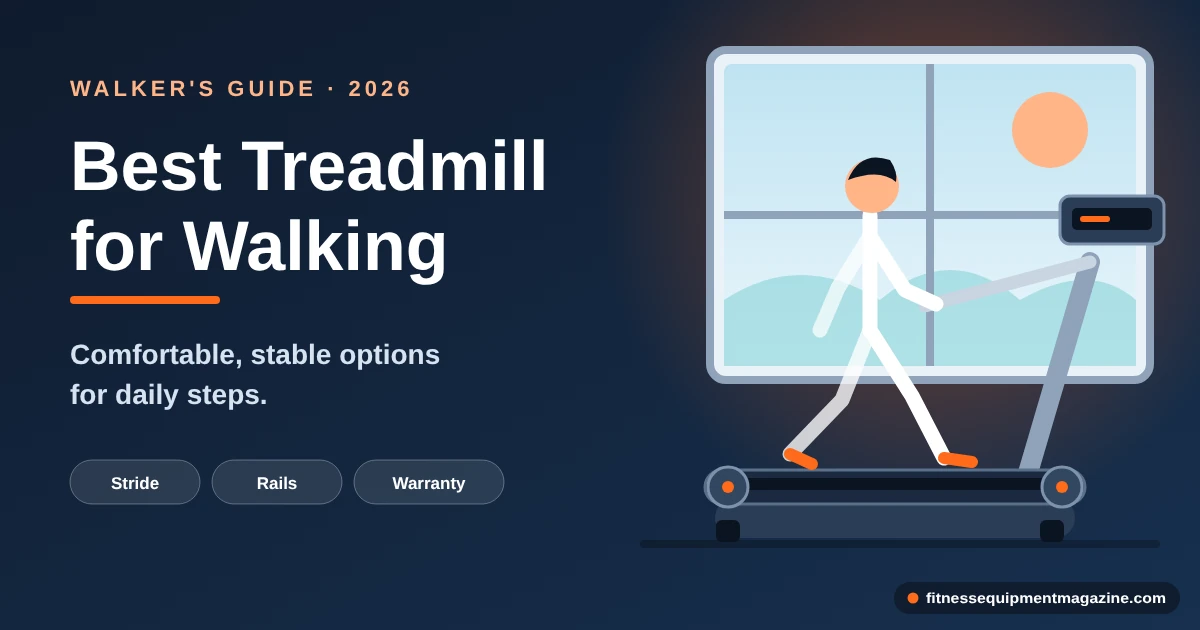
Picture the routine you’re actually buying for. It might be a podcast and a mug of coffee before the kids wake up. It might be forty minutes of a series you’d otherwise watch from the couch. Or it’s a rainy-day stand-in for the loop around the block.
Nobody in those pictures is sprinting. So why would you pay for a machine designed around 10 mph? That question trims a surprising number of products from your shortlist. This guide shows you how to use it to find the best treadmill for walking in your home.
The short answer
The best treadmill for walking has a deck long enough for a relaxed stride, commonly 55 inches or more for average-height adults. It also has handrails you can reach, a low and smooth start, and a motor rated for steady daily use rather than peak horsepower. Finally, the warranty should cover frame, motor and parts for years, not months.
- Who it fits: people building a daily step habit, TV and podcast walkers, and anyone who wants weather-proof walking. It also suits households where several people share one machine.
- The biggest tradeoff: compact, folding machines save floor space but usually shorten the deck. If you’re tall, or you walk with a long, loose stride, a slightly bigger machine usually wins.
- The common trap: paying for top speed and a giant touchscreen, then finding the deck short and the rails awkward.
If you walk mostly at a desk, a walking pad may be smarter. We compare the two in our walking pad vs treadmill guide.
How we researched this. This is research-based guidance built from manufacturer specification patterns, federal activity guidance and ownership problems that buyers commonly report. We haven’t hands-tested the machines described here, so you won’t find lab numbers, decibel readings or “our testers” claims. We name no brands and quote no prices for specific products. Figures below are typical ranges, so verify them against the current spec sheet. Last reviewed: October 2026.
How current is this?
Specs, warranties, availability and recalls shift every few months. Treat the numbers here as typical patterns, not quotes. Before buying anything, read the current spec sheet and warranty page. Then check the CPSC exercise equipment recall list for the model you’re considering.
What the Best Treadmill for Walking Really Needs
Most treadmill marketing starts from the top of the speed range and works down. Walkers live at the bottom of it. At 2 to 4 mph, the machine has a handful of jobs to do well. Nearly everything else on the spec sheet is decoration. Knowing which handful is how you find the best treadmill for walking.
The best treadmill for walking: a six-point scorecard
Here’s the short list we’d hand a friend before they open a single browser tab. Each item gets its own section later, so think of this as the map to the best treadmill for walking.
- Deck length that suits your stride. Walking uses a longer, steadier step than people expect, and a short deck makes you shorten it.
- A smooth, gentle start and a stable slow speed. Many treadmills feel fine at 3 mph and jerky at 1.5. Walkers spend their lives at the slow end.
- Handrails and a step-up height you can live with. Rails are your balance aid, your phone-holder and your way on and off.
- A motor built for hours of steady use. Continuous-duty ratings matter far more than a “peak” horsepower number.
- Comfort and noise you won’t resent. Cushioning, belt quality and motor sound decide whether the habit survives week six.
- A working safety key, readable controls and a real warranty. Boring, and exactly what keeps a daily machine daily.
Notice what isn’t on the list: 12 mph top speed, huge touchscreens, a dozen sprint programs. They aren’t bad things. They just don’t help someone who walks.
Why the best treadmill for walking isn’t a runner’s machine
A runner’s footstrike loads the deck and frame with a repeated impact. So running machines get heavy frames, powerful motors and thick cushioning. Walking is gentler on hardware. The load is lower, the cadence is slower, and one foot is always in contact with the belt. That means a well-built walking machine can be simpler and, often, cheaper than a runner’s model without being flimsy.
That said, walkers hit the machine differently in other ways. Daily use means a lot of hours, and hours wear belts, rollers and motors even at low load. A machine rated for walking-only use can be perfectly good, as long as the warranty and duty rating match your plan. The sneaky mismatch is a light-duty machine bought for two hours a day.
A quick self-check
Write down three numbers before you shop. First, the minutes you’ll walk on a typical day. Next, how many people will use the machine. Finally, the tallest person’s height. Those three figures drive the deck length, the duty rating and the warranty length you should look for. Everything else is secondary.
Who this guide is written for
We’re writing for adults hunting for the best treadmill for walking steadily at home. If you’re also planning to jog, our guide to the best treadmills for home use covers the mixed-use case. The longer treadmill buying guide explains every spec in more depth. If balance or an older household member is your main concern, our treadmill for seniors guide goes deeper on rails and supervision.
General activity guidance is a useful backdrop. The HHS Physical Activity Guidelines describe weekly activity amounts for adults, and brisk walking counts toward them. We won’t tell you how much to walk or what it will do for your body. That’s a conversation for you and a qualified professional. What we can do is help you pick a machine that makes walking easy to repeat.
The 1 to 4 mph Speed Ladder: What Each Pace Asks of the Machine
Walking isn’t one speed. A recovery stroll while you answer email sits near 1 to 2 mph. A comfortable stroll sits around 2.5 to 3. A brisk walk lands around 3.5 to 4. Each rung asks something slightly different from the machine. Seeing them side by side clears up a lot of spec-sheet confusion.
Notice how undemanding the whole ladder is. The best treadmill for walking doesn’t need to be extreme. Even the top rung stays well under the speeds that justify a large motor. That’s why a modest, well-built walking machine can serve a household for years. The bottom two rungs matter most. That’s where belt start-up and low-speed smoothness get tested every day.
What top speed really tells you
A 12 mph top speed says the machine can run. It says nothing about whether it walks well. In fact, a belt and motor tuned for high speed can feel a touch rough at 1.5 mph. Controlling very slow motion smoothly is a separate engineering problem from going fast.
So treat top speed as a footnote. When you compare candidates for the best treadmill for walking, rank them on low-speed behavior first. If a walking-focused machine tops out at 6 to 10 mph, that’s plenty. A higher cap is only a bonus for the day you decide to jog.
Likewise, the speed increments matter. Look for a console that steps in 0.1 mph increments, or at worst 0.5. A jump from 2 to 3 mph in one press is a wake-up call you don’t need with a coffee in hand. If you’re choosing between machines, the one that lets you creep up gently is the better daily companion.
The motor question, answered briefly
You’ll see continuous-duty horsepower (CHP) quoted on better machines and “peak” horsepower on cheaper ones. For walkers, a steady rating around 2.0 to 2.5 CHP is typically more than adequate. Many good walking machines sit a little lower.
What you want is a motor that doesn’t strain over hours of use. Heavier users or heavy daily schedules should lean toward the upper part of that range. Our full buying guide explains the CHP-versus-peak distinction. A quick spec reference sits near the end of this article.
Low-Speed Smoothness: Where the Best Treadmill for Walking Stands Out
Ask anyone who has owned a treadmill for years what annoys them. You’ll hear about the first two seconds. A belt that lurches to life turns a relaxing walk into a low-grade irritation. So does one that surges faintly every few steps at 1.5 mph. This is the least-advertised quality of the best treadmill for walking. It’s hard to put in a spec table.
What “smooth” actually means
Three things add up to a smooth slow walk. First, the motor controller has to hold belt speed steady as your footfalls change the load. It shouldn’t slow on each heel strike and then catch up. Second, the belt and rollers need to be well aligned and properly lubricated, so friction stays even. Third, the start ramp has to be gentle. The belt should begin at a crawl, not jump to the displayed speed.
How to judge it without testing the machine
You can’t feel a belt through a screen, but you can gather clues.
Read owner reviews specifically for words like “jerky,” “surges,” “lurch” and “hesitates,” and note how many mention low speeds. Look at the speed floor too. Many machines start at 0.5 mph, and a few at 0.1. That tells you someone designed for slow users. If a showroom lets you try a machine, spend five minutes at 1.0 mph with a phone in one hand. That’s the test. Ten minutes of reading reviews this way tells you more about the best treadmill for walking than the spec table does.
Also check for a “soft start” or “quick-start” description in the manual. Some machines begin at a crawl and let you press up from there. Others launch straight to a stored speed. That’s lovely for runners and mildly alarming with a mug in your hand. The best treadmill for walking in a shared household usually starts slow every time, whatever the last user did.
Watch for
Reviews that describe belt “slip” or a “hiccup” at low speed often point to tension, alignment or lubrication. Sometimes they point to a controller that simply wasn’t designed for slow work. A single review proves nothing, but a pattern is worth taking seriously.
Deck Length: Matching the Best Treadmill for Walking to Your Stride
If we could make shoppers check only one measurement, it’d be the length of the running surface. Not the overall footprint, not the belt width, not the console size. The running surface, measured from roller to roller on the belt you actually walk on. Listings round it up with enthusiasm, so find the true figure on the spec sheet.
How long is a walking step?
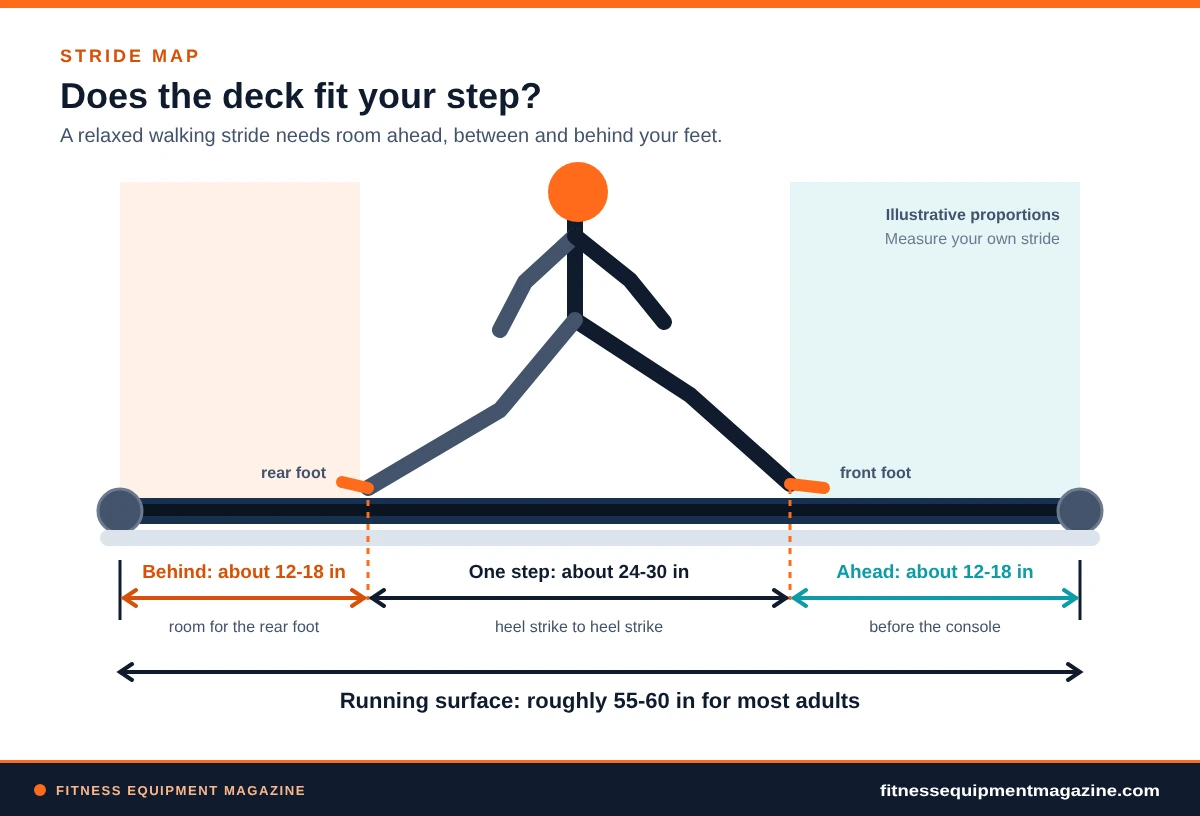
An easy stroll for an average-height adult covers roughly 2 to 2.5 feet per step. Brisk walking and taller bodies stretch that, and some tall walkers cover close to 3 feet. Your feet alternate rather than leaving the belt together. Even so, you need room for one full step ahead of your rear foot, plus a safety margin behind you. In practice, that’s why 55 inches is a common comfortable minimum. It’s also why shorter compact decks can feel cramped.
Width matters too, but less than length for pure walking. Many walkers are happy with 16 to 18 inches. Twenty inches feels roomier, especially if you swing your arms or share the machine with someone broader. Walking with a wide, slightly rolling gait? Take the extra width.
Measure your stride at home in two minutes
- Mark a start line. Put a strip of tape on a hallway floor and stand with your toes behind it.
- Walk ten ordinary steps. Use your usual pace, not a model-walker one, and keep your eyes up.
- Measure and divide. Measure from the start line to your last footprint, then divide by ten for your average step.
- Add a margin. Add about 12 to 18 inches for the step ahead and breathing room behind. Then compare with a deck’s real length.
Most people discover their step is a little longer than they guessed. That alone sends them from a 48-inch compact deck toward something nearer 55 or 60. It’s the best use of two minutes in the whole shopping process. It also helps if you ever shift from a plain stroll to a faster pace, which opens up your stride.
Signs a deck is too short for you
- You catch yourself shortening your steps to stay off the front console.
- Your rear foot drifts toward the back edge when you speed up.
- You glance down at your feet more than you would on a sidewalk.
- You hold the rails more tightly the faster the belt moves.
Any one of those suggests mild cramping, and it’s a quiet reason many walkers abandon a machine within weeks. Longer decks cost more floor space, a tradeoff we weigh in the archetypes section. Our treadmill belt size explainer digs into width, length and footprint.
Handrails, Step-Up Height and Stability: Where Walkers Feel Safe
Runners barely touch the rails. Walkers use them all the time. They help you step on, steady a head turn, hold a phone and rest a hand while reading. That makes rail design more important than photographs suggest. It also explains why the best treadmill for walking often has a different frame shape than a racer’s machine.
Rail height, spacing and reach
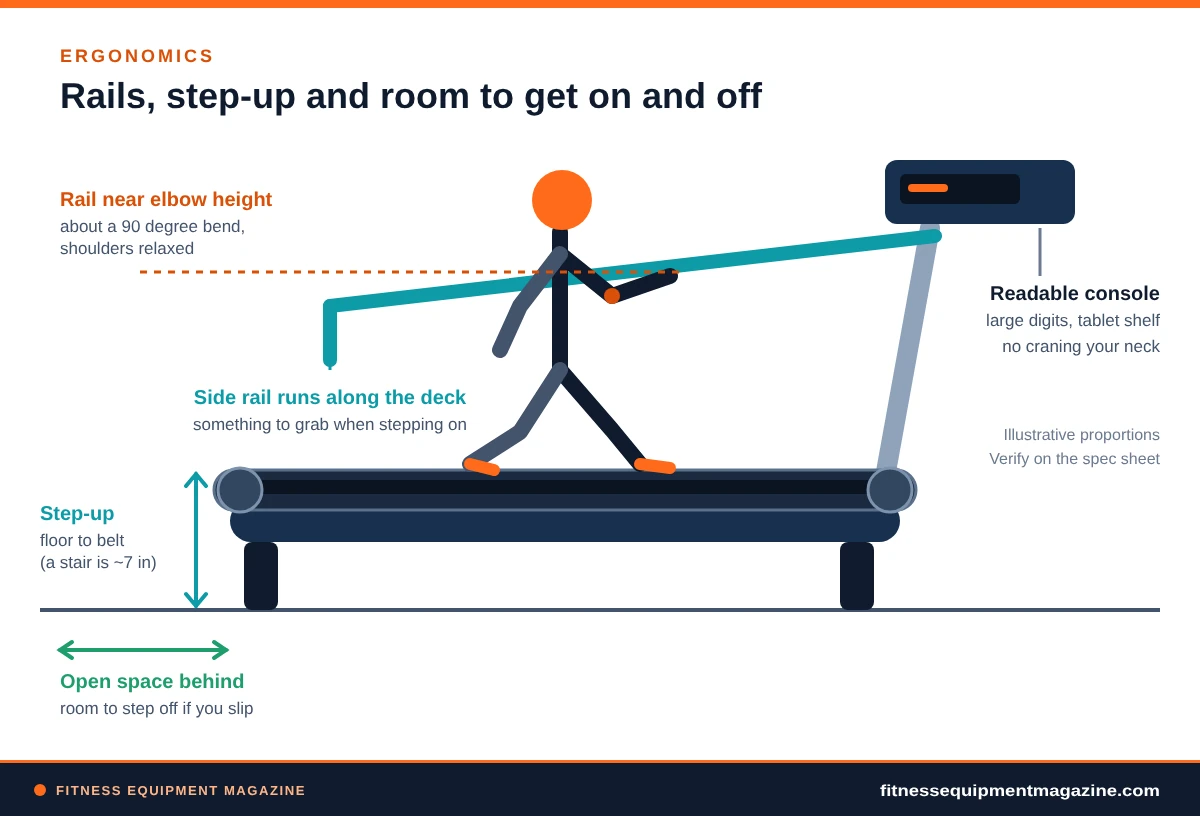
Stand relaxed with your elbows bent about 90 degrees. The rails should meet your hands at roughly that height without making you hunch or raise your shoulders. Check the spacing too: too narrow and your elbows brush the uprights, too wide and the grab becomes a stretch. Side rails that continue along the deck, rather than stopping at the console, give you something to hold when you step on or off. That matters more than it sounds.
Padded, rounded grips feel kinder over long sessions than thin, hard tubes. Beyond comfort, they are also easier to hold with a damp hand. If someone in your household is less steady on their feet, look for sturdy side rails and a wide stance. Then read the older-adult treadmill guide for supervision and setup tips.
Step-up height and the first foot on the belt
Step-up height is the distance from the floor to the top of the belt, and it’s nearly invisible in listings. Low-profile decks are easier to climb onto. They sometimes carry thinner cushioning, though. High decks, which usually hide a thicker motor housing or a bulkier cushioning system, can feel like a small curb. For most adults it’s irrelevant. For an older family member or a shorter person, it’s the difference between stepping on casually and bracing yourself.
Try a quick comparison before you commit to what you think is the best treadmill for walking. Stand next to the bottom stair in your home and step up and down a few times. A typical stair rises around 7 inches. If a deck is higher than that, you’ll feel the extra lift every time. Manufacturers rarely print the number. Check the dimension diagrams, ask the retailer, or read reviews for words like “tall” and “high step.”
Frame stability: the wobble test for the best treadmill for walking
A stable frame is the point of the best treadmill for walking, which is a daily machine. Look for a wide base, a broad stance in the rear stabilizer feet and a total weight that sounds reassuring. Machines in the 150 to 250 pound class often feel steadier than ultra-light folding models.
Good folding designs can still hold their own when assembled correctly. Read the user weight rating too, and treat it as a ceiling, not a target. A walker near the limit will want a heavier frame and a stronger motor than the label requires.
- After assembly, push gently on the console and see if the whole unit shifts or rattles.
- Tighten every bolt again after the first week, since vibration loosens them.
- Level the feet so the frame doesn’t rock on an uneven floor.
- Put the machine on a mat to protect the floor and absorb a little vibration.
A wobbly console is more than an annoyance. It changes how you use the rails. A walker who doesn’t trust the rails starts walking tentatively, which defeats the comfort of a good machine. If a wobble persists after tightening, contact the seller early, while the return window is open.
Incline for Walking: How Much Slope Is Actually Useful?
Incline is the one feature that can change the character of a walking session without any extra speed. A modest slope makes the same pace feel more purposeful and gives long sessions variety. It even lets you walk “uphill” in a spare bedroom. But incline also adds cost, weight and moving parts, so it deserves a clear-eyed look before you pay for it.
The range that matters for walkers
Most walkers get what they want from roughly 0 to 6 percent incline. A few reach for 10 or 12. Percent grade is rise over run. A 10 percent incline raises the front of the deck about 1 foot for every 10 feet of belt.
Because decks are only about 5 feet long, the rise is smaller than the number sounds. Whether a slope belongs on your shortlist for the best treadmill for walking depends on how often you’ll use it. A 15 percent top end is for a specific kind of buyer. Our treadmill incline guide goes through how much slope actually does what.
Manual or motorized incline?
Manual incline is set by hand with a lever or pin.
It’s fine for walkers who find a slope and stick with it. It adds little cost, has fewer parts to fail and is often found on compact machines. Motorized incline is a quality-of-life feature. You press a button, the deck lifts, and you vary your session on the fly. It’s also another motor, another warranty line and a part that can need servicing.
If you’ll adjust the grade several times a session or share the machine with others, motorized incline earns its place. If you walk flat at one pace most days, don’t pay extra for it. A reliable manual incline with a robust warranty beats a fancy motorized one with a thin warranty.
Decision rule
Walk flat 80 percent of the time? Skip motorized incline and spend the difference on deck length or warranty. Love hill variety, or share with someone who does? Motorized incline up to about 10 to 12 percent is plenty, and anything higher is for a different shopper.
Cushioning, Noise and Controls: The Daily-Use Comforts
Cushioning that suits walking
Cushioning is one of the most hyped treadmill words and one of the least standardized. Brands describe it with proprietary names and zone diagrams. The underlying idea is simple. The deck flexes a little under your foot, usually through rubber or elastomer supports between deck and frame. Walkers don’t strike as hard as runners. They need less impact absorption but still benefit from a slightly forgiving surface.
A firm deck can feel harsh over long sessions on hard footwear, while an overly squishy one can feel unstable. A mid-level, even cushioning, with consistent feel from front to back, suits most walkers. Our treadmill cushioning explainer goes into the design types and the myths around them. For now, remember this: comfort claims are subjective. Read owner reviews for phrases like “firm,” “springy,” “dead” and “even.” Give weight to people who describe walking, not running.
Noise: the household’s vote
You, your partner and the neighbor downstairs each get a vote on noise. The best treadmill for walking in a shared home passes all three. Walking machines are usually quieter than running ones, since lower speeds ask less of the belt and motor. Still, the differences between models can be large. Walking noise comes from the motor hum, the belt slap or squeak, and footfall thumps carried through the floor.
- Motor hum: A well-matched motor that isn’t straining tends to hum low and steady. A small motor pushing hard sounds whiny.
- Belt noise: Dry or misaligned belts squeak and flap. Regular lubrication and alignment fix many problems.
- Floor transmission: A thick mat and a stable frame take the edge off footfall thumps, especially on upper floors.
If you live in an apartment, the issue grows more pressing. Our dedicated treadmill noise guide for apartments covers mats, timing and neighbor-friendly habits. As a quick rule, a machine used at 2 to 3 mph is typically less disruptive than one at a jog. A TV walker in a condo is a realistic plan.
Controls and readability
Here’s an unglamorous truth: you’ll look at the console more than at anything else on the machine. A good walking console shows speed, time, distance and incline in large digits, with buttons you can press without staring. Quick-select speed keys are helpful, though some can be too eager, so check that stepping is gentle. A tablet holder or shelf at a comfortable height matters, because many walkers read or watch while moving.
Large touchscreens are tempting, but they come with trade-offs. They add cost and can lag. They depend on software that may stop being updated, and some link their best features to a subscription. If you want classic buttons and a clean readout, you’re not being old-fashioned.
You’re buying a machine that will work the same in five years. That’s what the best treadmill for walking should be. Bluetooth for a heart rate strap or step app is a plus. Just make sure the treadmill works fine without it.
Safety Key, Warranty and Daily-Use Maintenance
The safety key is not optional
Every treadmill should have a tether that stops the belt if it’s pulled from the console. Clip it to your clothing every time you walk, even at slow speeds. It sounds fussy until someone stumbles while turning to answer the door. Check that the key is included and the clip is sturdy. Confirm the console stops the belt immediately when the key comes out. If a machine lacks an emergency stop, skip it.
Safety first
Keep children and pets away from a running treadmill, and unplug or remove the safety key when you’re finished. The CPSC exercise equipment recall page lists treadmill recalls, many of which involve belts, electrical parts and pinch points. Check your model there before purchase and again after any ownership change.
Reading the warranty like a daily user
Warranties on home treadmills usually split into separate periods for frame, motor, parts and labor. These can differ widely. A common pattern is a long frame and motor term, a shorter parts term and a short labor term. For a daily walker, parts and labor terms matter most. Belts, boards and sensors tend to wear before the frame does.
- Read for “residential use” limits, since some warranties assume a certain number of hours per week.
- Check whether labor is covered, and for how long, as this is often the shortest period.
- Find out who services the machine and how you reach them: phone, email, local technicians?
- Confirm that wear items like belts and decks are addressed, even if only for a short period.
- Keep your order confirmation and serial number in one folder from day one.
A seven-year frame warranty sounds impressive, but if the labor term is ninety days, you’ll shoulder most real repair costs. Our treadmill buying guide unpacks typical structures. The question to ask a seller is simple. If the belt, board or controller fails in year two, what exactly happens? A good warranty is part of the best treadmill for walking, not an add-on.
A simple daily-use maintenance routine
Daily walking is a small gift to a treadmill, but it’s also steady wear. The machines that last are rarely the fanciest. They’re the ones whose owners spent five minutes a week looking after them. Maintenance keeps the best treadmill for walking worth its price.
- After each session Wipe the console, rails and belt edges with a slightly damp cloth. Sweat and dust corrode and clog.
- Weekly Check the belt for centering; it should sit evenly between the side rails. Vacuum around the motor cover and under the deck edges.
- Monthly Check bolts, look at the power cord and listen for new squeaks. Lubricate as the manual specifies; many modern belts need it less often, but the manual decides.
- Every six months Lift the motor cover, with the machine unplugged, and look for dust, wear or loose connections. Check the deck and belt for visible wear patterns.
Use only the lubricant type your manual recommends, and apply the right amount. Too much is nearly as bad as too little, since excess oil collects dust and can make the belt slip. If you’re unsure, write down the date of each maintenance task on a card taped to the wall. It sounds quaint, but it keeps the routine alive.
Signs a belt or deck needs attention
- A slow drift to one side that keeps coming back after adjustment.
- A smell of hot rubber or a burning odor, which means stop and unplug.
- Visible fraying on the belt edge or a shiny, glazed look on the surface.
- A faint thud or slap on each step, which may indicate deck or belt damage.
Fix small things early. A belt that wanders by half an inch is a ten-minute job. The same belt a month later may be frayed, and a frayed belt is a replacement, not a tweak. The same attitude applies to electrical parts. If the console flickers or resets mid-session, stop using the machine until you’ve contacted support.
Five Walker Archetypes: Finding the Best Treadmill for Walking in Your Home
No single machine is the best treadmill for walking across every home, so here are five archetypes. They’re machine types and buyer profiles, not brand picks. Each lists the criteria that earn it a place on your shortlist. The shoppers described are hypothetical; they exist to show how the trade-offs play out.
Archetype 1
The compact folding walker
Fits an apartment, folds upright or flat, and is meant for one or two walkers on a steady schedule.
Archetype 2
The full-deck daily walker
A 55 to 60 inch deck, sturdy frame and decent cushioning for people who walk long and often.
Archetype 3
The incline walker
A mid-weight machine with a motorized slope for hill-style routines.
Archetype 4
The shared-household walker
Slow, safe starts, clear controls, and a stable frame for people of varying size and confidence.
Archetype 5
The walking pad alternative
Under-bed or under-desk belt for people who simply need to move while working.
1. The compact folding walker
Think of a one-bedroom apartment where the treadmill lives behind a door or against a wall during the day. A folding model solves the space problem. For a single walker at 2 to 3 mph, it’s often all that’s needed.
Here, the best treadmill for walking is the one that disappears at night. The compromise is usually deck length, so measure your stride and be honest. A deck of around 48 to 52 inches may suit someone of average height. It will squeeze a long-legged walker.
Look for a soft-drop folding system so the deck doesn’t slam down. Check that transport wheels roll on your floor and the footprint fits the closet you’ve measured. Rails that lock firmly matter more than you’d think. A rattling hinge is both annoying and a stability worry. We cover the folding trade-offs in more detail in our folding treadmill guide.
Strengths
- Easy to stash, so the habit doesn’t take over the room.
- Typically lighter and simpler to move.
- Walking-first designs often start slow and quiet.
Tradeoffs
- Shorter decks cramp tall or brisk walkers.
- Hinges are an extra wear point.
- Lighter frames can feel less planted.
2. The full-deck daily walker
Now picture a home with a spare room or a corner of the basement. The owner plans to walk forty-five minutes most mornings, and wants the machine to feel boringly solid. This is the closest thing to a default recommendation for the best treadmill for walking. Picture a deck around 55 to 60 inches long and 20 inches wide where space allows. Add a continuous-duty motor, a stable frame and a warranty with real parts-and-labor coverage.
The price of that comfort is footprint and weight. A non-folding full-deck machine can run 6 feet long or more. It may be heavy enough to need two people for delivery. Measure the room, the doorways and the stairs before you order, then measure again. Our guide to choosing a treadmill for your space and training shows how to lay it out.
3. The incline walker
Our hypothetical incline walker lives somewhere hilly and misses the climbs when the weather turns. She doesn’t need speed; she needs a slope that responds quickly and a motor that doesn’t groan on it. For her, motorized incline up to roughly 10 to 12 percent is a solid target.
She also wants a stronger continuous-duty motor and a frame heavy enough to resist flexing. For her, the best treadmill for walking is a hill machine. For a deeper look at what slope does, see our incline treadmill guide.
Check the incline’s quietness and speed. Some mechanisms are loud and slow; others glide. Also verify that the warranty covers the incline motor as seriously as the main motor. It’s a separate part with its own failure modes.
4. The shared-household walker
Here’s a family of four. There’s one tall adult, one shorter adult who’s cautious about speed, and a teenager who wanders in when no one is watching. A grandparent visits for months at a time. The best treadmill for walking in this home is the one all four can use confidently. That points to a simple console and a gentle start at every session. It also means a stable frame with sturdy rails and a deck long enough for the tallest walker.
Pay special attention to child safety. A key that must be inserted before the belt moves is worth the extra minute. So is a console that locks, and a place to store the key out of reach. Also set a weekly rule about where the key lives. It sounds like homework. It’s also the kind of habit that prevents accidents of the sort listed in the CPSC records.
5. The walking pad alternative
Finally, a lot of people reading this don’t need a treadmill. They need to move while they work, or fit a walk into a studio apartment. A walking pad is a flat, handle-less belt that slips under a bed or sofa. Many people find it plenty for easy strolling. The tradeoff is the absence of rails and incline, shorter belts and usually a narrower speed range.
If that fits you, read our guide to the best walking pads for home and office. Then use the walking pad vs treadmill comparison to confirm the choice. If you mainly plan to walk at a standing desk, the under-desk treadmill guide is the better starting point.
Quick match
Small home, one walker, flat pace: archetype 1. Spare room and long daily sessions: archetype 2. Hill lover: archetype 3. Several users: archetype 4. Desk-first lifestyle: archetype 5. Notice that none of the five depend on a famous name, which is the point of choosing the best treadmill for walking by criteria.
Fitting Daily Walking Into a Real Home
A machine is only as good as the routine around it. Most abandoned treadmills weren’t bad machines. They were awkward to reach, unpleasant to look at or tied to a schedule that didn’t last. So let’s talk about how daily walking lives in an actual home.
The TV walker
Plenty of people buy a walking machine so they can get through a series they’d have watched anyway. In a living room, the best treadmill for walking is also the least obtrusive one. If that’s you, the placement matters more than any spec. Put the machine where the screen sits at eye level. Give the rails a spot that fits a tablet or phone. Check the line of sight on the treadmill in the store listing: a high console can block the picture.
Noise is the TV walker’s quiet enemy, since a whining motor competes with dialogue. A quieter, slower machine is a better partner than a powerful one. Wireless earbuds help too, but keep one ear free if you’re near stairs or children.
The weather-proof walker
Maybe you love walking outside and just need a backup for ice, heat, smoke or dark winter evenings. In that case, a modest machine may be the smartest choice. You’ll use it a few dozen times a year, not a few hundred. Here the best treadmill for walking is the one you can ignore for months. Resist the temptation to over-buy. Prioritize a stable frame, good rails and a readable warranty, then store it where you won’t trip over it.
Two small tips. First, keep a pair of indoor-only shoes near the machine, since clean soles keep dust off the belt. Second, put a small fan nearby. Moving air makes indoor walking noticeably more pleasant, and it costs almost nothing.
The step-count walker
If you live by a step counter, you probably care about consistency more than intensity. The best treadmill for walking for you is therefore the one that welcomes five-minute sessions as readily as forty-minute ones. That implies a console that starts quickly and a belt with no long warm-up. It also implies a space where you can step on in ordinary clothes. A machine hidden behind two closets and a box of holiday decorations will lose that contest.
One practical note: step counts from wrist devices can differ indoors and out, since arm motion and stride vary. Treat the numbers as a personal trend line rather than a precise measurement, and don’t compare them with a friend’s.
Space, floors and the room itself
Even a walking machine wants some clearance. Leave space beside it so you can step off. Leave more behind it so a slip doesn’t end at a wall. A common recommendation is a couple of feet at the sides and several feet at the back.
Still, check your manual, because the maker’s clearance figures are what count. Hard floors benefit from a mat. Carpet is fine, though a very thick pile may let the frame sink and tilt over time. If your floor is shaky or your ceiling low, check those before ordering.
Ceilings matter more on incline machines, which raise your head by several inches at their top setting. In a basement with low joists or a sloped bedroom ceiling, stand where your head would be. Add the incline rise and the step-up height, then compare. It’s a small thing to check and a large thing to discover afterward.
What to Ignore, and What to Avoid, When Shopping for Walking
Half of good shopping is knowing which numbers to skip. Treadmill listings are crowded, and the loudest claims are rarely the ones that help a walker. Here is a plain sorting of what matters and what doesn’t. Skipping the noise is how you find the best treadmill for walking without overspending.
Safe to mostly ignore
Skip
Peak horsepower
Peak numbers describe a momentary burst, not steady performance. Look for a continuous-duty rating instead, or a detailed explanation from the maker.
Skip
Extreme top speed
A 12 mph limit doesn’t make a machine nicer at 2.5. For pure walking, a lower cap is perfectly fine.
Skip
Dozens of preset programs
Most walkers use manual mode. A few simple programs are plenty, and some are lovely, but they shouldn’t drive the price.
Skip
Giant touchscreens
Big displays add cost and can tie features to subscriptions. Useful for some, unnecessary for most walkers.
Red flags worth walking away from
- No clear running-surface dimensions, or a listing that mixes belt size and overall size.
- A warranty that’s vague about labor, or that can only be read as an image.
- Reviews that mention a safety key not stopping the belt, or burning smells.
- A seller that offers no return window for a heavy item you can’t test.
- Features that need an app subscription to function at the basic level.
- A model that appears on the CPSC recall list without a clear fix.
A tiny spec reference
Use this as a sanity check when you compare listings for the best treadmill for walking. These are typical ranges for walking-focused home machines in the US market in late 2026. They change, so verify against the spec sheet.
| Spec | Typical walker-friendly range |
|---|---|
| Running surface length | About 50 to 60 inches |
| Running surface width | About 16 to 20 inches |
| Continuous motor rating | Roughly 2.0 to 2.5 CHP for daily use |
| Speed range | Starting at 0.5 mph or lower, up to 6 to 10 mph |
| Incline | 0 to 10 percent is plenty for most walkers |
| User weight rating | Pick one comfortably above the heaviest user |
How long should a walking treadmill last?
Manufacturers rarely promise lifespans, and we won’t invent one either. What we can say is that the frame and motor of a decently built machine commonly outlast its belt, deck and electronics. Daily use shortens every one of those lives. Owners who clean, tighten and lubricate on schedule report the fewest surprises. Owners who ignore the squeak tend to meet the repair shop sooner. If you walk a lot, a longer parts-and-labor warranty is a more honest signal than any headline durability claim.
A Shopping Routine for Finding the Best Treadmill for Walking
When people ask us for a quick plan, we give them this one. It takes an evening, not a month, and it keeps the shortlist honest.
- Measure the room and the path. Floor space, ceiling height, doorways, stairs and the spot where it will live. Include the clearance the manual asks for.
- Measure your stride and the tallest user. Use the two-minute hallway test and set the minimum deck length from it.
- Set the duty and the warranty bar. Hours per day and number of users decide the motor rating and the parts-and-labor coverage you need.
- Pick an archetype. Compact, full-deck, incline, shared household or pad. Cut every listing that doesn’t fit.
- Read three kinds of reviews. The five-star praise, the one-star complaints, and the mid-range comments from people who say how long they’ve owned it.
- Check recalls and return terms. Open the CPSC list, read the return policy, and look at assembly and delivery arrangements.
- Plan the first week. Tighten bolts, check the belt, set the safety key habit and agree on rules for kids and pets.
If you’re torn between a budget model and a step up, our budget treadmill guide shows where extra spending pays off. For a walking machine, the answer is nearly always more deck and a better warranty, rarely more screen.
Questions Walkers Ask About the Best Treadmill for Walking
What is the best treadmill for walking only?
The best treadmill for walking only is a stable, quiet machine with a deck that suits your stride. For average-height adults that’s commonly around 55 inches. Rails you can reach, a gentle start and a clear warranty matter more than top speed or horsepower claims. A folding model can work well in a small home, and a non-folding full-deck model suits long daily sessions. Verify specifications on the manufacturer’s current spec sheet.
How long should the deck be on the best treadmill for walking?
Many adults find a running surface of about 55 inches comfortable for relaxed walking. Taller people often prefer 58 to 60 inches. Shorter decks around 48 to 52 inches can work for shorter walkers at an easy pace. Measure your own stride, add a margin for the step ahead and behind, then compare. Remember to check the running surface, not the overall length of the machine.
Is a walking pad as good as the best treadmill for walking?
It depends on how you walk. A walking pad is smaller, quieter and easy to stow, which suits desk walkers and tiny homes. A treadmill usually offers rails, a longer deck, incline and a sturdier frame. For brisk walking, tall users or anyone who wants handrails, a treadmill tends to feel more secure. Our walking pad vs treadmill guide compares the two in depth.
How much motor power does the best treadmill for walking need?
For daily walking, a continuous-duty rating of roughly 2.0 to 2.5 CHP is typically more than enough. Some good walking machines sit slightly lower. Peak horsepower figures are less useful because they describe short bursts. Heavier users, long sessions and incline walking lean toward the upper end. Always compare the manufacturer’s continuous rating, and read the warranty for the motor.
Do I need incline on the best treadmill for walking?
You don’t need it, but many walkers enjoy it. Incline adds variety and makes the same speed feel more demanding. A range up to about 10 percent covers most preferences. If you walk flat most days, skip motorized incline and put the money into deck length or warranty. If you love hills or share the machine, motorized incline is a worthwhile convenience.
Which is the best treadmill for walking for older adults?
For older adults, the best treadmill for walking has sturdy side rails, a low step-up and a slow starting speed. Add a clear emergency stop and a wide, stable frame. Supervision and a clear space around the machine matter as much as the hardware. Our treadmill for seniors guide covers the details. For any new routine, a conversation with a healthcare professional is the right starting point.
Can I use the best treadmill for walking every day?
Most home treadmills are built for regular use. Still, check the duty rating and the warranty’s residential-use terms for your planned hours. Daily walking wears belts, rollers and motors even at low speeds. So keep the belt clean and lubricated as the manual says, and listen for changes in sound. How much you should walk is a question for you and a qualified professional.
How do I choose the best treadmill for walking in an apartment?
For the best treadmill for walking in an apartment, start with noise, size and stability. Choose a walking-focused machine with a gentle start. Use a thick mat, walk at reasonable hours and keep the frame level. A folding model helps with space, though a shorter deck may cramp a tall walker. Our guide to treadmill noise in apartments explains mats, timing and neighbor-friendly habits in more detail.
How much should I spend on the best treadmill for walking?
Prices vary widely and change often, so we won’t quote figures. Spend first on deck length, frame stability and a warranty you can read, since those shape every walk. Treat screens, subscriptions and extreme speed as optional. If you walk only a few times a week, a modest machine with solid basics beats an expensive one with extras you never use.
Bottom Line: Choosing the Best Treadmill for Walking
The best treadmill for walking is a calm machine that gets out of your way. It has a deck that fits your stride, rails you trust and a smooth start. Its motor suits steady use, its warranty is honest, and you’ll keep the routine. Chase those and ignore the horsepower showmanship. You’ll likely end up with something you still use a year from now.
Here are your next steps. Measure your stride and your room tonight. Pick the archetype that fits your household. Then compare finalists for the best treadmill for walking on deck length, warranty and review patterns. Check the CPSC recall page, and read the return terms before you pay. If you want the wider view first, start with our guide to the best treadmills for home use. Dip into the complete treadmill buying guide whenever a spec confuses you.
Sources and Further Reading
- HHS Physical Activity Guidelines — federal guidance on weekly activity for adults
- CPSC exercise equipment recalls — check model safety history before you buy
Some links on this site may be affiliate links. If you buy through them we may earn a commission at no extra cost to you. Recommendations are based on the criteria in the article, not payout. This article is general information about equipment and isn’t medical advice; talk to a qualified professional about your own health and training. Last reviewed: October 2026.