
Treadmill electricity usage is one of those costs everybody wonders about and almost nobody checks. The machine sits in the corner, you walk or run, and a few weeks later the utility bill arrives with no line item for it. So is it pennies, or is it a quiet drain? For most households it lands closer to pennies per session. Still, a few habits and a few spec-sheet details can double or triple that number.
Think about the difference between a refrigerator and a hair dryer. One runs all day at a modest draw. The other pulls a lot of power for ten minutes. A treadmill behaves like a mix of both. It asks for a burst of power at start-up, settles into a steady draw while you move, and then sips a little whenever the console stays awake.
This guide walks through that pattern in plain numbers. You’ll learn how to turn watts into dollars, what changes the draw, how to measure your own machine, and how to keep the outlet safe. Nothing here needs an engineering degree. A calculator and a rough idea of your electric rate will do.
For typical home use, treadmill electricity usage is modest. A treadmill commonly pulls somewhere around 200 to 400 watts at the wall while walking and perhaps 400 to 900 watts while running, with higher draws at steep incline or for heavy users. At an electric rate in the mid-teens to high-teens of cents per kilowatt-hour, an hour of walking usually costs a few cents.
- Who it matters to: daily walkers, households with several users, people in high-rate states, and anyone planning to leave a console powered on around the clock.
- The biggest tradeoff: a stronger motor and more incline cost more to run, but a motor that is too small works harder and wears faster. Match the motor to your use instead of minimizing watts.
- The hidden piece: standby power. A console that stays awake all day can add up to a surprising share of the yearly total.
If you’re still choosing a machine, our guide to the best treadmills for home use covers the bigger decisions first.
How we researched this. This is research-based guidance built from manufacturer specification patterns, federal guidance and ownership problems that buyers commonly report. We haven’t hands-tested the machines described here, and we didn’t measure any wattage ourselves. So you won’t find lab numbers or “our testers” claims. We name no brands and quote no prices for specific products. Every wattage and dollar figure below is a typical or illustrative range, so check your own machine’s rating plate and your own utility rate. Last reviewed: October 2026.
Electric rates, specs, warranties and recalls change from year to year. Treat the numbers here as typical patterns rather than quotes. Before you plug in a new machine, read the rating plate and the manual’s electrical section. Then check the CPSC exercise equipment recall list for the model you own or plan to buy.
Watts, Kilowatt-Hours and Rates in Plain English
Three words cause most of the confusion around treadmill electricity usage: watt, kilowatt-hour and rate. Once they click, every estimate in this article becomes easy to redo with your own numbers.
A watt is a speed, a kilowatt-hour is a distance
A watt measures how fast a device pulls energy right now. It’s like the speedometer in a car. A kilowatt-hour, usually written kWh, measures the total energy used over time. That’s the odometer. Your utility bills you for the odometer, not the speedometer.
One kilowatt-hour equals 1,000 watts running for one hour. So a 300-watt treadmill used for an hour burns 0.3 kWh. Used for three hours, it burns 0.9 kWh. The math never gets harder than multiplication and a decimal point.
Your electric rate is the multiplier
Your rate is the price of one kWh. In the US it varies widely by state and utility, and it often changes by season or time of day. Many households pay somewhere in the teens of cents per kWh, while some regions pay noticeably more and a few pay less. Your latest bill lists the rate, either as a single number or as tiers.
Look for the “price per kWh” line, or divide the energy charges by the kWh used. Delivery fees, taxes and tiers can shift the effective number. If that sounds fiddly, use the total bill divided by total kWh as a safe, slightly high estimate.
Why bother counting at all
Fair question. For many people the answer is that treadmill electricity usage will never move the needle on a household budget. Counting still helps in three cases. First, you may be choosing between a walking pad and a large motorized machine. Second, you might share a circuit with a space heater or a window air conditioner. Third, you may simply dislike mysteries on your utility bill.
Find your rate in cents per kWh on the latest bill. Then find the electrical line on the treadmill’s rating plate, usually a sticker near the power cord or under the motor hood. That plate lists volts and amps, and sometimes watts. Together those two numbers answer most questions in this guide.
What this guide covers and what it skips
We stick to home machines on ordinary 120-volt household outlets, which covers nearly every treadmill, walking pad and under-desk model sold for residential use. Commercial machines sometimes need 208 or 240 volts and a dedicated circuit, and that’s a different conversation with an electrician. We also stay away from calorie claims. Electricity use and the effort your body spends are two separate things, and this page deals only with the first.
If you’re weighing machine types as well, our treadmill buying guide explains motors, belts and warranties in depth, and the walking pad vs treadmill comparison sets the two formats side by side.
How Many Watts a Treadmill Really Draws
There’s no single wattage for “a treadmill.” The draw depends on what the machine is doing and who is standing on it. Still, the patterns are consistent enough to give you honest ranges, and that’s enough to plan with.
The ruler explains why treadmill electricity usage rarely alarms anyone. A walking session sits in the same neighborhood as a television plus a laptop. Even a hard run stays below a microwave. The danger zone only appears when something else shares the circuit, and we’ll return to that in the circuits section.
Walking: the modest end
At an easy pace on a flat belt, the motor mostly fights belt friction and your body weight rolling the deck. In that situation, treadmill electricity usage for many home machines sits at roughly 200 to 400 watts at the wall. Lighter users on lightly loaded decks can come in under that, and heavier users on a stiff belt can exceed it.
Part of the figure is overhead. The console, display, cooling fan and motor controller all run whether you walk fast or slow. That’s why the draw doesn’t fall to nearly zero at 1 mph.
Running: higher speed, higher load
Running asks more of the motor in two ways. The belt moves faster, and your footstrike lands harder on the deck. Treadmill electricity usage while running commonly climbs into the 400 to 900 watt range, and a large runner at speed on a big incline can push higher. Machines with strong continuous-duty motors can draw more because they’re built to deliver more.
So don’t read a high wattage as a flaw. A powerful motor that runs easily at 60 percent of capacity often lasts longer than a small one that strains at 95 percent. Our treadmill motor guide explains why continuous horsepower matters more than the peak number printed on the box.
The start-up bump
Pressing start triggers a brief jump in current while the motor accelerates the belt and the controller wakes up. It usually lasts a second or two. For billing it means almost nothing, because the energy involved is tiny. For circuits it matters a little more, since a breaker already near its limit can trip at that moment.
Walking pads, manual and curved treadmills
Walking pads use small motors and often draw roughly 100 to 250 watts while in use, which is part of their appeal for desk workers. Our guide to the best walking pads covers what else to weigh. Manual and curved treadmills sit at the other extreme. Your legs turn the belt, so there’s no motor to feed, and the only electricity involved is a battery or two for the display. We compare those formats in manual vs motorized treadmill.
Treadmill Electricity Usage in Dollars: The Math Without the Mystery
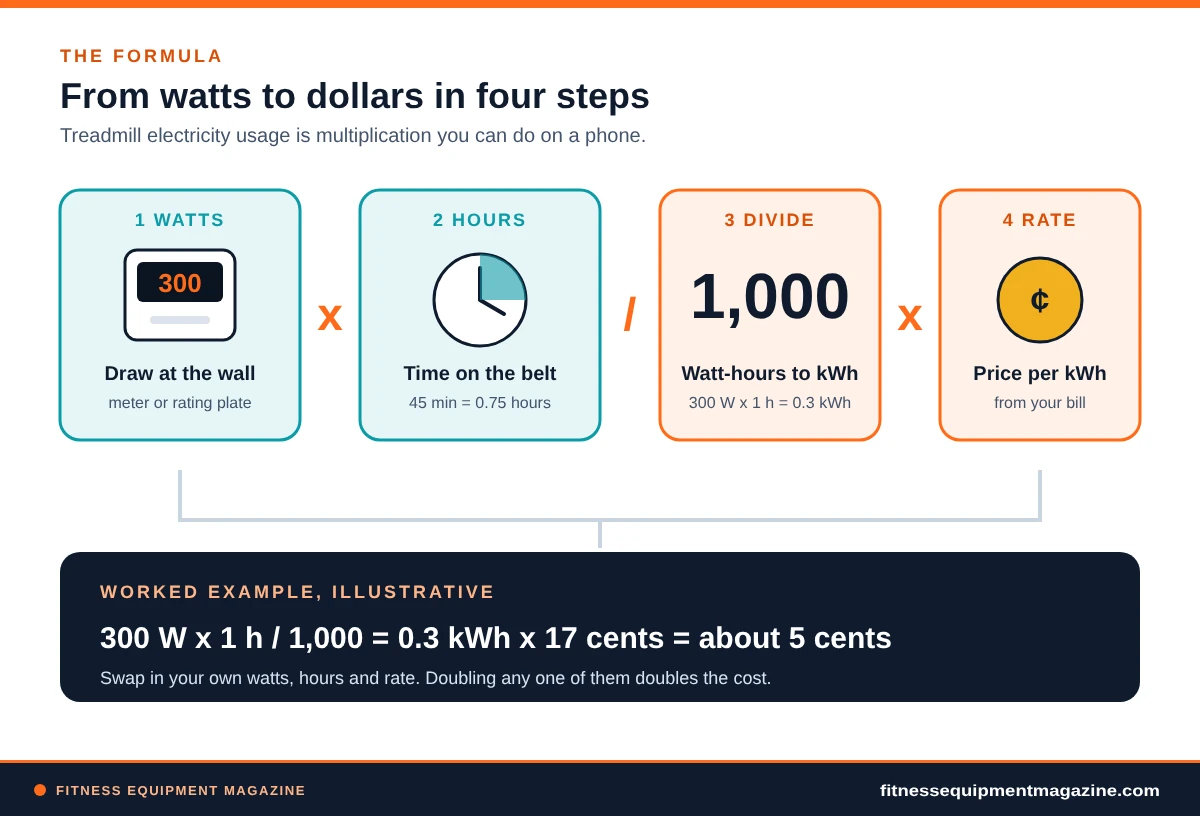
Here is the whole calculation. Multiply the watts by the hours, divide by 1,000 to get kilowatt-hours, then multiply by your rate. That’s it. The tricky part is choosing a believable wattage, not the arithmetic.
Three worked examples
Take an easy walker first. A machine drawing about 300 watts for one hour uses 0.3 kWh. At 17 cents per kWh, that comes to roughly 5 cents. Walk every single day for a year and you’ve spent about 110 kWh, or around 19 dollars.
Now try a runner. Say 700 watts for 45 minutes. That’s 0.525 kWh, which costs about 9 cents at the same rate. Four sessions a week for a year adds up to roughly 110 kWh again, so the annual figure lands near 19 dollars as well. Longer, harder, but fewer sessions can cost the same as a gentle daily habit.
Finally, price matters. In a region paying 30 cents per kWh, the daily walker’s year of 300-watt hours costs closer to 33 dollars. The machine didn’t change. The rate did.
All dollar figures here assume an illustrative 17 cents per kWh. Replace that with the number on your bill. If your rate is double, the cost doubles. If you’re on a time-of-use plan, use the rate for the hours you actually exercise.
What a year looks like for four kinds of users
Single sessions are easy to shrug off, so let’s stack them into a year. The chart below uses four invented profiles with rounded assumptions. Each bar splits into the part you cause by exercising and the part the machine causes by sitting there powered on.
Look at the orange slices. In the daily walker’s bar, standby is roughly a third of the total, even though the machine is idle nearly all day. We dig into that effect in its own section, because it’s the easiest piece of treadmill electricity usage to fix.
Perspective against other household costs
By these estimates, the electricity for a year of daily walking on a motorized treadmill costs roughly what a couple of casual restaurant lunches do. So treadmill electricity usage is rarely the reason to choose or skip a machine. It becomes relevant at the margins, for example when you’re comparing similar models or sharing a circuit.
What Pushes Treadmill Electricity Usage Up or Down
Two people on the same treadmill can produce different readings on a watt meter. That isn’t a mystery, just physics plus a few design choices. The drawing below marks the main contributors.
Rider weight and belt speed
A heavier rider presses harder on the deck, which raises friction between belt and deck, and the motor answers with more current. A faster belt also takes more power, and not in a straight line. Doubling the speed asks for more than double the effort once you factor in the harder footstrike.
Both effects on treadmill electricity usage are real, yet neither is a reason to avoid a machine. Heavier users should favor a motor with headroom, because a stout motor sipping from its capacity beats a small one at its limit. Our heavy-duty treadmill guide goes deeper on that pairing.
Incline: a second motor and extra load
Raising the deck does two things. A small incline motor draws power only during the few seconds it moves the frame, which is a negligible slice of treadmill electricity usage. The bigger effect is on the main motor, which now has to lift you up a grade the whole time. A steep slope at a brisk pace is one of the heaviest loads a home treadmill sees.
If incline is a big part of your plan, the treadmill incline guide shows what different grades feel like. Expect higher draws for steep sessions, and make sure the motor and circuit can handle them.
Belt condition and tension
This one surprises people. A belt that’s dry, dirty or tightened too far adds drag that the motor has to overcome every second of every session. The result is higher treadmill electricity usage, a hotter motor and a belt that wears faster. Following the lubrication schedule in the manual is cheap insurance for both your bill and your hardware.
We cover the routine in our treadmill maintenance guide. If the belt seems to hesitate or slip under load, read our belt slipping troubleshooting steps before the motor works itself hot.
Motor and controller design
Two machines with the same horsepower rating can differ in how much electricity they pull for the same job. Controllers, motor windings and drivetrain friction all play a part. Manufacturers rarely publish wall efficiency, so you can’t compare it from a spec sheet. In practice it’s a second-order factor, and the maintenance and usage habits above matter more.
Console, fans and accessories
A bright touchscreen can draw noticeably more than a small LED readout, and built-in fans, speakers and device chargers add their own watts. During a workout the extra load is small compared to the motor. During the 23 hours when you aren’t exercising, however, it can dominate the total. That brings us to the next topic.
Standby Power: The Quiet Part of Treadmill Electricity Usage
Walk into any home gym at night and look at the treadmill. If the console glows or a tiny light blinks, the machine is drawing power right now, with nobody on it. It’s small. Multiplied by 8,000-plus idle hours a year, it stops being trivial.
The idle math
Suppose a console stays awake at 6 watts. Over a year that’s 6 watts times roughly 8,400 idle hours, or about 50 kWh. At 17 cents per kWh, that is around 8 to 9 dollars. Compare it with 110 kWh for a year of one-hour daily walks at 300 watts. The idle slice equals nearly a third of the whole treadmill electricity usage for that household.
Cutting standby without fuss
Start with the machine’s own power switch. Many treadmills have a rocker switch near the cord inlet, and flipping it cuts most idle draw. Make it part of the routine, as automatic as lowering the lid on a laptop.
If your model has no switch, you’ve got a few options. Unplug it after use, if the outlet is reachable. Or plug it into an outlet controlled by a wall switch. Each approach costs nothing and takes two seconds.
Be careful with timers and smart plugs, though. A treadmill can draw more than many plugs are built to carry, and manuals often say to connect the cord straight to the wall. Only use an accessory rated for the full amp load on the rating plate, and only if the manual allows it.
Sleep modes and screens
Some consoles dim or sleep after a period of inactivity, which trims idle draw a bit. Others stay lit until switched off. Wi-Fi radios, app connections and always-on screens can all keep the controller alert. If the settings menu offers an auto-off timer, enable it. That small tweak is the closest thing to a free efficiency upgrade you’ll find.
Using the power switch or unplugging after each session may cut a good portion of a home treadmill’s yearly electricity. Savings are modest in dollars. They also come with a bonus: a machine that is truly off isn’t exposed to power surges or storm spikes.
One Workout, Watt by Watt
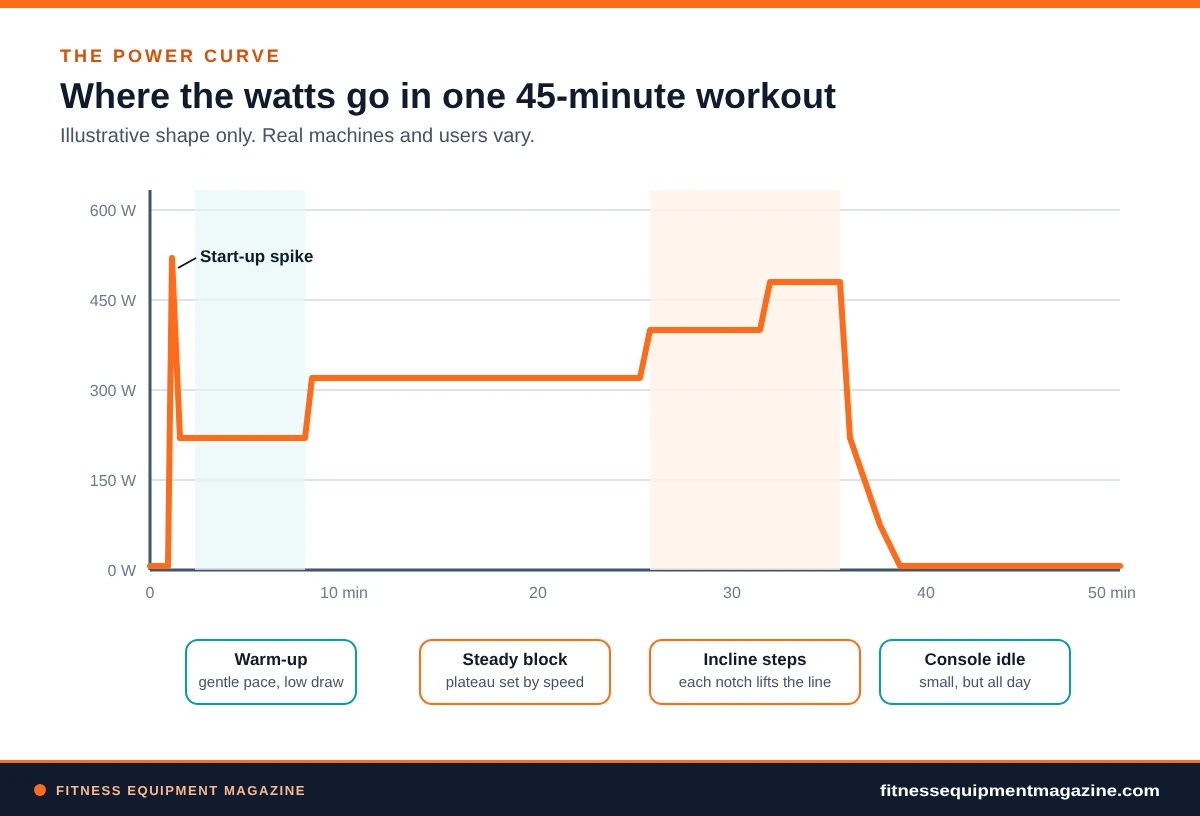
An average figure hides the shape of a workout. The power curve rises, plateaus and drops, and each change comes from a specific decision you made on the console. Seeing the shape helps you trust the estimates and spot problems later.
Reading the curve
The first spike is the start. The belt accelerates, the controller wakes up, and current jumps for a second or two. After that the draw settles at a level that depends on speed and your weight. Warm-up at a gentle pace sits low, the main block sits higher, and each incline step lifts the plateau a notch.
When you finish, the belt coasts down and the draw falls close to the idle level. That residual floor is what the standby section was about. Notice how thin the bright part of the curve is compared with the long flat tail you can’t see on a 45-minute chart.
Intervals versus steady effort
Intervals create a sawtooth. Each speed-up asks for a short burst of extra power, then the draw eases back. Averaged over the session, treadmill electricity usage often lands close to a steady effort at the mid-point speed. So you don’t need to avoid intervals for the sake of the bill.
What does matter is how long you sit at the peak. Ten minutes at a steep incline and fast pace costs noticeably more energy than ten minutes of easy walking. That’s still small in cents, but it’s the right instinct if you’re comparing programs.
How to Measure Your Own Treadmill Electricity Usage
Estimates are fine for planning. Your machine, though, can behave differently from the textbook version. A plug-in watt meter takes the guesswork out for a modest cost, and the whole test takes about fifteen minutes.
A simple measuring routine
- Check the meter’s limit. Read the meter’s maximum amps or watts. It must exceed the treadmill’s rating plate. Many consumer meters top out near 1,800 watts, but some are rated lower, and plugging a heavier load into a lighter-rated meter risks overheating.
- Plug the meter into the wall. Skip extension cords and power strips for this test. They add risk and can skew the reading.
- Plug the treadmill into the meter. Leave the machine off first and note the idle reading. That number is your standby draw.
- Test at a few speeds. Walk for a minute each at a slow, medium and brisk pace, then at your usual incline. Write down the highest steady reading at each step.
- Reset and run a full session. Use the meter’s kWh counter to capture a real workout from start to cool-down. Divide by your rate for the actual cost.
- Repeat with a different user or setting. If two people share the machine, test both. The difference is often smaller than expected.
Never exceed a meter’s rating, never use a damaged cord, and stop if anything feels hot or smells like burning plastic. If the cord, plug or outlet looks scorched, stop using the machine and have an electrician look at it. For recalls and hazard notices, search the CPSC exercise equipment page.
If you don’t have a meter
Start from the rating plate. Multiply volts by amps for the maximum the machine may ask for, for example 120 volts times 12 amps equals 1,440 volt-amps. Typical use sits well below that maximum, often at a fraction of it for walking. Treat it as the ceiling, not the average.
You can also use your utility’s online dashboard. Many smart meters show hourly use. Compare an hour with and without the treadmill on a quiet day. The difference won’t be precise, but it gives a sanity check on the estimates, and some dashboards break out the data by day.
What your numbers should tell you
If your walking reading falls inside the ranges above, the machine is behaving. A reading far higher than expected points to extra drag, such as a dry belt or one pulled too tight, or to a heavy user on a small motor. A high idle reading points to a console that never sleeps. Either is worth fixing, and neither is an emergency.
A reading that drifts upward over months deserves attention. Rising draw at the same speed often means more friction. That’s a cue to clean and lubricate the belt per the manual, and to check alignment.
Finding Treadmill Electricity Usage on Your Utility Bill
You can’t spot a treadmill on a statement, but you can learn what the bill is made of. That helps when you want to know whether a number is reasonable or whether something else is going on.
The lines that matter
Look for total kWh used, the energy charge per kWh, and any delivery or distribution charge. Some bills combine them, while others list them separately. For a rough cost of treadmill electricity usage, divide the total bill by the total kWh. That all-in figure includes fees and runs a bit higher than the headline rate, so it errs on the safe side.
Comparing months fairly
Summer cooling and winter heating swing a bill far more than any exercise machine. So comparing July with January tells you nothing. Compare the same month across years, or watch a smart-meter hourly graph on days with and without a workout. Even then, expect noise from cooking, laundry and everything else in the house.
If your utility offers a home energy report, check whether it groups your use into categories. These breakdowns are estimates, not measurements, and they won’t isolate one treadmill. Still, they show how small the exercise corner is next to the big loads.
Tiers, seasons and time of day
Tiered plans charge more once monthly use passes a threshold. If you’re already near the top tier, extra treadmill electricity usage lands at the highest price. Seasonal and time-of-use plans do something similar by the clock. In those cases, a quick call or a look at the utility’s rate page tells you which hours are cheapest, and a morning or off-peak workout could cost less.
Outlets, Circuits and Extension Cords: Where Treadmill Electricity Usage Meets Safety
The electric bill is the gentle part of this topic. The wiring is the part worth respecting. A treadmill won’t cost much to run, but it can ask a lot of a single circuit in the moment, especially if something else is plugged in nearby.
Why manuals ask for a dedicated circuit
A dedicated circuit means nothing else shares that breaker. Larger motors, especially those designed for heavy or frequent use, often come with that recommendation in the manual. The reasoning is simple. The treadmill’s draw spikes at start-up and during hard efforts, and a circuit already carrying a freezer, a space heater or a window air conditioner has less margin.
You can check without any tools. Flip the breaker for the outlet and see what else goes dark. If the answer is “half the garage and the freezer,” think twice about starting a run at the same moment the compressor kicks on.
Extension cords and power strips
Most manuals say to plug the treadmill straight into a wall outlet. That’s the safest default. A thin extension cord can heat up under load, and a cheap power strip may not be built for 12 or more sustained amps.
When the outlet is too far, the better fix is moving the machine or having an electrician add an outlet. If a cord is truly unavoidable, use a short, heavy-gauge one rated above the treadmill’s draw, and check the manual first. Our broader home gym electrical planning guide covers outlets and circuits for the whole room.
GFCI outlets and surge protectors
Garage, basement and outdoor outlets are often GFCI-protected, and some treadmills trip them now and then because motors can leak a small amount of current. Manuals differ on GFCI use, so read yours. A machine that keeps tripping a GFCI deserves a closer look rather than a workaround.
Surge protectors split opinion as well. Some manufacturers recommend one rated for the load, while others say to avoid anything between the cord and the wall. Follow the manual for your model. If you can’t find guidance, ask the manufacturer’s support line before you improvise.
Don’t swap a 15-amp breaker for a bigger one, and don’t defeat the grounding pin with an adapter. Both remove protection the wiring depends on. If you need more capacity, an electrician can add a circuit properly. In apartments and rentals, ask the landlord before changing anything inside the walls.
Planning around where the treadmill will live
Place the machine so the cord runs along a wall, not across a walking path, and keep the outlet reachable for a quick unplug. Leave clear space behind the deck as the manual asks. For a bigger picture of what electric equipment a room can carry, see which cardio machines need electricity.
Buying With the Power Bill in Mind
Electricity shouldn’t decide which treadmill you buy, but it should inform a few choices. The goal is to match motor and circuit to your plans without paying for headroom you’ll never touch.
Reading the electrical section of a spec sheet
Look for the voltage, the amperage and whether a dedicated circuit is recommended. Those lines usually sit in the manual’s “electrical requirements” page, which retailers often post as a PDF before you buy. Also look for continuous-duty horsepower. A figure around 2.0 to 3.0 CHP commonly suits regular home use, while heavier or more intense users lean higher. Our complete treadmill buying guide unpacks the horsepower numbers in detail.
Five machine types and what they mean for the meter
The desk walker
Small motor, low draw, often rated for slow speeds only. Easy on the meter. Less suited to running or heavy daily mileage.
The compact folding walker
Mid-sized motor aimed at walking and light jogging. Draw stays modest, and folding keeps the console off the floor traffic. See our folding treadmill guide.
The family machine
A continuous-duty motor with steady headroom. Higher peak draw, but it runs relaxed at ordinary speeds and lasts.
The long-deck runner
Big motor and long deck. Draws more when pushed, and often asks for a dedicated circuit. Worth it if you train hard.
The no-plug option
Self-powered belt, nothing on the meter, a different training feel. Compare the tradeoffs in our manual vs motorized treadmill guide.
Does a bigger motor waste electricity?
Not in the way people fear. A motor draws what the job demands, not what its label says. A strong motor running an easy walk pulls roughly the same watts as a modest one, and it works at a lower share of its capacity, which usually means less heat and longer life. The extra headroom costs money at purchase, not on the meter.
Why headroom helps
- Runs cooler at everyday speeds
- Handles heavier users and steeper grades
- Often comes with a stronger warranty
Where it bites
- Higher purchase cost
- May want a dedicated circuit
- Heavier, harder to move
Questions worth asking before you buy
- What are the rated volts and amps, and does the manual recommend a dedicated circuit?
- Does the console have a real power switch, or does it stay on whenever the cord is plugged in?
- Is there an auto-off or sleep setting for the display?
- Does the warranty cover the motor and drive system for residential use at my planned hours?
- Will the machine run from a standard outlet in the room where it will live?
If you want a wider framework for the purchase itself, our overview of choosing a home treadmill by space and training puts the electrical question in context with size, noise and budget.
Six Household Profiles: Treadmill Electricity Usage in Real Rooms
The following are hypothetical shoppers, built to show how treadmill electricity usage plays out. They aren’t real people or measured cases, and the figures are rounded and illustrative.
The remote worker with a desk pad
Two hours of slow walking on weekdays at about 150 watts costs a few cents a day. The pad’s power adapter stays plugged in, so a pad-style machine with a real switch saves the idle trickle. For this person, noise and cable routing matter more than the meter. Our under-desk treadmill guide covers the desk-side details.
The early-morning walker
One hour at roughly 300 watts, every day, through a year of cold winters. That level of treadmill electricity usage comes to about 19 dollars of active use at the example rate. The surprise here is the console, which sits awake all night. Flipping the switch off after each walk would trim the yearly total by something like a third.
The four-day runner
This runner pulls closer to 700 watts for an hour, four times a week. The bill barely moves, but the circuit matters. The garage outlet also feeds a chest freezer. A dedicated circuit, or at least a rule to avoid starting the run when the freezer motor is cycling, avoids nuisance trips.
The couple sharing one machine
Two people, two hours total on a typical day, with a bit of incline. At around 450 watts average, the year lands near 270 kWh of active use. Even at a higher rate, that treadmill electricity usage is a modest line on the bill. The better question for them is wear. More hours mean more belt and roller care, which we cover in the maintenance guide.
The garage walker in winter
This one adds a space heater to take the chill off. The treadmill alone is harmless. The pair on one 15-amp circuit is not, because together they can exceed what the breaker is willing to carry. The fix is a separate circuit, or skipping the heater and dressing for the temperature. Never run both through one extension cord.
The apartment renter watching every dollar
Rent already feels heavy, so this reader wants proof that the treadmill won’t spike the bill. The numbers say it won’t. Their real concerns are floor vibration and neighbors, so our guide to treadmill noise in an apartment will earn more of their attention than any wattage chart.
Practical Ways to Trim Treadmill Electricity Usage Without Wrecking the Habit
None of these tips is about exercising less. The bill is small enough that the point isn’t penny-pinching. It’s removing waste, which also tends to protect the machine. Here are the changes that matter, ordered roughly from easiest to most involved.
Turn it off at the switch
We’ve said it already, but it deserves a line of its own because it’s the single biggest lever. The console, the controller and any wireless radio idle for 23 hours a day. A switch or an unplugged cord ends that. Put a small reminder note on the console if you tend to forget.
Use cheaper hours if your plan has them
Some utilities charge less for electricity at night or midday and more in the early evening. If you’re on such a plan, a morning or late-evening session may cost half of a peak-hour one. The dollars are small either way. Still, scheduling a workout around the cheap window costs you nothing, so it’s worth knowing the hours.
Right-size the motor to the plan
An oversized motor won’t waste much power, but an undersized one will run hot and wear quickly. Be honest about hours, body weight and speed, then pick a machine with comfortable headroom. If you mostly walk, a compact walking-focused model is an efficient choice. If you run, buy the motor that suits running. Our motor guide helps with that call.
Keep the belt and deck happy
Friction is the quiet thief. A clean, correctly lubricated, properly aligned belt lets the motor do less. Follow the manual’s schedule, wipe the deck edges, and vacuum under the machine. Those chores shave the draw, cut noise and extend belt life. All three matter more than the watts.
Question the extras
Built-in speakers, device chargers, giant screens and fans all add draw. If you use them, fine. If you don’t, switch them off in settings, or choose a model with a simpler console. A plain display often pairs with a lower idle draw.
What about solar, batteries and generators?
Households with rooftop solar can run a treadmill on free sunlight during the day, and treadmill electricity usage becomes even less of a worry. Backup batteries and portable generators are a different story. A treadmill’s start-up surge can trip a small inverter, so check the unit’s surge rating against the treadmill’s rating plate before relying on one.
Myths and Facts About Treadmill Electricity Usage
Some beliefs about treadmill power sound plausible and leak into reviews and forums. Here are the common ones, sorted.
“Treadmills spike your bill.”
For ordinary home use they rarely do. The running cost is small next to heating, cooling, water heating or a refrigerator. The bigger risk is circuit overload, not the monthly bill.
Running costs more than walking
Higher speed and harder footstrikes raise the draw. The difference shows up in watts far more than in dollars.
“Peak horsepower tells you the draw.”
That label describes a motor’s short-burst ability. Your real draw depends on the load, not the number on the box.
Standby adds up
A console that never sleeps can account for a large share of the yearly energy of a light user.
“An extension cord is fine for a quick workout.”
A thin cord can overheat even in short use at high current. Manuals commonly say to plug straight into the wall.
Maintenance changes the draw
A dry or over-tight belt makes the motor work harder, so care can nudge the number down.
Costs That Matter More Than Treadmill Electricity Usage
If you’re trying to understand what a treadmill really costs to own, electricity sits near the bottom of the list. Looking at the bigger items puts the whole question in proportion, and it keeps you from fixating on a number that rarely changes a decision.
The purchase and the warranty
The price tag, delivery and assembly dwarf a year of power. So do warranty terms. Coverage for the frame, motor, parts and labor differs widely, and a long motor warranty tells you the maker expects the motor to last. Read the residential-use language, because commercial hours often void coverage.
Belt, lubricant and repairs
Belts, rollers and decks wear with miles. Lubricant is cheap, but a replacement belt or a drive-motor repair can cost far more than a decade of electricity. That is why the maintenance section above matters: the most useful way to protect your wallet is to keep the machine healthy. A clean machine also uses less power.
Floor protection
A good mat helps with vibration and protects flooring. Heavy machines on thin carpet or fragile floors can leave dents that cost real money at move-out. Our treadmill mat guide explains what to look for.
Space and the cost of not using it
The largest hidden cost is a machine that never gets used. If the treadmill becomes a laundry rack, the electricity bill is the least of your problems. Choosing a machine you enjoy stepping onto matters more than any savings on the meter. The HHS Physical Activity Guidelines describe weekly activity amounts for adults, and an easy-to-use machine at home can make a routine easier to repeat. We won’t promise health outcomes, and your own clinician is the right person to talk to about your plan.
Treat electricity as a footnote to the purchase decision and as a reason for a few small habits. Put your real attention on fit, stability, warranty, noise and safe wiring.
Questions People Ask About Treadmill Electricity Usage
How much electricity does a treadmill use per hour?
Most home treadmills draw roughly 200 to 400 watts at the wall while walking and about 400 to 900 watts while running, so an hour uses somewhere around 0.2 to 0.9 kWh. At a rate in the mid-teens to high-teens of cents per kWh, that’s usually a few cents up to about 15 cents. Heavier users, steep incline and dry belts push the number up. Measure yours with a plug-in watt meter for a real figure.
Does treadmill electricity usage raise my monthly bill noticeably?
For most households, no. A daily one-hour walk costs a couple of dollars a month at typical rates, and a four-day runner pays a similar amount. Treadmill electricity usage becomes visible mainly in high-rate regions, with several heavy users, or when the console stays powered on around the clock. Compared with heating, cooling and appliances, it is a small line item that few people can pick out of a statement.
Does a treadmill use electricity when it’s turned off?
It can. Many consoles keep drawing a few watts whenever the cord is plugged in, even when no one is exercising. A real power switch cuts most of that draw, and unplugging stops it entirely. Over a full year, those idle watts can add up to a surprisingly large share of a light user’s total. If your machine has an auto-off timer, enable it, and use the switch after workouts.
Does incline increase treadmill electricity usage?
Yes, mainly because the main motor must lift your weight uphill the whole time. The small incline motor draws power only while it moves the deck, which adds almost nothing. A steep grade at a brisk pace is among the heaviest loads a home treadmill meets. The extra cost is still measured in cents per session, but make sure your motor and circuit can handle those sessions comfortably.
Is a walking pad cheaper to run than a treadmill?
Usually, yes. Walking pads use smaller motors, often drawing roughly 100 to 250 watts in use. That helps if you plan long hours at a desk. The difference in yearly dollars is still modest, so choose on fit, noise and deck length first. Our walking pad vs treadmill comparison walks through the other tradeoffs, including rails, incline and stability.
Can I plug a treadmill into an extension cord?
Most manuals say no. A treadmill can draw 10 to 15 amps for long stretches, and a thin cord or ordinary power strip may overheat. Plug straight into a wall outlet, ideally one on a circuit that is not shared with other big loads. If you can’t reach an outlet, move the machine or ask an electrician to add one. Check your manual for specifics on your model.
Does a treadmill need a dedicated circuit?
Some do. Manuals for larger motors often recommend a dedicated circuit, meaning nothing else shares that breaker. Smaller walking machines may be fine on a normal outlet if the circuit isn’t already busy. The safest approach is to read the electrical section of your manual, and to check what else sits on the same breaker. An electrician can confirm what your wiring can carry.
How can I cut my treadmill electricity usage?
Switch the console off or unplug it after workouts, enable any auto-off setting, and keep the belt clean and lubricated per the manual. Choose a motor sized for your actual use, since an overworked small motor wastes energy as heat. If you pay time-of-use rates, exercise in cheaper hours. None of these steps requires exercising less, and most also help the machine last.
Bottom Line: Treadmill Electricity Usage in Perspective
Treadmill electricity usage is small for most people and easy to estimate. Multiply watts by hours, divide by 1,000 and use your own rate. Expect pennies per session, a few dollars a month at most, and a surprising share of that coming from a console that never sleeps. The more important numbers are on the rating plate, because they decide what your wiring can safely carry.
Here are your next steps. Look up your rate on the latest bill. Read the electrical line on the treadmill’s rating plate. If you can, borrow or buy a plug-in watt meter and measure a session. Then switch the machine off after use and keep the belt in good shape. If you’re still shopping, start with our guide to the best treadmills for home use, and check the CPSC recall page before you pay.
Sources and Further Reading
- CPSC exercise equipment recalls — check model safety history and electrical hazards before you buy
- HHS Physical Activity Guidelines — federal guidance on weekly activity for adults
Some links on this site may be affiliate links. If you buy through them we may earn a commission at no extra cost to you. Recommendations are based on the criteria in the article, not payout. This article is general information about equipment and electricity and isn’t medical or electrical-engineering advice; talk to a qualified professional about your own health and wiring. Last reviewed: October 2026.


