Treadmill cushioning is the part of a machine you feel in your first thirty seconds and misjudge for the next three years. It’s the give under your foot, the way the deck settles, the faint rebound at the end of each stride. A showroom can make it feel wonderful. A cramped apartment, a heavier user or a faster pace can make the same deck feel like something else entirely.
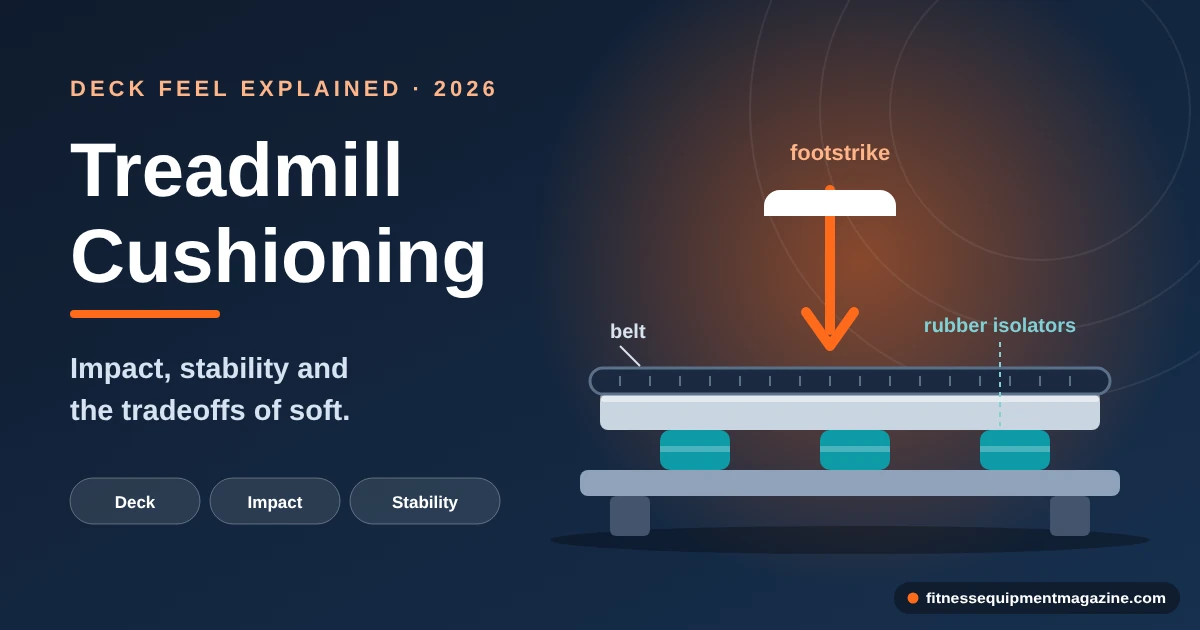
Here’s the thing most listings skip. Treadmill cushioning isn’t a single feature you can rate from one to ten. It’s the result of a deck board, a belt, a set of rubber or spring elements and a frame all working together. Change any one of them and the “feel” changes. That’s why two machines with the same marketing words can feel nothing alike, and why one machine can feel soft at a walk and oddly springy at a jog.
The short answer
Good treadmill cushioning is firm enough to feel stable and soft enough to take the sting out of each footstep. It isn’t the softest deck you can find. The right amount depends on your speed, your body weight, how you move and what the machine sits on.
- Who it matters to: runners, joggers, older adults who walk daily, heavier users, and anyone sharing a floor with neighbors.
- The biggest tradeoff: softer decks feel kind at a walk, but they can feel bouncy, vague or tiring at speed, and they can wear unevenly.
- The common trap: trusting words like “orthopedic,” “joint-friendly” or “shock-absorbing” without asking what the system is made of and how it’s adjusted.
If you can step on the machine before you commit, do that. If you can’t, read the return policy as carefully as the spec sheet.
How we researched this. This is research-based guidance. We built it from manufacturer specification patterns, federal guidance and ownership problems that buyers commonly report. We haven’t hands-tested the machines described here, so you won’t find lab numbers, decibel readings or “our testers” claims. We name no brands and quote no prices. Descriptions of how systems behave are general and vary by design, so verify details against the current spec sheet. Nothing here is medical advice. Last reviewed: October 2026.
What treadmill cushioning actually is
Picture a hardwood floor and a gym mat. You can walk on both, but the mat gives a little under your heel. Treadmill cushioning is an attempt to build that mat into the machine, with one extra requirement. It has to stay level, quiet and predictable while a belt moves under you at a set speed.
The job description
A cushioned deck does three things at once. It lets the deck surface move down a small amount when your foot lands, so the peak of the force is spread over a little more time. It then returns most of that movement so the surface doesn’t feel mushy. And it keeps vibration from traveling into the frame, the floor and the room.
Notice what’s missing from that list. Nothing in it says “protects your joints.” The deck can make landings feel gentler, and many people find that more pleasant. That’s a comfort claim, and it’s the only kind this guide will make.
Why it isn’t one feature
Spec sheets often list treadmill cushioning as a single line, something like “advanced shock absorption.” In practice the feel comes from several layers. The belt has its own thickness and texture. The deck board has its own stiffness. Isolators or springs sit between the board and the frame. Then the frame, the feet and your floor decide how much of the remaining movement reaches the room.
That’s why this guide spends its first half on parts and only then talks about shopping. If you understand the stack, a vague marketing line stops being a mystery. For the broader picture of how treadmill cushioning fits next to motor, belt and warranty, our treadmill buying guide covers the full checklist.
What to expect from this guide
We’ll cover the four common system types, the reasons a softer deck can backfire, how different users experience the same surface and where noise and floors come into it. After that comes the marketing vocabulary, a plan for evaluating a machine without overclaiming, adjustability, aging and a short, careful section on joints. Along the way you’ll meet five hypothetical shoppers who show how the decisions play out.
One caution up front. Everything here is general. Designs vary a lot, and a specific machine can break any rule below. Treat the guidance as a way to ask better questions, not as a verdict on any product.
Deck, belt and frame: where the feel comes from
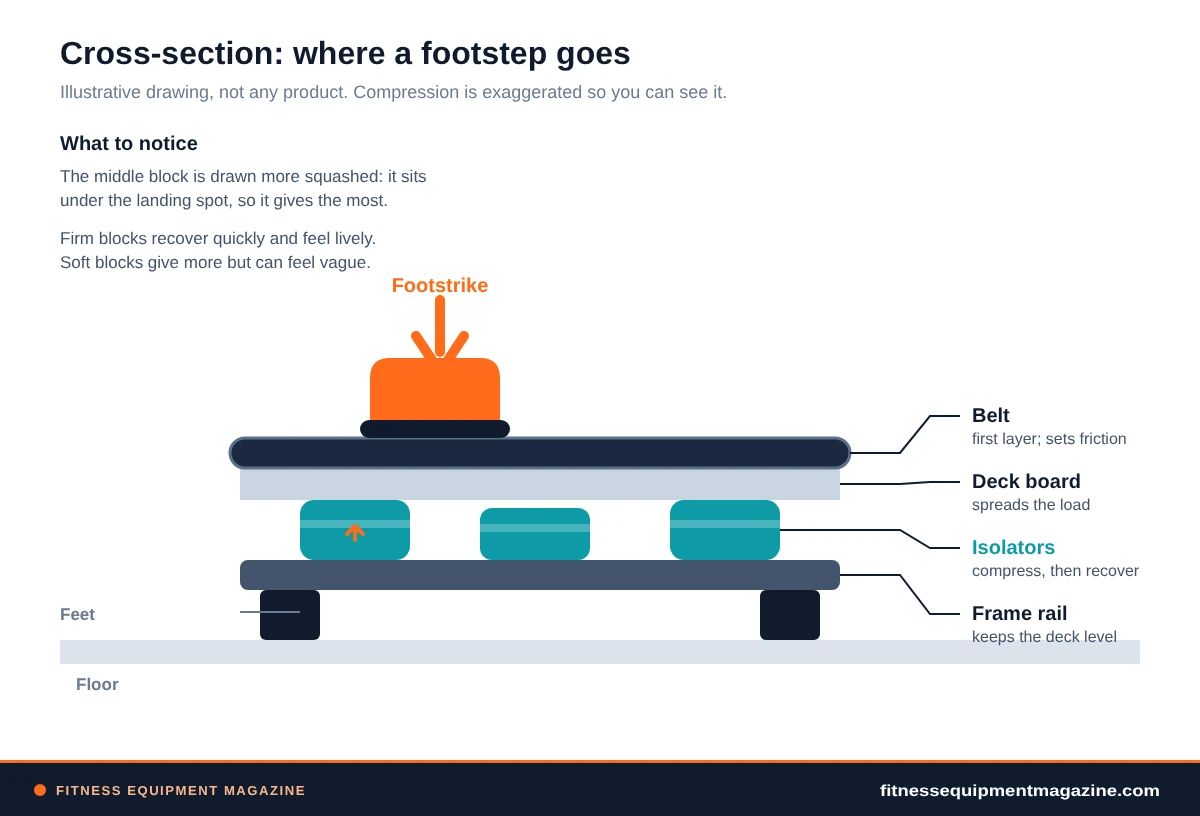
Before comparing systems, it helps to know the layers. Walk through them from the top down, because that’s the order your foot meets them.
The belt: the first layer you notice
The belt is the thin layer that touches your shoe. Most are multi-ply, with a textured top and a low-friction underside. A thicker belt can feel a touch more forgiving, but it’s a small effect next to the deck. The belt’s bigger role is friction. If the belt drags on the deck, the motor works harder and the surface feels sticky, which is a different complaint from “too hard.”
Belt size also matters for how comfortable a stride feels. If you’re unsure which dimensions suit you, our guide to treadmill belt size walks through length and width.
The deck board: stiffness sets the baseline
Under the belt sits the deck, usually a coated wood-based board. Thickness and construction vary, and a thicker board is not automatically softer. A thick board can actually be stiffer, because it resists bending. Many manufacturers pair a fairly rigid board with treadmill cushioning elements below it, so the board spreads your footstep and the elements do the giving.
Some designs go the other way and let the board itself flex. That’s the “flex deck” idea, and we’ll look at it in a moment.
Isolators and springs: where the give happens
Between the board and the frame sit the parts that compress. These are commonly rubber or elastomer blocks, sometimes springs, sometimes both. Their number, position and hardness decide how the deck moves. Four soft blocks at the corners behave very differently from a row of firmer ones under the landing zone.
The frame and the floor: the quiet partners
A stiff frame keeps the deck from twisting, which keeps the feel consistent from one side to the other. A flimsy frame can add its own wobble, and that’s easy to mistake for “soft” cushioning. Finally, the feet and the floor decide where leftover vibration ends up. A concrete slab swallows it. A wooden floor over an apartment ceiling can pass it along.
Quick mental model
Think of the feel as a sandwich. Belt on top, board in the middle, give underneath, frame and floor as the plate. If any layer is wrong, the whole sandwich tastes wrong, even when the other layers are fine.
Four treadmill cushioning systems compared
Manufacturers use plenty of branded names, but nearly all of them fall into four families. A few machines mix more than one. Knowing the family tells you what behavior to expect before you ever step on.
1. Elastomer (rubber) isolators
This is the workhorse. Blocks of rubber or similar material sit between the deck and the frame, often at the corners and along the rails. Harder compounds feel firmer, softer ones feel kinder. Because rubber absorbs vibration as well as movement, this design tends to be quiet. Its weak spot is age, which we’ll get to in the wear section.
2. Springs
Coil springs compress readily and return energy quickly. That gives a livelier feel. It can be great for someone who likes a bit of rebound. It can also feel bouncy if the springs are soft for the user’s weight. Springs on their own are less effective at damping noise, so well-built designs usually pair them with rubber.
3. Flex decks
Here the deck board is meant to bend slightly under load, held at the ends by supports. The middle gives the most, and the ends stay firm. The idea is simple and has few moving parts. The tradeoff is that the feel changes with where you land. A short walker who stays near the front will feel something different from a tall runner who drifts toward the middle.
4. Variable-zone designs
Zoned designs use different hardness in different places. Many descriptions put softer elements under the landing area and firmer ones toward the push-off end, so the foot lands gently and leaves from a stable surface. It’s a sensible concept. Whether it feels right depends on whether your actual stride lines up with the zones, a point we’ll test later in the hands-on section.
Reading the listing
If a product page names a family (“rubber isolators,” “spring-assisted,” “flex deck,” “zoned”), you’ve learned something useful. If it only says “advanced treadmill cushioning technology,” you’ve learned almost nothing. Ask the seller what the system is made of.
Why softer isn’t always better
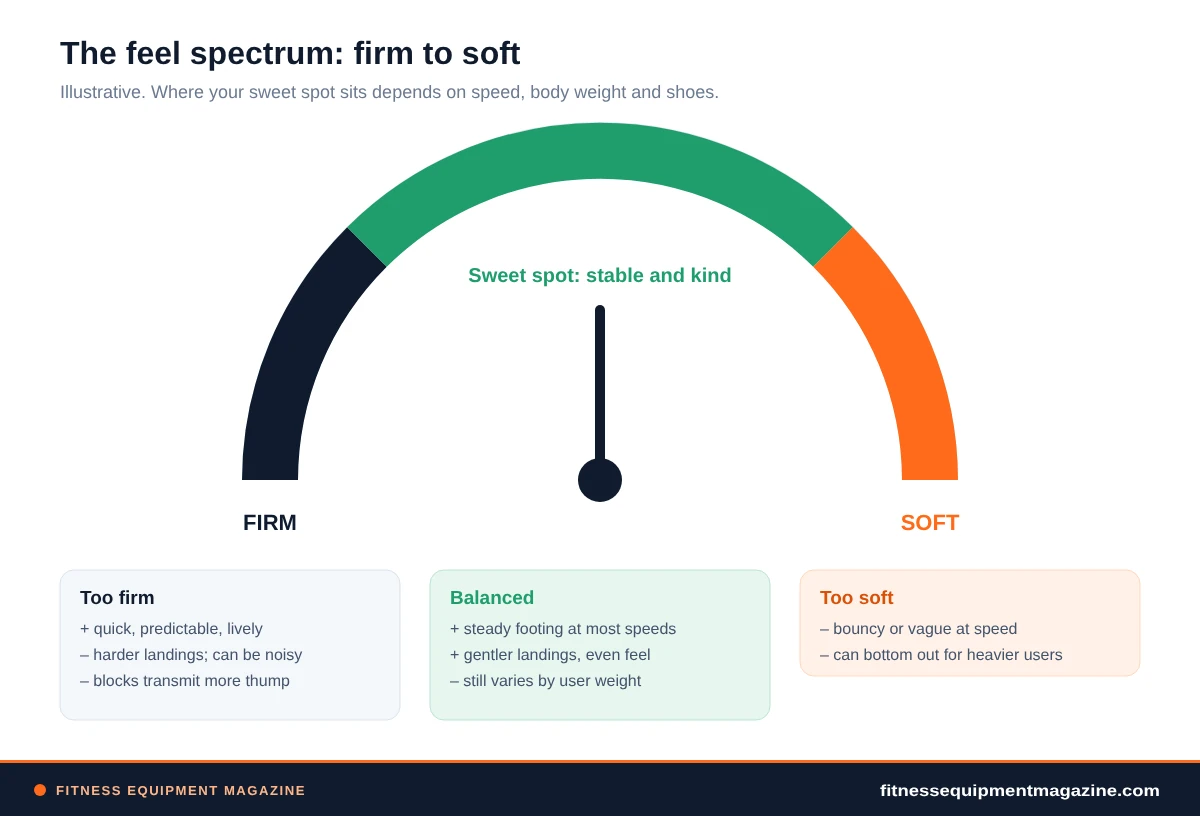
It’s tempting to assume that more give means more comfort. For slow walking on a short session, that’s often true. Past that point, several problems start to show up.
Stability: soft surfaces move under you
A very soft deck lets your foot sink and then settle, and that sinking asks your ankle and hip to make small corrections. Over a short walk you won’t notice. At a faster pace or on a longer session, the extra stabilizing work can feel tiring or wobbly. A firm, predictable surface lets your body run on autopilot.
Energy return: giving some back
Every soft element stores a little energy as it compresses and returns most of it. The part it doesn’t return turns into heat. A surface that returns a good share feels springy and efficient. One that returns too little feels like walking on sand, and many people describe it that way. Heavier decks with soft rubber can feel dull for exactly this reason.
Those are owner impressions, not measurements, and they vary with speed and body weight. Still, they explain why a surface that feels lovely at 3 mph may feel flat at 6.
Ankle feel at speed
At a jog, your foot spends a short time on the deck. A surface that takes a moment to recover can interfere with that rhythm. Runners often say they want the deck to feel “quick,” meaning it settles and returns before the next step. This is why the guidance in our best treadmill for running guide leans toward firmer, more consistent treadmill cushioning than a walker would choose.
Bounce and the resonance problem
Every cushioned deck has a natural bounce rate, like a diving board. If your stride rate lands near it, the deck can start to feel like it’s bobbing in time with you. Light users on a stiff setup rarely notice. A heavier user on soft elements, or a lighter user on a very soft deck, can get this effect. It’s one of the main reasons a spec that “feels great” in a store can feel odd at home.
Heavier users and compression
More weight compresses the same elements further. A deck that feels supportive to a lighter user can feel mushy or bottom out for a heavier one. Bottoming out means the rubber compresses fully and the deck feels suddenly hard at the end of travel. If you’re near the upper end of a machine’s stated user weight, firmer cushioning is usually the safer bet. Our buying guide’s section on user weight explains why that rating matters.
Watch for this
If a deck feels great for the first minute and odd by minute ten, that’s useful information. Short demos flatter soft cushioning. Plan a longer test, or choose a seller whose returns let you run the experiment at home.
Walkers, runners and older adults feel it differently
The same deck can be a good match for one person and a poor one for another. Speed, stride and body weight change what “right” means. Here are the main groups, with the caveat that individuals vary widely.
Walkers
Walking is gentle on the deck. Forces are lower and the foot stays in contact longer, so a moderately soft surface usually feels pleasant. Walkers also tend to cover long sessions, which is where a very soft deck can start to feel tiring. A gentle middle ground, with a stable feel and a little give, tends to suit people who stack up hours of easy walking. If your treadmill is mainly a walking machine, our best treadmill for walking guide covers the other features that matter.
Runners and joggers
Running lands harder and faster. Forces are commonly described as a multiple of body weight, noticeably higher than in walking. Runners usually want cushioning that takes the edge off without slowing the deck’s recovery. Consistency matters as much as softness. If the deck feels different in the middle than at the front, your stride has to adapt every step. Many runners choose a firmer feel for speed work and accept a slightly harder landing as the price of a lively, predictable surface.
Shoes matter here too, and often more than people expect. A cushioned shoe on a cushioned deck can feel doubly soft. A firmer shoe on the same deck can feel balanced. Treat the pair as one system.
Older adults
For older adults, stability usually outranks plushness. A deck that moves a lot underfoot can be unsettling, particularly when someone steps on and off or changes speed. Gentle, even cushioning that doesn’t wobble is generally a better fit than a soft, bouncy feel. Handrails, a slow start speed and a safety key often matter more than the deck, and our guide for older adults covers those in detail.
The federal HHS Physical Activity Guidelines describe weekly activity targets for adults, including older adults. A comfortable, steady surface can make regular walking easier to keep up. It isn’t a substitute for advice from a clinician about your own situation.
Heavier users
Heavier users compress treadmill cushioning more, so a medium-soft setup for a lighter person can behave like a very soft one. Look for machines with a generous weight rating, a stiff frame and cushioning that doesn’t bottom out. Our look at the best heavy-duty treadmill criteria explains how frames and motors back this up.
One machine, many people
Households rarely have a single user. A walker, a jogger and a teenager may share a machine. In that case the best answer is often moderate cushioning and, if available, a way to change it. We’ll look at adjustability shortly.
Treadmill cushioning, vibration, noise and your floor
Cushioning doesn’t just serve your feet. It also decides what the building hears. Every step sends energy down through the deck, and what happens to it next explains many noise complaints.
Absorbed versus transmitted
Well-designed isolators do two jobs. They let the deck move for your foot, and they keep that motion from rattling the frame. Poorly matched or worn isolators can do the opposite, passing a sharp thump straight through. If a machine feels soft but sounds loud, the elements may be soft in the wrong way: compliant to your foot, yet rigid to the structure.
Your floor changes the answer
Concrete slabs hide a lot. A wooden floor on joists acts like a drum skin and sends low-frequency thumps into the room below. A cushioned deck helps, but it can’t override the floor. This is where a dense rubber mat, a stable placement near a wall or a load-bearing beam, and a level machine all contribute. Our treadmill noise in an apartment guide goes deep on these tactics.
A mat is not extra treadmill cushioning
Many buyers put a thick mat under the machine and expect a softer ride. Mats mostly protect the floor and reduce vibration and walking-off creep. A soft mat under a treadmill can also make the frame wobble, which makes the surface feel less stable. If you want a mat, choose a dense, firm one and keep the machine level.
Neighbor test
Ask someone to stand in the room below while you walk and then jog for a minute or two. Low thumps usually come from structure and isolation. High rattles usually come from loose parts. The two problems have different fixes.
Marketing terms, decoded
Product pages are full of treadmill cushioning words. Some describe real design choices. Others are decoration. Here’s how to read the common ones.
What the words usually mean
Common
“Shock absorption”
A generic term. Look for a named mechanism, such as rubber isolators or springs, and a count or location.
Usually real
“Zoned” or “variable”
Suggests different hardness in different spots. Ask how many zones and where the softest one sits.
Check
“Orthopedic” or “joint-friendly”
Not a regulated treadmill cushioning standard. Treat it as a comfort claim, and ignore any health promise attached to it.
Vague
“Advanced” or “premium”
Tells you nothing about construction. If the seller can’t explain it in one sentence, move on.
Percentage claims
Some listings promise something like “reduces impact by a large percentage.” Without the test method, the surface it was compared to and the speed used, that number can’t be checked. A comparison to concrete is a very different claim from a comparison to a competitor. Don’t let a single figure carry your decision.
Reading owner reviews without being misled
Owner reviews are the closest thing to long-term evidence, but they need careful reading. Look for reviews that describe the user’s weight range, speed and floor, because “feels great” means little without that context. Weight early praise lightly, since the first week flatters almost any deck. Reports from the second or third year, such as a new thud or a flatter feel, are far more useful.
Also watch for patterns rather than single stories. One person who dislikes a firm deck is taste. Twenty people describing the same knock at foot strike is a signal. Keep in mind that reviews skew toward very happy and very unhappy buyers, and that we haven’t verified any of them. Use them to decide what to test, not to settle the question.
Questions a good seller can answer
- What are the treadmill cushioning elements made of, and where are they located?
- Is the feel the same across the whole deck, or are there zones?
- Can the treadmill cushioning be adjusted or the elements replaced, and what does a replacement cost?
- Does the warranty cover treadmill cushioning parts, and for how long?
- What’s the stated user weight, and was the cushioning designed for the top of that range?
A clear answer is a good sign. A vague one is information too. Our best treadmills for home use guide shows how these questions fit into a full shortlist.
Treadmill cushioning by machine type
Treadmill cushioning isn’t the same across categories. Where a machine sits on the spectrum from walking pad to full-size runner tells you a lot before you read a single spec.
Folding treadmills
Folding frames add hinges and a lifting mechanism, and designers often have less room for deep isolators. Many folding models still feel good, particularly for walking. A stiffer frame helps, because a flexing frame adds its own bounce on top of the treadmill cushioning. Check how the deck sits when unfolded and whether it feels the same from the first step to the last. Our folding treadmill guide goes through the hinge and latch questions.
Walking pads and under-desk models
Slim walking pads usually have thin decks with simple, low-travel cushioning. That suits slow, steady walking, where forces are modest. It’s less suited to jogging, which is why most makers cap the speed. If you’re comparing these with a full-size machine, the trade-offs are laid out in our walking pad vs treadmill comparison. Expect a firmer, shallower feel, and don’t read that as a defect.
Full-size motorized runners
Larger frames usually carry more elements, more deck mass and a stiffer structure. That tends to make treadmill cushioning more consistent across the deck, at the price of weight and space. It’s also where adjustable or zoned designs are most common. Even so, bigger isn’t automatically better. A heavy, soft system can feel dull, while a lighter, firmer one can feel quick.
Curved and manual treadmills
Curved, self-powered treadmills work differently. The surface is a set of slats, and the feel comes from the slat design, the curve and your own effort rather than rubber blocks under a deck. Don’t expect the same sensation as a motorized deck. Our curved treadmill guide walks through why they feel and behave so differently.
How to evaluate treadmill cushioning without over-claiming
Here’s an uncomfortable truth. You can’t fully judge treadmill cushioning from a spec sheet, and you can’t judge it from a ninety-second showroom walk either. What you can do is stack small, honest tests so that no single impression decides.
Step one: read what the maker will commit to
Start with the written material. Look for the system family, the number and location of elements, the stated user weight and the warranty terms for cushioning parts. Written specifics are more reliable than adjectives. Our full buying checklist explains how to compare warranty structures, which is where cushioning coverage often hides.
Step two: try it, and try it properly
If you can visit a store, bring the shoes you actually exercise in. Then do more than a casual stroll. The sequence below takes about ten minutes and tells you a lot.
- Warm up at your normal walking speed.Notice whether the deck feels the same near the front, middle and rear. Shift your position every minute or so.
- Add speed in small steps.Go to a brisk walk and then a jog if you jog. Pay attention to the moment the surface starts to feel bouncy, vague or harsh.
- Stand still and rock.Shift weight heel to toe while the belt is stopped. Watch how far the deck moves and how it settles.
- Listen from outside.Ask a friend to stand beside the machine and describe thumps, rattles or hum. Your ears are inside the sound.
- Step off and wait a minute.Ask how your feet and calves feel. That’s a useful comfort check, though it isn’t a medical test.
Step three: treat the return policy as part of the spec
If you buy online, which is the common case, the return policy becomes your test lab. Check how long the window is, who pays for return shipping and whether a heavy item needs a pickup fee or repackaging. A machine that takes four hours to rebox is a machine you’ll keep out of politeness. Read the terms before you click buy, not after.
Also check whether the policy covers a “doesn’t feel right” return or only defects. Some retailers treat comfort as a matter of taste and exclude it. That’s worth knowing in advance.
Step four: run a two-week home trial
Once it arrives, use it the way you actually will. Put it on the floor you actually have. Wear the shoes you actually use. Keep brief notes after each session on comfort, bounce and noise. Patterns emerge after a few sessions that no first impression catches.
Safety first
Check the model against the CPSC exercise equipment recalls before buying. If a deck feels unstable, rattles or shifts, stop using it and contact the seller. Don’t improvise repairs on the deck or the frame.
What not to conclude
One more discipline helps. A comfortable first week does not prove a deck is good for your body, and a rough first week does not prove it’s bad. Your comfort is a legitimate reason to choose a machine. It simply isn’t evidence of any health outcome. Keep those two ideas apart.
How treadmill cushioning interacts with speed, incline and the motor
Treadmill cushioning doesn’t work alone. A few other settings change how the same deck feels from one workout to the next, and knowing that keeps you from blaming the wrong part.
Speed changes the whole picture
As speed rises, each footstep lands faster and with more force, and the deck has less time to recover. That’s why a surface that feels perfect at a stroll can feel different at a run. If you change speed a lot, test at the extremes of your range. The middle of your range tells you the least.
Incline shifts where you land
On an incline, most people land more toward the forefoot and take shorter steps. That moves the contact point on the deck and changes how the elements load. Some decks feel noticeably different when tilted, because the front zone does more of the work. Our treadmill incline guide explains how grade changes the workout itself. For this topic, the lesson is simple: test the deck at the incline you actually plan to use.
Motor behavior can feel like treadmill cushioning
Surprisingly, the motor and controller can masquerade as a cushioning issue. A belt that hesitates or surges as your foot lands can feel like a spongy deck. If the feel seems inconsistent but the elements look fine, the drive system may be the real cause. The treadmill motor guide covers what a healthy drive should feel like.
Belt and deck friction
The belt’s top texture and the lubrication under it also color the experience. A grippy, well-lubricated belt feels smooth and predictable. A dry one feels like it’s fighting you. Because these effects stack with the deck’s give, it’s easy to credit or blame the wrong layer.
A simple worksheet for comparing two machines
If you’re stuck between two machines, a short worksheet beats gut feeling. Score each item from one to five for both machines, then compare the patterns rather than the totals. Treat the numbers as your own notes. They aren’t measurements.
What to score
- Stability at your speed.Does the deck feel settled and predictable at your usual pace and your fastest pace?
- Consistency across the deck.Does the feel stay similar from front to back and from side to side?
- Sound at foot strike.Is the thump soft and even, or sharp and rattly?
- Comfort after ten minutes.Do your feet feel relaxed, or are you compensating?
- Written clarity.Does the maker describe the system plainly and cover it in the warranty?
How to read the result
Look for the machine without a low score. A machine that scores a four everywhere will usually serve you better than one that scores five on softness and two on stability. Anything that scores a one on stability or sound deserves a hard look, whatever the other numbers say.
Finally, write down your confidence. If you tested one machine for two minutes and the other for twenty, say so. Honest notes keep you from treating a thin impression as a verdict.
Adjustable treadmill cushioning: what it can and can’t do
Some machines let you change the feel. The idea is attractive, particularly in shared households. The reality is more modest than the marketing suggests.
The common ways to adjust
Adjustability comes in a few forms. Some designs let you slide or rotate hardness-selecting inserts. Others have a lever, dial or console setting that changes how stiff certain elements are. A few let you swap elements for harder or softer ones. Each form has different effort and risk.
- Insert or block swaps: flexible and often inexpensive, though they need basic tools and patience.
- Dials or levers: convenient for sharing, and typically limited to a narrow range.
- Console presets: easy to use, but check whether they change the physical deck or only the label.
The honest limits
An adjustment changes a part of the stack, not all of it. It can’t fix a wobbly frame, a worn belt or a bad floor. It also can’t make a soft system truly firm, or the reverse. The range is the whole story. A dial that moves the feel by a little is a nice touch. A dial that spans soft to firm is rare.
Before you rely on adjustability, ask for the range in plain language, and check whether any change is tool-free and reversible. Mislabelled or hard-to-reach adjusters tend to stay at the factory setting forever.
Setting it up for a shared household
If two people with different weights share a machine, set the cushioning for the one who needs stability most, usually the heavier user or the faster runner. Then check whether the lighter user finds it too hard. That’s easier to live with than a bottomed-out deck. Write the setting on a piece of tape on the frame if it’s adjustable, and move on.
Wear and aging of treadmill cushioning elements
Cushioning isn’t permanent. Elements that compress thousands of times a week change slowly, and the change often arrives so gradually that you miss it. Here’s what generally happens and how to spot it.
What actually changes
Rubber compounds can slowly harden with heat, sunlight and age. They can also develop compression set, where a block stays slightly squashed after thousands of loads. Springs can lose some of their original stiffness, and any fasteners that hold the system can loosen. The result tends to be a deck that feels flatter, noisier or uneven from side to side.
Signs it’s time to look closer
- The deck feels noticeably harder than it did a year ago, with no change in shoes or routine.
- One side sits lower than the other, or the belt tracks differently than it used to.
- New knocks, squeaks or a dull thud appear at foot strike.
- You can see cracks, flattening or crumbling on rubber blocks.
Simple habits that slow the drift
You can’t stop aging, but you can avoid speeding it up. Keep the machine out of direct sun and away from heat sources. Keep it level, because a rocking frame loads some elements more than others. Follow the maker’s belt and deck lubrication schedule, since extra friction forces the elements to work harder. And avoid parking heavy objects on a folded deck for long periods.
When you do see wear, contact the manufacturer before you buy generic parts. The wrong hardness can change both feel and noise, and some warranties exclude self-installed substitutes. If a repair involves lifting or removing the deck, unplug the machine and consider a professional.
Leveling and break-in
Start with the easy part. Place the machine on a flat spot and use the leveling feet until it doesn’t rock. A rocking frame loads some isolators more than others and makes the deck feel uneven from side to side. Then treat the first few sessions as a break-in. Rubber and belt surfaces can feel slightly different after they’ve settled, so don’t judge the final feel on day one.
Lubrication and belt tension
A dry or overly tight belt drags on the deck. You feel that as a sticky, heavy surface, and it can be mistaken for hard treadmill cushioning. Follow the manufacturer’s lubrication and tension instructions exactly. If the maker says the deck is pre-lubricated and needs no service, believe the manual, not a forum post.
What to budget for replacements
Ask early what replacement elements cost and who sells them. Some makers stock them for years. Others treat the deck as a sealed assembly, and a worn system means a repair visit or a new machine. This is worth a line in your shortlist notes. A modest part that’s hard to buy is a bigger problem than a pricey part that’s in stock.
Joint comfort claims, handled carefully
This is the section where marketing gets slippery, so let’s be plain about what we can and can’t say.
Comfort, not treatment
A cushioned deck can make a walk or run feel gentler for many people. That’s a comfort observation. Nothing in this guide says a cushioned treadmill treats, prevents or improves any condition. The research on surfaces and joint health is complicated, and a deck is only one factor alongside shoes, speed, stride, training load and individual anatomy.
Claims to treat with caution
Be skeptical of any listing that promises relief from pain, protection from injury or “joint-saving” results. If a seller makes that promise, ask for the evidence. A responsible company describes how its deck is built and leaves the health claims out.
If you have pain
If you have joint pain, a past injury or a medical condition, talk to a clinician or physical therapist before choosing exercise equipment or changing your routine. They can advise on speed, duration and surfaces for your situation, which no buying guide can do.
Where treadmill cushioning fits in the bigger picture
The most useful thing a comfortable machine can do is make regular activity easier to repeat. The ACSM fitness trends report reflects continuing interest in home exercise, and a machine you enjoy using will beat a theoretically superior one that sits unused. Comfort matters because it supports consistency. That’s all we’re claiming.
Five hypothetical shopper profiles
These are invented composites, not real customers, and none of them is medical advice. They’re here to show how the same treadmill cushioning question lands differently depending on the person.
The apartment walker who wants quiet
Imagine a renter on the third floor who walks 40 minutes most evenings at an easy pace. Noise worries them more than bounce. For this person, rubber isolators with a stiff frame are a sensible fit, since they tend to be quiet and predictable. The deck’s softness matters less than how much of the thump reaches the unit below. A dense mat and a level placement near a load-bearing wall would likely help more than any extra give.
The weekend jogger with new shoes
Now picture someone who jogs three times a week and just bought a plush pair of running shoes. A very soft deck plus soft shoes can feel like running in foam. This shopper would probably be happier with a medium-firm, consistent deck, and a long in-person test at jogging speed. If the machine is meant for running, the criteria in our running treadmill guide apply first and treadmill cushioning second.
The older adult who values steadiness
Think of a retired reader who walks daily at a modest speed and wants to feel secure. A deck that moves a lot may feel unsettling. A steady, even surface with good handrails and a slow start is likely a better match. This shopper should also ask a clinician about their routine, which is general advice for anyone with health questions, and consult our senior treadmill guide for the non-cushioning features.
The heavier user near the weight limit
Consider a shopper close to a machine’s stated user weight. Soft cushioning that suits a lighter person may compress too far here. Firmer elements, a rigid frame and a generous weight rating are usually safer bets. This shopper should ask directly whether the treadmill cushioning was designed for the top of the weight range, and check the return policy before committing.
The shared household with three users
Last, picture a family where a teenager sprints, a parent jogs and a grandparent walks. No single setting will be perfect. A moderate system, ideally with a simple adjustment, serves everyone acceptably. The family might also consider whether a separate machine, or a different category such as a curved model, would suit the sprinter better. Our piece on curved models covers how those surfaces behave differently.
Common mistakes and myths
Some errors show up again and again in owner discussions. Fixing them before you buy saves time and returns.
Myth versus fact
Myth
Softest is best
Fact: comfort usually peaks in a middle range. Very soft decks can feel unstable, dull or bouncy.
Myth
More treadmill cushioning means more protection
Fact: cushioning changes feel. It doesn’t guarantee any health outcome, and no listing can promise one.
Myth
A mat will soften the deck
Fact: mats mostly protect floors and calm vibration. A soft mat can make the frame wobble.
Myth
Cushioning lasts forever
Fact: elements age with use, heat and weight, so check the feel every so often.
Buyer errors that cost money
- Judging a deck from a one-minute showroom walk at slow speed.
- Buying a plush deck for fast running because it felt great at a walk.
- Ignoring the return window and the cost of sending a heavy machine back.
- Replacing worn elements with generic parts that change the feel or void a warranty.
- Reading a health promise into a comfort feature.
One more tip comes from the bigger picture. If treadmill cushioning is your top priority, don’t let it crowd out the basics. A stable frame, a motor suited to your speed and a clear warranty still matter more than any single deck feature. The complete shopping guide ranks those priorities in order.
Treadmill cushioning FAQ
Questions about feel and comfort
What is treadmill cushioning, in plain terms?
Treadmill cushioning is the set of parts that let the deck give slightly when your foot lands. It usually combines a deck board with rubber blocks or springs underneath, plus the belt and frame. The goal is a surface that feels gentler than a rigid slab without feeling mushy or loud.
Is softer treadmill cushioning better for my joints?
Not necessarily, and nobody can promise that. Softer decks often feel gentler, but they can also feel unstable or tiring. Comfort depends on your speed, shoes, weight and stride. If you have pain or a medical condition, a clinician or physical therapist is the right person to ask, not a product page.
How do I know if a treadmill deck is too soft?
Common signs include a bobbing feel in time with your stride, a sense of sinking at heel strike, or a surface that feels flat at speed. Heavier users may notice the deck bottoming out. If it feels fine for a minute but odd after ten, take that seriously and test longer.
Questions about buying and upkeep
Do cheaper treadmills have worse treadmill cushioning?
Often they have simpler systems, such as fewer or less refined elements, but price alone doesn’t decide the feel. A well-matched simple system can feel better than a poorly tuned fancy one. Read the written specs, check the warranty on cushioning parts and use the return window to test it. Our best budget treadmills guide covers where to spend.
Can I add treadmill cushioning to a treadmill I already own?
Usually not in any meaningful way. A mat protects the floor but does not soften the deck, and it can make the frame less stable. Some machines allow element swaps or adjustments, so check the manual and the manufacturer first. Avoid improvised mods, because they can affect safety and warranties.
How long does treadmill cushioning last?
There isn’t a single number. Rubber and spring elements age with use, weight, heat and humidity. Many owners notice a gradual change over several years of regular use. Check for cracks, an uneven deck or new thuds at foot strike, and ask the manufacturer about replacement parts and warranty coverage.
Does treadmill cushioning reduce noise?
It can, because good isolators keep vibration out of the frame and floor. But a soft feel doesn’t guarantee a quiet machine. Floor type, frame stiffness and loose parts matter too. Our guide to quieting a treadmill in a shared building goes into placement and mats.
What treadmill cushioning is best for a walking-only machine?
Most walkers do well with moderate, even cushioning that feels stable over long sessions. Extreme softness tends to tire people on long walks, and extreme firmness can feel harsh. Try the machine at your normal pace for at least ten minutes, in your usual shoes, before deciding.
Conclusion: choosing treadmill cushioning with a cool head
Treadmill cushioning is worth caring about, but it’s easy to overrate. It’s one layer in a stack, and its quality shows up in consistency, stability and quiet more than in raw softness. Aim for a deck that feels steady at your speed, suits your weight and doesn’t make your floor complain.
Here are the next steps. Write down your main use, your weight range and your floor type. Read the maker’s written description of the system. Test at your real speed, in your real shoes, for more than a minute. Check the return policy and the CPSC recall page. Then use the machine for two weeks before you decide it’s right. If you’re still weighing the whole purchase, start with our guide to the right home treadmill and come back here for the finer points.
A short recap to carry with you
- Name the system family before you judge the feel.
- Choose firm and consistent over soft and flashy if you run or weigh more.
- Test at your real speed, in your real shoes, for ten minutes or more.
- Read the return policy and the cushioning warranty as part of the spec.
- Check the feel once a year, and look at the rubber when something changes.
Sources and further reading
- HHS Physical Activity Guidelines — federal guidance on weekly activity for adults and older adults
- CPSC exercise equipment recalls — check model safety history before you buy
- ACSM top fitness trends for 2026 — context on interest in home exercise
Some links on this site may be affiliate links. If you buy through them we may earn a commission at no extra cost to you. Recommendations are based on the criteria in the article, not payout. This article is general information about equipment and isn’t medical advice; talk to a qualified professional about your own health and training. Specs, warranties and recalls change, so verify them with the manufacturer and the CPSC before you buy. Last reviewed: October 2026.