The manual vs motorized treadmill question sounds like a simple one: do you want a machine with a motor, or one that runs on your own legs? In practice it’s really four questions wearing one coat. How much do you want to spend over five years? How should the belt feel under your feet? How much floor can you give up? And who else in the house will step on it?
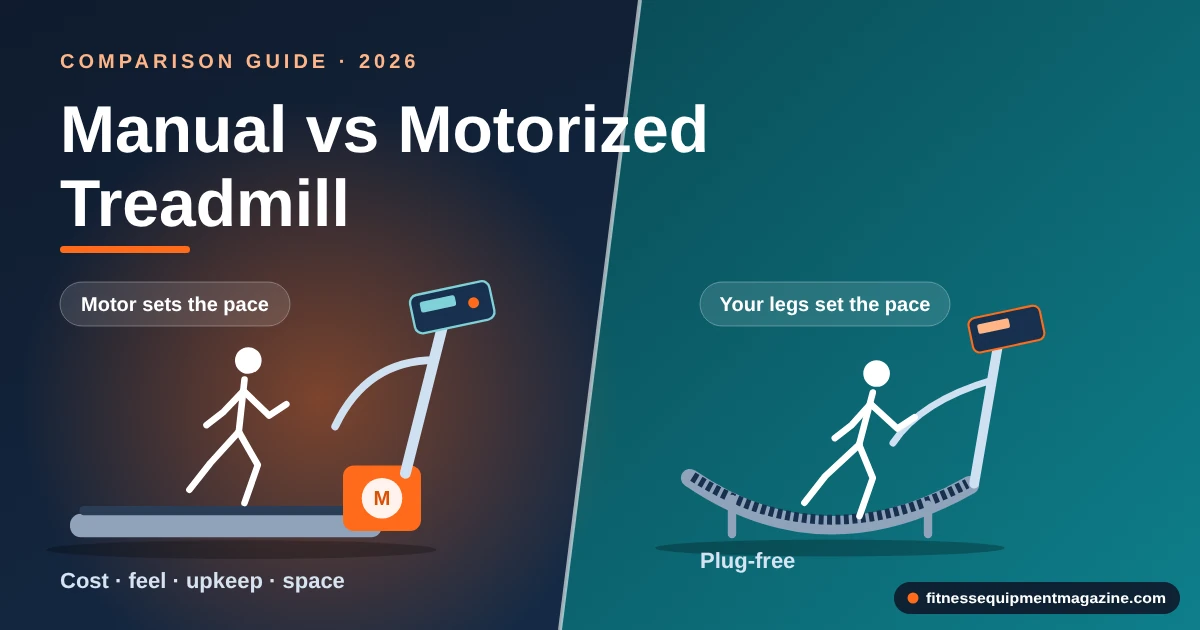
Picture two garages. In the first, someone taps a button, the belt hums up to 3.5 mph, and they read a book on a tablet while they walk. In the second, someone leans into a curved deck, leg-drives the belt into motion, and is breathing hard forty seconds later. Both are “treadmill workouts.” They share almost nothing else. This manual vs motorized treadmill guide walks through where the two designs really differ, and where the marketing says they differ but the daily experience doesn’t.
The short answer
In a manual vs motorized treadmill contest, for most households, a motorized treadmill is still the easier, safer and more flexible pick, especially for walking, beginners, older adults, and anyone who wants a fixed pace. A self-propelled machine earns its place when you want a quiet, plug-free, effort-driven workout and you have the budget, floor space and patience to learn it.
- Who each fits: motorized suits steady walkers, mixed households, long runs and incline work. Manual suits short, hard, sprint-style sessions and people who dislike cords, motors and belt-speed settings.
- The biggest tradeoff: a motor gives you control over speed. A manual machine gives you control over effort, but you give up the ability to “set it and forget it.”
- The common trap: assuming a non-motorized machine is the cheap option. Basic flat-belt models can be, but the best-known self-propelled designs often cost as much as a good motorized treadmill, or more.
The rest of this guide shows why, one factor at a time, and ends with a short decision flow you can follow in about two minutes.
How we researched this. This is research-based guidance. We built it from manufacturer specification patterns, federal guidance and ownership problems that buyers commonly report. We haven’t hands-tested the machines described here, so you won’t find lab numbers, decibel readings or “our testers” claims. We name no brands and give no prices for specific products. Ranges and sizes are typical patterns that change often, so verify every one against the current spec sheet and return policy. Last reviewed: October 2026.
How current is this?
Specs, prices, warranties and recalls shift every few months. Treat the sizes and ranges here as typical patterns, not quotes. Before you buy anything, read the manufacturer’s current spec sheet and warranty page, then check the CPSC exercise equipment recall list for the exact model.
What a Manual vs Motorized Treadmill Really Is
Before comparing anything, it helps to pin down the words. Retailers use “manual,” “non-motorized,” “self-powered” and “curved” almost interchangeably, and that blur causes real shopping mistakes. So let’s separate the three machine families you’ll actually meet.
The motorized treadmill
A motorized treadmill has an electric motor that turns a front roller, which pulls the belt around a flat deck at whatever speed you set on the console. A controller board reads your input, adjusts the motor, and keeps the belt moving at a steady pace no matter how hard you push. You step on, press start, and the machine does the moving.
That arrangement explains most of what people like and dislike about it. The pace is predictable, the incline is usually motorized too, and the console can run programs. On the other side, there is a motor, a controller, a power cord and a set of electronics that can fail. The machine also has a minimum footprint driven by its long deck and rear safety zone. If the motor question is your next stop, our treadmill motor guide explains horsepower claims in detail.
The flat-belt manual treadmill
A flat-belt manual treadmill has no motor. You push the belt backward with your feet, and the rollers, bearings and sometimes a small flywheel carry it from there. A flat belt on a level deck resists movement a lot. So makers typically add a built-in slope, an adjustable resistance brake, or both, so the belt moves without a heroic effort.
These are usually the least expensive way to get a treadmill-shaped object into your home. They are also the category with the widest quality gap. A well-built one can be a decent walking tool in a small room. A weak one can feel jerky, with a belt that stalls between steps and a stride that never settles. If you’re considering one mainly because it’s cheap, read our guide to the best budget treadmills first, since a modest motorized walker is sometimes the better deal.
The curved manual treadmill
A curved treadmill replaces the flat belt with a row of slats riding on a concave deck. Your foot lands on the front slope, gravity and your stride roll the belt back, and you accelerate by driving forward and up the curve. Pace comes from effort alone. There’s no speed button because there’s no motor to obey it.
This design is the one most people picture when they hear “manual treadmill” in a gym context, and it deserves its own deep dive. We keep that discussion in our curved treadmill explainer. Here, we treat it as one end of the comparison, because for the manual vs motorized treadmill decision it behaves very differently from a flat manual belt.
A look inside
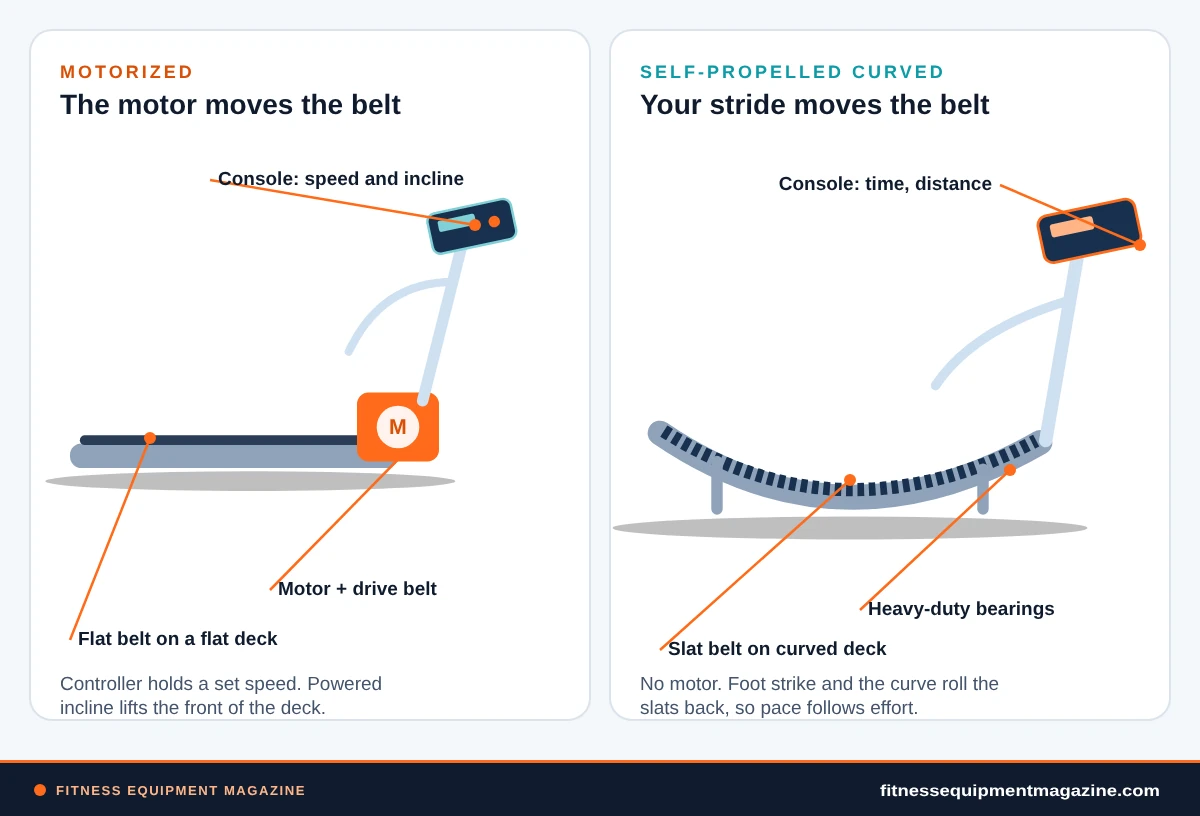
Words only go so far in a manual vs motorized treadmill comparison, so the cutaway below shows where the work happens in each family. Notice how little a flat manual machine has compared with a motorized one, and how much steel a curved deck carries.
A vocabulary note that saves money
Listings sometimes call a motorized treadmill with a hand-adjusted incline a “manual incline treadmill.” That machine still has a motor. Likewise, “manual” in a product title sometimes describes only the fold, the lubrication or the incline lever. When a listing says “manual,” ask one question: what turns the belt? If the answer is a motor, you are shopping the motorized column of the manual vs motorized treadmill debate, whatever the title says.
Manual vs Motorized Treadmill Training Feel: Walking, Running and Intervals
Here is the part spec sheets can’t capture about a manual vs motorized treadmill. The same person, at the same body weight, will feel a different workout on each design, even when the display reads the same speed. The difference comes from who controls the belt.
Walking
On a motorized machine, walking is passive in the best sense. The belt arrives at your set pace, you match it, and your attention goes somewhere else: a podcast, a video call, a hard look at your inbox. That’s why motorized machines dominate desk setups and daily step goals. Our comparison of a walking pad vs a treadmill goes further into that lifestyle case.
On a manual machine, walking asks for a small, constant push. A good curved deck makes a slow walk feel natural after a few sessions, but you do stay engaged with the belt. Most people find it harder to read, type or talk comfortably, since the pace drifts with every step. If your goal is easy, distracted minutes, that drift is a feature you don’t want.
Running
Running is where preferences split. A motorized belt hands you a metronome. You can lock in a pace and hold it for 40 minutes, which suits steady-state training and anyone following a plan written in minutes per mile. The belt does some of the work of moving your foot backward, so your effort goes into staying upright and keeping rhythm.
A curved machine removes that help. Because you push the belt, you run at an effort that feels closer to hill work, and many runners describe a more forward, midfoot-friendly stride. Those are experience reports, not guarantees, and nothing here promises a particular benefit. What you can count on is that you’ll tire faster at a given pace, and that a flat manual belt rarely supports real running at all.
Plan for it
If you switch from a motorized treadmill to a self-propelled one, expect your first sessions to feel harder and shorter than the numbers suggest. Treat the display as a rough guide, cut your first sessions well below your usual time, and let the stride settle before you judge the machine.
Intervals
Interval work shows the contrast most clearly. On a self-propelled machine, you start a sprint the instant you decide to, by driving forward. The rest period is just you slowing down. There is no console to program and no seconds of waiting for a belt to ramp.
A motorized treadmill handles intervals too, but with a delay. You press a speed key or the machine runs a preset, and the belt accelerates over several seconds. That lag is predictable, and many athletes like it, because speed jumps are controlled. It’s also a little awkward for short sprints under about 20 seconds. We’d call motorized the better tool for structured intervals with a plan, and self-propelled the better tool for all-out efforts you decide on the spot.
None of this makes either side of the manual vs motorized treadmill debate better for every workout. It means your training style should decide the question before the price does.
Speed Control and Consistency on a Manual vs Motorized Treadmill
Speed is the single biggest practical difference in the manual vs motorized treadmill comparison, and it cuts both ways.
Holding a set pace
A motorized treadmill is a pace machine. If your plan says 6.0 mph for ten minutes, you set 6.0 and it stays there until you change it. That consistency matters for pacing practice, for tempo runs and for anyone building toward a race. It also matters for beginners and cautious walkers, who benefit from knowing the belt will not suddenly speed up or slow down.
A self-propelled machine has no set pace. The speed you see is calculated from how fast the belt turns, and it drifts as your stride changes. Good runners learn to feel steady effort instead of steady speed. Many find that a useful skill, but it requires patience, and it makes pace-based training plans awkward.
Can you trust the speed readout?
On a motorized machine, the displayed speed comes from the motor controller and is usually close, though belt wear and load can nudge it. You can check it with a simple test: mark the belt, count revolutions for a minute and compare with the display. On a manual machine, the readout comes from a sensor on a roller, and quality varies a lot between models.
So we’d treat the number on a manual console as a way to compare your own sessions. It isn’t a pace you can quote to a race director. A few lower-cost flat manual machines display only time and rough distance, which is honest about their limits.
Ramp-up and stopping
Motorized belts ramp up over a few seconds and slow down over a few more when you stop. That gentle change is a safety feature, and we cover it in the safety section below. Manual belts do whatever your legs ask. If you stop pushing, the belt stops within a step or two on most curved decks. How quickly depends on the design and on how much momentum you carried.
Incline Options on a Manual vs Motorized Treadmill
Incline is where the manual vs motorized treadmill gap is wide and easy to overlook. Hills change how a workout feels, and what you can adjust differs sharply by design.
Motorized incline
Most home motorized treadmills offer powered incline, often somewhere from 0 to roughly 10 or 15 percent on mainstream models. Some premium machines go higher or even offer decline. You press a button and the deck rises. That makes structured hill workouts simple and lets you change slope mid-session without stopping.
A few budget motorized walkers have manual incline, which means you stop, adjust a mechanism by hand and carry on. It works, but it discourages mid-workout changes. Check which type a listing offers before you assume the console controls it.
Flat-belt manual incline
Flat manual treadmills commonly rely on a fixed slope or a few hand-set positions. The slope does a job: gravity helps pull the belt backward so you can walk without a motor. But the incline is part of the drive, not an extra, so you can’t pick a hill and a flat session separately. Shoppers who want true hill training generally need to look elsewhere.
Curved decks and “built-in hill”
A curved deck bakes a hill into the shape. Because you drive the belt up the curve, effort feels like hill work at almost any pace. A few models allow small tweaks to resistance, and others offer no slope adjustment at all. If you need a precise 6 percent grade on demand, a motorized machine remains the cleaner tool. For a deeper treatment of slopes, see our treadmill incline guide.
Watch the label
A listing that advertises “incline” on a flat manual treadmill may mean only that the whole deck is tilted. That is not the same as adjustable hill work. Look for photos or a spec line that names the adjustment range and how you change it.
Manual vs Motorized Treadmill Cost: Purchase, Electricity and Repairs
Money is where the manual vs motorized treadmill argument gets muddled. So let’s take it in three layers. First, what you pay at checkout. Next, what you pay to keep it running. Finally, what you pay when something breaks. Dollar figures here are deliberately loose, because prices swing with sales, tariffs and shipping, and we name no products.
Purchase price
In the US market in late 2026, motorized treadmills span a huge range, from lower-priced walking-first machines up to premium units that cost many times more. Flat-belt manual models usually sit at the bottom of that range or below it. Curved manual treadmills do the opposite: they typically cost as much as a solid mid-range motorized machine, and often noticeably more, because the slat belt, steel frame and heavy bearings are expensive to build.
So “manual” can mean cheap or expensive, depending on which family you mean. A shopper who sees a low price on a flat manual unit and a high price on a curved one may conclude that manual machines are inconsistent. They are. The cheaper flat ones and the pricier curved ones solve different problems.
Electricity
A motorized treadmill draws power while it runs. During a walk the draw is modest, and it climbs with speed, incline and body weight. Even so, the yearly cost is usually small for typical home use. Think a few hours a week at average US electricity rates. The result is a handful of dollars up to a modest amount, not a line item on your budget. Standby draw from a console left plugged in adds a bit more, which is why some owners switch the machine off at the wall.
A manual machine uses no electricity to run. Its console may take batteries, and a few have small built-in generators. So the manual advantage here is real but small. Don’t let electricity swing a purchase decision unless you run a treadmill for hours every day. It’s one of the weakest arguments in this entire comparison.
Repairs and parts
This is where the stories differ. Motorized treadmills fail in familiar ways: a worn belt, a drive belt that slips, a motor controller board, an incline motor or a console. Parts are widely available for popular designs, and many repairs are within reach of a handy owner. The warranty usually separates frame, motor, parts and labor, and the labor portion is often the shortest. Our treadmill buying guide explains how to read those terms.
Manual machines have fewer electronic parts, so there’s less to go wrong in the console and nothing to go wrong in a motor. What can wear out are mechanical items: bearings, rollers, slats, bushings and the belt itself. Replacement parts, though, can be harder to find for lower-cost flat models, and some are essentially disposable. Curved models tend to have stronger support, but their parts can be pricey and sometimes need a technician.
A five-year view of manual vs motorized treadmill costs
The graphic below stacks the same five-year manual vs motorized treadmill costs for three typical machines. The numbers are illustrative shapes only. What matters is the proportion: the purchase price dominates every bar, electricity is a sliver, and repairs vary most with build quality.
Money rule
If two machines cost about the same, pick on feel and fit, not on running costs. If one costs far less, ask what was cut. For motorized units, it’s usually motor duty, frame mass and warranty. For flat manual units, it’s belt quality and bearings.
Manual vs Motorized Treadmill Safety: Stopping, Belt Speed and Beginners
Treadmills are common enough in homes that the U.S. Consumer Product Safety Commission keeps a running list of exercise equipment recalls, and the usual hazards are falls, belt-related incidents and cord or console faults. That’s general context rather than a verdict in the manual vs motorized treadmill debate. What matters here is how each type behaves when something goes wrong.
What happens when you stop
On a motorized treadmill, the belt keeps moving at set speed until you press stop, pull the safety key or leave the belt. Pulling the safety clip cuts power, and the belt slows within a couple of seconds. That’s reassuring, but it only works if you actually wear the clip. A common scene: the clip hangs on the console, unused, until the day a foot catches the side rail.
On a self-propelled machine, the belt only moves while you move it. If you stumble, the belt generally stops pushing against you. That sounds like a safety win, and in some ways it is. But a curved deck has its own hazard: stepping onto a stationary curved belt, or off a fast-moving one, takes practice. Hands on the rails, a smooth first step and no sudden stops are the usual rules.
Belt-speed control
Motorized machines can run belts faster than a user can handle, so a good one restricts the start speed and makes changes in small steps. Treat a machine that jumps to 3 mph the instant you press start as a warning sign for beginners. A manual machine can’t surprise you with speed. The cost is that nothing helps you hold a slow, steady pace either.
Handrails and posture
Handrails differ more than people expect. Most motorized treadmills have fixed side rails and a console grab bar. Many curved models have rails that are lower and farther forward, and some designs offer only a minimal handlebar. If you need real support, as older adults and anyone unsteady often do, check rail height, stiffness and reach. Test rail reach with the machine off, before you ever step on a moving belt.
Safety first
Wear the safety key on a motorized treadmill every session. Keep kids and pets away from any moving belt. Never step onto a belt that is already moving unless the machine’s manual says it is designed for that. If you have a health concern, talk to a clinician before you start. This site gives general information, not medical advice.
Kids, pets and shared homes
Households with children or animals deserve a separate thought. A motorized treadmill left plugged in, with its safety key in the console, is an invitation to a curious toddler. Pull the key, unplug it when you can, and store the key out of reach. The belt also pulls in loose items such as toys and pet fur, so a quick sweep before use matters.
A manual machine looks harmless, and in one respect it is: a child can’t start it with a button. But a curved deck still has moving slats and a heavy frame, and a child who pushes a slat can send the belt rolling. So treat both designs as exercise equipment, not furniture. Keep them in a room with a door that closes, or at least behind a gate when nobody is training.
Beginners
For a first treadmill, our manual vs motorized treadmill advice leans motorized in most cases. A set pace lets a nervous walker focus on posture, not on pushing the belt. A manual curved deck can overwhelm a total beginner in the first minutes, because starting, stopping and staying centered all require technique.
That said, a coached beginner who wants short, hard sessions can learn a curved machine quickly. Federal guidance suggests adults accumulate regular weekly activity, and the HHS Physical Activity Guidelines count any form of aerobic movement. The best treadmill is the one you’ll use safely. The safer one for you depends on your balance and confidence as much as on the drive type.
Noise, Space, Weight and Assembly
Floor plans and neighbors settle more manual vs motorized treadmill purchases than any feature list. This section is where the two designs stop being abstract.
Noise
A motorized treadmill makes two kinds of sound: the motor and drive system, and your footfalls on the deck. Motor hum is steady and rarely loud on a decent machine; the thump of running, especially on a thin floor, is what neighbors hear. We cannot give decibel readings, because we haven’t measured any, and we’d distrust any listing that quotes one without a method. Mats and placement help with the thump more than the hum.
Manual machines remove the motor hum. In exchange, a curved deck adds the rumble of slats rolling over bearings, and some people find that louder than a motorized walk. A flat manual unit is often quiet when it works well and squeaky when it doesn’t. So the honest answer is this: manual is not automatically quieter. It is quieter in the one way people expect, and sometimes noisier in another.
Footprint and clearance
Every treadmill needs room behind it, because a fall or a hasty dismount shouldn’t end against a wall. Manufacturers commonly recommend a clear zone of several feet behind the deck, and it’s wise to follow the manual for your model. Curved decks are often shorter than motorized ones but wider-looking from the front, and they tend to need more room beside them for safe stepping on and off.
A third-floor condo, as a test case
Imagine a third-floor condo with a shared wall, a hallway closet and a downstairs neighbor who works nights. A motorized folding walker fits the closet and runs quietly at walking speed, which makes it a natural choice. A curved machine would need a permanent floor spot, a floor that tolerates the weight and a plan for sprint noise. That doesn’t rule it out, but it shifts the cost from the price tag to the logistics.
Now flip it: a detached garage with a concrete slab and no neighbors. The curved machine’s weight and rumble stop mattering, its lack of a cord becomes a plus, and a motorized unit would sit idle in cold weather. Place changes the answer, which is why we ask about the room before the machine.
Weight and moving it
Weight surprises buyers more than size does. A curved manual treadmill is often among the heaviest machines you can buy for a home, since a thick steel frame has to survive hard sprints. Many weigh well over 200 pounds, and some far more. Motorized treadmills vary from light folding walkers to very heavy commercial-style units.
That has practical consequences. A heavy curved machine on a second floor needs a joist check and a plan for the stairs. A folding motorized unit can slide against a wall, while most curved models can’t fold at all. If you move often or share a small space, mobility is a quiet reason to prefer a folding motorized model.
Assembly and delivery
Motorized treadmills ship mostly assembled, apart from the uprights and console, and usually take one or two people an hour or two. Curved treadmills often ship in heavy crates and need two people, plus time for leveling. Flat manual units are the quickest, though cheaper ones sometimes arrive with loose hardware that deserves a second tightening after the first week.
Ask the retailer about delivery before you pay. A “curbside only” delivery of a 300-pound crate is a different purchase from a two-person white-glove drop. Neither design is hard to set up, but both reward a flat floor, a plan for the box and a helper.
Manual vs Motorized Treadmill Maintenance: Belt Care vs Slat Wear
Manual vs motorized treadmill maintenance differs by design, though not as dramatically as marketing suggests. In both cases a little attention early prevents a lot of grief later.
Motorized treadmill care
A motorized machine asks for a few regular tasks. Wipe down the frame and console after use. Vacuum around the motor hood and under the deck, since dust and pet hair drive heat and wear. Check belt tracking and tension periodically, and lubricate the belt deck if your model calls for it. Many modern machines use a pre-lubricated deck with no routine waxing, while others ask for periodic lubricant. Follow the manual for your model, not a forum post.
The motor itself needs little. Owners can listen for new sounds, smell for warm electrical odors and watch for hesitation under load. Those are the signs worth a call to support, not a DIY teardown.
Manual treadmill care
Without a motor, manual machines skip most of the electrical upkeep. A flat-belt model needs the belt kept clean and its rollers checked for squeaks, grinding or looseness. Curved machines add slats, bearings and the sprocket or chain system some designs use. Owners typically inspect the slats for cracks or loose fasteners, clean debris from the track and apply lubricant to bearings only where the manufacturer says to.
Dust and grit are the main enemies. A curved treadmill in a dusty garage can grind itself noisy, while the same machine in a clean room lasts longer. A cover can help, though covering a damp machine in a damp garage can make things worse.
How much time it takes
Plan on a few minutes after each session and a more thorough check every few months. Neither design is a hobby, though a curved treadmill can punish neglect faster than a flat one. Whichever side of the manual vs motorized treadmill split you pick, a short habit helps: wipe, glance at the belt, listen for anything new. Most expensive repairs begin as small noises that nobody mentioned for three months.
Warranty and parts access
Before settling a manual vs motorized treadmill choice, find out how repairs actually work. Does the maker send parts, or does a technician visit? Is labor covered, and for how long? Are slats, bearings and belts treated as wear items outside warranty? A friendly phone line and a clear parts diagram are worth more than an extra year of frame coverage on paper. The questions to ask are in the checklist near the end of this guide.
Consoles, Tracking and Programs
Consoles are where motorized treadmills have the clearest advantage in the manual vs motorized treadmill matchup, and where manual machines are, by design, quite plain.
What motorized consoles do
A motorized console controls speed and incline, runs preset programs, tracks time, distance and estimated calories, and often pairs with a heart-rate strap or an app. Some tie into subscription platforms with video classes, and those subscriptions are an ongoing cost that should be checked before purchase. Even a basic console lets you build a simple interval plan and walk away from it.
Features vary hugely. A budget walker may offer a monochrome display and three presets, while a premium machine includes a large touchscreen. Don’t pay for a screen you won’t use. If a console matters, ask whether core functions work without the subscription.
What manual consoles do
Manual treadmills usually offer a small display: elapsed time, distance, estimated speed, maybe heart rate or calories. Some curved models include modes such as timed intervals or distance goals, and a few connect to apps. The tracking depends on a roller sensor and an algorithm, not a motor command, so treat the numbers as relative.
The simplicity is a mixed blessing. You won’t be lost in menus, and there’s less electronic hardware to fail. But if you want guided programs, automatic cooldowns and pace targets, a manual console can’t provide them. Calorie estimates on both types are rough, and neither design should be treated as a precise measurement of energy burned.
Tracking that actually helps
Whatever you buy, the useful numbers are simple: how long, how often and how hard it felt. A notebook or phone log gives you that on any machine. If you use a heart-rate strap, compare sessions to each other rather than to a published chart. The point of tracking is to see your own trend, not to win an argument with a console.
Longevity: What Actually Wears Out on a Manual vs Motorized Treadmill
People weighing a manual vs motorized treadmill ask which type lasts longer, as if the answer lived in the drive system. It mostly lives in build quality, how the machine is used and how it’s looked after. Still, some patterns are worth knowing.
Motorized wear points
Belts and decks wear, especially under heavy running. Motors and controllers can fail from overheating, power surges or dust. The console and incline motor are other common failure points. A motorized machine matched to the user, meaning a motor rated for the speeds and hours you’ll really use, can run for many years. Undersized motors on stretched-spec budget machines tend to disappoint sooner.
Manual wear points
Without a motor, curved treadmills may last a long time in the electronics sense, but they have heavy mechanical loads. Slats, bearings, drive components and the frame carry a lot of stress. Owners who sprint often subject those parts to shock, so mechanical wear is the thing to plan for. Flat manual machines have light-duty parts, and lifespan depends on the build, with cheaper ones sometimes meant for occasional walking only.
Expected life, honestly
We can’t quote lifespans we haven’t measured, and nobody serious should. What we can say is that a well-built machine of either type, used within its limits and maintained, tends to outlast a bargain machine of either type. Warranty length is a hint, not a promise. A long frame warranty on a machine with a one-year parts warranty tells you where the maker expects trouble.
Longevity habit
Keep the room clean, level the machine, avoid damp garages, and match use to rated limits. Those four habits do more for lifespan than the choice between a motor and no motor.
Myths and Facts in the Manual vs Motorized Treadmill Debate
A lot of shopping advice online repeats the same few claims. Some hold up, some only half do. Here are the ones we see most often, with a plain verdict on each.
“Manual means cheap”
Half true. A basic flat-belt manual treadmill often is cheap. A curved machine usually is not. The word covers two different products, so judge the specific design, its frame and its warranty, not the label.
“No motor means nothing to break”
Mostly false. You skip the motor and controller, which removes some failure points. You keep bearings, rollers, slats, belts and fasteners, and heavy sprint use puts real stress on them. Fewer parts that fail, yes. Nothing that fails, no.
“Manual workouts are always harder”
Not always. A curved deck tends to feel harder at the same displayed speed, but a well-planned motorized session with incline and intervals can be just as demanding. Effort comes from how you use the machine as much as from how it’s built.
“Manual is quieter”
Sometimes. The motor hum disappears, but the slats and bearings make their own sound, and heavy footfalls travel through floors either way. Treat any quiet claim as a reason to read the room layout, not as a guarantee.
“Motorized is only for beginners”
False. Powered incline, steady pacing and long-run comfort make motorized machines the standard for most serious treadmill training. The manual vs motorized treadmill debate is not a ladder where one design is the graduate version of the other. They are different tools.
Who Should Choose Which Manual vs Motorized Treadmill, and Hybrid Cases
After all the details, the manual vs motorized treadmill decision usually comes down to three things. Who you are. What you do on the machine. What your space allows. The profiles below are hypothetical shoppers, offered as patterns rather than real people.
Five shopper patterns
Motorized
The daily walker
Thirty to sixty easy minutes a day, often while working or watching something. You want a quiet, steady belt and a console that stays out of the way. Motorized, ideally a folding walker if floor space is tight.
Motorized
The marathon-plan runner
Your training plan is written in paces and hills. You need a set speed, powered incline and a deck long and wide enough for a real stride. A motorized treadmill makes the plan repeatable.
Manual (curved)
The short, hard-session athlete
Twenty minutes of sprints and hill-like efforts is your idea of a good day. You like not waiting for a belt to ramp. A curved machine suits you if you have the space and budget.
Either, with care
The two-person household
One person walks, one sprints. A single motorized machine covers both, but the sprinter may want a curved model if there’s room. Compare the full cost, including floor strength.
Probably neither
The tiny-apartment occasional user
If you’ll use it a few times a week and have almost no space, a compact walking pad may beat both. Our walking pad vs treadmill comparison covers that case.
Hybrid cases in the manual vs motorized treadmill choice
Some situations don’t fit neatly. A few buyers choose a motorized treadmill for everyday use and add a separate sprint tool, such as a hill, a track or a bike. Others pick a curved machine and walk outdoors for easy days. Gyms often keep both because members want different things. In a home, you rarely have the room or the budget for both, so the real question is which one you’ll use most often.
One more hybrid trap: motorized treadmills that can be “unplugged” to run manually. A few exist, but they are usually not designed to be run that way, and doing so may void the warranty or cause damage. If a listing hints at dual use, read the manual carefully and ask the maker directly.
What to check before you buy either type
Whichever side you land on, a short checklist saves the common regrets. Print it, or keep it on your phone while you shop.
- Measure the room. Length, width, ceiling height and the clear zone behind the deck, plus the path from the door to the spot.
- Check the floor. A heavy curved machine or a long run of hard sprints calls for a solid floor, and for upper-floor homes a quick look at joist direction.
- Read the warranty in plain terms. Frame, motor, parts and labor each have a length. Note which items are called wear parts.
- Ask about parts and service. Who ships belts, slats or bearings, and how long does that take?
- Confirm the return policy. Delivery fees and restocking charges on a heavy machine can be steep.
- Look up recalls. Search the model name on the CPSC list before ordering.
A two-minute manual vs motorized treadmill decision flow
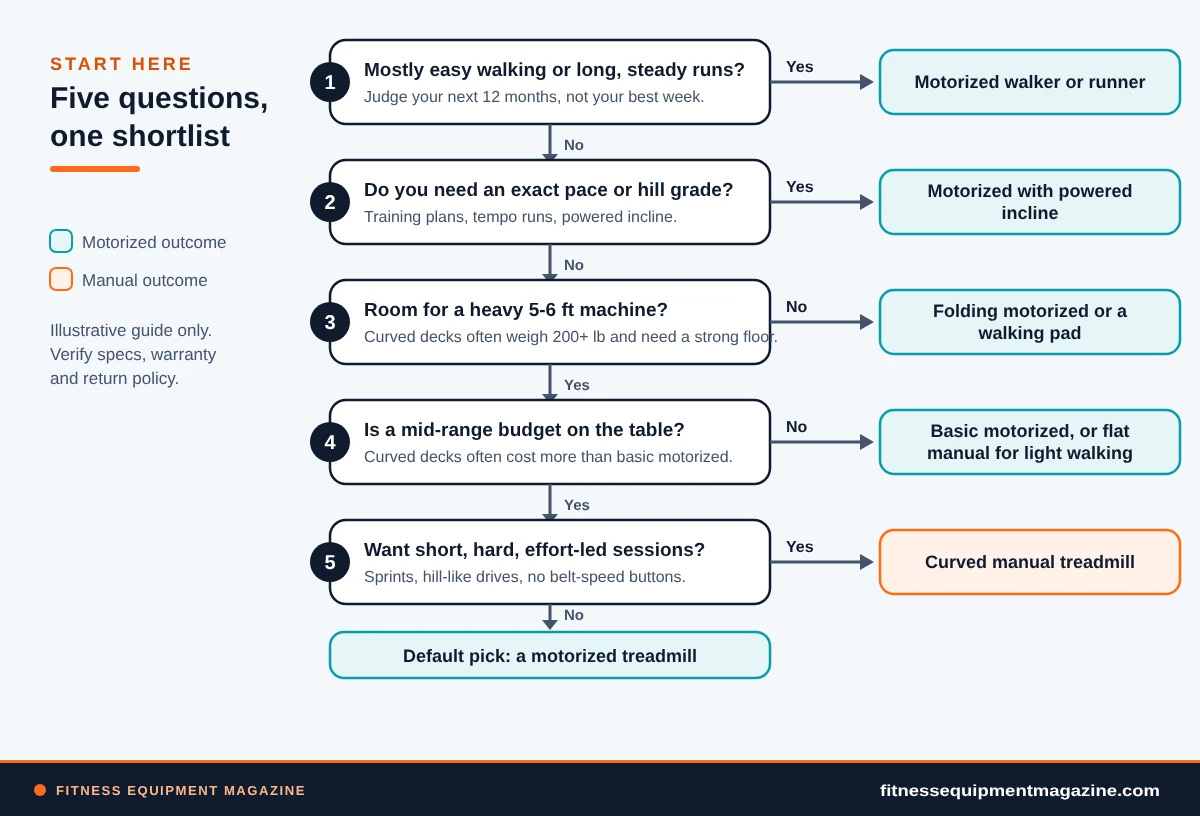
If you like flowcharts, the graphic below puts the manual vs motorized treadmill decision into five questions. Start at the top, follow your answers, and treat the result as a starting point for your shortlist.
If you’re still torn
Return to the basics in our guide to the best treadmills for home use, then narrow the shortlist with the spec checks in the buying guide. A good return policy is the best tiebreaker, since a week at home tells you more than a month of reading.
Questions Buyers Ask
Is a manual vs motorized treadmill a big difference for walking?
Yes, mostly in effort and attention. For walking, the manual vs motorized treadmill gap shows up in focus more than in speed. A motorized treadmill gives a steady belt, so you can read, type or take calls while you walk. A manual machine needs you to push the belt, which suits shorter, more active sessions. For long, easy, distracted walks, most people prefer motorized.
Are manual treadmills cheaper in the manual vs motorized treadmill comparison?
Flat-belt manual models usually cost less. Curved manual treadmills, though, often cost as much as a good motorized machine or more, because the build is heavy and complex. Compare similar quality levels, not categories, and check warranty terms before you decide.
Which is better for running in a manual vs motorized treadmill choice?
It depends on the kind of running. Motorized is better for steady, pace-based training and long runs. A curved manual machine suits short, hard, effort-based sessions. Flat manual belts are generally not good for real running. Choose by training style first, because the manual vs motorized treadmill answer changes with the workout.
Does a manual vs motorized treadmill choice change calories burned?
Many people feel they work harder on a curved machine at the same displayed speed, but we won’t promise a number. Console calorie estimates on any treadmill are rough. Focus on how hard the session feels and how consistently you do it, rather than on one figure.
Is a manual vs motorized treadmill choice a safety question?
Each has different risks. A manual machine can’t run away from you, but starting and stopping on a curved deck takes practice. A motorized treadmill keeps a steady belt but needs the safety key worn. Beginners and anyone unsteady often do better on motorized. Check CPSC recalls for any model.
How much does it cost to run a motorized treadmill?
For typical home use, electricity is usually a small part of ownership, from a few dollars to a modest amount per year depending on use and local rates. The purchase price and repairs matter much more, so do not let power cost decide the manual vs motorized treadmill choice.
Do curved treadmills need maintenance compared with motorized ones?
Yes, but usually less than people fear. Expect to wipe and clean the track, inspect slats and bearings, tighten fasteners and lubricate only where the manual says to. Without a motor, the electrical side is simpler. Dust and heavy sprint use are the main wear drivers.
Can I turn a motorized treadmill into a manual one?
Generally, no. Motorized treadmills are not designed to be pushed by hand, and doing so can strain the motor and drive system or void the warranty. If you want a self-propelled workout, buy a machine built that way and read a full curved-treadmill explainer first.
Which manual vs motorized treadmill option fits an apartment better?
A folding motorized treadmill is usually the easiest apartment fit, because it stores upright. Curved manual machines are heavy and cannot fold. For very small spaces and light use, a walking pad can be a smarter choice. Check your floor and neighbors first.
Manual vs Motorized Treadmill Bottom Line: Pick the Machine You’ll Use
The manual vs motorized treadmill choice is rarely about which technology is cleverer. It’s about the way you move, the room you have and how much hassle you’ll tolerate. A motorized machine remains the safest default: steady pace, powered incline, helpful console, and plenty of folding options. A curved manual treadmill is the better pick for people who want hard, short, effort-led sessions and have the budget and floor for a heavy machine.
Your next steps for settling the manual vs motorized treadmill question are simple. Write down your main use, measure your space, set a real ceiling, then check warranty terms and return policies for two or three candidates. If a motorized model wins, our treadmill buying guide helps you compare the details. If a curved machine tempts you, read the curved treadmill deep dive before you order.
Sources and further reading
- HHS Physical Activity Guidelines — federal guidance on weekly activity for adults.
- CPSC exercise equipment recalls — check any treadmill model for recalls and safety notices.
- ACSM top fitness trends — a yearly look at what is popular in fitness.
Some links on this site may be affiliate links; if you buy through them we may earn a commission at no extra cost to you. Recommendations are based on the criteria in the article, not payout. This article is general information and not medical advice. Last reviewed: October 2026.