Every treadmill buying guide you’ll find online wants to hand you a shortlist, but the shortlist is the easy part. What actually protects your money is knowing what a motor rating means. It helps to know why a 55-inch belt feels different from a 60-inch one, too. And you need to know what a warranty does and doesn’t cover once the box is on your porch. This treadmill buying guide is the long, slow version: every spec explained in plain language, with the traps marked.
The short version of this treadmill buying guide
The short answer
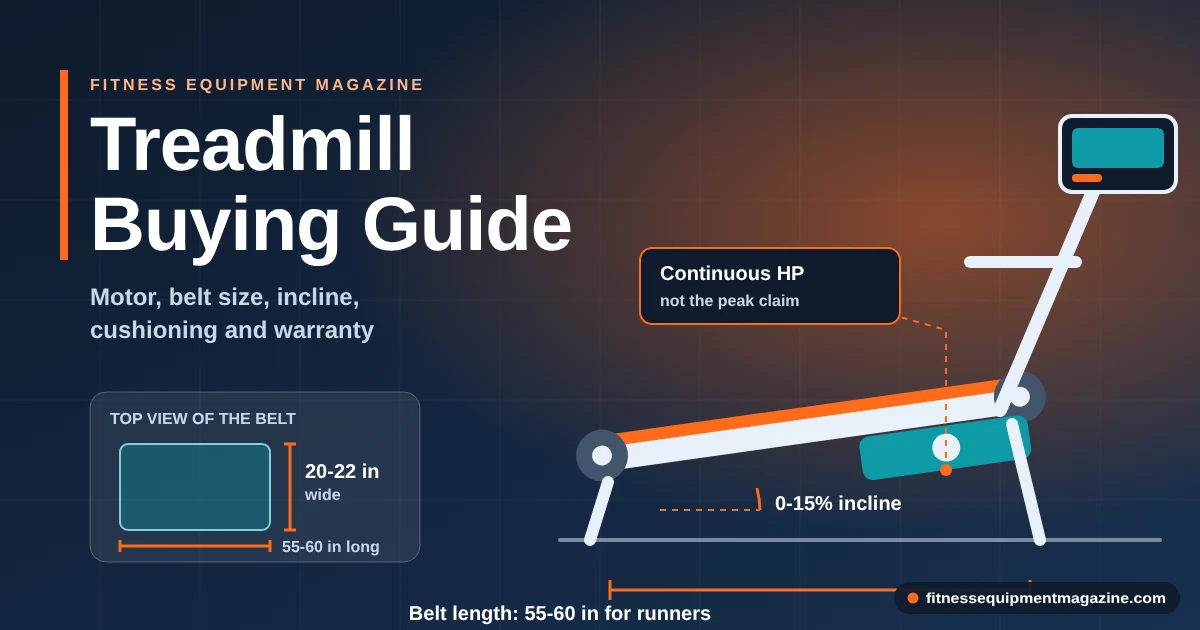
If this treadmill buying guide had to fit in one sentence, it would be this. Buy for the way you move, not for the biggest number on the box. A treadmill that fits your stride and runs on a motor sized for your speed and weight will serve you for years. So will one that comes with a warranty you’ve actually read. A flashy one with a thin belt and a vague warranty will not.
- Walking only: a 2.0 to 2.5 continuous horsepower motor and a belt around 20 by 55 inches is usually plenty.
- Jogging or running: look for roughly 3.0 continuous horsepower or more, and a belt of 20 by 55 inches at minimum, 60 inches if you’re tall or fast.
- The biggest tradeoff: cushioning and size cost space and money, and softer is not automatically better.
- The most skipped step: reading the warranty, the electrical requirements and the subscription terms before you pay.
What we know, and how we know it
How we researched this treadmill buying guide. This is research-based guidance built from manufacturer specification patterns, federal guidance and ownership problems commonly reported by buyers. We haven’t hands-tested the machines described here, so you won’t find lab numbers, decibel readings or “we tried it” claims below. Specs given are typical ranges; always confirm them against the manufacturer’s spec sheet and manual. Some links on this site may be affiliate links. If you buy through them we may earn a commission at no extra cost to you, and recommendations are based on the criteria in the article, not payout.
How current is this treadmill buying guide?
Last reviewed: October 2026. Specs, prices, warranty terms, subscription fees and recalls change faster than most people expect. Treat every range here as a starting point, and check the CPSC recall page before you buy anything, new or used.
What’s inside this treadmill buying guide
How to use this treadmill buying guide
Who this treadmill buying guide is for
This treadmill buying guide sits at the center of our treadmill coverage, so it goes deep on how the parts work. If you only want a short list of machine types matched to rooms and routines, start with our broader piece on choosing the best treadmills for home use. If you’re still deciding whether a full treadmill is the right tool, the comparison of a walking pad versus a treadmill will settle that question faster.
Come back to this treadmill buying guide once you know a treadmill is the answer. Treat it as the reference you keep open in another tab while you compare spec sheets. You don’t have to read it top to bottom in one sitting.
Three ways to read this treadmill buying guide
Not everyone needs every section. Pick the route that matches where you are.
Just starting
Read in order
Anatomy, motor, belt, speed and incline first. Those four sections give you the vocabulary for everything else.
Comparing two machines
Jump to the sheet
Go straight to the spec sheet decoder, the warranty section and the final scorecard, then fill the gaps as questions come up.
Ready to order
Run the checklist
Use the shopping workflow, the electrical section and the recall check. Those catch the expensive surprises.
What this treadmill buying guide won’t do
It won’t name a winner. We haven’t tested machines. And a treadmill that suits a 5-foot-2 walker in a studio apartment is the wrong machine for a 6-foot-4 runner in a garage. Instead, this treadmill buying guide gives you the criteria and the reasoning, and you apply them to the models you can actually buy this month. That’s slower than a ranked list, but it’s also the only approach that doesn’t go stale in six weeks.
Likewise, this isn’t medical advice. We talk about activity in general terms only. If you have a health condition or a recent injury, ask a qualified professional before you set the speed dial anywhere. Do the same if you wonder how hard you should train.
Treadmill anatomy: what you’re paying for
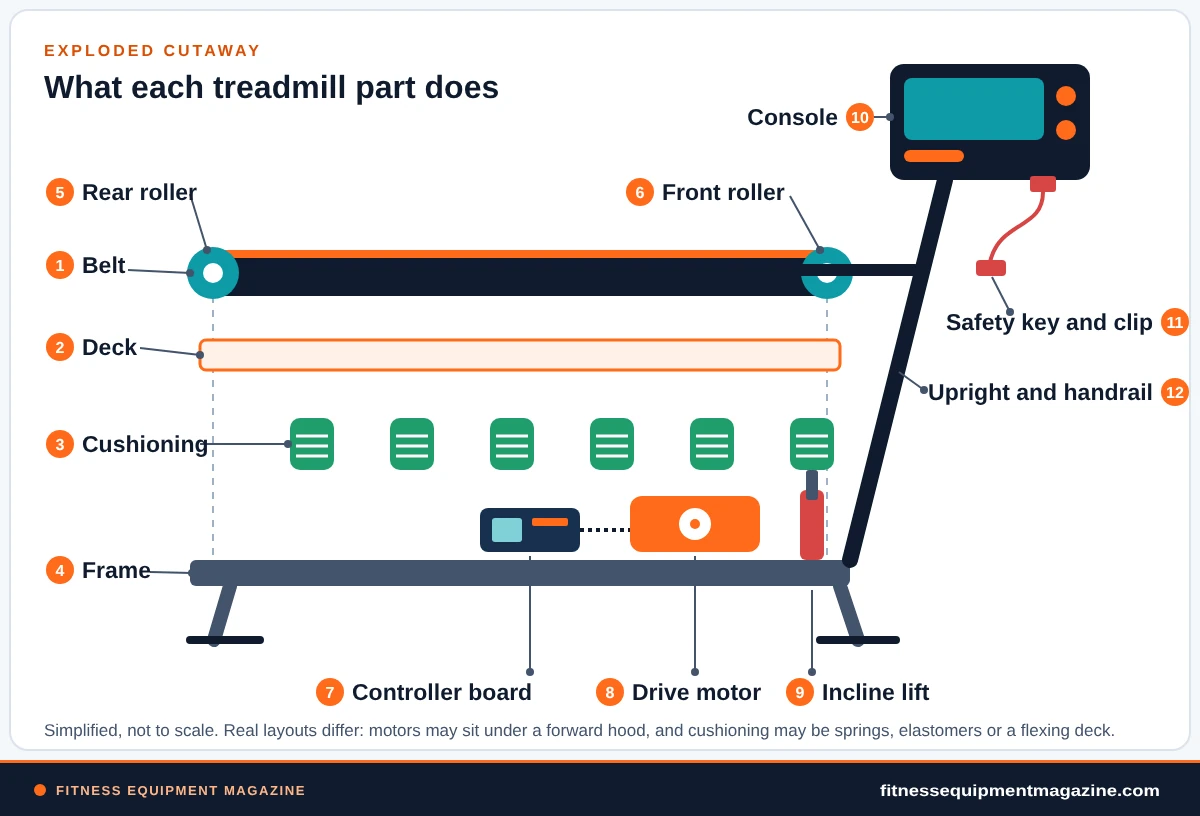
A treadmill looks simple: a belt goes round and you stay in place. Underneath, though, every price difference comes down to about a dozen parts. Once you can name them, a spec sheet stops being a wall of jargon and starts reading like a parts list. Any treadmill buying guide worth reading begins here, so this one does too.
The drive train: motor, controller and rollers
The motor spins the front roller, usually through a drive belt, and the roller pulls the running belt along. A controller board sits between the wall outlet and the motor, and it sets the speed you ask for on the console. When people say a treadmill “died,” the controller or the motor is the usual suspect, so both matter more than the paint job.
The rollers matter too. Wider, heavier rollers spread the load across a larger surface, which tends to mean smoother belt travel and fewer tracking complaints. We’ll return to that in the frame section.
The running surface: belt, deck and cushioning
The belt is the part your feet touch. Beneath it sits the deck, a rigid board that supports your weight, and between the deck and the frame you’ll often find a set of cushioning elements. Together these three control the feel of each footfall: how much it gives, how quickly it comes back and how stable it stays at speed.
The structure: frame, uprights and incline mechanism
The frame holds everything in alignment. If it flexes, the belt wanders, the console shakes and every other part wears faster. The incline mechanism raises the front of the deck, and on most home machines it’s a motorized lift. Cheap machines either skip it or use a manual pin that you set by hand.
The brains: console, sensors and safety key
Last comes the console. It can be a pair of buttons and a small screen, or a tablet-sized display that streams classes. Whichever you choose, the safety key matters most: a clip on a cord that cuts power the moment you drift off the belt. Every treadmill we’d consider has one, and we’ll say more in the safety section.
Reader habit worth building
When a product page lists a feature, ask which of these four groups it belongs to. Keep that habit for the rest of this treadmill buying guide. A “dual-layer 7-zone cushioning system” is a running-surface feature. A “smart AI coach” belongs to the console. Sorting claims into groups makes it obvious when a machine spends its budget on the wrong group for your needs.
Motor: continuous horsepower and duty cycle
The motor is the number everyone looks at first, and it’s also the number most likely to mislead you. Two machines can both say “4.0 HP” on the box and behave nothing alike. The difference is which kind of horsepower the brand chose to print, and a treadmill buying guide that skips this distinction leaves you guessing.
Continuous vs. peak horsepower
Continuous horsepower (often written CHP) describes what the motor can deliver for a sustained stretch without overheating. Peak horsepower describes the highest output the motor can reach for a brief moment. Think of the instant you hit start, or the second the belt lurches under a heavy step. That second figure is a real physical thing, but it says almost nothing about how the motor behaves at minute thirty.
Peak ratings often run well above continuous ones, sometimes by a factor of one and a half or two. So a motor labelled 4.0 peak horsepower might sustain only a little over 2.0 continuous. If the product page gives only one number and doesn’t say which kind it is, treat it as the flattering one.
What duty cycle means in plain language
Duty cycle is the share of time a motor can run at its rated output before it needs a rest. Think of a runner who can hold a steady pace for an hour versus one who can sprint for twenty seconds. Heavy-use motors are built for long, continuous duty, while many light-duty home motors are designed around shorter sessions and a cooldown between them.
Manufacturers rarely print a duty cycle for home machines, but they hint at it. Look for phrases such as “continuous duty,” “commercial-grade” (with suspicion, because there’s no regulated definition) or a stated maximum user session length in the manual. A manual that tells you to rest the machine after thirty minutes tells you a lot about the motor inside.
Why marketing horsepower misleads
There are three common tricks, and none of them requires an outright lie. First, the brand quotes peak instead of continuous, and the page never says so. Second, the number refers to the motor on a test bench, not the motor installed with a controller and belt that waste some of the output. Third, the headline figure sits in big type while the continuous rating hides in the spec table or the PDF manual.
Also, more horsepower isn’t free. A bigger motor adds weight, heat and cost, and it needs a controller and frame to match. A well-matched 3.0 continuous motor in a solid frame beats a larger motor bolted into a flimsy one. The weak link decides how long the machine lasts.
Red flag
A product page that lists horsepower with no qualifier, no continuous figure and no manual to download. When a brand is proud of its motor, it says exactly what the number means.
Motor sizing in a treadmill buying guide: weight, speed and routine
Use this part of the treadmill buying guide as a starting point, not a formula. Three things push a motor harder: your body weight, your speed and how long you go. Incline adds load as well, because the motor lifts you uphill.
- Walking up to about 3.5 mph, lighter user: a continuous rating of roughly 1.5 to 2.0 is commonly enough for casual use.
- Daily walking with some incline, or a heavier user: roughly 2.25 to 2.75 continuous gives more headroom.
- Regular jogging: roughly 2.5 to 3.0 continuous is a common minimum for the mainstream market.
- Frequent running, tall or heavy runners, or shared use: roughly 3.0 to 4.0 continuous and a frame built to match.
These ranges drift with the design, so check how the manufacturer describes the rating. And if two people with very different weights share the machine, size for the heavier one.
A worked example: two people, one question
Take two hypothetical users. The first weighs about 140 pounds and walks at 3 mph for half an hour. The second weighs about 210 pounds, runs at 6.5 mph for 45 minutes and likes a 2 percent incline. Both could buy a machine labelled “3.0 HP,” yet the machine asks very different things of its motor in each case.
For the walker, a 3.0 continuous motor idles along at a fraction of its capacity, stays cool and lasts. For the runner, the same motor works much closer to its limits for far longer, so a 2.5 continuous rating would leave almost no margin. The lesson is not a magic number. The more weight, speed, incline and minutes you add, the more continuous capacity you should buy above the bare minimum.
Signs a motor is working too hard
Owners commonly report a few warning signs. One is a hot-plastic smell. Another is a belt that hesitates or surges at steady speed. A third is a motor hood that feels uncomfortably warm after a normal session. None of these proves a defect on its own. Still, if all three show up on a new machine, call the seller before the return window closes.
Belt and deck size: matching length and width to your stride
If the motor is the number brands inflate, belt size is the one that decides whether you’ll enjoy using the machine at all. A belt that’s too short forces you to shorten your stride, and a belt that’s too narrow makes you watch your feet instead of the TV. Owners commonly say their regrets trace back to size, not motor. That’s why a treadmill buying guide has to give the belt as much room as the motor.
Belt length vs. step length
Walking steps are short, so a belt around 50 inches often works for most adults. Step length grows with speed. At a hard pace, a taller runner can cover four feet or more between one foot landing and the other. The belt must be long enough that you never land on the rear edge.
That’s why commonly cited guidance runs along these lines. Plan on about 50 to 55 inches for walking and 55 inches as a floor for jogging. For running, think 58 to 60 inches, especially if you’re tall or plan to run fast. Check these against your own build, because stride depends on leg length, speed and how you run. No treadmill buying guide can replace a tape measure.
Belt width and the comfort margin
Width is about confidence. At 16 to 18 inches, you have to center your feet and hold still, which suits slow walking but feels tight when you jog. At 20 inches, most people stop thinking about their foot placement. Twenty-two inches adds room for wide-shouldered runners and anyone who drifts.
Narrow belts are also where the compact, folding market lives, so the width tradeoff is usually a space tradeoff in disguise. If you’ve got a small apartment, a 20-inch belt on a folding frame may be the best compromise available. For help weighing the folded footprint, jump ahead to the folding and floor-space section.
Sizes by use case
Walker
Compact walking deck
Roughly 16 to 20 inches wide and 48 to 55 inches long. Fine for steady walking, light incline and tight rooms.
Jogger
The 20 by 55 workhorse
The most common mid-market size. It handles easy jogging for most adults without taking over the room.
Runner
The 20 to 22 by 58 to 60 deck
Built for longer strides, faster paces and taller bodies. It costs more and usually needs more floor.
We cover where each size sits within a realistic budget in the piece on budget treadmills and which features matter most. As a preview, belt length is usually the last thing worth trimming.
How to measure yourself at home before using a treadmill buying guide
You don’t need a gait lab to apply this treadmill buying guide. A tape measure and a hallway will do.
- Mark a start lineTape a line on a hard floor and stand with your toes behind it.
- Walk and run a few stridesMove at the pace you plan to use on the treadmill, then mark where each footfall lands over several steps.
- Measure step to stepMeasure from the landing of one foot to the landing of the other foot. That single step is your working number, and it grows as you speed up.
- Add a marginThe belt should exceed your step length by a generous margin, commonly 10 inches or more, so you can land centered without feeling the rear edge.
Lastly, remember that the “belt length” on a spec sheet sometimes means total belt loop, and the walkable area is shorter. Ask the seller for the usable running surface, not just the belt size.
Quick test in a store
If you can try a machine in person, walk at a brisk pace, then jog briefly. If your eyes drift down to check your feet more than once, the belt is probably too narrow or too short for your build.
Speed and incline ranges: what you will actually use
Product pages love big ranges. “Up to 12 mph and 15% incline” sounds like a promise of power, but most people live in a narrow slice of that span. A smarter move, and the one this treadmill buying guide recommends, is to work out your slice first, then pay only for the range that surrounds it.
Speed range by activity
Typical home treadmills start somewhere between 0.5 and 1.0 mph and top out around 10 to 12 mph, with some performance models going a bit higher. For context, a casual walk sits near 2 to 3 mph. A brisk walk runs around 3 to 4, an easy jog around 4.5 to 6, and a steady run around 6 to 9. Very few home users spend much time above 9.
So a 12 mph ceiling is helpful only if you really run fast or do intervals near it. If your hardest pace is 7 mph, the ceiling matters less than whether the motor and belt feel stable at 7 for a full session. Also look at the low end. Gentle starting speeds matter for slow walking, for returning from a break and for anyone who prefers to step on while the belt crawls.
Speed steps, quick keys and response
Fine increments make a difference. Machines that change speed in 0.1 mph steps let you settle exactly where you want. Those that jump by 0.5 or more feel blunt for interval work. Quick-select keys are a convenience, not a necessity, though they’re nice when your hands are busy.
Response matters as well. Owners commonly report that cheaper machines accelerate with a lag or surge slightly when you change speed. That’s one reason to read reviews for the words “hesitates” and “surges” rather than just star ratings.
Incline and grade in a treadmill buying guide: slope geometry explained
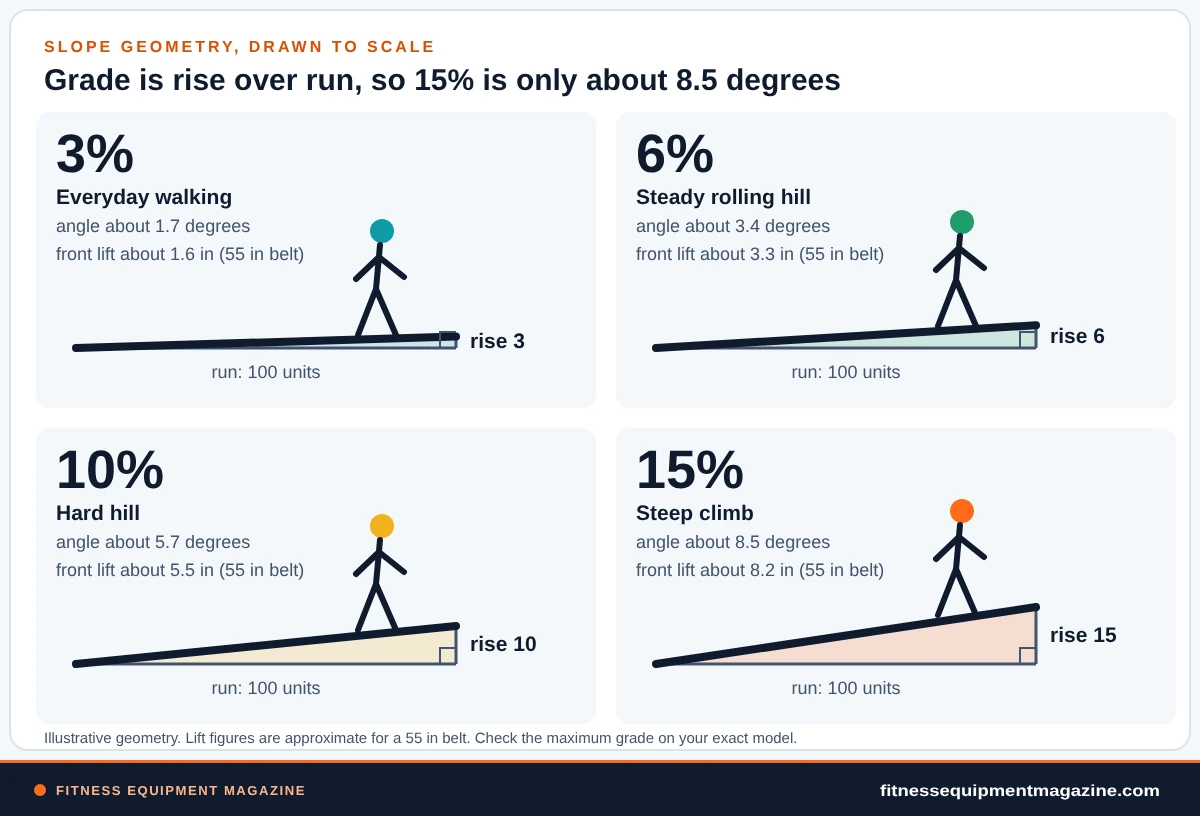
Incline is shown as a percentage grade. Grade is rise divided by run, multiplied by 100. A 10% incline climbs 10 units for every 100 units you move forward horizontally. It does not mean a 10-degree slope, and that’s the part many shoppers get wrong.
The angle is smaller than the percentage suggests. A 3% grade is under 2 degrees, and a 6% grade is about 3.4 degrees. A 10% grade is close to 5.7 degrees, and a 15% grade is roughly 8.5 degrees. On a belt about 55 inches long, a 15% setting lifts the front by something like 8 inches. That small rise still changes how hard your legs and heart work, which is why incline is such an efficient lever.
How much incline range do you need?
Most mid-market machines offer 0 to 10 or 0 to 12 percent, while higher-end ones climb to 15 or beyond. Think about use before range. A steady 1 to 3 percent covers most walkers and runners, and a handful of hill sessions rarely demand more than 8 to 10.
If you want to train for hilly walks or hikes, a 12 to 15 percent ceiling is a useful extra. Otherwise, you’re paying for a lift mechanism that spends most of its life at 1 percent.
Motorized vs. manual incline
Motorized incline
- Changes in seconds from the console, even mid-run.
- Fits interval and hill programs.
- Easier on shared machines, because everyone resets it.
Manual incline
- Cheaper and has one fewer motor to fail.
- Needs you to stop, step off and adjust by hand.
- Usually offers only two to four steps, and rarely any steep ones.
For anyone planning real hill work, motorized incline is the sensible pick. Walkers who mostly stay flat could save money with a manual setting, provided they accept the stop-and-adjust routine. Fixed-flat folding walkers skip incline entirely, so check our look at walking pads for home and office if that is your use case.
Decline: a feature worth a second look
Some machines tilt below flat, commonly to around negative 3 percent. Decline changes how the legs absorb each step, so it can feel quite different from level walking. It’s a niche option, and if you add it you should start with small amounts and short sessions. If you have any health concern, ask a qualified professional first.
Spec-sheet reality check
Check whether the incline range is “up to” on a high-end version only. Brands often show one headline number for a whole product family, and the cheaper variants in the family stop lower. Compare the range for the exact model you plan to buy.
Cushioning and deck construction: why softer isn’t always better
Cushioning sells more treadmills than any other feature, and it is the hardest one to judge from a screen. A treadmill buying guide can only teach you what to ask. Every brand names its system something different, so the names tell you nothing. What matters is how the deck behaves under your weight, at your speed.
What cushioning actually does
Each time a foot lands, force travels through the belt and deck into the frame. Cushioning elements, whether springs, elastomer blocks or a deliberately flexing deck, absorb part of that force and return it over a longer moment. The result feels gentler than a hard surface such as pavement.
That said, cushioning is a feel feature, not a health promise. We won’t tell you it protects any joint, because comfort is individual and the evidence for a particular system does not live on a spec sheet. Treat it as comfort and preference. No treadmill buying guide can feel the deck for you.
Deck and belt construction
The deck is usually a thick board, commonly around three-quarters of an inch to an inch, often with a low-friction coating. A thicker deck tends to feel firmer and flex less. The belt on top may have one, two or more plies, and extra plies generally add durability and resist stretching.
Belts that are too thin can stretch, stick or tear sooner, so compare ply count and thickness when a manufacturer lists them. If they don’t list them at all, ask. The answer, or the lack of one, is information.
The tradeoffs of a soft deck
- Stability: very soft decks can feel wobbly or slow to rebound, which makes your ankles and hips do extra stabilizing work.
- Energy return: a deck that sinks deeply can feel sluggish when you run.
- Bottoming out: heavier users may compress the cushioning fully, so the extra softness stops helping.
- Consistency: zones that are soft at the front and firm at the rear change your stride from step to step.
Matching the surface to the runner (or walker)
Walkers often like a plush deck, since steps are gentle and speeds are low. Runners usually prefer a responsive middle ground, because they want a stable base that gives some of the shock back. Some machines offer adjustable cushioning, which lets two users with different tastes share a machine.
Because the feel is personal, the return policy matters more here than almost anywhere else. Buy from a seller that lets you try the machine for a reasonable period, and run a few full sessions before you decide whether it suits your legs.
Frame, rollers and weight capacity: the stability section
Nothing shows the gap between a cheap treadmill and a good one as clearly as stability. At walking speed, almost every frame feels fine. At a jog, the weak ones start to talk: a rattle from the console, a sway in the uprights, a belt that creeps toward one side. This part of the treadmill buying guide explains what causes each of those, so you can spot it on paper.
Weight capacity in a treadmill buying guide: the headroom rule of thumb
Every treadmill lists a maximum user weight. That figure is a design limit, set by the frame, deck and motor together, and it assumes a gentle load. Running multiplies the force on the deck at each footfall, so a rating that’s fine for walking can feel marginal for jogging.
A common rule of thumb is to choose a machine whose rating sits comfortably above your weight. Often that means 50 pounds or around 15 to 20 percent of margin, and more if you run. It isn’t an official standard, so treat it as sensible padding. Also remember that people sometimes share a machine, and the heavier user sets the bar.
Roller diameter and why it matters
Rollers sit at both ends of the deck and carry the belt. Bigger rollers, commonly 2.5 inches or more in diameter on sturdier machines, turn more slowly for the same belt speed and spread tension across a larger contact patch. Small rollers spin faster and may wear belts and bearings sooner.
Not every sheet lists roller size, but many do, and it’s a quick quality filter. If one machine lists a roller diameter and a rival hides it, ask yourself why.
Where wobble comes from
Wobble has a handful of root causes, and most can be anticipated. A narrow base lets the frame rock sideways. Thin uprights flex under a hand on the rail. A console mounted on a long, light mast shakes with every step. Loose fasteners, uneven floors and missing leveling feet all add their own contribution.
- Look for a wide base and a stable stance, especially behind the machine.
- Check that the uprights are thick-walled steel rather than thin tubing.
- Ask about leveling feet. Floors are rarely perfectly flat.
- Tighten every bolt after the first week, since fasteners settle.
Frame materials and welds
Most home frames are steel, and the quality shows in the gauge of the tubing and the quality of the joints. You can’t inspect welds through a website, so read the warranty: a long frame warranty is a brand betting that the structure holds. It isn’t proof, but it is a signal.
Console, apps and subscriptions: what works offline
The console is where treadmills have changed most in the last few years. It’s also where many buyers end up paying for things they didn’t plan on. A large screen can be a pleasure or a recurring bill. The question is which one you’re buying.
Basic, mid-range and large-screen consoles
A basic console shows time, speed, incline, distance and a pulse reading if you grip the handles. A mid-range one adds preset programs and maybe Bluetooth for a fitness app. A large touchscreen may stream classes, show maps and run its own operating system. Each step up adds convenience and a possible monthly fee. The treadmill buying guide rule of thumb: pay for the console you will actually use.
Think about whether you’ll really follow classes, since this treadmill buying guide would rather you save the money. Many owners start with enthusiasm and drift back to a favorite playlist and a podcast. If that sounds like you, a good basic console plus a tablet holder costs far less.
Offline behavior: what still works without a subscription
This is the question to ask before paying. Can you run the treadmill manually with the subscription lapsed or the internet down? Does the screen still show speed and incline? Do your own programs still work? Some machines keep the full manual mode, while others lock features behind an account. The product page rarely says, so read the support page or the FAQ.
Ask before you buy
“If I never activate a membership, which features stay available?” Get the answer in writing, even if that only means a chat transcript with the retailer.
Subscriptions, price changes and bundles
Streaming memberships on connected machines commonly run from a few dollars to a few dozen dollars a month in the US market, and they can rise. Introductory periods can be generous and then end. Terms may auto-renew, and the price you see at checkout today isn’t promised forever.
- Find the feeLook for the monthly price, the contract length and whether the first months are free.
- Read the cancel rulesNote whether you can cancel online and whether a cancelled account limits the machine.
- Do the mathMultiply by 36 months. If the console’s convenience costs more than a second, simpler machine would, rethink it.
Privacy, accounts and connectivity
Connected consoles collect data: workouts, heart rate, sometimes camera and microphone permissions. Read the privacy terms the same way you’d read them for a phone app. See what the device shares, whether you can delete your account and what happens to your data if you resell the treadmill.
Connectivity itself should be boring. Bluetooth for a heart-rate strap, wireless for updates, a USB port for charging. If the machine depends on cloud servers to work, that dependency is a risk. Servers get retired, and a machine that only works online goes with them.
Heart-rate features: grips and straps
Handle grips with contact sensors read your pulse roughly, and readings are only as steady as your hands. Chest straps or arm bands that connect over Bluetooth tend to be steadier. Treat any of these as a rough guide for effort rather than a medical measurement.
Noise and vibration: living with the machine
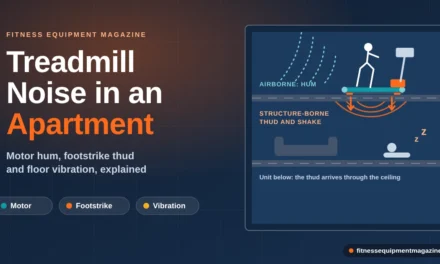
The sound a treadmill makes is partly the motor and partly everything else. The belt slaps over the deck, your footfalls land, and the frame carries vibration into the floor. In an apartment, the last part often matters most to the neighbor downstairs.
What makes a treadmill loud
- The motor and drive belt: a hum or whine that rises with speed. Higher-power motors sometimes run quieter under light load.
- Belt and deck friction: a dry deck adds a rasping noise and heat.
- Footstrike: a firm deck transmits more thud, and a heavy stride adds more.
- The frame: rattles from loose bolts or a console on a long mast.
This treadmill buying guide can’t give you decibel numbers because we haven’t measured any, and manufacturer claims of “whisper-quiet” are rarely defined. Rely on the construction clues above and on owner reports of noise at the speeds you plan to use.
Reducing noise and floor vibration
A good mat helps, but it won’t fix a noisy machine. Pick a thick rubber mat made for fitness equipment and size it so the machine’s feet sit fully on top. Keep the deck lubricated if the manual calls for it, and tighten the hardware regularly.
Upstairs, think about placement as well. Positioning the treadmill over a load-bearing wall or near the edge of a room, instead of the middle of a floor span, can reduce the thump downstairs. If you’re unsure, ask a contractor or your building manager.
Neighbor test
Before the first long session, have someone downstairs listen for two minutes while you jog at your usual pace. It’s a ten-minute favor that can head off a long argument.
Folding mechanisms and the floor space you really need
A spec sheet gives you the machine’s footprint, and that number nearly always understates the space you need. You also need room to step on and off, a runout behind you in case you stumble, and clearance above your head. Draw the real footprint before you fall in love with a model. Every good treadmill buying guide says so, and it still gets skipped.
Footprint, clearance and ceiling height
Full-size home treadmills commonly run about 70 to 80 inches long and 30 to 36 inches wide when open. Manufacturers usually recommend several feet of clear space behind the machine and a little on each side. The exact figures differ, so read the manual. Treat the numbers in the drawing below as an illustration of the idea, not a rule. They don’t replace the manual, whatever treadmill buying guide you use.
Don’t forget height. Your head rises when you stand on a belt that sits several inches off the floor, and incline lifts the front further. If you run, you also bounce. In a basement with exposed pipes or a low ceiling, measure from the belt surface at full incline up to the lowest obstacle. Then compare that with your own height plus a generous margin.
Folding styles: hydraulic, spring-assist and manual
Folding treadmills lift the deck upright so the machine takes up less floor. Most use a gas strut or spring to ease the lift, and some use a latch you lock by hand. The better ones lift smoothly and lock with a positive click, while the poor ones slam down or stay up only when you hold them.
- Soft-drop designs: a damper lowers the deck gently, which protects floors and toes.
- Spring-assisted lift: easy to raise, but you need to guide the descent.
- Manual lock and lift: cheapest, and the heaviest to move.
Check how tall and how deep the machine is when it’s folded. A folded deck standing up against a wall can still stick out two feet, and it may block a door or window.
What folding costs you
Folding adds hinges, latches and a more complicated frame, and each one is a place for play and wear. In treadmill buying guide terms, that is the price of the space you save. A well-made folding frame is perfectly good for walking and moderate jogging. A heavy runner who wants maximum stiffness may prefer a fixed frame and a dedicated spot, if the room allows.
If your real problem is a lack of space, compare a folding treadmill with a slim walking pad before you decide. The walking pad comparison from the intro lays out where each wins.
Transport wheels and storage reality
Transport wheels make a folded machine rollable, but not light. A full-size folding unit often weighs well over 150 pounds. Before you plan to wheel it into a closet every day, picture doing it with a tired back and a rug in the way.
Power and electrical needs: what a treadmill asks of your outlet
Treadmills draw real power, especially at start-up and under load. Most home models are designed to run on a standard 120-volt household circuit in the US, but “standard” has fine print. Because this is a safety topic, this treadmill buying guide keeps it short and sends you to the real authorities: your manual and a qualified electrician.
Standard 120V circuits and dedicated circuits
Many manufacturers specify a dedicated circuit, meaning a circuit that powers only the treadmill and nothing else. The reason is simple. If a vacuum, space heater or window unit shares the circuit, the breaker can trip. A sudden power loss mid-run is a nuisance at best. The required amperage varies, with 15 and 20 amps both common in manuals.
So the manual is your source here, not a blog post or a treadmill buying guide, ours included. Look for a section titled “Electrical requirements” or “Grounding instructions,” and follow it exactly.
Safety
Don’t guess about wiring. If you’re not sure your outlet and circuit meet the manual’s requirements, ask a licensed electrician to check them. Don’t modify a plug, remove the grounding pin or use an adapter that defeats grounding.
Extension cords, surge protectors and GFCI outlets
Manuals frequently advise against extension cords and sometimes against ordinary power strips, because thin cords can overheat under a motor load. Some manuals recommend a surge protector designed for this use, and others warn against one, so follow your own. GFCI outlets, the kind with a test and reset button common in garages and basements, can sometimes trip a motor’s circuit unexpectedly. If that happens, speak with an electrician instead of swapping outlets yourself.
Planning where the outlet is
Before you order, find the outlet, trace its circuit at the panel and note what else it feeds. Then check that the treadmill’s power cord reaches it without stretching across a walkway. A cord that must cross a doorway invites tripping, and a cord pulled tight can damage the plug.
Delivery, assembly and moving: the logistics nobody advertises
Treadmills arrive in a very large, very heavy box. The sticker price rarely includes the effort of getting that box to the right room, and many buyers meet the problem on the doorstep. No treadmill buying guide can lift it for you, but this one can warn you.
The box, the doorway and the stairs
Shipping weight for full-size machines often runs from about 150 to more than 300 pounds, and the carton can be six feet or more long. Measure your doorways, hallway turns and stairwells. If the delivery driver drops the box curbside, ask who gets it inside. Some retailers offer white-glove delivery, which means they carry it in, set it up and haul away the packaging, for an extra fee.
- Measure the tightest doorway and stair turn before you order.
- Ask whether delivery is curbside, room of choice or white-glove.
- Find out the return shipping process and who pays if it must go back.
- Plan two adults for any lift. Treadmills punish solo heroes.
Assembly: time, tools and a second pair of hands
Assembly is often described as one to three hours with two people, though that varies by model. Most of the work is attaching the uprights, console and covers, and running cables through the frame. Pay attention to the cable connections, because a pinched wire can cause intermittent console faults that look like a larger failure.
Tighten every fastener at assembly, then re-tighten after your first week and every few months. Take photos as you go. If you ever need support, those pictures speed up the conversation.
Is paid assembly worth it?
For many buyers, yes. A professional setup takes pressure off your back and often makes sure the belt is tracked and the machine is leveled. Then again, check whether using a third-party assembler affects the warranty. A few brands require authorized service, so ask first.
Moving the treadmill later
If you may move in a year or two, add it to your treadmill buying guide checklist as a buying criterion. Heavy fixed frames are hard to dismantle, while folding ones with wheels are easier but still bulky. Keep the original box and hardware if you can, and see whether the manual says anything about moving the machine without voiding the warranty.
Warranty anatomy: frame, motor, parts, labor and the fine print
If you read only one section of this treadmill buying guide before buying, make it this one. A warranty is the part of the price you can’t see until something breaks, and treadmills break in predictable ways. The headline line, say “lifetime frame and motor,” is usually the least useful part of the document.
The layers: frame, motor, parts and labor
Most treadmill warranties split coverage into separate periods. The frame is typically covered longest, often for many years or “lifetime.” The motor usually follows, commonly for several years up to lifetime. Parts, such as the controller, console, rollers and incline motor, tend to receive far less time, often one to three years. Labor, meaning the cost of the technician, is frequently the shortest, sometimes only 90 days to a year.
That last gap catches buyers out. A motor can be covered for ten years while the labor to swap it is covered for one, which leaves you paying a technician in year four. The coverage that looks generous on paper can feel thin when a repair arrives. That gap is why a treadmill buying guide has to spend real time on labor.
Wear items and what’s usually excluded
Belts and decks are commonly treated as wear items, meaning they carry short coverage or none. Cosmetic damage, shipping damage you didn’t report in time and normal wear are also standard exclusions. Pay attention to these, since the belt and deck are among the most expensive parts to replace. A treadmill buying guide should flag them early.
In-home service, ship-in and who pays shipping
A warranty that promises parts is different from one that promises a repair. Some brands send a technician to your home. Others mail you replacement parts and expect you to install them. A third group asks you to ship the machine in, and that third group is a problem when the machine weighs 200 pounds.
- Does a technician come to your home, or must you do the repair yourself?
- Who pays to ship parts, and who pays if the machine must go back?
- How long do typical repairs take, and is there a support line with real hours?
- Is the warranty with the manufacturer or the retailer, and who do you call first?
Registration, original-owner rules and proof of purchase
Some warranties only activate if you register within a short window. Some cover the original owner only, which hurts resale. Others require proof of purchase from an authorized seller, so a bargain from an unauthorized reseller could leave you with no coverage at all. Keep your receipt, the serial number and your registration confirmation in one folder.
How warranties get voided
The usual causes are surprisingly ordinary. Warranties often exclude commercial or multi-user facility use, unauthorized repairs and the wrong lubricant. Power surges and improper electrical connections are common exclusions too. So is damage from storing the machine outdoors, in a damp garage or in extreme heat. Missing a required maintenance step can also hurt a claim.
Read this once, in full
Before you click buy, open the warranty PDF and search it for “commercial,” “residential,” “lubricat,” “authorized” and “labor.” Those five searches reveal most of the traps in a few minutes.
Habits that make a claim go smoothly
When trouble starts, take a short video of the symptom. Note the serial number and write down what you did and when. Every treadmill buying guide should prepare you for that day. Then contact support in writing, so you’ve got a record. Keep the maintenance log current. A claim with documentation tends to move faster than one built on memory.
Maintenance and the real cost of ownership
A treadmill buying guide has to cover upkeep, because the purchase price is only the start. Over several years, upkeep, electricity and add-ons shift the real cost. A cheap machine that needs constant attention can cost more than a pricier one that needs little.
Routine care: cleaning, lubrication and tracking
Most treadmills ask for a few simple jobs. Wipe the belt and the console after use, vacuum the dust that gathers beside the motor hood and check that the belt is centered. Many belts need periodic lubrication, though some come pre-lubricated and specify that you shouldn’t add any. The manual rules, since the wrong product can damage a belt and void a warranty.
- Every session: a quick wipe-down and a glance at the cord and safety key.
- Monthly: vacuum around the motor area when the machine is unplugged and check the belt for drift.
- Every few months: tighten hardware and follow the lubrication schedule if the manual lists one.
Belt tracking and tension
A belt that drifts to one side or slips under footfall needs adjusting. Manuals show the adjustment with a hex key and small turns on the rear roller bolts. Adjust gently, a quarter turn at a time, while the belt runs slowly. Over-tightening can strain the roller and motor, so go slowly and follow your manual.
Wear parts and hidden costs
Belts and decks wear, and replacement costs can be a meaningful share of a budget machine’s price. A good mat, a lubricant if required and the occasional service call add up too. Electricity use is modest compared with other household appliances, and it depends on how often you run.
Accessories that earn their keep
A few small purchases protect the machine and the room. A thick equipment mat tops the list: it guards the floor, cuts some vibration and catches dust. A fitted cover helps in a garage or a dusty basement, as long as you let the motor cool before you cover it. A tablet or book holder costs little and replaces a pricey screen for many people.
Be pickier about lubricant and electrical add-ons. Use only the lubricant the manual names, and follow its instructions on how much to apply and how often. As for surge protectors and power strips, follow the manual. If it forbids them, don’t use them just because the box says “heavy duty.”
Buying used? Add inspection time
Second-hand machines can be a good deal, but you inherit the wear. Ask for the age, how often it ran and whether the warranty transfers. Run it at several speeds. Listen for knocks, look for a frayed belt edge and check the incline travels smoothly. Then check the recall list, because an older machine may have been recalled long ago.
Safety features and CPSC recall checks
Treadmills are useful, and they also injure people every year, so a treadmill buying guide without a safety section would be incomplete. Most of the risk is mundane: falls, belt-related friction injuries and children or pets reaching the moving parts. Good design reduces the odds, and good habits do the rest.
The features that matter
Every home treadmill should include a safety key tied to a clip you wear, which cuts power if you move away from the console. Look as well for a clear emergency stop, sturdy handrails you can grip easily and a belt that starts slowly rather than jumping to speed. Some machines offer a child lock or key removal that stops the belt from running in your absence.
Safety
Always wear the safety clip while the belt moves. Remove the key and unplug the machine when it isn’t in use, particularly if children or pets are around. Never leave a running treadmill unattended.
How to check the CPSC recall database
The U.S. Consumer Product Safety Commission publishes recalls of fitness equipment on its site. Before you buy any treadmill, new or used, look up the brand and the model on the CPSC exercise equipment recall page. Do it again once the machine is yours, and register your product with the maker so you hear about any future notices.
A recall isn’t automatically a reason to avoid a brand. Recalls show a company can find a problem and respond. What matters is how a recall was handled and whether the model you want is affected.
Household rules for kids and pets
Treadmills pose a particular hazard to curious toddlers and animals. Set a rule early that nobody approaches the machine without an adult. Keep the key out of reach, and give the machine a clear zone. If you’ve got a small child, folding and storing the deck upright may help, though it creates its own tip-over risk, so secure it.
How to read a spec sheet and spot marketing inflation
A spec sheet is a sales document dressed up as a data table. That doesn’t make it dishonest. It does mean the marketing team chose what to include, what to bold and what to leave out. Learning to read between those choices is the closest thing to a superpower a treadmill shopper has. This treadmill buying guide treats it as a core skill.
A treadmill buying guide decoder: seven claims and what to ask
Patterns of inflation to watch for
Marketing inflation tends to follow the same few shapes. A superlative with no definition (“commercial-grade,” “pro-level,” “ultra-durable”) tells you nothing, since no regulator defines those words for home equipment. A range with “up to” on it, such as incline, speed or weight, describes the best variant, not the machine in your cart. A named technology (“AirFlex-style” zones, “AI” coaching) may describe something real, but the name alone tells you less than a measurement would.
Likewise, watch for missing numbers. Suppose a sheet gives you screen size, motor peak and number of programs. If it omits belt thickness, roller diameter and continuous horsepower, the gaps are the story.
Questions to ask a retailer or the brand
- What is the continuous duty horsepower?
- What is the usable running surface in inches, and how many plies is the belt?
- What is the roller diameter, and what is the deck thickness?
- What is the user weight capacity for running, if it differs from walking?
- Which features still work without a subscription or internet connection?
- Does the warranty include in-home labor, and who pays shipping?
- What are the exact electrical requirements?
If a seller answers quickly and specifically, that’s a good sign. If they answer with a marketing paragraph, you’ve learned something about the support you’d receive later.
Six myths that cost buyers money
Myth
More horsepower always wins
Fact: continuous horsepower, frame quality and a matched controller decide how a motor lasts. A big peak number alone says little.
Myth
A bigger screen means a better machine
Fact: screens add convenience and often fees. They do nothing for belt size, rollers or warranty.
Myth
Softer is kinder
Fact: softness is a feel preference. Very soft decks can feel unstable, and we make no joint promises for any deck.
Myth
Lifetime means free repairs forever
Fact: “lifetime” usually covers named parts, often excludes labor and ends under conditions in the fine print.
Myth
Any outlet will do
Fact: manuals often call for a dedicated circuit, and a shared one can trip the breaker mid-run.
Myth
Folded means out of sight
Fact: a folded full-size deck still stands taller than most furniture and often sticks out from the wall.
Reading owner reviews without being fooled
Owner reviews can help, but read them with care, as a supplement to a treadmill buying guide and not a replacement. Scan for repeated specific complaints, such as belt drift at four months or a console that froze after an update, instead of overall star scores. Notice when a review mentions the same product with a different belt size or motor. Brands often reuse a name across variants, and you’ll want reports on your exact version. Also discount reviews posted within days of delivery, since durability problems take time to appear.
A step-by-step treadmill buying guide workflow
Everything in this treadmill buying guide becomes useful only if you turn it into a sequence. This is the workflow we’d follow ourselves, in the order that avoids the most mistakes. It takes an evening or two, which is a modest price for a machine you’ll look at for years.
The ten steps, in order
- Define your use in one sentenceWrite something like “I walk 40 minutes most mornings, I jog twice a week, and two adults will use it.” That sentence drives every later choice.
- Measure your spaceInclude doorways, stairs, ceiling height and the area behind the machine. Note where the outlet and its circuit are.
- Measure your strideUse the hallway test earlier in this guide and pick a belt length with real margin.
- Set a total budgetInclude delivery, a mat, possible assembly and a repair cushion, not only the sticker price.
- Shortlist three machinesFilter by belt size, continuous horsepower, user weight capacity and warranty terms before you look at screens.
- Decode each spec sheetUse the question list above, and email the seller for any missing figures.
- Read the warranty and subscription termsCompare labor coverage, service model and what stays free.
- Check recalls and return policySearch the CPSC exercise equipment recalls (linked in the safety section) and confirm how returns work for heavy items.
- Verify the electrical fitMatch the manual’s requirements to your outlet, and call an electrician if there is any doubt.
- Buy, assemble, and test in the return windowRun every speed and incline you plan to use, check noise, then register the product.
Why this order works
Why the order matters
The treadmill buying guide order exists for a reason. Space and stride come before price, and warranty comes before screens. Buyers who do it backwards usually end up with a machine that’s too big, too short or too fancy for the money.
Where to buy: retailer types and what they mean for returns
Where you buy shapes your experience almost as much as what you buy. A specialty fitness store usually lets you try machines in person, which settles questions about belt width and deck feel in ten minutes. Big-box and online retailers often offer more variety and sharper prices, but you pay for that with a less hands-on experience.
Buying direct from a brand can simplify warranty claims, since there’s no middleman. Marketplace sellers deserve extra scrutiny: confirm the seller is authorized, because an unauthorized reseller can leave you without warranty coverage. In every case, read the return policy for a 200-pound item before you read anything else.
- How long is the return window, and does it start at delivery or at the order?
- Is there a restocking fee, and who pays return freight on a heavy item?
- Must the machine go back in its original box, and can you realistically repack it?
- Does the retailer, the brand or both handle warranty service?
Shortlist archetypes (not brand picks)
This treadmill buying guide doesn’t name brands or models, because we haven’t tested them and prices change monthly. What we can do is describe machine types that earn a spot on a shortlist, so you know what to search for.
Archetype
The compact folding walker
Belt around 18 to 20 by 48 to 55 inches, modest motor, light incline, easy fold. Earns its place in apartments.
Archetype
The all-rounder 20 by 55
Continuous horsepower around 2.5 to 3.0, motorized incline to 10 or 12 percent, fold optional. The default for mixed use.
Archetype
The runner’s 22 by 60
A strong continuous motor, large rollers, stout frame and extra user capacity. Needs space and a decent budget.
Archetype
The shared family machine
Higher capacity, adjustable cushioning, child lock and solid support, because several people with different needs share it.
For a wider set of machine types tied to real rooms, the best-treadmills hub linked near the top extends this idea with floor plans and routines.
Four hypothetical shoppers, worked through this treadmill buying guide
These four profiles are invented for illustration. They aren’t customers or test subjects, and the numbers are typical rather than measured. Still, walking through them shows how the same criteria pull in different directions.
Shopper one: the apartment walker
Imagine someone about 5 feet 4 inches tall on the third floor of an older building who wants 40 minutes of walking before work. Her neighbor works nights. Her step is short, so a belt near 50 inches is plenty, and a continuous motor around 2.0 is more than enough. Noise and vibration outrank everything else. That points her toward a thick mat, a soft-drop fold and a drive that runs quietly under light load. She skips the large screen, since she listens to podcasts anyway, and spends the savings on stronger labor coverage.
Shopper two: the tall garage runner
Picture a 6-foot-3 runner with a garage that gets cold in January. His step at tempo pace is long, so he wants a 60-inch belt, a 22-inch width and a user capacity comfortably above his 190 pounds. Because the garage swings from freezing to humid, he reads the storage and environment clauses in the warranty and buys a cover and a mat. He also asks an electrician about a dedicated circuit, since the only garage outlet feeds a chest freezer too.
Shopper three: the shared family machine
Consider a household of four that shares one treadmill: two adults of different weights, a teenager who jogs and a seven-year-old who wanders in. Sizing goes to the heaviest adult, and capacity headroom matters more than a console. Adjustable cushioning helps because tastes differ. Child safety moves up the list as well: a removable key, a clear zone behind the machine and an agreed spot for the key. More users mean more wear, so strong in-home labor coverage matters here.
Shopper four: the budget-conscious returner
The last shopper is returning to exercise after a long break. She wants to walk now and maybe jog later, and she has a firm ceiling on spending. She skips the runner’s deck and keeps a 20 by 55 belt with a continuous motor near 2.5. She insists on a long return window and a clear warranty. She also passes on connected features and buys a cheap tablet holder. That’s the right trade: the parts that carry load get the money, and the extras can wait.
Price tiers and value logic
Prices in this part of the treadmill buying guide are rough, hedged ranges for the US market in late 2026, and they will drift. Treat them as shapes, not quotes. What they illustrate is where extra money tends to buy something real, and where it mostly buys a bigger screen. Read the staircase below as a value map, not a price list, like any honest treadmill buying guide would.
What each tier typically buys
Where the value is, and where it isn’t
The biggest jumps in quality often come in the middle of the market. Moving from the entry tier to a lower-mid machine commonly brings a stronger continuous motor, a longer belt and a better warranty. Moving from mid to upper adds refinement: larger rollers, a stiffer frame, better cushioning and service. After that, a lot of the extra money goes to screens, brand and content.
The value logic of this treadmill buying guide fits in one line. The best buy for most households is the lowest tier that comfortably meets your belt, motor and capacity needs. Then spend a little extra on the warranty and a mat. When money is tight, the budget treadmill piece linked earlier shows what to protect and what to cut.
Sales, financing and timing
Treadmill prices swing around holidays and new-year sales, and discounts can be generous. A sale price on a machine you don’t need still costs money, a point any treadmill buying guide should make plainly. Zero-interest financing is only free if you pay on time, so read the terms. Also remember that the sale price rarely changes the warranty, and the warranty is often the better lever.
Thinking in cost per use
A machine you use four times a week for five years gets used over a thousand times. Divided like that, even a pricey unit can look sensible, while a cheap one that gathers dust costs more per session. The point is not to justify spending. It is to match the price to how realistic your routine is. Federal guidance such as the HHS Physical Activity Guidelines offers general activity context for adults, but only you know how often you’ll really step on the belt.
Common mistakes and how to avoid them
Every treadmill buying guide ends up listing the same handful of errors, because most regrets cluster around them. Some come from marketing, but plenty come from ordinary optimism. Here are the ones that surface again and again in owner reports.
Spec mistakes a treadmill buying guide should flag
- Buying on peak horsepower without finding the continuous rating.
- Choosing a short belt because the machine looked fine at walking speed.
- Paying for a high incline range you’ll never touch.
- Trusting “lifetime warranty” without reading what’s covered.
Mistakes with space and setup
- Measuring the room but not the stairwell or doorway.
- Forgetting ceiling height at full incline.
- Plugging into a shared circuit, then wondering why the breaker trips.
- Skipping a mat and then dealing with floor marks and noise.
Mistakes with mindset
The quietest mistake, and one no treadmill buying guide can fix for you, is buying for the person you hope to become. If you’ve never run, a runner’s machine could be wasted money, and if you plan to start, you may want a machine that grows with you. Be honest about what you’ll do in the next six months, then leave a little room above it.
Another classic is chasing the screen. A gorgeous display can distract from a thin belt and a short warranty. Put the money into the parts that move and bear weight, and let your phone or tablet handle entertainment.
The final buyer scorecard
By now you’ve got a lot of criteria. The scorecard in this treadmill buying guide turns them into a decision you can defend. It also keeps a slick demo or a seasonal discount from overriding the things that will matter in year three.
Priority profiles: what each buyer should weigh most
Different riders need different things. The chart below sketches how a walker, a jogger and a runner might weight six core features. A treadmill buying guide can’t know your body, so treat the shapes as a starting point. Notice that warranty and service stay high for everyone, and that the runner’s profile bulges where the physical load is greatest.
Suggested weights for your scorecard
Weights are personal, so adjust them. As a starting point for a typical household buyer, here is how we’d spread importance across the criteria this treadmill buying guide has covered. The percentages are editorial judgment, not data.
How to score each finalist
- Score each criterion from 0 to 3Zero means it fails your need, one is marginal, two is good and three is comfortably more than you need.
- Multiply by your weightUse the percentages above or change them to fit your life.
- Apply the veto ruleAny zero on belt fit, electrical fit or warranty clarity ends the contest, whatever the total says.
- Compare totals, then total costPrefer the higher score. If two tie, pick the stronger warranty.
The pre-purchase treadmill buying guide checklist
- The belt exceeds my step length by a real margin, and the width feels comfortable.
- I know the continuous horsepower, not only the headline number.
- The user weight capacity leaves headroom for my body weight and my fastest pace.
- The warranty covers labor and says who pays shipping and where service happens.
- I read the subscription terms and know what works offline.
- My outlet, circuit and floor plan match the manual.
- I checked CPSC recalls, and I know the return policy for a heavy item.
- The total cost includes delivery, a mat and a repair cushion.
Frequently asked questions
Here are the questions a treadmill buying guide usually has to answer, grouped by theme.
Fit and motor
What should a treadmill buying guide tell me to check first?
Start with fit, then power, then paperwork. Fit means a belt long and wide enough for your step length and a frame rated well above your weight. Power means a continuous horsepower rating suited to your pace. Paperwork means a warranty you’ve read, with labor and service terms clear, plus electrical requirements your home can meet. Screens and apps come last, because they are the easiest part to replace with a tablet.
How much continuous horsepower do I need for a treadmill?
Most treadmill buying guide advice lands in similar places. For walking, roughly 1.5 to 2.5 continuous horsepower is commonly enough. For regular jogging, many buyers aim for around 2.5 to 3.0. Runners, tall or heavy users and shared machines usually do better with 3.0 or more. The word “continuous” is the point: a peak rating describes a brief burst and can be far higher than what the motor sustains. Check the manufacturer’s spec sheet, and ask the seller if the number isn’t labelled.
Belt and incline
What belt size is best for running?
For a treadmill buying guide answer, a belt around 20 by 55 inches handles easy jogging for many adults. Runners commonly prefer 22 by 60 inches, or at least 58 to 60 inches long, especially if they’re tall or fast. Step length grows with speed, so the belt must give you margin at your hardest pace. Measure your own step on a hallway, add generous padding, and confirm the usable running surface rather than the total belt loop.
Is a motorized incline worth it?
In our treadmill buying guide view, it is worth it if you plan to use hills, intervals or programs. You can change the grade in seconds without stopping. Manual incline is cheaper and has fewer parts to fail, but you must step off to adjust it, and the range is usually small. Many walkers who stay mostly flat do fine without motorized incline. Also check the maximum grade for your exact model, since a product family often shows its highest number in the headline.
Power and warranty
Do I need a dedicated circuit for a treadmill?
No treadmill buying guide can settle this for your home. Many manufacturers recommend or require one, particularly for larger motors, but the requirement varies by model. Your manual is the authority here, and a licensed electrician can confirm that your outlet and circuit meet it. Avoid extension cords or adapters unless the manual explicitly allows them. A shared circuit can trip the breaker mid-workout, which is annoying at minimum and a reason to check before you order.
What does a treadmill warranty usually cover?
Most split it into frame, motor, parts and labor. Coverage on the frame and motor runs long, while terms for parts and labor run much shorter. Belts and decks are often treated as wear items with little coverage. Look for whether service happens in your home, who pays shipping and whether registration or original-owner rules apply. The headline “lifetime” line rarely tells the whole story, so read the full document before you buy.
Feel and used machines
How can I tell if a treadmill is too soft or too firm?
A treadmill buying guide can describe the feel, but you will judge it underfoot. A deck that is too soft can feel slow, unstable or mushy, so your ankles and hips work harder to steady you. A deck that is too firm can feel harsh underfoot. Feel is personal, which is why a good return window matters more than any cushioning name. Run a few full sessions at your normal speeds before the window closes, and if the deck bothers you, send it back.
Should I buy a used treadmill?
It can save money, but you inherit the wear and often lose the warranty. Ask about age, usage and whether the warranty transfers. Run the machine at several speeds, listen for knocks and inspect the belt edge. Check the model on the CPSC recall page before you pay. If a seller won’t let you test it, walk away, because moving a heavy treadmill that fails costs more than the discount saved.
Value and staying current
How often do treadmill specs and warranties change?
More often than most people expect. Brands refresh product lines yearly, change warranty terms between tiers and adjust subscription fees without much notice. That is why this treadmill buying guide gets reviewed twice a year. It’s also why you should compare the current spec sheet, warranty PDF and recall page on the day you buy. If a number here differs from the manufacturer’s page, trust the manufacturer.
Does a more expensive treadmill always last longer?
Not always, but the middle of the market often brings real durability gains: stronger continuous motors, larger rollers, stiffer frames and better warranties. At the top, a lot of the added cost buys screens and brand. The better test in any treadmill buying guide is the parts list and the warranty terms, not the price tag alone. Match the machine to your pace and your weight, then pay for what bears load.
Conclusion and next steps for your treadmill buying guide research
A good treadmill buying guide shouldn’t hand you a winner. It should leave you able to look at any spec sheet and know which numbers to trust, which to question and what to ask next. If you take only a few things from this one, take these. Size the belt to your step. Read horsepower as continuous or not at all. Give a warranty the same attention you give a screen. Then check the electrical and recall details before you order.
From here, choose the path that matches your stage. If you’re still choosing a machine type, use the best-treadmills hub to match machines to rooms. If cash is the limit, read the budget treadmill priorities. If you suspect you only need a slim machine under a desk, the walking pad buyer’s guide is the next stop. All three sit in the “Keep reading” box just below. Then come back to this treadmill buying guide with your shortlist and work through the scorecard.
Sources and further reading
- U.S. Consumer Product Safety Commission: exercise equipment recalls — search recalls by brand and model before buying new or used.
- HHS Physical Activity Guidelines — general federal activity context for adults.
- ACSM top fitness trends for 2026 — background on why home cardio equipment stays popular.
- Manufacturer spec sheets, owner’s manuals and warranty documents — the final authority, and the companions to this treadmill buying guide, on ratings, electrical requirements and service terms for any specific machine.
Some links on this site may be affiliate links. If you buy through them we may earn a commission at no extra cost to you; recommendations are based on the criteria in the article, not payout. This treadmill buying guide offers general information, not medical or electrical advice. Specs, prices, warranties and recalls change, so verify before you buy. Last reviewed: October 2026.