The walking pad vs treadmill question sounds like a spec-sheet contest, but it’s really about your floor, your habits, and how hard you’ll push a motor. Pick wrong and you end up with a belt that can’t keep up with your jog, or a 200-pound frame parked in the corner collecting laundry.
We wrote this guide for people who are one click away from buying. It compares the two machine types on the things that decide satisfaction. Those are room, speed, incline, deck length, motor, noise, body size, safety, feel, software, upkeep, and total cost. Then it walks through seven very ordinary households and tells you what we’d pick for each.
The Short Answer on Walking Pad vs Treadmill
In one minute
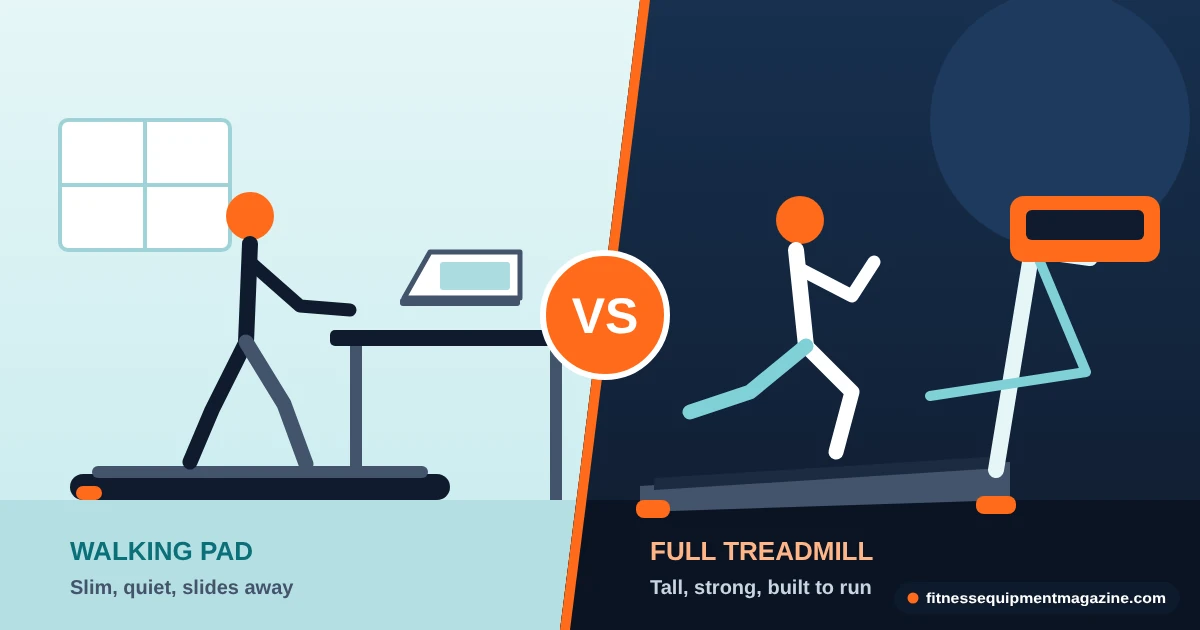
For most people the walking pad vs treadmill call is simple. Choose a walking pad if you want steady, quiet walking at a desk. It also fits when floor space is tight and you don’t plan to run. Choose a treadmill if you want to jog or climb a slope. It’s also the pick for long, fast walks or a heavier, taller user. A compact folding treadmill is the middle road when you want those abilities but can’t give up a permanent footprint.
- Pad fits: apartments, desk walkers, older adults who want gentle daily steps, renters, and anyone testing the habit.
- Treadmill fits: runners, interval walkers, couples who both train, and households that will use it most days for years.
- The main tradeoff: a pad buys you space and silence by giving up speed, incline, and durability under hard use. A treadmill gives all that back and charges you in floor area, weight, and money.
How we researched this. This walking pad vs treadmill comparison is research-based guidance built from manufacturer specification patterns, federal guidance, and ownership problems commonly reported by buyers. We haven’t hands-tested machines for this article, and we don’t name brands or quote prices for specific models. Numbers here are typical ranges for the US market in late 2026; they change, so verify them on the spec sheet and the retailer’s page. Last reviewed: October 2026.
How current is this?
Specs, prices, warranties, and recalls shift from season to season. Before you order anything, read the manufacturer’s spec sheet, confirm the return window, and check the CPSC exercise equipment recall list for the model you’re considering.
Walking Pad vs Treadmill at a Glance: Who Should Pick Which
Most of the confusion in the walking pad vs treadmill debate comes from treating these as rivals. They’re not. A walking pad is a low-profile belt with a small motor, designed to carry a person at walking speed for hours. A treadmill is a framed machine with a larger motor and a longer, wider deck. It usually has an incline too, and it’s built to carry a person at running speed for years. Same basic idea, very different engineering budget.
That gap shows up the moment you ask what you’ll do on it. If the honest answer is “walk while I answer email,” a pad does the job and does it quietly. If the answer is “run three mornings a week and walk hills on the others,” a pad will struggle. A treadmill will feel obvious.
The three machines hiding inside this debate
The phrase “walking pad vs treadmill” really covers three categories, and it helps to name them before we compare anything.
Type 1
The walking pad
Flat belt, usually no handrails, often a remote instead of a console. Typically tops out near walking pace or a light jog on a few models. Many fold in half or slide flat.
Type 2
The compact folding treadmill
Handrails, a console, often a manual or motorized incline, and a deck that lifts upright on a hydraulic arm. Usually rated for running and still hides in a corner.
Type 3
The full-size treadmill
Longer, wider deck, heavier frame, stronger motor, steeper incline. Takes real floor space and a delivery crew, but is built for daily use at speed.
When you read advice that says “just buy a treadmill,” it usually means types 2 and 3. When you read “a walking pad is all you need,” it means type 1 and a person who walks. Neither piece of advice is wrong. Both are incomplete without the other half of the picture, which is what the rest of this guide fills in.
The walking pad vs treadmill scorecard
If you only have thirty seconds, look at the chart below. It scores two archetypes on six traits. The numbers are our own illustrative judgment, built from how these machine classes are typically specified, not measurements of any product. Treat the shape as the message: the pad’s strength is on the left, the treadmill’s is on the right.

Notice what this walking pad vs treadmill chart doesn’t say. It doesn’t say treadmills are “better.” For a desk worker in a one-bedroom apartment, five of those six axes are irrelevant, and space decides everything. It also doesn’t say pads are “toys.” On the axes that matter for steady walking, many hold up fine. The honest verdict depends on where you live and what you do.
For deeper background on the full-size side, our guide to choosing the right home treadmill for your space and training goes through each machine class in detail. For the pad side, see the walking pad buying criteria for home and office.
Space and Storage: Where a Walking Pad vs Treadmill Really Lives
Floor space is the cleanest dividing line in any walking pad vs treadmill comparison, and it’s the one buyers underestimate most often. A listing says the machine is “compact,” you picture a bathroom scale, and then a box arrives that doesn’t fit through the hallway.
Footprints, folded and unfolded
Typical walking pads run roughly four to five feet long and about two feet wide in use. Many fold or slide down to a few inches thick. Compact folding treadmills commonly measure around five and a half to six and a half feet long when open, and about two and a half feet wide. Folded, they stand roughly three feet deep and five feet tall. Full-size treadmills often run six and a half to seven feet long, about three feet wide, and stay put. These are ranges, not promises; read your candidate’s dimensions section.
Here’s the part spec sheets bury. The footprint listed is the machine alone. You also need clearance behind it, so a stumble doesn’t send you into a wall. Leave room beside it too, so you can step off. Many manufacturers suggest roughly six feet of free space behind the belt for running machines. A pad used at a slow walk can get by with much less, though you still shouldn’t back it against a radiator or a bookshelf.
Storage is where good intentions go to die
A pad that slides under a bed or couch sounds ideal. In practice, you need about five to six inches of clearance, and a lot of sofas sit lower than that. Measure the gap with a ruler before you count on it. Also remember the weight: a pad might weigh thirty to sixty pounds, which is easy to slide and annoying to lift onto a closet shelf.
Folding treadmills solve a different problem. They stand upright, so they claim a vertical slab instead of a horizontal one. Upright, they still look like a treadmill, and some of them tower over a short hallway. If you live under a low basement ceiling, check the folded height too, not just the open length.
Measure before you shop
Tape the open footprint on your floor with painter’s tape, including the runoff zone behind the belt. Then walk around it for a day. If you trip over the tape in your own living room, the machine will annoy you just as much when it’s real.
Doors, stairs, and the delivery path
Big treadmills often ship in a box close to three feet wide and over a hundred and fifty pounds. Before you order, measure every doorway, stair turn, and elevator on the path to the room. A walk-up apartment is a delivery problem even when the room is big enough. Many retailers offer white-glove carry-in for a fee, and that fee belongs in your budget, a point we’ll return to in the cost section.
In the walking pad vs treadmill delivery contest, pads dodge the whole issue. A boxed pad is typically small enough for one person to carry upstairs. For a surprising number of fourth-floor walk-ups, that alone settles it.
Speed, Incline, and Deck Size: Match the Machine to the Workout
Start the walking pad vs treadmill comparison with a blunt question: what’s the fastest you’ll want to move on this thing in the next two years? Not the fastest you’ve ever moved, and not the fastest the box says. The fastest you’ll actually choose on a Tuesday morning. That number sorts most of the field.
The speed ladder
Walking pads are built around a slow-to-moderate walking range. Many top out near three to four miles per hour, and a smaller group goes higher, with a few advertising light jogging speeds. Compact folding treadmills usually reach eight to ten miles per hour. Full-size machines commonly reach ten to twelve or more. Those are typical ranges for the US market, and the spec sheet is the final word.
The ladder below puts activities on the same scale. Where a bar ends, the machine class stops being a comfortable fit. Notice that “brisk walking” lands right on the edge for many pads, which is why a person who loves a fast power walk is often disappointed.
There’s a subtler point hiding in that picture. A machine can reach a speed without being comfortable or durable there. A pad that “goes to six” may use the same short deck and light motor as one that stops at four. If you plan to spend real time above a brisk walk, shop for a machine built for it, not one that merely allows it.
Can you run on a walking pad?
Short answer: occasionally and carefully, if the manufacturer says the specific model supports it. Long answer: most pads are designed and warrantied for walking, and the manuals often state a recommended use that excludes running. A short deck leaves little room for a longer running stride, and handrails are usually absent, so a stumble has nowhere to go but backward. If running is on your list even twice a month, we’d buy for running from the start. Our treadmill buying guide covering motor, belt size, incline, and warranty explains how those specs line up for runners.
Incline: where the walking pad vs treadmill gap is widest
Most walking pads are flat. A few have a small manual tilt, and some of the newer ones add a modest motorized slope, but that’s the exception. Compact folding treadmills usually offer either a few manual positions or a motorized incline, and full-size machines commonly go to ten, twelve, or fifteen percent grade.
Why does that matter? Because incline is the cheapest way to make walking harder without making it faster. If your joints or your neighbors don’t love speed, a slope lets a slow walker work at a higher effort level. People who buy a flat pad and later realize they want that option usually end up shopping again. If hill walking sounds appealing, count it as a requirement now, not a bonus.
Watch the wording
“Incline” on a spec sheet can mean three things. It might be a fixed lift under the front, a manual lever with a few notches, or a motorized grade you change mid-workout. Confirm which one you’re getting, and whether the rated percentage is real grade or a rough approximation.
Deck size, stride length, and why short belts feel odd
The belt is the surface you live on, and its length matters more than its marketing. A normal walking stride for an adult is commonly somewhere around two to two and a half feet, and taller people stride longer. A running stride is longer still and covers more distance between footfalls. A belt that’s too short makes you shorten your stride, stay hunched near the front, or hover nervously at the back.
Pads commonly have belts about forty to fifty inches long and fifteen to eighteen inches wide. Run-rated treadmill belts are often fifty-five to sixty inches long and about twenty inches wide. Tall or fast runners usually prefer the long end of that range. Width matters for comfort and confidence; a wider belt forgives wandering feet.
You can measure your own stride at home. Walk naturally for ten steps on a driveway, measure the distance, and divide. Compare the result with the belt length on the spec sheet. If you land within a few inches of the belt’s usable length at a brisk pace, move up a class.
Motor, Frame, and Durability at the Speed You Actually Use
The motor is where the walking pad vs treadmill gap gets technical. A treadmill motor is rated in horsepower, and that’s where marketing and engineering part ways. Pads often list peak horsepower, which is the burst the motor can reach for a moment. Treadmills that run all day are better judged by continuous duty horsepower, which describes sustained output. The two numbers aren’t comparable, so a pad listing “2.5 HP” and a treadmill listing “2.5 CHP” aren’t twins.
Duty cycle: the idea that explains most failures
Duty cycle is how many hours of use, at which load, the design expects. A pad may be designed around a few hours of light walking per day. A run-rated treadmill expects higher speeds, heavier bodies, and incline, because those are the loads it was sold to carry. Push a light motor outside its intended zone and you get heat, belt slip, and a burning smell. That’s the “belt that smells hot” situation, and it’s one of the most commonly reported problems in the category.
So the useful question isn’t “is a pad durable?” It’s “durable at what?” A pad used for two hours of easy walking is often fine for years. The same pad pushed to its top speed for an hour a day, by a heavier user, is a different life.
Frames, rollers, and the parts that wear
Compact pads use light frames and small rollers, which keeps weight down and makes them easy to move. Full treadmills use heavier frames, larger rollers, and thicker belts, which is part of why they weigh over a hundred pounds and cost more. Those heavier parts matter most under impact, because running generates forces many times body weight each stride, and that load has to go somewhere.
- Belts stretch and drift, and every machine class needs occasional tracking adjustments.
- Lubrication matters on many belts; some are factory-treated, others need periodic silicone lubricant.
- Foot-fall cushioning decks wear differently from firm pad decks.
- Fold hinges and hydraulic arms on folding treadmills are common wear points over years.
What warranty patterns tell you
Warranties are a decent proxy for the engineer’s confidence, though not a perfect one. Pads commonly carry short warranties on the motor and frame, often measured in one to a few years with very short coverage on parts. Run-rated treadmills commonly carry longer motor and frame coverage, sometimes a decade or lifetime on the frame, with shorter coverage on parts and labor. Always read what’s excluded: commercial use, user weight above the rating, and “improper maintenance” are standard carve-outs.
Ask a retailer two direct questions: how do I get a repair done, and who pays for shipping a heavy machine? A great warranty that requires you to box and ship a hundred-fifty-pound deck is a weaker warranty than it looks. If you want help reading these specifications side by side, the warranty and motor explanations in our treadmill guide take it one spec at a time.
A pad that’s lightly used for years will outlast a treadmill that’s overworked for months, and the reverse is just as true.
Noise, Safety, and Feel: Living With the Machine Every Day
In the walking pad vs treadmill choice, specs tell you what a machine can do. Living with it tells you whether you’ll keep doing it. Three things decide that more than people expect. One is how much noise leaks into the next room. Another is how safe you feel at your chosen speed. The last is how the belt feels at the end of a long day.
Noise and apartment life
We won’t quote decibel numbers, because we haven’t measured any, and published figures vary by method and by room. What we can say is how the noise behaves. A pad at a slow walk is mostly motor hum and the soft pat of shoes. That’s often quiet enough for a call, though a hard-floor room echoes it. A treadmill adds more motor, a heavier belt, and, when you run, the thump of each footfall traveling through the frame and the floor.
Floors, mats, and the neighbor downstairs
The airborne sound is rarely the neighbor problem. Impact is. Footfalls travel through joists as vibration, and the person downstairs hears a rhythmic thud even when your own room feels calm. That’s why a thick, dense mat under any machine in an upstairs apartment is not decoration; it’s the cheapest noise control you can buy. It also helps if the machine sits away from shared walls.
- Run on hard floors only with a mat that’s firm and dense; a squishy mat can make the machine wobble.
- Check your lease for quiet hours; a 6 a.m. jog may be the rule you break first.
- Keep the machine off the middle of a room if the floor bounces when you walk across it.
- Test the sound at your real speed on day one, and use the return window if it bothers you.
If you rent on an upper floor below a light sleeper, a pad at walking speed is the machine least likely to start a conversation in the hallway. A treadmill in the same unit is a negotiation.
Weight capacity and body size
In a walking pad vs treadmill comparison, every machine lists a maximum user weight, and it’s worth treating that number as a ceiling for comfort, not a target. Pads often list ceilings around two hundred twenty to three hundred pounds. Many run-rated treadmills list three hundred or more. Because running multiplies forces on the frame and motor, a rated limit on a walking-only deck assumes walking loads.
Here’s a practical rule. Choose a machine whose rated capacity is comfortably above your weight. Then add a margin if you’ll work at higher speed, climb an incline, or have a tall frame. Also count anyone else in the household. If two adults of different sizes will share it, the heavier person sets the requirement. And remember that capacity covers the user; a pad’s rating doesn’t account for a toddler hitching a ride on your lap.
Height and stride
Height is the other half. A tall walker on a short pad risks stepping off the back or shortening their natural stride. If you’re over six feet, lean toward the longer decks in each class and confirm the headroom if you’ll use a desk setup. A pad belt can feel perfect at five-foot-four and tight at six-foot-three.
Stability, handrails, and falling off
Here’s where the walking pad vs treadmill difference matters most for safety. Most pads don’t have handrails. Many treadmills do. A handrail isn’t just something to hold; it’s a mental anchor that lets you step on and off, adjust a setting, or recover from a wobble. Older adults, anyone with balance concerns, and people who just feel unsteady on a moving belt often feel better with something to grab.
Pads do offer partial answers: some have a foldable bar, and you can place a pad next to a sturdy desk or counter for reference. But a standing desk isn’t designed to bear a falling person’s weight, so please don’t count it as a safety rail. If stability is a real worry, choose a machine with built-in handrails and a safety key clip. Talk with your clinician too about whether treadmill walking suits you.
Safety basics
Use the safety key or clip if your machine has one. Keep children and pets away from the belt and rollers, and stand on the side rails before you start the belt. Never step onto a belt that’s already moving fast. Check the CPSC recall listings for exercise equipment before you buy and again when you register the machine.
Cushioning and how it feels
Cushioning is the most subjective trait in the guide, and it’s easy to oversell. Treadmill decks often use some form of spring, elastomer, or flexing-deck design to soften impact. Pads typically have a thinner deck with a simpler cushion, which feels firmer and more connected to the ground. Some people like that; others find it tiring over long sessions.
Think about your shoes, your floor, and your hours before you settle the walking pad vs treadmill question. If you’ll walk for two hours in sneakers while working, a modest cushion is plenty. If you’ll run on it, cushioning is a feature to shop for, and an extra layer of mat won’t fix a deck that wasn’t designed for impact. You can read more about how run-rated decks work in our overview of treadmill decks, motors, and training use cases.
Walking pad vs treadmill comfort checks you can do before buying
You can’t test a machine in your living room before it arrives, but you can still learn a lot. Visit a store if a local retailer carries a similar class, and walk on one at your normal pace for five minutes. Notice whether you shorten your stride, whether the belt feels narrow, and whether the vibration bothers you. Then read return policies with the same energy you’d apply to a mattress. For anything heavy, a hassle-free return is the closest thing to a free trial you’ll get.
Consoles, Apps, Assembly, and Upkeep
The boring parts of ownership decide how often you use the machine, so they belong in any walking pad vs treadmill decision. A clunky start-up routine, a console that’s confusing, or a belt that needs fiddling every week slowly turns a purchase into furniture.
Console, remote, and app subscriptions
Pads usually drop the console for a small remote or a phone app, and a few have a tiny display on the belt housing. That’s fine for walking; you press a button and go. Many treadmills have a full console with speed, incline, time, distance, and preset programs. Some also pair with a subscription app that streams classes or maps routes.
Read the app terms carefully. In this category a machine often works without a subscription but nudges you toward one. Occasionally its smartest features sit behind a monthly fee. Ask a simple question before you buy: if I never pay for the app, what can this machine do? If the answer is “everything I need,” subscriptions are optional. If the answer is “not much,” count the monthly fee in the cost of ownership.
- Does the machine run without the app, with its own start, stop, and speed controls?
- Can you change the speed with a button that works when your phone is dead?
- Do the app and the machine speak a standard fitness-tracking protocol, or only their own?
- Is there a physical emergency stop that doesn’t depend on Bluetooth?
Assembly and delivery
Pads are the easy case. Many arrive nearly assembled, perhaps needing a handle or a remote battery and a thin coat of belt lubricant. Plan on a few minutes and one set of hands.
Treadmills vary. Folding compacts often arrive mostly built, and you attach the uprights and console with a handful of bolts. Full-size machines can take an hour or two with two people, and some retailers offer paid assembly. If you aren’t comfortable with a wrench and a ninety-pound box, the extra fee is often money well spent. A mis-tightened console is both annoying and unsafe.
- Clear the pathMeasure doorways, stairs, and the final room, then confirm the carton size from the listing.
- Unbox with a helperLift from the base, not the console, and keep the packaging until your return window closes.
- Follow the torque and order in the manualHand-tighten everything first, then finish each bolt in the sequence shown. Don’t mix up hardware lengths.
- Level the machineAdjust the feet so it doesn’t rock, then confirm the belt runs centered at a slow speed.
- Register the machineWarranty claims often hinge on a serial number and a purchase date, so save both.
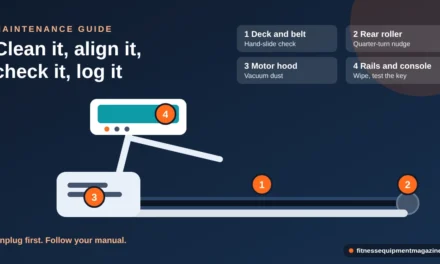
Maintenance: ten minutes a month beats a repair bill
Whichever side of the walking pad vs treadmill debate you pick, you’re buying a mechanical system with a moving belt, so it needs small, regular care. The good news is the care list is short.
Each use
Wipe and look
Wipe sweat from the console and side rails. Glance at the belt for fraying and the floor for belt dust.
Monthly
Check tracking and tension
The belt should sit centered and shouldn’t slip when you step firmly. Small adjustments, made a quarter-turn at a time, fix most drift.
Per manual
Lubricate if required
Some belts are maintenance-free; many aren’t. Use only the lubricant the manual names, and apply it as directed.
Yearly
Vacuum under the hood
Unplug it, remove the motor cover if the manual allows it, and clear dust. A clean motor runs cooler.
One practical difference: you can flip a pad on its side for a good clean underneath. That area catches an alarming amount of dust, pet hair, and sock lint. Treadmills hide it better, but they hide a lot more of it. Either way, heat and debris are enemies of any motor, so keep the floor around the machine clean.
Walking Pad vs Treadmill Cost: What Each Really Costs Over Five Years
The sticker price is the first number and rarely the last one. A fair walking pad vs treadmill cost comparison adds the mat, delivery, and assembly. It also counts any subscription, small repairs, and the odds of replacing the machine early. We’ll give ranges, not quotes, because prices move with sales, supply, and the season.
Typical price bands in the US market
In late 2026, walking pads commonly sit somewhere around two hundred to seven hundred dollars, with a few feature-heavy or run-capable ones above that. Compact folding treadmills commonly land between roughly five hundred and twelve hundred dollars. Sturdy full-size machines often start around the high hundreds to a thousand and go up past three thousand. A cheap machine isn’t automatically a bad one, but the cheap end of each band is where weaker motors, shorter warranties, and vague specs cluster.
If your budget is tight, our guide to which treadmill features matter most at a lower price ceiling shows where to spend and where to save.
The hidden line items
Read the walking pad vs treadmill chart for shape, not for dollars. The pad bar is short, but its repair and replacement slices take a bigger share of the total, because light machines wear faster under heavy use. The treadmill bar towers, but much of it is up-front: delivery, assembly, and a stronger machine you may keep for a decade. The compact folding treadmill lives between the two, and for many households it’s the best value per year of use.
- Mat: roughly thirty to a hundred dollars for something dense enough to protect floors and quiet vibration.
- Delivery and assembly: free for many pads, sometimes a hundred dollars or more for white-glove treadmill setup.
- Power: small; a few dollars a month at most for typical use, though verify your local rate.
- Subscriptions: optional on most machines, and they add up if you keep one for years.
- Repairs: belts, motors, and control boards are the common ones; ask who pays shipping.
Resale, longevity, and the “second hand” trap
In the walking pad vs treadmill resale picture, heavy treadmills from a respected tier hold some value. Moving a used one is its own project, though. Pads have a thin resale market, partly because they’re cheap new and partly because buyers can’t judge wear. If you plan to buy used, ask for the serial number, the purchase date, and a video of the belt running at your intended speed. Then check recalls with the CPSC before you hand over cash.
Longevity is the single biggest hidden variable in the walking pad vs treadmill cost story. A treadmill used four times a week for eight years costs a few cents a minute. A pad that gets used twelve times and then gathers dust costs more per use than any machine in the guide. Habit is the real price.
Seven Household Scenarios and the Verdict for Each
These walking pad vs treadmill scenarios are hypothetical shopper profiles we built to show the reasoning, not real customers. Find the one closest to you, then adjust for your own details.
1. The small apartment and remote work
You work from a one-bedroom, your desk is a standing model, and your goal is more steps without leaving the house. A walking pad fits. In the walking pad vs treadmill contest, this household leans pad. Pick a quiet one with a belt long enough for your stride, put a dense mat underneath, and slide it against the wall when guests come. A treadmill would eat the room, and you probably wouldn’t use its top speed. The one caution: if you already know you’ll jog on weekends, look at a compact folding treadmill instead.
2. The couple sharing one machine
One of you walks at a desk, the other likes a weekend run. That mismatch is the classic reason couples regret a pad in the walking pad vs treadmill decision. Because the machine’s weakest user sets its limits, buy for the more demanding person. A compact folding treadmill with a run-rated belt usually covers both, and a quiet mode helps the walker. If space is brutal, consider two roles: a pad for the daily walker and outdoor runs for the other.
3. The runner in a garage
You have the floor, the motivation, and a long stride. Buy a full-size run-rated treadmill and don’t look back. Look for a long, wide belt, a motor rated for continuous use, a sturdy frame, and an incline you’ll actually use. Add a mat, keep the garage temperature in mind, and cover the belt in dust season. Garage cold and humidity are rough on electronics, so read the manual’s operating-temperature range. Our guide to the best treadmills for home use by training style covers the runner’s checklist in more depth.
4. The older adult walking daily
This one splits. If steadiness is good and the goal is gentle daily steps, a pad with a remote and a simple start can be wonderful. If balance is a concern, a treadmill with handrails and a safety clip is the safer answer, and a gentle starting speed matters more than top speed. Either way, talk with a clinician about whether treadmill walking suits you. Then read the federal Physical Activity Guidelines for the general weekly activity picture. Handrails beat convenience here.
5. The family with kids and pets
Curious fingers, dog tails, and toy cars all find their way to a moving belt. A pad has the advantage of disappearing: stand it upright or slide it under something, and the risk drops. A folded treadmill is tall and can tip if pulled on, though most have locking mechanisms. In both cases, remove the safety key, keep the cord out of reach, and make the belt a no-play zone. Choose by the room that gives you a door you can close.
6. The renter with a strict landlord
Weight, noise, and floor damage are the three words that cause trouble. A pad on a mat keeps all three small. A big treadmill on a second-floor unit may breach a clause, and it can leave dents in softer flooring. Read the lease, ask the landlord in writing if you’re unsure, and put anything heavy over a broad, thick mat. If you want to run, you may be happier at a gym or outdoors.
7. Someone who will “just try it”
This is the most common walking pad vs treadmill buyer, and honestly the one most often steered wrong. If you’ve never kept an exercise habit, don’t buy the machine you wish you were. Buy the cheapest one that will be pleasant at your current level, with a generous return window, and run a thirty-day experiment. A modest pad is a decent trial. If you walk on it twelve times a month, graduate later. If you don’t, you’ve lost little. The walking pad shopping criteria for home and office help you choose without overspending.
When to Buy Neither
A walking pad vs treadmill guide that only ever says “buy something” isn’t doing you a favor. Sometimes the best equipment decision is a pair of walking shoes and a route you like. Here are the situations where we’d pause before spending a dime.
Signs you’re not ready for either machine
- You haven’t walked regularly outdoors in months, so a machine seems like a fix for something it can’t fix.
- You love walking outside, and the real obstacle is weather for three months a year, which a gym membership or a mall loop could cover.
- Your floor can’t take the weight, your lease forbids it, or your space is a hallway that you also need to walk through.
- The budget is thin enough that a failed purchase would hurt, and returns are hard or expensive.
- You’re hoping the machine will create motivation. It rarely does; it only makes use easier once the motivation exists.
Cheaper ways to test the habit first
Run a four-week experiment before you buy. Pick a time, walk indoors or outdoors for thirty minutes, and keep a plain tally on a sticky note. If you hit most days, you’ve earned a machine. If you don’t, you’ve saved a few hundred dollars and learned something. The HHS Physical Activity Guidelines give general weekly targets for adults. That’s a handy yardstick when you decide how much to commit.
A rental, a short-term gym pass with treadmills, or borrowing a friend’s machine for a weekend each tell you something a spec sheet can’t. They tell you whether the sound, the belt, and the time of day suit you.
An honest note
A machine can’t promise any particular health result, and we’re not offering one. It’s a tool that makes regular walking or running easier to do at home. If you have a medical condition, an injury, or a balance concern, check with a clinician before starting a new routine.
A Five-Minute Decision Flow
You’ve read the details. Here’s the whole walking pad vs treadmill logic as a route map. Follow it from the top and answer for the next twelve months, not the next twelve days. Treat the result as a starting category, not a final purchase. The next step in your walking pad vs treadmill search is checking specs and return policies for machines in the category.
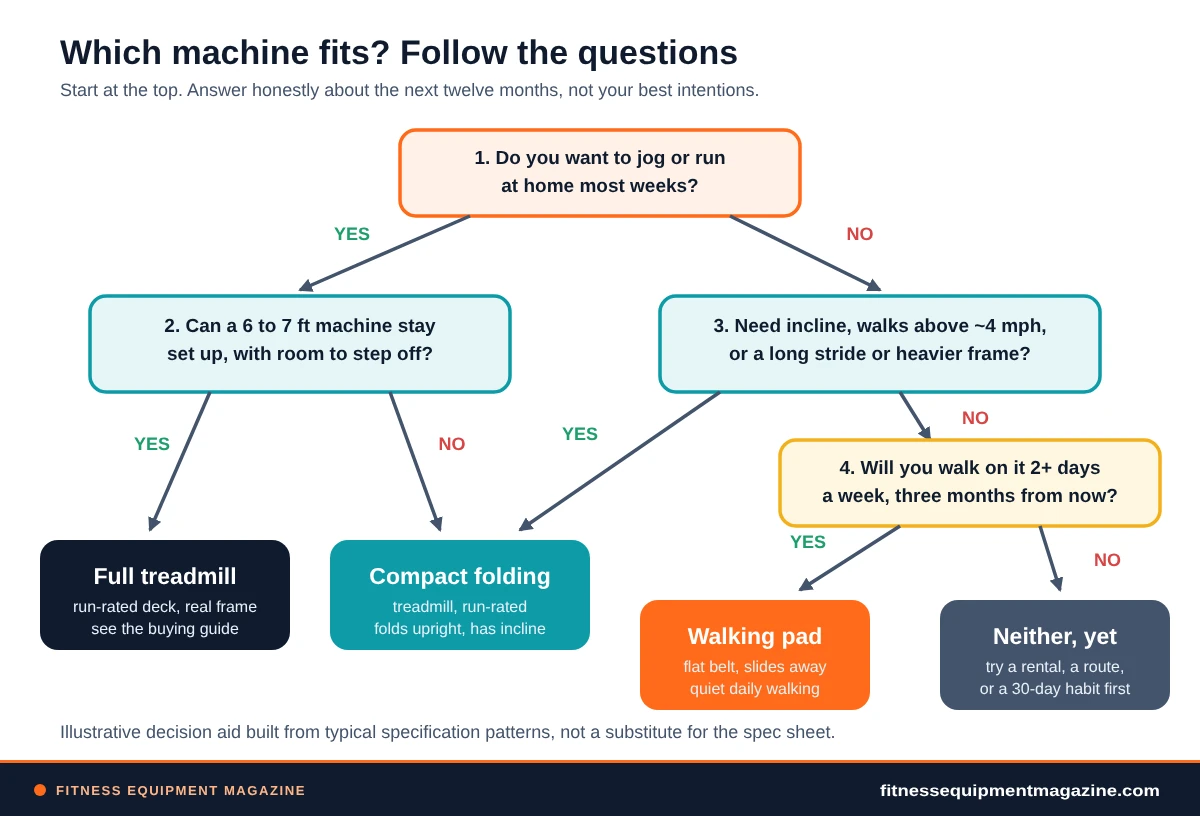
How to read your walking pad vs treadmill result
If you landed on walking pad, use our checklist for choosing a home or office walking pad and look at belt length, rated user weight, and noise control. If you landed on compact folding treadmill or full-size treadmill, start with the cornerstone guide and follow its specification order.
If you landed on neither, yet, that’s an honest answer, not a failure. Revisit the tree in a month.
Seven questions to ask before settling walking pad vs treadmill
- What is the rated top speed, and what is it designed for?Ask whether the manual allows running, and at which speeds sustained use is recommended.
- What are the exact belt length and width?Not the “running surface” marketing term; the measured belt.
- What’s the real user weight rating?And does it apply at all speeds and inclines?
- Is the motor rating continuous or peak?The two are not comparable.
- What does the warranty cover, and who pays shipping?Frame, motor, parts, and labor are often covered for different periods.
- What does it do without the app?If the answer is “not much,” factor in a subscription.
- What’s the return window and restocking fee?For heavy items, ask who pays return freight.
Mistakes and Myths in the Walking Pad vs Treadmill Debate
A few ideas circulate so widely that people stop questioning them. Some are partly true, which makes them harder to spot.
Five walking pad vs treadmill myths, checked
Myth
“A pad is just a cheap treadmill.”
Not quite. It’s a different design with a different job. Compared fairly, a pad wins on size and quiet and loses on speed, incline, and durability under hard use.
Myth
“Peak horsepower tells you how strong it is.”
Peak numbers describe a burst. For repeated use, continuous ratings and the whole system (frame, belt, rollers) matter more.
Myth
“More features means a better machine.”
Screens and programs are fun, but a quiet motor, a long enough belt, and honest ratings do more for years of use.
Myth
“I’ll just run on the pad sometimes.”
Maybe, if the model supports it. If it doesn’t, you risk both your warranty and your balance.
Myth
“A treadmill always beats a pad.”
Only if you’ll use what it adds. A big machine you avoid is worse than a small one you use.
The mistakes that cost the most
The costliest walking pad vs treadmill mistake is buying for the person you hope to become. The marathon plan can wait, so buy for the next year. Close behind: ignoring the runoff space, skipping the mat, and trusting a “peak” number. The last one is subtle. People often assume a bigger number means a bigger machine, and the spec sheet cheerfully lets them.
Another mistake is forgetting that a treadmill is a piece of furniture too. If it sits in your living room all day, the color, the fold, and the look matter more than a spec table suggests. You’ll glance at it every evening. Choose something you won’t resent.
The final mistake is leaving the cost of the cheap choice out of the equation. A pad you replace in two years because it overheated doesn’t save money over a folding treadmill you keep for eight. The reverse holds if you never needed the extra power. To see how the numbers shake out at the lower end of the market, try the budget treadmill breakdown of the features worth paying for is a useful next stop.
Frequently Asked Questions About Walking Pad vs Treadmill
Space, speed, and everyday use
Is a walking pad better than a treadmill for a small apartment?
In the walking pad vs treadmill contest for tiny spaces, a pad usually wins if you plan to walk. A pad needs a fraction of the floor area, lifts more easily, and typically runs quieter, which makes it friendlier to neighbors. A compact folding treadmill is worth a look if you also want to jog or use incline, because it folds upright. Measure your space, including runoff room behind the belt, before choosing either.
Can I run on a walking pad?
Only if the manufacturer’s manual says that specific model supports running at your speed. Most pads are designed for walking, with shorter belts, lighter motors, and no handrails. Running on one that isn’t rated can void warranty coverage and raise the risk of a fall. If you plan to run even occasionally, a run-rated treadmill is the safer pick.
Which lasts longer, a walking pad or a treadmill?
In the walking pad vs treadmill durability question, it depends on the load, not the label. A pad used for easy walking within its rating can last for years. A run-rated treadmill generally has a sturdier frame, bigger motor, and better parts for heavy use. It tends to hold up better when you push speed, weight, or hours. Match the machine to your real use, and look at warranty terms.
Durability, upkeep, and cost
Is a walking pad quieter than a treadmill?
On noise, the walking pad vs treadmill gap is real at walking speed, and the pad is usually quieter. Pads have smaller motors and lighter belts, and walking footfalls are gentle. The bigger neighbor issue is impact vibration traveling through the floor, which a dense mat helps reduce on either machine. Because noise varies by model, floor, and speed, test it at your real pace during the return window.
How much should I budget for a walking pad vs treadmill?
In the US market in late 2026, pads often fall between roughly two hundred and seven hundred dollars. Compact folding treadmills run about five hundred to twelve hundred, and sturdy full-size models start around a thousand. Add a mat, delivery, and possible repairs. Prices change often, so confirm current numbers and warranty terms before ordering.
Do walking pads and treadmills need maintenance?
Yes, but not much, and the walking pad vs treadmill upkeep difference is small. Wipe them down, keep the area around the machine free of dust, check that the belt sits centered, and lubricate if your manual calls for it. A few minutes each month prevents most avoidable problems. Follow the manufacturer’s instructions for lubricant type and schedule, because the wrong product can harm the belt.
Desk walking and who it suits
Is it okay to use a walking pad all day at a standing desk?
Many people do walk for a couple of hours at a time, and in the walking pad vs treadmill desk-walking debate that’s where pads shine. Pads are built for that kind of light, steady use. Check the manual’s recommended daily use and rest periods, wear supportive shoes, and listen to your body. If you have a health or balance concern, ask a clinician first. Take breaks, and don’t treat it as a replacement for varied movement.
What’s the best choice for older adults, a walking pad or a treadmill?
It depends on balance and confidence. If you’re steady and want gentle daily walking, a pad with a simple remote can work well. If you want something to hold, a treadmill with handrails and a safety clip is usually the more secure choice. Ask a clinician about your situation, and start at a slow speed.
Conclusion: Your Next Three Moves
The walking pad vs treadmill decision comes down to three honest answers. How fast will you go? How much floor can you give up? And how many days a week will you really use it? In short, the walking pad vs treadmill answer is that pads are the right tool for quiet, steady walking in a small space. Compact folding treadmills make a good middle road. Full-size treadmills earn their footprint when you run, climb, or share the machine across a household.
- Tape out the footprintMark the open size plus runoff space on your floor and live with it for a day.
- Write down your fastest realistic speedUse that, not a wish, to choose the category.
- Read the spec sheet and return policyConfirm belt size, rated weight, warranty, and who pays freight, then check CPSC recalls.
If you’re still torn on walking pad vs treadmill after that, reread the in-depth guide to treadmill specifications. Or walk the decision tree once more. Last reviewed: October 2026.
Sources and further reading
- HHS Physical Activity Guidelines for Americans — federal weekly activity guidance for adults.
- CPSC: Exercise equipment recalls — check any model before you buy.
- ACSM: Top fitness trends for 2026 — context on the growth of home and wearable-friendly fitness.
- Manufacturer spec sheets and owner’s manuals — belt size, rated weight, motor rating, and warranty terms for any specific model.
Some links on this site may be affiliate links. If you buy through them we may earn a commission at no extra cost to you. Recommendations are based on the criteria in the article, not payout. This article is general information, not medical advice, and no machine can promise a specific health outcome.