Choosing the best home gym equipment for strength training is mostly a question of order. Almost everyone eventually wants a rack, a barbell, plates, a bench and a pair of dumbbells. Nobody needs all of it on day one. Buying it in the wrong sequence is how people end up with a $900 cable tower and nothing to stand on. Start with the lifts you actually plan to do, then buy the cheapest piece of gear that makes them possible and safe.
This guide is the hub for our strength-training series. It walks through the best home gym equipment for strength training stage by stage: what to buy first, what can wait a year, what to skip, and how to judge quality when every listing promises “commercial-grade” steel. For the deep dive on the single most important purchase, our guide to the best power racks for home gyms covers stability, hole spacing, safety and attachments in detail.
Quick answer: the best home gym equipment for strength training, in buying order
For most people the best home gym equipment for strength training is a short list bought in a deliberate order: a pair of adjustable dumbbells or a few fixed pairs, a sturdy adjustable bench, then a barbell with plates held by a rack that has real safety catches. Everything else, cables, machines, specialty bars, is a second-stage upgrade that depends on what you find yourself missing.
- Who it fits: adults who want to train major muscle groups at least twice a week in a spare room, garage or corner of a living space.
- The big tradeoff: dumbbells are cheap, quiet and flexible but cap out on heavy squats and presses. A rack and barbell remove that ceiling but need floor, ceiling height and a larger budget.
- Do before buying: measure your ceiling and floor space, check what the floor can carry, and search the CPSC recall list for any model you shortlist.
Read this first: how we researched this guide
How we researched this. This guide to the best home gym equipment for strength training is research-based. It is built from manufacturer specification patterns, federal guidance and the ownership problems that buyers commonly report. We have not hands-tested the equipment types described here, and we name no brands or models on purpose.
Treat every number as a typical range and confirm it on the spec sheet of the exact product you’re considering. Some links on this site may be affiliate links. If you buy through them we may earn a commission at no extra cost to you. Recommendations are based on the criteria in the article, not payout.
Last reviewed: October 2026. Specs, prices, warranty terms and recalls change often. Before you commit to any of the best home gym equipment for strength training, check the seller’s current terms and search the CPSC exercise equipment recall list for the product name.
What is inside this guide
Start with the lifts you want to do
Walk into any big-box fitness store and the equipment is sorted by brand and price. That is a sales convenience, not a training logic.
A more useful way to sort it is by movement. Nearly every strength program is built from a handful of patterns: squatting, hinging at the hips, pushing, pulling and carrying. That is true from a three-day beginner plan to a serious powerlifting block. Once you know which of those you want to train, the list of best home gym equipment for strength training almost writes itself.
How much strength work is enough to plan around
Federal guidance gives a useful floor. The HHS Physical Activity Guidelines for Americans recommend that adults do muscle-strengthening activity involving all the major muscle groups on two or more days a week. That is general activity guidance, not a prescription, and it is a modest target. Two sessions of 30 to 45 minutes can be built around very little equipment.
This matters for shopping because it caps the amount of gear you need to start. The best home gym equipment for strength training for a two-day plan is a much smaller list than most catalogs suggest. Picture two or three full-body sessions a week. A bench and a good pair of adjustable dumbbells already cover most of the five patterns above. A rack becomes the right purchase when dumbbells stop being heavy enough for squats and presses, which for many lifters takes longer than they expect.
Three kinds of buyer, three different lists
Most shoppers fall into one of three groups, and the best home gym equipment for strength training looks different for each. The groups below are broad on purpose. You may sit between two of them, which is fine.
The routine builder
Wants to feel stronger, keep muscle with age and fit training around work and family. Needs adjustable dumbbells, a bench and bands. Rarely needs a rack in the first year.
The barbell lifter
Wants to squat, bench and deadlift with numbers that keep climbing. Needs a barbell, plates, a rack with safeties and a bench. Dumbbells come later.
The small-footprint trainer
Lives with a closet, a bedroom corner or a lease. Needs gear that stores flat or vertical, stays quiet and moves easily. Kettlebells, bands and one adjustable bench win here.
Be honest about how you’ll train before choosing the best home gym equipment for strength training
Here is the uncomfortable part. Equipment you do not use is the most expensive kind. Before you spend, write down the days you will really train, how long you have, and whether you will lift alone. Solo lifters need more safety gear per pound lifted, because nobody is there to grab the bar. A person who trains with a partner or in short, light sessions can take a different route.
It also helps to separate “what I want to be” from “what I will do on a Tuesday at 6 a.m.” The second person is the one using the gear, so shop for them. Buying for that person tends to produce a smaller, better-chosen setup and fewer pieces gathering dust.
Measure the room before you shop for the best home gym equipment for strength training
When you shop for the best home gym equipment for strength training, floor space and ceiling height eliminate more purchases than budget does. Strength equipment is tall, long and heavy, and the dimensions printed on a listing describe the object, not the space you need around it. A barbell is roughly seven feet long, and the plates stick out beyond the rack on both sides. A rack that “fits” a ten-foot room can leave you no way to load the bar.
Ceiling height: the quiet dealbreaker
Standard residential ceilings are about eight feet, or 96 inches. A tall lifter pressing a bar overhead can have the plates within a few inches of the ceiling.
Racks themselves commonly stand somewhere between 80 and 92 inches, and pull-up bars on top add a little more. Measure at the exact spot where the rack will stand, because soffits, ducts, garage-door tracks and ceiling fans all steal inches. Our guide on how much ceiling height you need for a power rack, pull-ups and overhead pressing goes into the arithmetic.
If the ceiling is the problem, there are workarounds. Low-ceiling racks exist, and some lifters press seated, from the pins, or with dumbbells. A garage with a raised door track or a basement with exposed joists can sometimes give you more room than a finished bedroom. Measure first and decide second.
Floor space and the loading zone
A rack’s footprint is usually around four feet square, but you also need space to move the bar, slide plates on and step back after a set. Many lifters like to leave about three feet beside each end of the bar, plus a clear lane behind the rack. The floor plan below shows a layout for a modest 12 by 11 foot room.
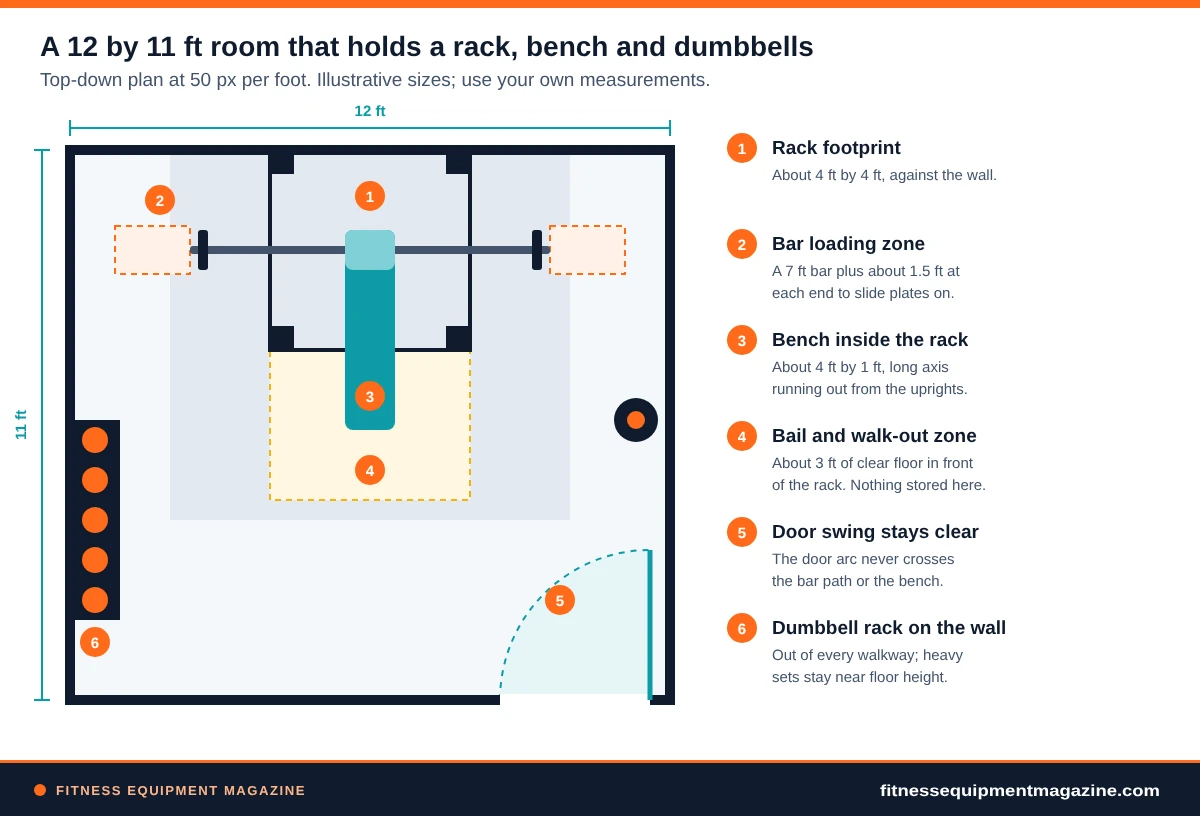
Notice what the plan protects when you fit the best home gym equipment for strength training into a modest room. The bar never sweeps through a door arc. The bench has room on both sides. The dumbbell rack sits against a wall where nobody can trip over it. Rooms smaller than this can still work, but they push you toward dumbbells, bands and a folding or compact rack rather than a full-length setup.
The floor underneath
Heavy equipment concentrates weight on small contact points. A loaded rack plus a lifter plus plates can push several hundred pounds onto four steel feet. A dropped barbell lands harder than its static weight. On a concrete slab that is fine. On a wood-framed upper floor, it deserves a closer look. We cover this in home gym floor load basics, and the practical protection layer is the subject of our home gym flooring guide.
If you live above someone, think about noise and structure together. Dropped weights, even onto rubber, carry sound downward. Lighter dumbbell work, controlled lowering and a platform are kinder to the neighbors than a deadlift session. Our apartment home gym guide lays out quiet-first choices.
The path in
One last measurement is easy to forget. A rack arrives in long, heavy boxes, and an eight-foot upright does not turn corners on a basement staircase. Check doorways, stairwell width and any tight corner between the driveway and the room. Some buyers find that a rack ordered in sections is the only thing that goes down the stairs.
The buy-first ladder: 7 stages of the best home gym equipment for strength training
Think of buying the best home gym equipment for strength training as climbing a ladder rather than working through a shopping list. Each rung adds a new set of exercises, and you only climb to the next one when the current rung stops being enough. This keeps spending tied to actual need and gives you a natural pause point after every stage to ask whether you are still training.
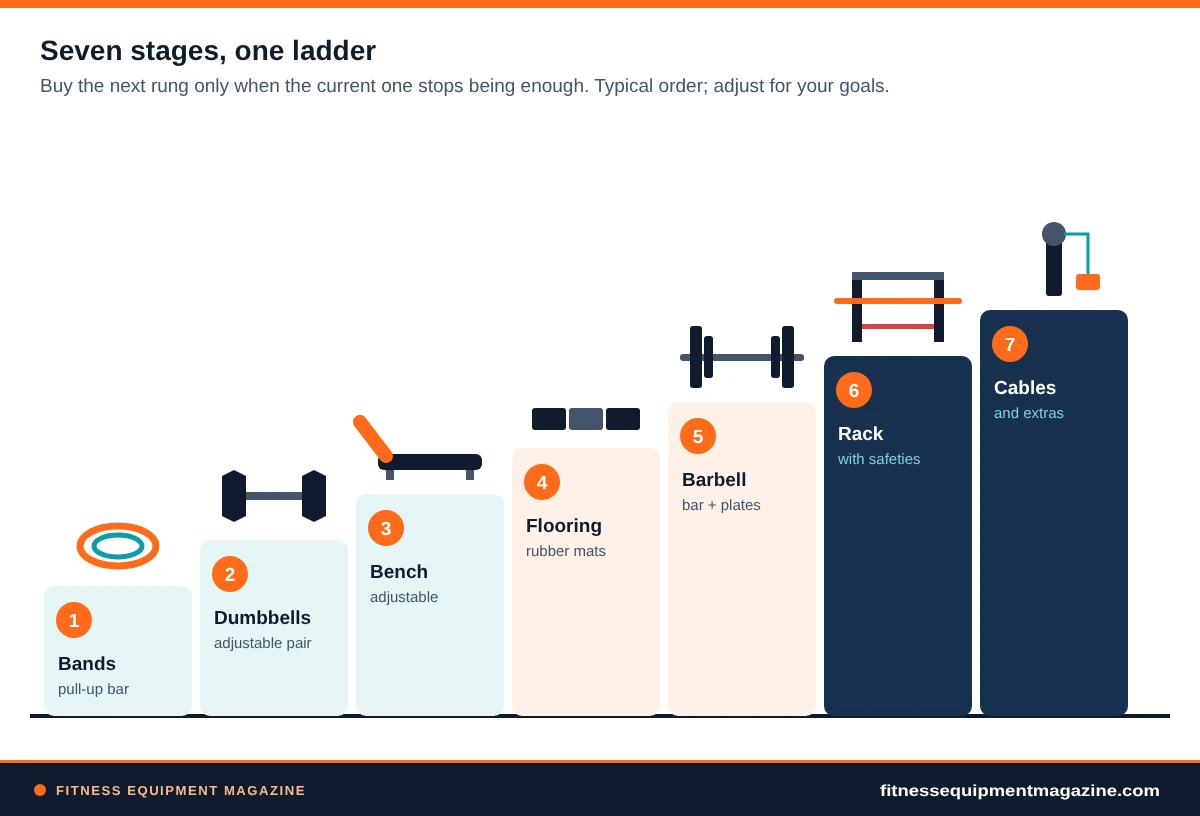
Stage 1: bands, a mat and a pull-up bar
If you have never trained consistently, start with the cheapest tools and prove the habit. Resistance bands, an exercise mat and a doorway or wall-mounted pull-up bar cost very little and cover pushing, pulling and some squatting. They also reveal whether you like training at home at all. Many people discover that the real obstacle was getting started, not a lack of equipment.
Stage 2: dumbbells
Dumbbells are the best first heavy tool among the best home gym equipment for strength training for most households. They are quiet, they train each side independently and they scale from light shoulder work to meaningful squats, rows and presses. We look at the choice between adjustable and fixed sets in the next section.
Stage 3: an adjustable bench
A bench turns dumbbells into a chest, shoulder and back program. It also becomes the anchor of every later purchase, because a rack without a stable bench loses half its use. It is a small outlay with a big payoff, so it earns the third rung.
Stage 4: floor protection
Flooring sits ahead of the barbell in the best home gym equipment for strength training for a reason. Once a bar and plates arrive, the first drop can crack tile, dent hardwood or leave black marks on a garage slab. Rubber matting or interlocking tiles protect the floor and quiet the room. Our home gym flooring guide covers thickness and subfloor protection.
Stage 5: barbell and plates
A barbell removes the weight ceiling that dumbbells impose, which is why it sits on every serious list of the best home gym equipment for strength training. It is also where the most expensive mistakes happen, because bars, plates and racks need to match in diameter and sleeve length. We explain that in the barbell section below.
Stage 6: the rack and its safeties
Many lifters buy the rack first because it looks like the centerpiece. In practice, the rack matters most once you start lifting heavy enough to need a failure plan. For solo lifters who squat or bench near their limits, it is not optional. Our comparison of a power rack and a squat rack explains how to pick between the two.
Stage 7: cables and specialty gear
Functional trainers, trap bars, landmine units and extra attachments come last. They are good tools, but they refine a program rather than create one. Add them when you can name the specific exercise the gear makes possible.
Experienced lifters can leapfrog stages one and two, and a space-limited household may never need stages five and six. Skip a rung only when you can say why. “It looked more serious” is not a reason.
Dumbbells, kettlebells and bands: the first loads worth owning
These three tools do most of the work in most home programs, and they anchor any list of the best home gym equipment for strength training. They also fit in the smallest spaces and are the least likely to annoy a landlord. If you only ever own these, you can still build a complete routine.
Adjustable dumbbells
An adjustable set swaps plates or dials on a single handle, so one pair does the job of a whole rack. The savings in space are real. A set that replaces fifteen pairs fits under a bench. The tradeoffs are speed, handle feel and, sometimes, durability. Changing weight takes seconds, which adds up during supersets, and some designs feel bulkier or longer than fixed dumbbells.
When comparing listings, check the weight range, the increment size, how the selector locks, and whether the handle length suits your hand. Look for steel handles with good knurling, secure locking mechanisms and a clear warranty on moving parts. Our guide to the best adjustable dumbbells breaks down speed, durability and range in depth.
Adjustable sets
- One compact footprint replaces many pairs
- Small increments help steady progress
- Lower total cost than a full fixed set
- Easy to store under a bench or in a corner
Tradeoffs
- Slower to change between exercises
- Moving parts can wear or jam
- Often a bulkier head that limits some movements
- Capacity may top out before you do
Fixed dumbbells
Fixed dumbbells come as rubber hex, urethane-coated or bare iron. They are fast, simple and almost impossible to break. They also take space and cost more across a range of weights.
A good compromise for many homes pairs an adjustable set for the working range with one or two fixed pairs. Choose the fixed pairs for the exercises you do most. For example, a heavier fixed pair for goblet squats or lunges saves time and avoids loading a selector on every set.
Kettlebells
Kettlebells shine for swings, carries, goblet squats and getups, all of which are hard to copy with dumbbells. A single mid-weight bell and one heavier bell can cover a surprising amount of ground. Look for a smooth, wide handle, a flat base, and a finish that does not chew up your hands. We compare cast iron, competition and adjustable designs in our kettlebell buying guide.
Resistance bands
Bands are not a toy, and they deserve a place among the best home gym equipment for strength training. They add variable resistance to squats and presses, assist pull-ups, and make rehearsal of movement patterns easy anywhere. They also travel, which no rack can claim. Loop bands, tube bands with handles and flat strips each serve a different job. A small mixed set is usually a better buy than a single band. Check bands for nicks before every session, because a snapped band can sting.
How much weight do you really need?
This is the question behind every dumbbell purchase, and it has no single number for the best home gym equipment for strength training. A rough pattern, though, is that presses top out well before squats and rows do. A set that feels generous for overhead work can feel light for goblet squats within a few months. If you suspect you will progress quickly, favor a range that goes higher on the heavy end, or plan to add a barbell later.
Write down the heaviest weight you can press for ten controlled reps and the heaviest you can row for ten. Then ask whether your candidate set’s top weight is at least a third higher. If it isn’t, you may outgrow it quickly, and a barbell may be the better long-term spend.
The three tools side by side
The bars above are an illustrative editorial judgment, not a measurement. They show why a mix of tools beats any single one, and why the heaviest lifts eventually point toward a barbell. If you are weighing this against a full build, our budget guide for the best equipment order turns the ladder into dollar-based plans.
The adjustable bench: the quiet workhorse of home strength training
A bench rarely gets the attention a rack does, which is odd, because it is the piece you will touch in nearly every session. It supports presses, rows, step-ups, split squats, seated curls and a lot of core work. A wobbly one ruins all of that. If you plan to buy only one bulky item in the first year, make it a good bench. Treat it as part of the best home gym equipment for strength training rather than an accessory.
Flat, adjustable or both?
Flat benches are simple, stiff and usually cheaper. Adjustable benches change the backrest angle, so you can press on an incline, sit upright for shoulder work and lie flat for the rest. For a home gym, adjustable almost always wins, because one frame covers three or four positions.
The exceptions are heavy bench pressers who want the maximum stiffness a flat frame can give. Rack users who need a bench that slides neatly into a narrow gap are another exception. We lay out the decision in flat bench vs adjustable bench.
What to check before you buy
Spec sheets for benches are short, but a few items separate a good one from a wobbler when you pick the best home gym equipment for strength training. Start with the stated capacity and ask what it includes: lifter, bar and plates, or lifter only. Then look at the frame steel, the width of the feet and whether the legs are solid or thin tubes. Weight capacity numbers that look generous can still sit on a narrow base.
- Rated capacity: read the fine print on what it covers and aim well above your lifting plus body weight.
- Foot width: wide, planted feet resist the sideways rocking that happens with heavy dumbbell presses.
- Pad firmness: overly soft foam bottoms out under heavy loads, and slick covers let you slide.
- Pad gap: a modest gap is normal on adjustable frames, but a large one is a comfort and form problem.
- Adjustment feel: pins and ladders should lock with a clear click and no side-to-side play.
- Seat height: a seat that sits too high makes it hard to plant your feet on the floor.
- Move-ability: transport wheels are a gift when you share the room, as long as they don’t make the bench skate.
Our full list of checks lives in the dedicated guide to the best adjustable weight benches. If the bench is going into a rack, also measure the rack’s inside width, since some benches with wide front feet won’t slide in.
Fit your body, not the average
Shorter lifters sometimes find a tall seat awkward, and taller lifters can run out of pad. The test is simple in a store, and nearly impossible online, which is why return policies matter. If you can’t try the bench, look for dimensions on pad length and seat height and compare them to a bench you already know. Check what the seller charges to take a heavy return.
Barbell and plates: what to know before you load the best home gym equipment for strength training
A barbell is the most efficient piece among the best home gym equipment for strength training. Two feet of floor space and a few plates hold more load than most dumbbell sets will ever reach. It also confuses new buyers more than any other item, mostly because the product pages use jargon: tensile strength, knurling, bushings, needle bearings, whip. Here is what each term means for a home user shopping for the best home gym equipment for strength training.
Olympic or standard: choose once
For home lifters choosing the best home gym equipment for strength training, Olympic bars take plates with a two-inch hole. Standard bars take plates with a one-inch hole and are usually shorter and thinner. The two are not interchangeable, and the Olympic format is what every serious rack, bench and plate set expects. Unless you are buying a very small, light setup, go Olympic. Our guide to Olympic vs standard barbells explains sizes, capacity and compatibility.
The specs that actually matter
Marketing pages love tensile strength numbers, and they can be useful, but they are only part of the picture. A higher figure usually points to a bar that resists bending permanently under heavy loads. Pair it with knurling that grips without shredding your hands, a finish that resists rust, and sleeves that spin freely. For home users in humid garages, the coating deserves as much thought as the steel.
- Weight rating: look for a clear, honest capacity that exceeds your plan with room to spare.
- Sleeve spin: bushings are fine and affordable for most lifters. Bearings spin more freely and cost more.
- Knurling: aggressive marks hold better but wear skin. A medium pattern is the safer first choice.
- Finish: bare steel feels great and rusts fast. Coatings resist rust but can wear at the grip.
- Straightness: roll the bar on a flat surface. Any wobble is a return.
The full breakdown, including diameter, bearings and coatings, is in our barbell buying guide.
Plates: iron, bumper or urethane
Plates come in three broad types, and each changes how you use the best home gym equipment for strength training. Iron plates are thin, durable and affordable, but loud and hard on floors. Bumper plates are thick and rubber-coated and can be dropped from the overhead position. Urethane plates are denser and quieter again, with a higher price. If you plan to drop weights, or share a floor with neighbors, rubber is your friend. If you lift mostly deadlifts and squats with controlled lowering, iron is perfectly fine.
The weight plate guide compares bumper, iron, urethane and change plates, and our look at the best bumper plates covers bounce, thickness and accuracy. One practical point deserves repeating here. Thicker plates mean fewer fit on the sleeve, so check the loading length before you plan a heavy lift on a short bar.
Collars and the small items
Plates slide, and collars stop them. Spring clips are fine for light work, but heavier lifting warrants locking collars. They are cheap, and a slipped plate on one side can tip the bar mid-rep. Add a pair of collars to every bar order. Do it even if the listing says they are included, because included collars are often the weakest part of the package.
Racks and stands: the safety system behind heavy lifting
A rack does two jobs. It holds the bar at a convenient height so you can unrack it without a clean-and-press, and it catches the bar when a rep fails. The second job is the one that matters most in any list of the best home gym equipment for strength training. Lifting alone with a loaded barbell and no catch system is a gamble, and experienced lifters tend to be the first to say so.
When people list the best home gym equipment for strength training, the rack belongs on every barbell-based list for exactly that reason.
Power rack, half rack or squat stand
Four-post power racks are the most stable and the most forgiving. A cage surrounds the lifter, safeties sit on both sides, and attachments bolt on easily. Half racks use two uprights with a base that extends behind, which saves floor space. Squat stands are lighter and smaller, and they fold or store easily, but they put more trust in your own sense of balance.
For solo lifters choosing the best home gym equipment for strength training, we lean toward a four-post cage or a stable half rack with strong safeties. Our power rack vs squat rack comparison works through that decision, and the detail on tubing, holes and attachments lives in the best power racks guide.
Four-post power rack
- Cage catches failed lifts from every side
- Highest stability, even with kipping or band work
- Space for pull-up bars, dip bars and attachments
Tradeoffs
- Largest footprint and ceiling demand
- Heavy to move and awkward to deliver
- Usually costs more than a stand
Safeties: arms, straps and why height matters
Spotter arms are rigid metal bars that sit across the rack. Safety straps are webbing that hangs between the uprights and lets the bar sink slowly. Arms are simple and strong. Straps are gentler on the bar and plates and have a bit more give, but they depend on correct placement. Either one only helps if it sits at the right height, just below the bottom of your lowest rep.
Test the setup before every heavy session. Walk the bar down to the safeties with an empty bar and confirm that you can bail. A rack that has never been tested is a rack you are guessing about. Our power rack safety guide covers clearances, anchoring and spotter arms in more depth.
Never train heavy alone without a catch system, and never rely on collars to keep a stuck bar from tipping. If you can’t afford a rack yet, that is a reason to stay with dumbbells longer, not to take risks with a loaded bar. Search the CPSC exercise equipment recalls for any rack you consider.
Stability, anchoring and the wobble test
Three details separate a solid rack from a shaky one. The first is the steel itself: thicker walls and wider uprights reduce flex. The second is the footprint: a wider stance resists tipping when a bar slams onto the hooks. The third is whether the rack can bolt to the floor or gets weighed down with plates. Many home racks free-stand, which is fine when loaded correctly, but check the manual for anchoring advice.
After assembly, push the top of the rack side to side. A bit of movement is normal. A rack that sways like a ladder is not. Tighten the bolts again after the first week, because they settle.
Cable trainers, Smith machines and all-in-one gyms
Machines are where marketing and the best home gym equipment for strength training drift apart most. They look like a complete gym in one box, and a few of them are very good. Many others compress too many exercises into too little frame, with awkward positions and plastic pulleys. They also tend to be heavy, expensive to ship and difficult to resell.
Cable machines and functional trainers
Cables offer smooth, constant tension and a huge range of angles. A good functional trainer, with two adjustable arms and a weight stack, covers rows, flyes, curls, pressdowns, woodchops and more. The key specs are the pulley ratio, stack weight, travel and attachments. Ratios of 1:1 feel heavier per plate than 2:1, which is lighter but gives more cable travel. Our best functional trainers guide and the cable machine buying guide explain ratios, stacks and footprint.
Smith machines
A Smith machine guides the bar along fixed rails. That makes it feel safer for solo squatting and pressing, and it often includes built-in catches. The price is a fixed bar path that doesn’t suit every body, and it changes how stabilizer muscles work. Some lifters love it, others find it awkward. We compare it with a free rack in Smith machine vs power rack.
All-in-one multi-gyms
All-in-one home gyms bundle a bench, cables, presses and leg stations. They are convenient in theory, and often limited in practice. Moving parts have more wear points, and replacement parts can be hard to find. They suit lifters who want machine-style exercise with a modest weight and no need for free weights. For anyone planning to lift heavy, they are an add-on, not a substitute.
When machines make sense
- You train alone and want built-in guidance
- Joint comfort favors a fixed path
- You prefer quick changes between exercises
When they don’t
- You want to progress to heavy squats and deadlifts
- Space is tight and the footprint is large
- You expect to move or resell the gear
Specialty bars and attachments
Once the basics are in, a few specialty items earn a place. A trap bar makes deadlifting friendlier for many lifters and doubles as a carry tool. A landmine attachment turns any barbell into a rowing and pressing station with small footprint. Buy them when you can name the exercise you will do, and not before.
Flooring, storage and the small stuff
The unglamorous purchases decide whether a home gym built around the best home gym equipment for strength training stays pleasant. Flooring, storage and a handful of small items protect the room and make training smoother. Skipping them is how a promising setup turns into a mess.
Flooring that survives the first drop
Rubber is the standard answer. Rolled rubber, interlocking tiles and horse-stall mats all work, with different thicknesses and price points. Thicker is better for impact and noise, but only up to the point where the bench starts to feel squishy. On wood floors, many lifters add a plywood layer under the rubber to spread the load. We go through the options in the home gym flooring guide.
Storage that keeps the room usable
Loose plates, rolling dumbbells and bars in the corner become tripping hazards fast. A plate tree, a wall-mounted bar holder and a simple dumbbell rack tame most of the clutter. Rack-mounted storage pegs use space that is already taken up. Our home gym storage ideas page compares trees, racks and wall systems for the whole room.
The small items that earn their keep
- Locking collars: a few dollars of safety that is easy to forget.
- A floor fan or ventilation plan: a stuffy room kills sessions faster than missing equipment.
- Good lighting: shadows hide mistakes, and you want to see the bar path.
- A towel and cleaning spray: sweat damages upholstery and finishes over time.
- A tape measure and level: use them on delivery day, not after the first wobble.
How to judge build quality from a listing
Strength equipment is simple, which makes bad versions of the best home gym equipment for strength training hard to spot.
Two racks can look identical in photos and differ by a quarter-inch of steel. We haven’t hands-tested anything here, so we focus on what you can verify from the page and the box. That means specifications, warranty language, return terms and the patterns of problems that owners report. Our own approach to reviewing gear is explained in how we test strength equipment, which also lists what a store visit can tell you.
Steel, welds and finish
Steel gauge and tube size are the first things to read. For racks and benches, thicker walls and larger tubing generally mean less flex. A listing that hides the gauge is hiding something. Welds should look continuous and tidy, not blobbed. Finish matters too: powder coat is common and durable, while cheap paint chips at the first collision with a barbell sleeve. Zinc-plated hardware resists rust better than raw steel bolts.
Tolerances and the fit between parts
Holes that line up, uprights that sit square and attachments that slide on without grinding are signs of decent manufacturing. Poor tolerances show up as rattles, uneven J-hooks and a bar that sits tilted. If photos of customer setups show gaps or bent pieces, take note. Reviews that mention consistent issues across many owners are more reliable than a single angry one.
Rated capacity: read the fine print
A capacity figure can mean the static load, the dynamic load or the weight of everything combined. Two products can both say “1,000 lb” and mean very different things. Look for the testing standard or at least a clear description of what the number covers. When capacity isn’t explained, assume the lower interpretation and size up accordingly.
Divide the listed shipping weight by the number of steel parts you expect. A rack that weighs far less than similar racks of the same footprint is probably using thinner steel. It isn’t proof, but it is a good reason to read the spec sheet closely.
Warranty and service
Warranties on strength gear usually split into tiers. Expect a long period on the frame, a shorter one on welds or finish, and one year on parts and moving components. Read the exclusions. Many warranties void themselves if the product is used commercially, if you drop a bar on the safeties or if you skip required assembly steps. Then check how easy it is to claim: is there a phone number, a replacement parts store and a history of responsive service?
Reading reviews without being fooled
Product reviews are noisy. Look for specifics: whether the owner mentions a number of months, whether a problem repeats and whether the seller replied. Be wary of listings with many five-star reviews posted in a short window, and of reviews that sound like marketing copy. Treat a moderately critical review with detail as more useful than a glowing review without any.
- No stated steel thickness or tube size
- Capacity listed with no explanation of what it covers
- Photos that show only renders, never real assembly
- Warranty that excludes “normal use” or is vague about the frame
- No contact method, replacement parts or return window
- A price far below every comparable item, with no explanation
Five hypothetical setups of the best home gym equipment for strength training
The profiles below are invented to show how the rungs of the ladder combine into the best home gym equipment for strength training for different homes. They are not case studies of real people, and the budget shares are illustrative. Your own numbers will differ, so use them as a template and not a prescription.
1. The closet starter
Maya rents a one-bedroom apartment above a neighbor. She has about 20 square feet of floor and a landlord who dislikes screws in walls. Her best home gym equipment for strength training is a set of adjustable dumbbells, a mid-weight kettlebell and a mixed set of bands. A foldable bench slides under the bed. She trains three mornings a week, quietly, and keeps it all in a closet. Nothing in the best home gym equipment for strength training for her needs a rack. It might never.
2. The spare-room generalist
Jordan has a 10 by 11 foot spare room and wants to build strength without turning the house into a gym. The plan is adjustable dumbbells, a sturdy adjustable bench, floor tiles, a pull-up bar and a wall-mounted dumbbell rack. Later, if dumbbells stop being heavy enough for squats, a compact half rack and a barbell can fit in one corner. For now the room still works as a guest bedroom.
3. The garage barbell lifter
Sam parks outside and uses the garage as a lifting space. A four-post rack, an Olympic bar, a mixed set of iron and bumper plates, a flat-to-incline bench, rubber stall mats and a plate tree make a complete setup. The garage is cold in winter and humid in summer, so Sam picks coated hardware, wipes the bar after sessions and keeps a small dehumidifier running. Our garage gym guide covers the climate side of this setup.
4. The shared-space couple
Chris and Dani share a basement and train at different times, with different goals. One lifts heavy, the other prefers lighter, higher-rep work. They buy a rack with a bench, adjustable dumbbells that cover both ranges and a few kettlebells. Duplicate purchases are the enemy here, because every second bench eats floor.
5. The low-ceiling basement
Priya’s basement ceiling is just over seven feet, with a soffit near the wall. Full overhead presses with a barbell are out. She chooses a low-profile rack for squats and benching, seated and landmine pressing, and a set of dumbbells for everything else. A shorter pull-up solution, like a neutral-grip bar on a joist, rounds out the room. It’s a smaller menu, but it is one she will really use.
What the best home gym equipment for strength training costs over time
Price is the part of this guide most likely to be out of date by the time you read it. So think of the best home gym equipment for strength training in ranges. Steel, shipping and demand all move. So we think in ranges and ratios, and we avoid pricing named products. Verify current numbers with each seller. The framework below should survive a price change.
Rough budget tiers
In the US market in late 2026, a minimal bands-and-dumbbells start usually costs a few hundred dollars. A solid dumbbell-and-bench home gym with floor protection lands in the low thousands. A full barbell setup with a rack, bar, plates, bench and flooring tends to cost more than that, and the spread between entry and premium versions is wide. For specific dollar plans, including $500, $1,000, $2,500 and $5,000 builds, see our home gym on a budget guide.
Costs people forget
- Shipping and delivery: heavy items can add a large fee, and curbside means you move it yourself.
- Flooring: a rack needs a floor under it, and that isn’t free.
- Collars, a bar holder and storage: small items add up.
- Replacement parts: sleeves, pins and bolts can need replacing over years of use.
- Time and tools: assembly takes hours, and a socket set helps.
Cost per session, honestly
A helpful way to think about value is to divide the purchase by the sessions you will realistically do. A $1,500 setup used three times a week for three years comes to a few dollars a session, which compares well with most gym memberships. The same setup used twice a month becomes expensive. This is why the ladder matters. Stop climbing when use stops climbing.
Also think about resale. Racks, bars and plates hold value surprisingly well. Cheap, branded-looking gear tends to sell for little, and bulky items are a pain to move. Used gear can be a smart way to buy, as long as you inspect it for rust, bent bars and cracked welds. Our guide to building a home gym covers the broader planning side.
Matching the best home gym equipment for strength training to common goals
Goals change the list of best home gym equipment for strength training more than most buyers expect. Someone chasing bigger numbers on a barbell needs different priorities than someone who wants to stay capable into their seventies. None of the groups below is better than another. They simply lean on different parts of the ladder, and none comes with a guarantee of results.
Building muscle
Muscle growth responds to enough hard sets across the week, and nearly any loadable tool can supply them. That makes variety and easy small jumps the main shopping points. An adjustable bench, a wide range of dumbbell weights and a cable station or bands for isolation work cover most of what lifters use.
A barbell and rack help with heavy compound lifts but aren’t required on day one. For this group, the best home gym equipment for strength training is anything that lets you add small amounts of load every few weeks.
Getting stronger on the big lifts
Maximum strength depends on practicing heavy squats, presses and pulls, so the best home gym equipment for strength training here is a barbell, plates and a rack with safeties. Add a sturdy bench and, if you can, bumper plates for deadlift safety on a thin floor. Small plates for gradual jumps matter more here than any accessory. Aim for a bar and rack that comfortably exceed the loads you expect in two years, because upgrading mid-program is a headache.
General fitness and healthy aging
For general strength that supports everyday life, comfort, stability and ease of use count most. Adjustable dumbbells, a stable bench with a back pad, a pair of kettlebells and bands handle nearly everything.
The best home gym equipment for strength training for this group stays simple. Many also like a sturdy chair or box for step-ups and a clear space for floor work. Our guide to equipment for older adults goes deeper on access and stability, and any new program should be cleared with a clinician when health conditions are involved.
Cross-training for a sport
Runners, cyclists and recreational athletes often use strength work to complement their main sport, and the best home gym equipment for strength training for them is small. Their priorities are time and simplicity: kettlebells for swings and carries, dumbbells for single-leg work, and bands for shoulder and hip prep. They rarely need a full rack. If your main sport is on a machine, our guide to the best treadmills for home use covers the cardio side of a combined room.
Short, frequent sessions
Parents and shift workers often have twenty-minute windows. For them, the best home gym equipment for strength training is whatever is already out and ready. A bench with dumbbells beside it beats a perfect rack in the garage. So does a pull-up bar in a doorway or a kettlebell by the sofa, because the garage rack takes ten minutes to set up. Setup friction kills more routines than missing equipment does.
Count the steps between deciding to train and the first working set. If it’s more than three or four, move something. Leave the bench out, hang the bands on a hook, and park the dumbbells within arm’s reach.
If you want cardio in the same room
Many households want both lifting and conditioning. A rower, bike or treadmill competes with the rack for floor space, and sometimes for the same electrical outlet. Plan the cardio machine first if it’s large, because a rack can fit around it more easily than the reverse. Our cardio machine guide compares the main options. The best home gym equipment for strength training still comes first in most rooms, and the home gym build guide shows how to lay out a mixed room.
A week of training with the best home gym equipment for strength training
Even the best home gym equipment for strength training only makes sense next to a plan. The three sample weeks below are not prescriptions, and they are not medical or coaching advice. They exist to show how a given set of equipment actually fills a calendar. If you can’t picture the Tuesday session, you probably don’t need the item yet.
Week A: dumbbells, a bench and bands
Three full-body sessions fit this setup well. A typical session starts with goblet squats or split squats. Next come a bench press or floor press, a one-arm row and a hip hinge such as a Romanian deadlift with dumbbells. A carry or a core exercise finishes it. Bands handle warm-ups and pull-aparts. Everything fits in one corner, and each session takes about 40 minutes.
The thing to watch is progression. Without a barbell, you increase load by adding reps first, then moving to the next dumbbell weight. If your selector jumps in five-pound steps, the heavy end of the range can feel like a big leap on presses. That is not a flaw so much as a planning detail, and slowing the tempo or adding a set bridges the gap.
Week B: barbell, rack and bench
Four sessions a week suit a barbell setup, either as upper and lower days or as a full-body rotation. A squat or deadlift day anchors the lower session, a bench or overhead press anchors the upper one, and rows, pull-ups and dumbbell accessories fill the gaps. The rack and safeties let you push sets close to failure without a spotter, which is exactly why the best home gym equipment for strength training for this lifter includes them.
Recovery needs more attention here. Heavy compound lifts can leave you sore, and a four-day schedule works best when you leave a day between hard sessions. That is general training logic, not a promise about results, and anyone with health concerns should ask a clinician before ramping up load.
Week C: kettlebell, bands and a pull-up bar
Two sessions a week can be enough to meet the federal muscle-strengthening floor. A kettlebell circuit of swings, goblet squats, presses and carries, plus band rows and a few pull-ups, takes about half an hour. It is brisk, quiet and cheap. A traveler, a renter or a parent with short windows can sustain it for years, and it leaves room to add a bench later.
The bars are an editorial illustration. They show that even a very small kit covers most of the patterns, while a barbell setup closes the last gap, which is heavy lower-body loading. If you want help choosing between these routes for your own space, our home gym equipment guide for every budget sets them side by side.
How to know when it is time to climb the ladder
People buy the next rung of the best home gym equipment for strength training too early far more often than too late. A few honest triggers tell you when the current setup has run out of road. Wait for at least two of them before spending.
Signs that you have outgrown a rung
- The top weight feels easy for sets of fifteen. That’s a sign dumbbells will no longer drive progress on that movement.
- Your warm-up sets are your working sets. You are spending sessions on setup, not training.
- You have trained consistently for a couple of months. The habit is proven, so equipment can follow it.
- You keep skipping an exercise because of the gear. The missing tool is the one worth buying.
- Your bench or stand moves, flexes or squeaks. A stability upgrade pays for itself in confidence.
Small jumps beat big ones
Lifters who buy a barbell often discover the smallest standard plate is two and a half pounds per side on a good day, and five on a bad one. Presses and curls rise slowly, and that tiny jump can feel huge. Fractional plates or magnetic add-ons solve it for a few dollars. Check whether your plate set includes small steps before you commit, since a set built only from big plates makes steady progress awkward.
When to pause and reassess
Buying also has a quiet cousin: not buying. If a month goes by and nothing in the room limits your training, the right move is to keep lifting. Money you don’t spend this season can fund the right rack next season. Owner complaints suggest that regret clusters around equipment bought in a burst of enthusiasm, and satisfaction clusters around gear that arrived after weeks of clear need.
New, used or bundled: how to save on the best home gym equipment for strength training
Strength gear is one of the few categories where used best home gym equipment for strength training is often as good as new. Steel doesn’t wear out the way electronics do, and a barbell can last decades. That makes secondhand shopping attractive, as long as you know what to inspect.
What to inspect on used gear
- Racks and benches. Look for cracked welds, bent uprights, stripped bolt holes and stretched hole patterns. Sit on the bench and rock it.
- Barbells. Roll the bar on a flat surface to check straightness, spin the sleeves by hand, and look at the knurling and finish for deep rust.
- Plates. Weigh a few if you can. Cracked rubber, deep gouges and bent iron rims are signs of hard use.
- Dumbbells. Check that the handles are tight and that the heads don’t spin. For adjustable sets, test the selector through its whole range.
- Cables and pulleys. Run a hand along the cable for fraying, and spin each pulley. A grinding sound is a repair bill.
Buying and moving it safely
Meet in daylight, bring a helper and a tape measure, and test everything before paying. Heavy gear loads badly into cars, so bring straps and blankets. Ask whether the seller still has the manual and any hardware. Old recalled products also circulate, so search the CPSC recall list for the make and model on the spot. If the seller can’t tell you what it is, that’s your answer.
Bundles and packages
Many sellers offer rack, bench, bar and plates as one package. The convenience is real, and so is the discount. The danger is that bundles pad the box with the weakest parts, such as thin collars, a short bar or a bench that is fine for light work only. Check each component separately against the criteria above. A bundle is worth it when every piece would pass on its own, and not otherwise.
Add the sale-price items to a list and wait a week. If you still need every item after seven days, buy. Sales cycles on heavy gear come around often, and waiting a week costs less than owning a bench you don’t use.
Delivery, assembly and the first week
The day the boxes land is when your plan for the best home gym equipment for strength training meets reality. Heavy items arrive on pallets, in pieces, often to a driveway. A little preparation turns delivery day from a scramble into an afternoon project.
Delivery day
Ask the seller what delivery means. Curbside drop-off is the cheapest and leaves the carrying to you. Inside delivery costs more but saves your back. Inspect every box before the driver leaves and note damage on the paperwork, because a dented upright or crushed bench pad is far easier to resolve on the day. Take photos of anything off, and keep the packaging until you know the product is fine.
Assembly in a sensible order
- Inventory the hardware. Count the bolts and washers against the manual before you touch a wrench.
- Build where it will live. A rack moved after assembly is a rack that can be scratched or bent.
- Leave bolts loose until the frame is square. Tighten only after everything lines up.
- Level the feet. A small shim now prevents rocking later.
- Test with the empty bar. Walk the bar to the safeties, unrack it and rock the frame.
The first-week checks
Bolts settle during the first sessions, and so does your opinion of the gear. Re-tighten every connection after about a week, and again after a month. Take notes on anything that rattles, rubs or wobbles. Photograph the serial number and keep the receipt, because warranty claims go faster with proof. If something isn’t right, contact the seller promptly, while the return window is open. For a longer version of this routine, see the home gym setup checklist.
It also pays to run a trial week before you celebrate. Use each piece for its intended purpose, in the way you plan to train. A bench that feels fine for a single press may bother your shoulder blades by the third set. A rack that looked huge online might leave you cramped when you bring the bar out.
Safety, kids and keeping the gear in shape
Home strength training with the best home gym equipment for strength training is generally safe when you respect the load, the setup and the room. Most injuries around home gear are mundane: a pinched hand, a dropped plate on a foot, a bar that tipped because a collar was missing. Careful habits prevent nearly all of them. The best home gym equipment for strength training can’t do much for you if the room around it is a hazard.
Habits that prevent most accidents
- Warm up and start light. Sets with the empty bar tell you whether the rack, bench and floor feel right today.
- Set the safeties first. Do it before the first loaded rep, not after you need them.
- Use collars every time. It takes five seconds, and it prevents the worst kind of tipping.
- Load both sides evenly. Add and remove plates one pair at a time.
- Keep the floor clear. Put away plates and dumbbells between sets so you can walk and bail.
- Know how to fail. Practice dumping a bar behind you or onto the safeties with a light load.
Kids, pets and shared rooms
Curious children find barbells, plates and folded benches irresistible. A dropped plate or a swung dumbbell can cause serious harm, and a collapsing bench or rack can crush. If children live in the house, lock the room, use a gate, or store loose weights up high and strap the rack. Teach older kids that the gym is a workspace, not a playground. Our family home gym safety guide covers storage, access and shared spaces in more detail.
This guide is general equipment information, not medical advice. If you have an injury, a heart condition or you’re returning to training after a long break, talk with a qualified clinician or coach before starting a heavy program. For older adults, stability and ease of access change the shopping list, and our piece on home gym equipment for older adults addresses that.
Keeping the gear in shape
Strength equipment lasts for decades when you give it a little care, so even the best home gym equipment for strength training repays a monthly check. Wipe sweat off pads and frames after sessions, because salt and moisture corrode steel and rot foam. Oil the bar sleeves lightly and brush the knurling occasionally. Check bolts every month or so, since vibration loosens them, and look at straps, cables and welds for wear. Rust spots deserve attention early.
Our strength equipment maintenance guide gives a seasonal checklist covering bolts, cables, upholstery, bearings and rust prevention. If you work out in a garage or basement, humidity is the quiet enemy, and a simple dehumidifier will protect your investment more than any spray.
Noise and neighbors
Sound travels through floors and walls more than through air. Dropping weights, even onto rubber, thumps through a slab or joist floor. If you share walls, favor controlled lowering, add a platform or thick mats, and train at reasonable hours. Our guide to home gym noise reduction covers dropped weights, vibration and wall noise.
Ten mistakes and seven myths
Most regrets in buying the best home gym equipment for strength training fall into familiar groups. Knowing them in advance saves money, space and a lot of frustration when you buy the best home gym equipment for strength training. We list the mistakes first, then the myths that lead people into them.
Ten mistakes that sink purchases of the best home gym equipment for strength training
- Buying the rack before the room. Measure ceiling, floor and the path in before ordering anything tall.
- Skipping flooring. The first drop is cheaper to prevent than to repair.
- Mixing bar and plate sizes. A standard bar with Olympic plates does not work, and returns are expensive.
- Trusting capacity numbers blindly. Read what the figure covers and size up.
- Ignoring safeties. Training alone without catches is the most avoidable risk in the room.
- Overbuying specialty gear. A cable stack and three bars you rarely use is a lot of rust waiting to happen.
- Underbuying the bench. A flimsy bench caps the progress of everything above it.
- Forgetting the neighbors. Noise complaints end more home gyms than budgets do.
- Chasing a complete setup. A complete gym on day one usually means half of it goes unused.
- Not checking returns. Heavy items often carry restocking fees, so read the policy first.
Seven myths about strength gear
“You need a rack to get strong.”
Not at first. Heavy dumbbells, bodyweight work and kettlebells build real strength for many people. A rack becomes important when barbell loads get heavy.
“Machines are always safer.”
They can guide the path, but they don’t remove risk. Poor fit, worn cables and heavy stacks bring their own problems.
“Thicker steel is always better.”
Thicker steel adds stability but also weight and shipping costs. Design, welds and bolt-ups matter as much as gauge.
“Adjustable dumbbells are flimsy.”
Some are. Many are durable. Check the locking design and the warranty rather than writing off the category.
“Home gyms are cheaper than memberships.”
Often, but not automatically. Unused gear costs more than a membership you use.
“Heavier plates mean a better bar.”
A bar rated for heavy loads helps, but you rarely need extreme ratings. Fit, finish and straightness matter more.
“More attachments equal more value.”
Attachments you never use are clutter. Buy one when a specific exercise needs it.
A decision framework and checklist for the best home gym equipment for strength training
If the choices of best home gym equipment for strength training still feel like too many, these questions narrow them quickly. Answer them in order, and stop when you hit a decision.
Four questions that settle most purchases
- Do you need heavy barbell work? If not, start with dumbbells, a bench and bands, and revisit in a year.
- Do you have 90 inches or more of ceiling over a four-foot square? If not, plan around low-profile or dumbbell options.
- Will you lift alone near your limit? If yes, a rack with safeties comes before heavier plates.
- Is noise or the floor a concern? If yes, add flooring first and choose quieter gear.
Space-limited households may find our guide to small home gym ideas useful at this stage. Those who also want cardio can compare options in our cardio machine guide, and anyone planning the whole room should read what you actually need at every budget.
Your pre-checkout checklist for the best home gym equipment for strength training
- I measured ceiling height at the exact spot where the rack or bench will stand.
- I confirmed doorway, stairway and corner widths for the longest box.
- I know what the floor can carry and have a plan for protecting it.
- I matched bar sleeve diameter to the plate hole size.
- I read what the weight rating includes and left a margin.
- I found the warranty terms for frame, welds, finish and moving parts.
- I checked the return policy and restocking fees for heavy items.
- I searched the CPSC recall list for the product and the brand name.
- I priced shipping, flooring, collars and storage on top of the sticker.
- I picked one thing to buy now and one thing to wait on.
For a longer pre-purchase and installation routine, our home gym setup checklist takes the same approach through delivery, assembly and testing.
When home equipment is not the right buy
Sometimes the honest answer on the best home gym equipment for strength training is not to buy. A gym membership may beat a home setup if you have no space, need heavy specialty machines or train better with other people around. Some people simply enjoy leaving the house to work out, and that’s a perfectly good reason.
Signs you should wait
- You haven’t kept a routine for at least a couple of months with the equipment you already have.
- You can’t give the gear a dedicated spot and would have to move it every session.
- The floor or ceiling won’t take the load, and you can’t change it.
- The main appeal is how the gear looks in photos.
- Your lease or your neighbors would make the noise a daily problem.
Middle paths
If you aren’t sure, try a cheaper bridge. A few months with bands, a kettlebell and a rented or borrowed bench will tell you more than any article. A hybrid is another option: a home setup for most sessions and a membership for heavy days. Reuse what you learn. Every session without a purchase is also a session that tells you what you will actually use.
Best home gym equipment for strength training: frequently asked questions
First purchases
What is the best home gym equipment for strength training if I can only buy one thing?
For most people, one pair of adjustable dumbbells is the best single purchase. They are quiet, they cover pushing, pulling, squatting and carrying, and they fit in a closet. If you already lift heavy and have the space, a rack with a barbell is the better first buy. Without a bench or rack, you can still train the whole body with dumbbells alone. Choose the one that matches how you will train in the next six months, not the next six years.
What should a beginner buy first for a home gym?
Beginners usually do best with adjustable dumbbells, a sturdy adjustable bench, a mat and a set of bands. This covers most major movement patterns and keeps costs and risk low. Add a pull-up bar if your door frame or wall allows one. Hold off on barbells and racks until you have a few months of consistent training behind you and know your space limits. The point is to buy the habit first and the heavy gear second.
Budget and used gear
How do I choose the best home gym equipment for strength training on a small budget?
Start with the cheapest tools that cover the most movement patterns: bands, a mat, a pull-up bar and one pair of adjustable dumbbells. Add a sturdy bench next. Buy used steel, such as plates and bars, when you can inspect it in person, and avoid cheap benches or racks with vague capacity claims. Spend on stability and safety first, not extras. Waiting a few weeks for the right item usually beats grabbing a compromise on day one.
Is it cheaper to build a home gym than to pay for a gym membership?
Often, but it depends on use. A modest setup that you use several times a week can cost less per session than a membership within a year or two. Unused equipment costs more. Add shipping, flooring and accessories to the price, and compare against what you pay for a membership now. Good used gear and patient buying lower the cost, and quality equipment retains resale value better than you might expect.
Do I need a power rack in a home gym?
Only if you plan to lift heavy barbells, especially alone. A rack lets you squat and bench with a safety net, which is valuable. If you train with dumbbells, kettlebells and bodyweight, you can skip it for a long time. Many people add one after a year, once they know they enjoy training and have outgrown their dumbbells. Our rack guides cover the options if you decide the time has come.
Space and floor
How much space do I need for strength training at home?
A dumbbell and bench setup can work in roughly a six by eight foot area. A rack with a barbell typically wants more like a ten by ten foot room, plus ceiling height of about eight feet or more for overhead work. Plan for the longest item, a seven-foot bar, and for clear floor on each side. Measure your actual room, and compare against the manufacturer’s stated footprint and clearance guidance.
What flooring do I need under strength equipment?
Rubber matting or interlocking tiles are the usual answer, often around three-quarters of an inch thick for heavy lifting areas. On concrete slabs, a rolled rubber layer is typically enough. On wood-framed floors, a plywood layer underneath helps spread load. If you drop weights, thicker is better. If you only lift controlled loads, thinner flooring can work. Check your equipment’s manual and, for upper floors, think about structure and noise together.
Safety and build quality
Are adjustable dumbbells good enough for serious strength training?
For many lifters, yes, up to a point. They suit presses, rows, curls, lunges and goblet squats well. The limits show up when you want very heavy squats, deadlifts or presses, where a barbell offers higher loads and easier progression. Check the maximum weight, the increments and the build quality of the locking mechanism. If the top weight is close to what you lift now, consider a different route.
Does the best home gym equipment for strength training include a cable machine?
Not usually at the start. Cable trainers are excellent for rows, pressdowns, flyes and curls, but they are large, heavy and expensive compared with dumbbells and bands. Most people get more value from a bench and a barbell or heavier dumbbells first. Consider a functional trainer once you have a stable routine, a spare corner and a clear list of exercises that cables would improve. Check pulley ratio, stack weight and footprint before buying.
How do I know whether a rack or bench is really sturdy?
Read the steel thickness, tube size, footprint and stated capacity, and note exactly what that capacity covers. Check owner photos and long-term reviews for flex, bent parts and loose bolts. After assembly, push on the frame and watch for rocking. Tighten the hardware again after a week. If a listing hides specifications or has a vague warranty, treat that as a warning. Also look for recall notices on the CPSC site.
Conclusion: choosing the best home gym equipment for strength training
The best home gym equipment for strength training is the equipment that gets you under a load twice a week, safely, for years. For most households that means a short list, bought in order. Start with bands and a bar for the habit, then adjustable dumbbells, a sturdy bench and floor protection. Add a barbell, plates and a rack with real safeties when your lifts outgrow dumbbells. Cables, machines and specialty bars can wait until you know exactly what they would do for you.
Measure the room, read the fine print on capacity and warranty, and check the CPSC recall list before checking out.
That habit matters more than any single brand-name pick of the best home gym equipment for strength training. If you remember one thing, make it this: the ladder is a plan, not a race. You can stop on any rung and still have a gym that works. When you are ready to go deeper, start with the best power racks guide or return to the home gym budget plans. Then check current prices and terms with the seller before you commit.
Sources and further reading
- Physical Activity Guidelines for Americans (HHS) — federal guidance on weekly aerobic and muscle-strengthening activity.
- CPSC: Exercise Equipment recalls — the public recall list to search before you buy.
- Manufacturer owner’s manuals and spec sheets for any product you consider. They are the final authority on dimensions, load ratings, clearances and warranty terms.
Editorial note: this article is research-based guidance, not a product test, and it names no brands. Some links on this site may be affiliate links. If you buy through them we may earn a commission at no extra cost to you. Recommendations are based on the criteria in the article, not payout. Last reviewed October 2026. Specifications, prices, warranties and recalls change, so verify them with the seller and the CPSC before you buy.